

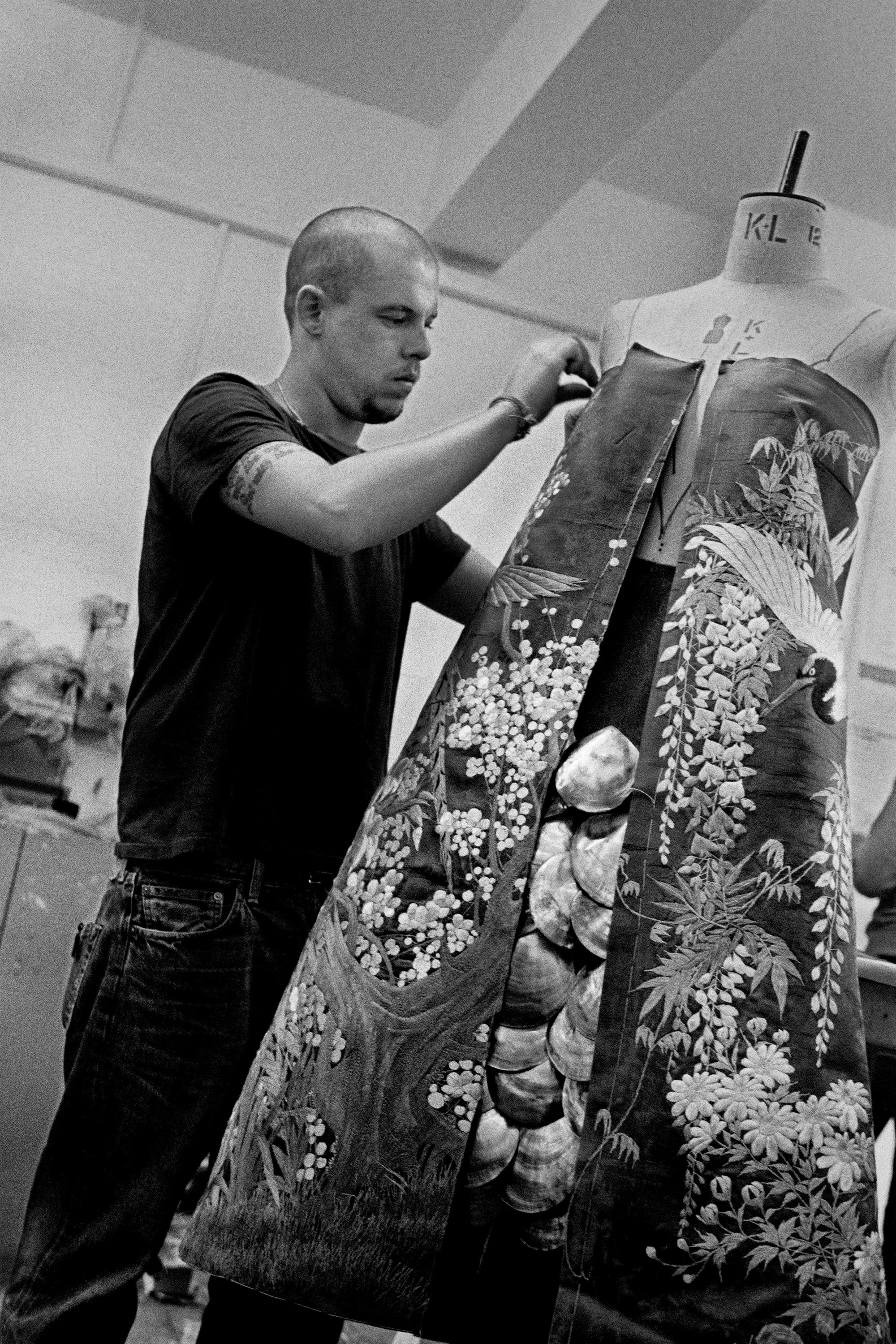
Alexander McQueen was a British fashion designer whose work joined technical precision with dramatic, often unsettling imagery. Trained as a tailor and educated at Central Saint Martins, he developed a language of sharply cut garments, sculptural silhouettes, and runway shows staged as complete environments.
Early collections established his reputation for challenging conventions: jackets with aggressively slashed seams, trousers cut low on the hip, and dresses that treated the body as a site of tension between protection and exposure. His pattern-cutting was exacting, allowing even the most extreme shapes to sit with surprising precision.
As creative director of his own label and later at Givenchy, McQueen built collections around narrative frameworks—myth, history, futurity, and ecological catastrophe. Materials such as leather, feathers, metal, and digital prints were used structurally, shaping silhouettes rather than simply decorating them.
Runway shows became immersive experiences where set design, sound, and choreography expanded the garments’ emotional charge. Models walked through storms, glass boxes, and rotating platforms; catwalks functioned as theaters in which themes of beauty, violence, and vulnerability played out.
McQueen’s influence extends beyond spectacle. His work demonstrated how tailoring, historical reference, and subcultural codes could be recomposed into a contemporary, critically engaged fashion language. Many designers trained in his studio, carrying aspects of his approach into subsequent generations.
Alexander McQueen was a British fashion designer recognized for technically rigorous, conceptually ambitious collections that combined sharp tailoring with dramatic presentation. His work remains highly influential and is preserved in major museum collections and retrospectives.
Alexander McQueen was a British fashion designer known for technically precise tailoring, sculptural silhouettes, and intensely staged runway shows. His work combined historical reference, subcultural influence, and conceptual storytelling, leaving a lasting impact on contemporary fashion.
