

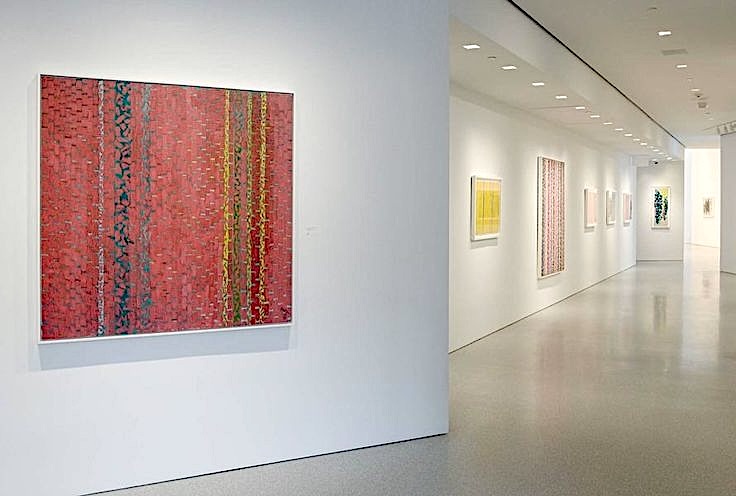
Alma Thomas was an American painter whose late-career abstractions are composed of small, hand-painted marks arranged in bands, arcs, and fields of vibrant color. A longtime teacher in Washington, D.C., she turned fully to painting after retirement, developing a distinctive language grounded in rhythm and light.
Thomas’s compositions often begin with simple frameworks: concentric circles, vertical cascades, or horizontal bands. Within these structures, she lays down short strokes of color that never fully touch, allowing the white of the canvas to act as mortar between tiles. The resulting surfaces feel both patterned and animated.
Nature—gardens, trees, and atmospheric phenomena—served as frequent inspiration, but Thomas translated these references into non-representational arrangements. A row of trees becomes a vertical sequence of broken stripes; a view of the sky becomes concentric waves of blue and white. Color carries the emotion of the scene rather than its literal form.
Working during a period when both abstraction and civil rights struggles were reshaping American culture, Thomas maintained an insistence on joy, celebration, and the right to make work centered on beauty and structure. Her paintings assert this position quietly but firmly.
Over time, exhibitions and museum acquisitions have cemented her place in the history of postwar abstraction, particularly within narratives of Black modernism and Washington Color Painting. Her works continue to resonate for their clarity, optimism, and carefully calibrated rhythm.
Alma Thomas was an American painter known for vibrant abstract paintings composed of short, mosaic-like strokes of color. Working in Washington, D.C., she developed a distinctive late style that has become an important part of postwar American art history.
Alma Thomas was an American painter celebrated for vibrant abstract works built from small, mosaic-like strokes of color arranged in rhythmic bands and arcs. Her late-career paintings, created in Washington, D.C., have become key works in postwar American abstraction.
