

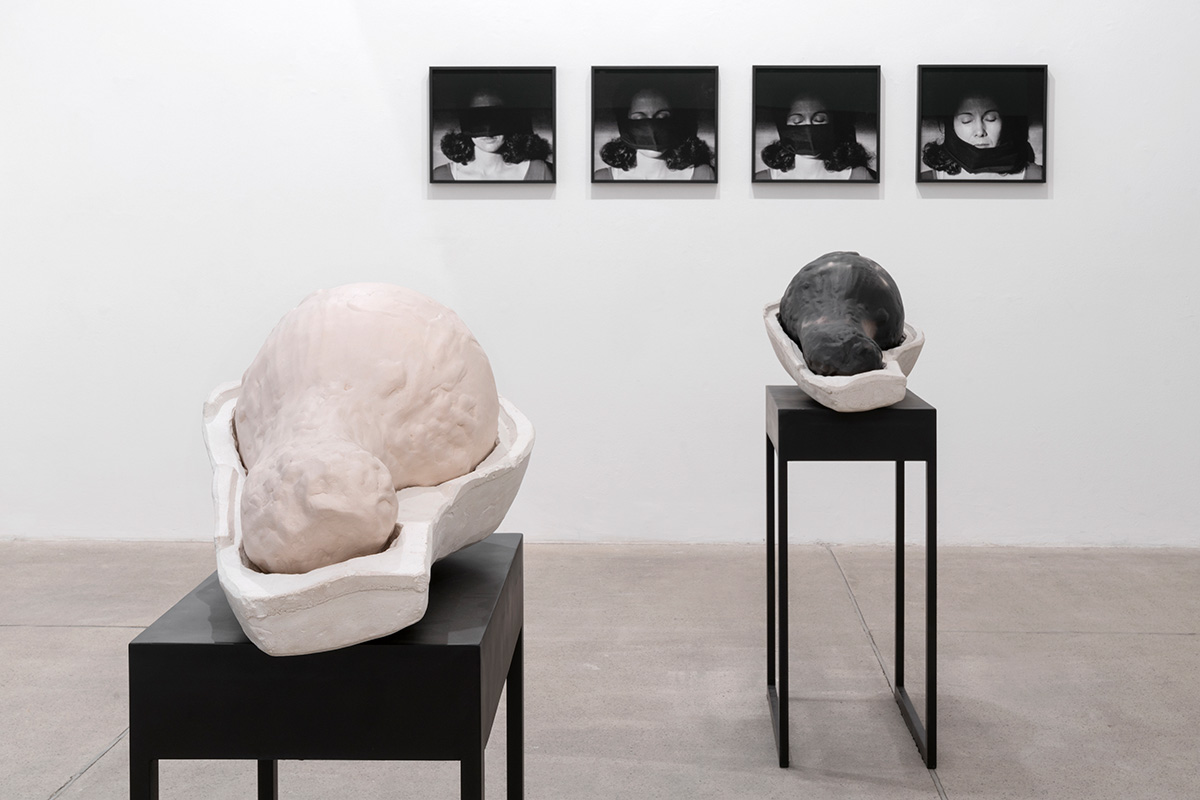
Anna Maria Maiolino is a Brazilian artist, born in Italy, whose work spans drawing, printmaking, sculpture, film, and installation. Since the 1960s she has explored themes of language, exile, domestic labor, and the body through processes that emphasize repetition and touch.
In many works she rolls clay by hand into simple forms—cords, lumps, or small blocks—then stacks or arranges them in grids, piles, or lines. These sequences read as both everyday labor and sculptural notation, recording time through accumulated gestures.
Her prints and drawings often feature cut, bitten, or perforated surfaces, invoking mouths, speech, and the act of consumption or interruption. Early involvement with Brazilian conceptual and experimental art in the 1960s and 1970s shaped her attention to political repression, censorship, and the struggles of daily life under dictatorship.
Installations frequently occupy the floor or corners of a space, working at a scale close to the body. Clay forms may appear vulnerable or provisional, emphasizing process over monument. Yet underlying the fragility is a rigorous structural logic—repetition, series, and modularity hold the works together.
Over decades, Maiolino has been increasingly recognized for her contributions to Latin American and global contemporary art. Retrospectives and major exhibitions have highlighted the coherence of a practice that joins intimate gesture with broader histories of migration, language, and resistance.
Anna Maria Maiolino is a Brazilian artist known for clay-based installations, prints, and drawings that use repetition and touch to explore language, domestic labor, and political history. Her work has been widely exhibited and is held in major museum collections.
Anna Maria Maiolino is a Brazilian artist whose clay sculptures, prints, and drawings turn repeated, hand-made gestures into structures that reflect on language, domestic labor, and migration. Active since the 1960s, she is a key figure in Latin American contemporary art.
