

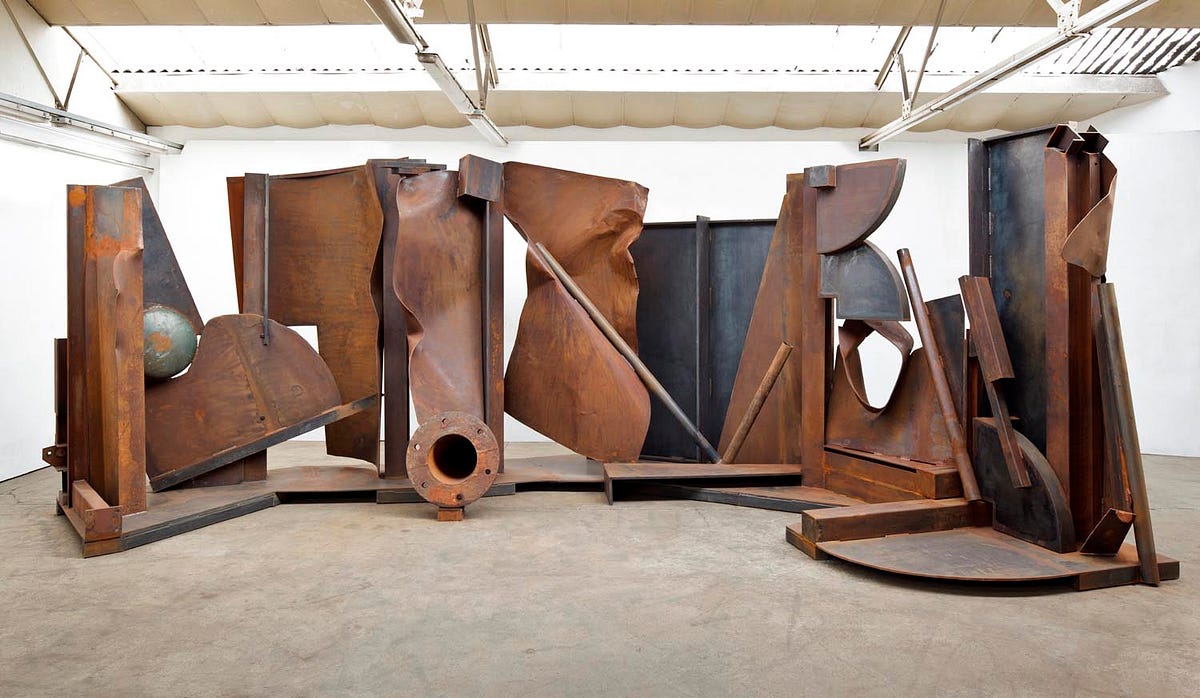
Anthony Caro was a British sculptor whose work helped redefine modern sculpture in the second half of the twentieth century. After early figurative work, he turned to abstract constructions made from welded and bolted steel, often painted in bold colors.
Influenced by time spent in the studio of Henry Moore and encounters with American abstract expressionism, Caro began, in the 1960s, to place sculptures directly on the floor without plinths. Beams, plates, and found industrial elements were arranged so that viewers could walk around and through spatial configurations rather than confront a single frontal view.
Color played a structural role. Painted surfaces unified disparate components, making the work read as continuous form rather than welded parts. The compositions balance mass and void, horizontal reach and vertical puncture, creating a sense of dynamic equilibrium.
Over subsequent decades Caro experimented with scale, material, and context—producing small table pieces, large outdoor works, and collaborations with architects. Yet the core concerns remain consistent: how volume, line, and plane can activate space and the viewer’s movement.
Caro also taught and influenced generations of sculptors, reinforcing an understanding of sculpture as constructed, spatial, and directly engaged with its environment.
Anthony Caro was a British sculptor known for abstract, floor-based steel constructions that helped shift sculpture toward open, constructed forms in the postwar period. His work is held in major museum collections worldwide.
Anthony Caro was a British sculptor whose abstract, floor-based steel constructions helped redefine modern sculpture, emphasizing open structures, color, and direct engagement with surrounding space.
