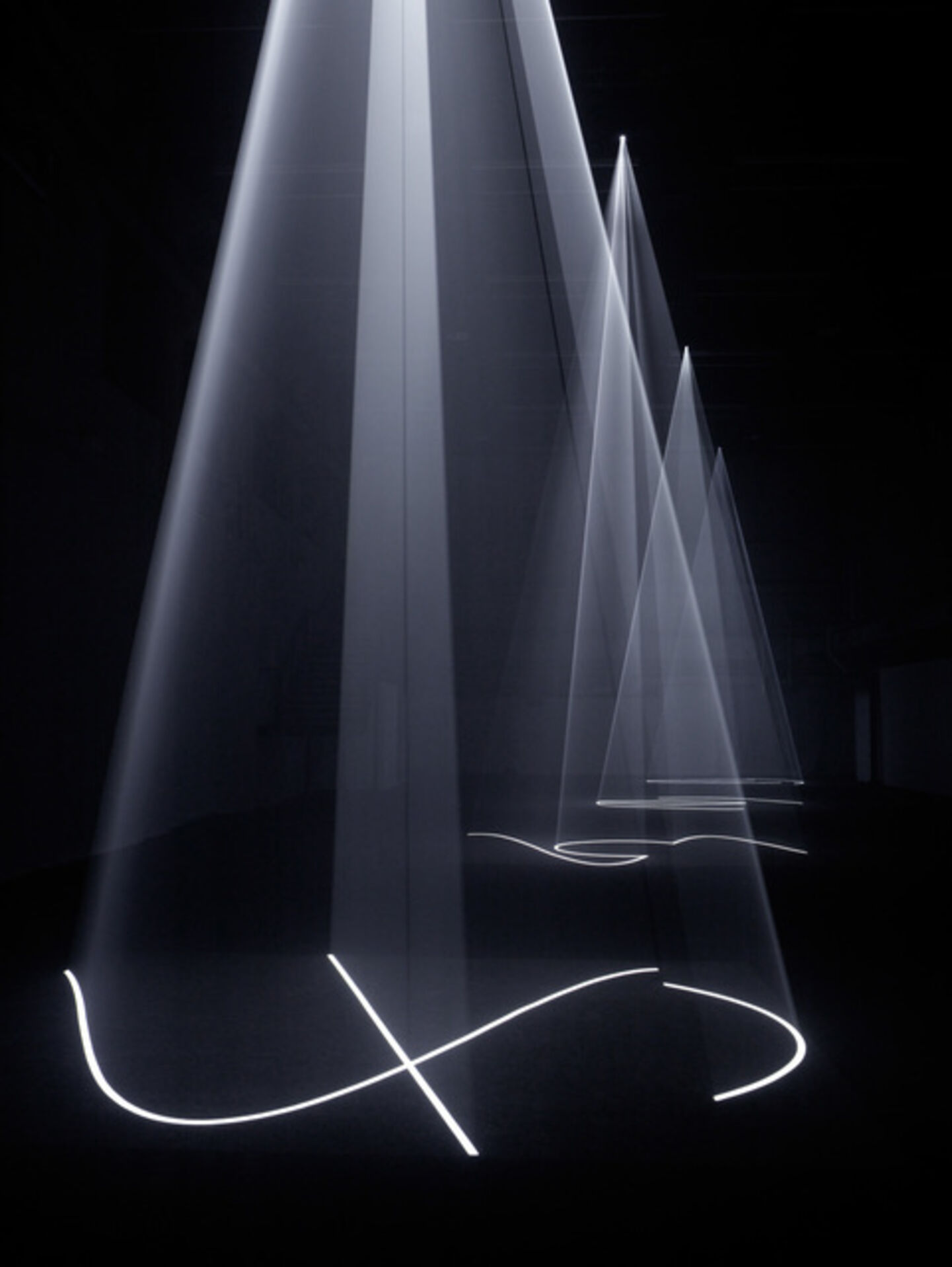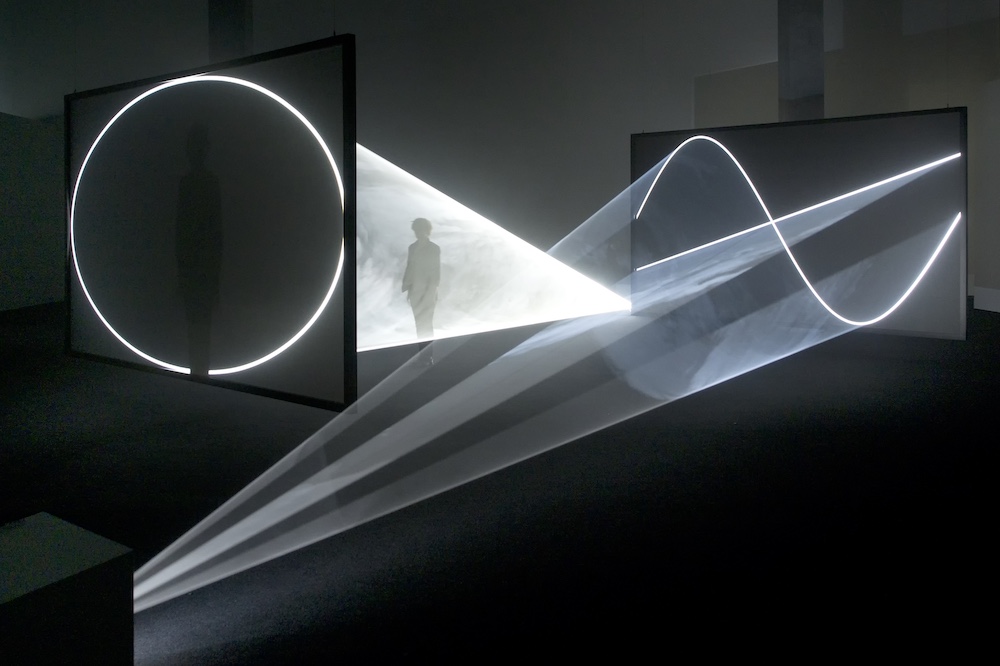
Anthony McCall is a British-born American artist known for “solid light” works—film projections that create three-dimensional, inhabitable forms using simple geometric animations and atmospheric haze. His practice emerged in the 1970s at the intersection of film, sculpture, and performance, redefining how projected light could occupy space.
McCall’s early films, such as Line Describing a Cone (1973), use minimal animation: a slowly drawn line that outlines a circle over many minutes. In a darkened room filled with haze, the projected line becomes a volumetric cone that audiences can walk through, touch, and interrupt. The work treats light as a material and time as a sculptural dimension.
Throughout subsequent decades, McCall refined this language. Adjusting speed, shape, and orientation, he created configurations—tunnels, double cones, intersecting planes—that behave like temporary architectural structures. Sound is often absent, heightening the viewer’s awareness of breath, movement, and the shifting density of the beam.
His installations rely on precise spatial conditions: controlled darkness, calibrated haze, and carefully placed projectors. Small deviations transform how the forms appear, emphasizing the experiential nature of the work.
After a long hiatus in the 1980s and 1990s, McCall returned to art in the 2000s, expanding into large-scale commissions and multi-projector pieces while maintaining the elemental clarity of his method.
Anthony McCall is a British-born American artist known for “solid light” installations that transform projected film into inhabitable sculptural form. His work has been widely exhibited and is included in major museum collections.
Anthony McCall is a British-born American artist whose “solid light” installations use projected film and haze to create inhabitable, sculptural volumes. His minimalist animations turn light into architecture and have been exhibited internationally.