

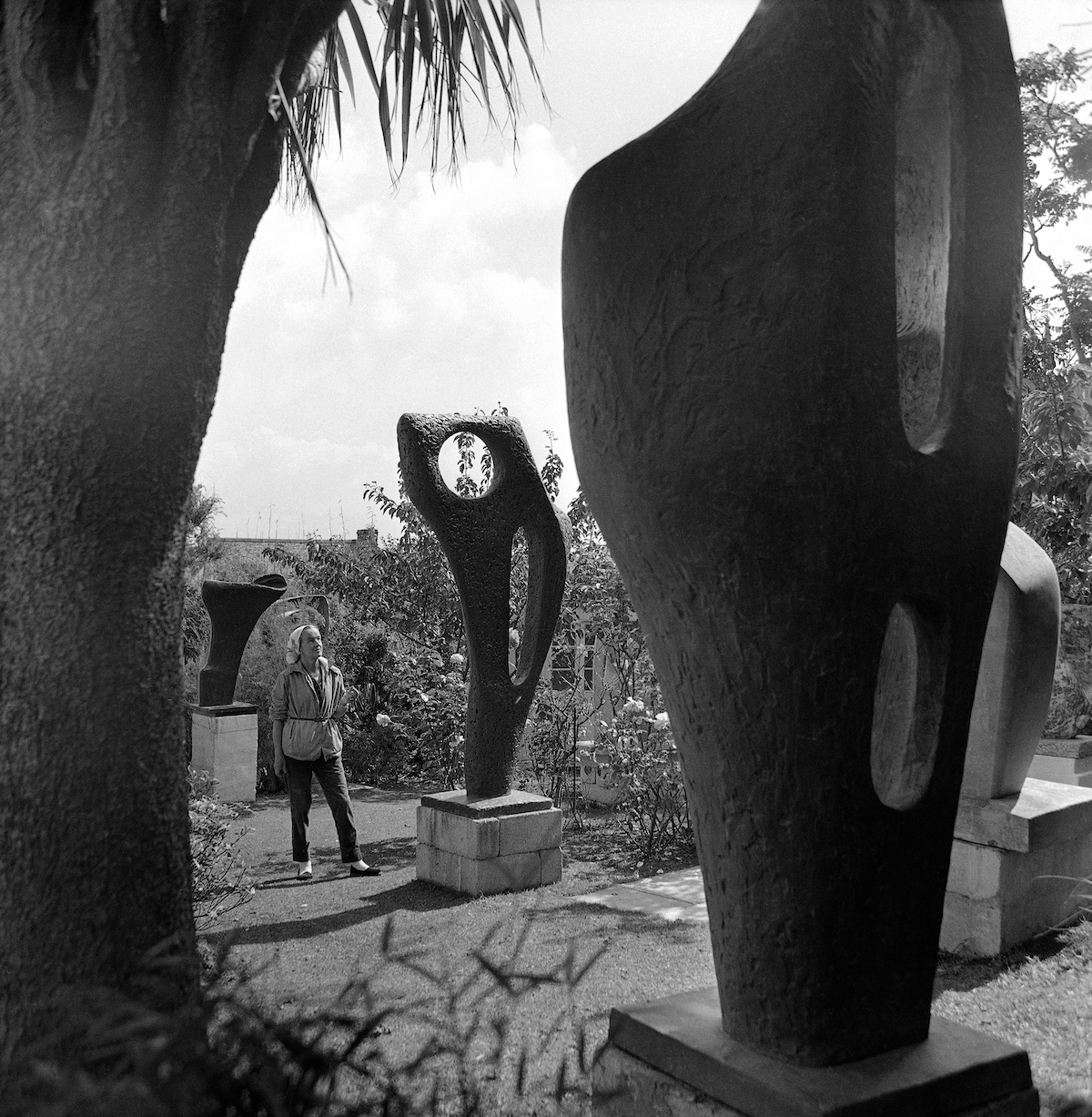
Barbara Hepworth was a British sculptor whose work explores relationships between mass and void, interior and exterior, and body and landscape. Emerging alongside Henry Moore but pursuing a distinct path, she developed a language of smooth, carved shapes often pierced by openings that reveal internal space.
Hepworth’s early works were carved from wood and stone, emphasizing direct engagement with material. Her pierced forms, introduced in the 1930s, established a new sculptural syntax in which openings frame space, light, and shadow.
In the postwar decades, she expanded into metal constructions and larger public commissions. Tensioned strings sometimes spanned the openings, introducing linear rhythm and suggesting spatial vibration.
Landscape was central to her imagination. Living and working in St. Ives, she responded to coastal forms—cliffs, waves, wind-shaped contours—translating them into abstract volumes that carry calm, balance, and gentle dynamism.
Hepworth’s work became a defining pillar of British modernism and continues to shape global understandings of abstraction in sculpture.
Barbara Hepworth was a British sculptor known for abstract carved forms with pierced centers that explore relationships between mass, void, and landscape. Her work is widely exhibited and held in major museum collections.
Barbara Hepworth was a British sculptor known for abstract forms with pierced openings that explore relationships between mass, void, and landscape. She is a central figure in twentieth-century sculpture.
