

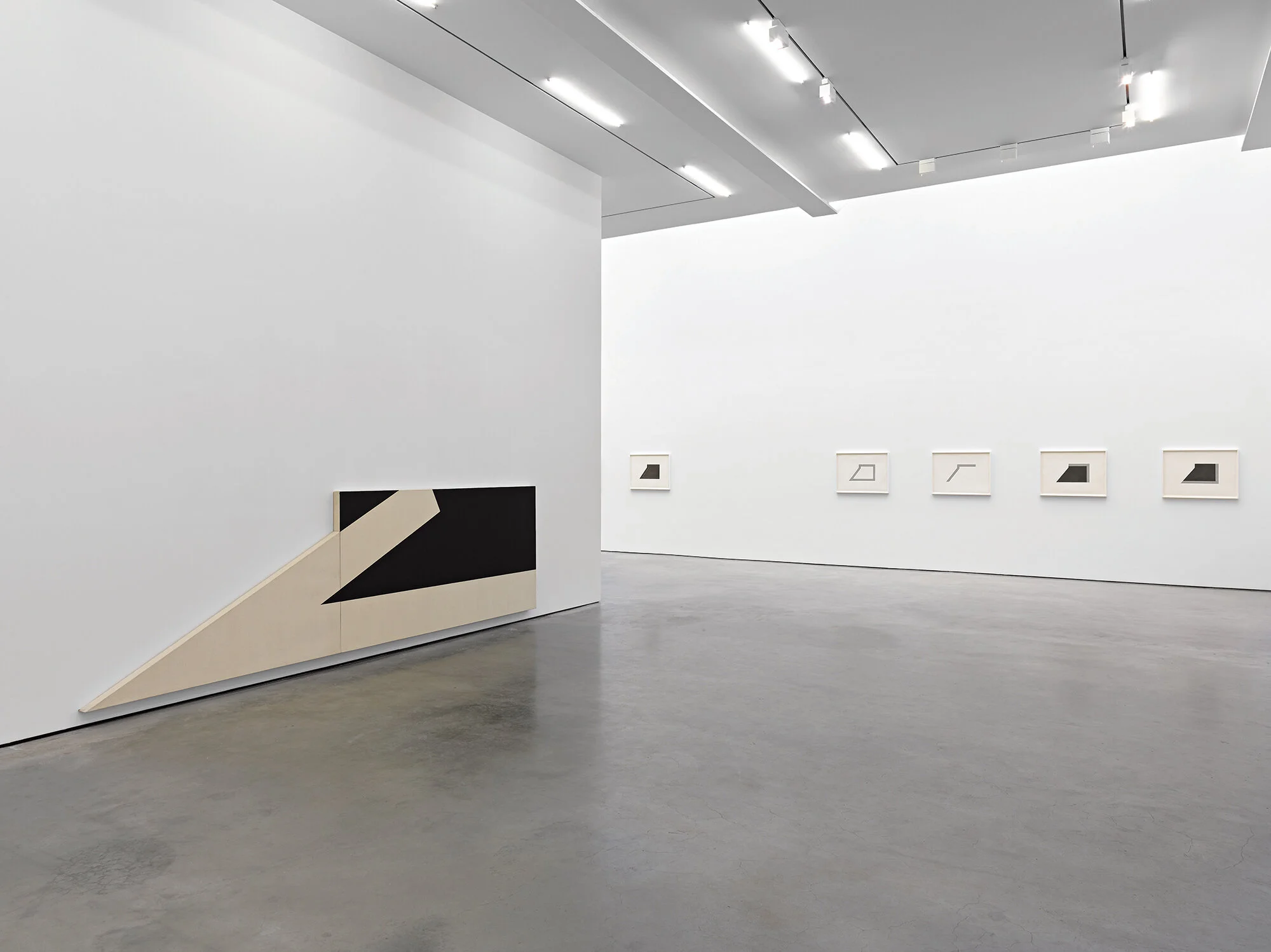
Ted Stamm was an American painter whose work developed at the intersection of minimalism, conceptual art, and the lived rhythms of New York City. Working primarily with shaped canvases, black-and-white palettes, and diagrammatic forms, Stamm reduced painting to essential structures while retaining a sense of motion, speed, and urban complexity.
Rather than treating the canvas as a neutral rectangle, Stamm reshaped it into an active field. Angled edges, cut corners, and directional forms transformed the support into a compositional force. These shaped canvases functioned as diagrams—visual systems that suggested pathways, intersections, and vectors rather than images or narratives.
Series such as Wooster and Dodger reveal Stamm’s engagement with the city as a system of movement. Lines, arcs, and blocks of black paint operate like notations or maps, evoking traffic patterns, architectural grids, and the acceleration of urban life. His paintings feel both precise and agile, holding strict geometry alongside a sense of improvisation.
Although Stamm’s work aligns with minimalist reduction, it resists neutrality. The surfaces are active, the forms directional, and the compositions charged with momentum. Geometry is not static but operative—shapes imply motion, edges suggest force, and negative space becomes a structural component rather than absence.
Stamm’s practice reflects the conceptual intensity of New York in the late twentieth century, where painting absorbed ideas from architecture, systems theory, and urban experience. His work stands as a distinct contribution to post-minimalist abstraction: disciplined, diagrammatic, and attuned to the speed and structure of the city.
Ted Stamm was an American artist known for minimalist geometric paintings—shaped canvases and diagram-like forms influenced by urban movement.
