

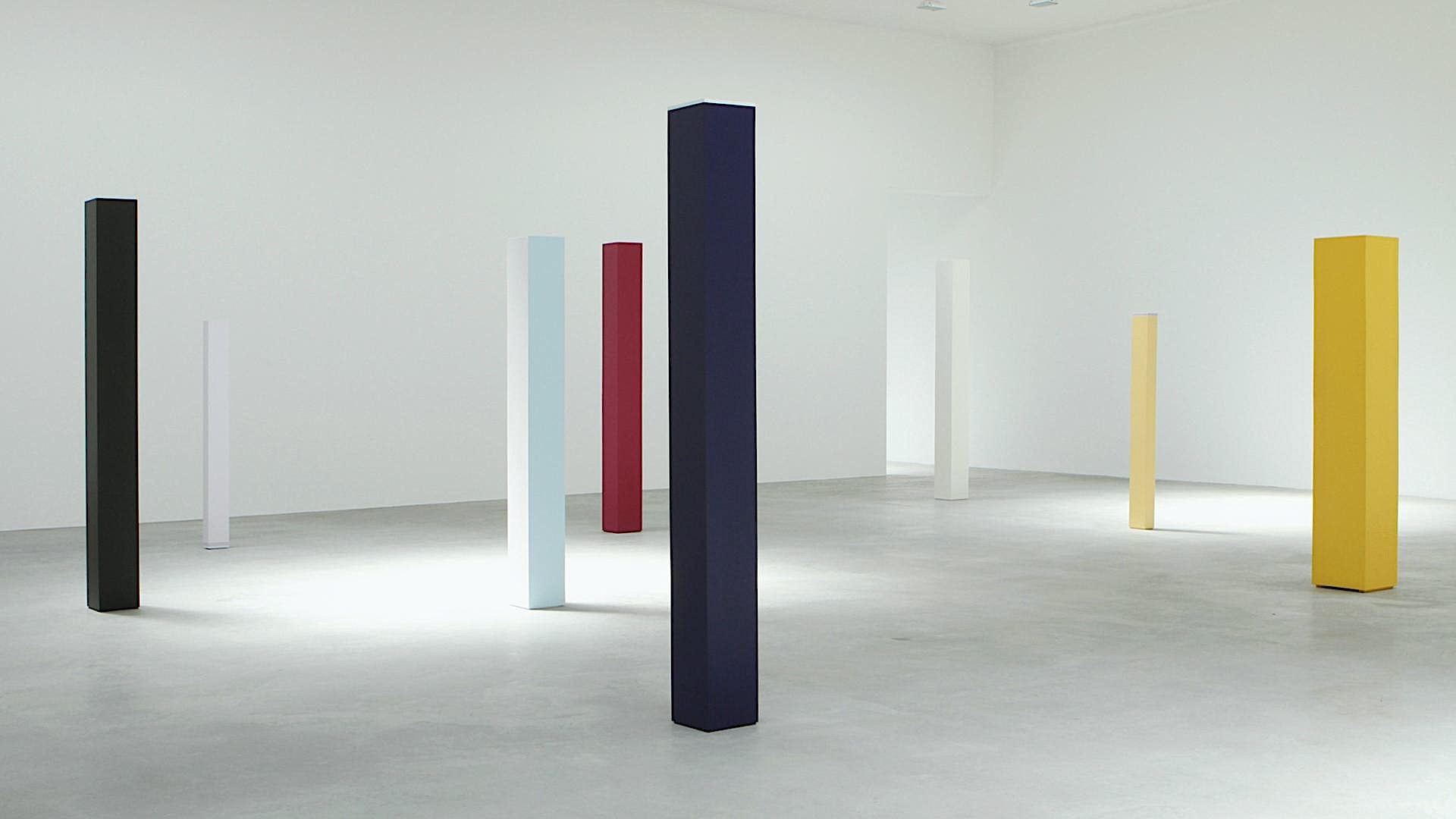
Anne Truitt was an American artist whose work is often associated with minimalism, yet rooted in personal memory and perception. She is best known for upright wooden columns, carefully painted in layered colors that recall architecture, landscape, and childhood experience.
After working as a writer and sculptor, Truitt began making her signature columnar forms in the early 1960s. Each piece is built from simple carpentered shapes—rectangular prisms, tapered or slightly stepped blocks—then coated with multiple layers of acrylic paint. Edges are taped and sanded so that color feels both precise and softly breathing.
The sculptures stand at or near human scale, occupying space like quiet figures or fragments of buildings. Color placement—bands at the base, vertical divisions, thin borders—creates spatial illusions and references to fences, horizons, or architectural thresholds without becoming literal depiction.
Truitt’s diaries reveal a practice tied to daily life, time, and reflection. Painting became a disciplined, almost meditative process: layer after layer applied, sanded, and adjusted until the work held the desired balance of clarity and feeling.
While often discussed alongside minimalism, her work maintains a distinct position, emphasizing subjective memory and psychological resonance within a pared-down formal language.
Anne Truitt was an American artist known for columnar sculptures painted in luminous, layered colors that evoke architecture and landscape through minimal means. Her work has been widely exhibited and is represented in major museum collections.
Anne Truitt was an American artist known for tall, painted wooden columns whose layered color and precise edges evoke architecture, landscape, and memory. Working within a minimal formal vocabulary, she brought a deeply personal dimension to postwar abstraction.


