

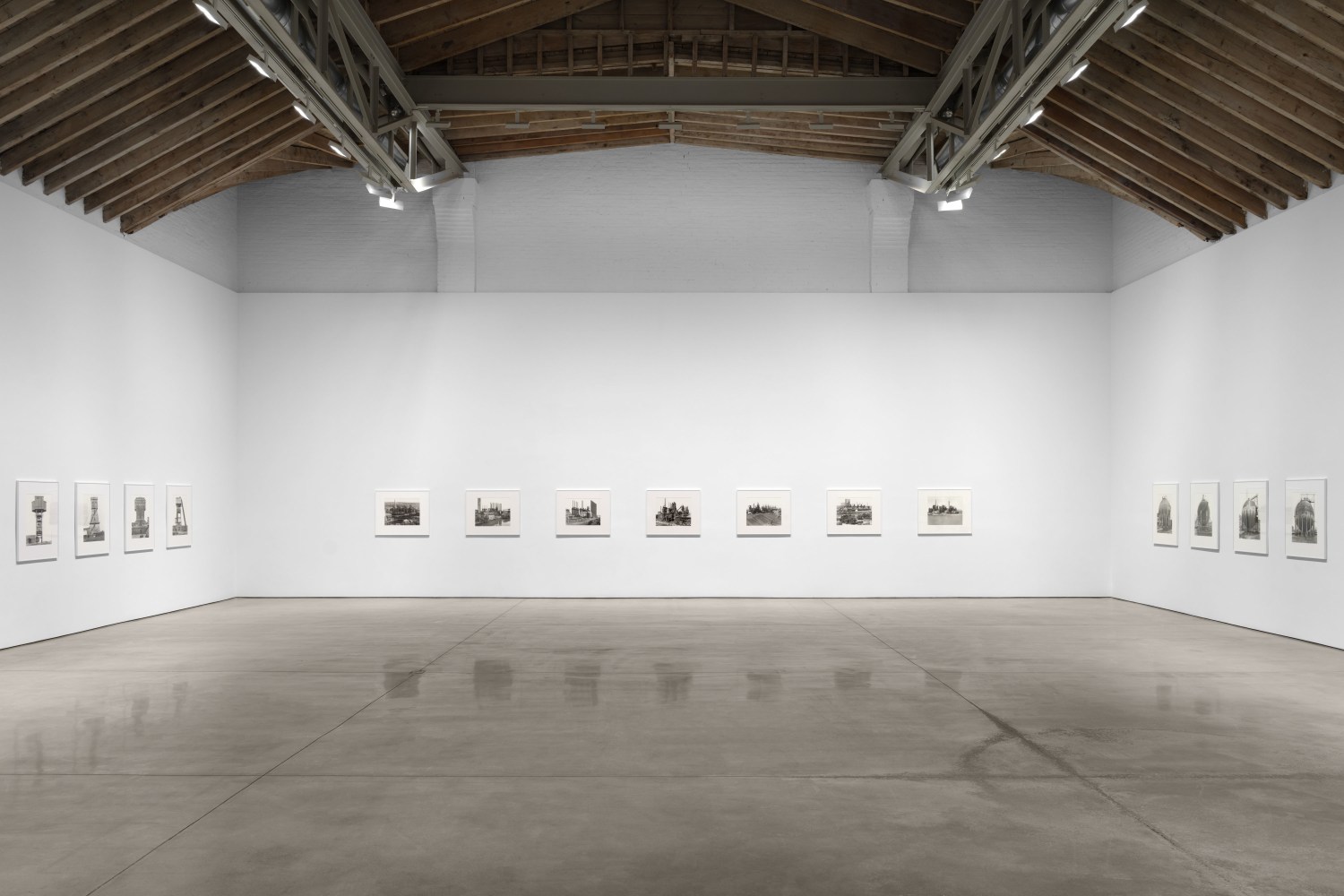
Bernd (1931–2007) and Hilla Becher (1934–2015) were German photographers whose collaborative practice redefined documentary photography through systematic typological study. Beginning in the late 1950s, they produced extensive black-and-white photographic series of industrial structures across Europe and the United States, including water towers, blast furnaces, winding towers, gas tanks, silos, and cooling towers.
Bernd Becher initially trained as a painter, studying typography and graphic arts in Siegen and later at the Kunstakademie Düsseldorf. Hilla Wobeser (later Becher) studied photography in Potsdam and Hamburg before joining Bernd in Düsseldorf. The two began working together in 1959 and developed a disciplined method that would define their practice for decades.
Their project emerged during a period of industrial decline in postwar Germany. As mining regions in the Ruhr and Siegen were dismantled, the Bechers began documenting the disappearing architecture of heavy industry. Rather than approach these buildings as romantic ruins, they photographed them under strictly controlled conditions: overcast skies, frontal or standardized viewpoints, consistent distances, and absence of expressive lighting. By eliminating atmospheric variation, they created images that could be directly compared.
The Bechers arranged their photographs into typological grids—carefully sequenced groups in which each structure functioned as a variant within a broader family of forms. These “typologies” transformed industrial buildings into comparative studies of geometry, proportion, and functional adaptation. Cylinders, cones, latticed frames, and stacked volumes became legible as recurring structural solutions shaped by engineering necessity rather than individual authorship.
In 1976, Bernd Becher was appointed professor at the Kunstakademie Düsseldorf, where he and Hilla influenced a generation of photographers associated with the so-called Düsseldorf School, including Thomas Ruff, Andreas Gursky, Thomas Struth, and Candida Höfer. Their pedagogical emphasis on seriality, conceptual rigor, and formal discipline profoundly shaped contemporary photographic practice.
One of their most significant publications, Anonymous Sculptures (1970), framed industrial structures as forms shaped by function and collective labor rather than artistic design. The title reflects their sustained interest in architecture produced without singular authorship—buildings constructed by teams, modified over time, and governed by technical constraints.
Throughout their career, the Bechers exhibited internationally and participated in major exhibitions including Documenta and the Venice Biennale. Their work is held in major public collections worldwide, including The Museum of Modern Art (New York), Tate (London), Centre Pompidou (Paris), and the Art Institute of Chicago.
The Bechers’ practice occupies a pivotal position between documentary photography and conceptual art. By structuring their images through repetition and comparison, they shifted photography from singular depiction toward serial system. Their grids established a model in which neutrality, consistency, and adjacency became tools for revealing structural difference.
Bernd & Hilla Becher were German photographers known for typological photographs of industrial structures taken under uniform conditions, foundational for the Düsseldorf School and conceptual photography.

