


Industrial structures were being dismantled faster than they could be recorded. In Siegen, Germany, mines were closing and blast furnaces were being cut apart; landscapes that had structured both labor and memory were disappearing in real time. Bernd Becher had trained as a painter, but drawing could not keep pace—demolition moved faster than the hand. Photography was not an aesthetic turn but a structural necessity. The image had to outlast demolition long enough for the form to be studied and compared. The discipline was born not from romance, but from speed.
Water towers, winding towers, preparation plants—buildings shaped by necessity rather than style. Rarely designed by a single architect, they accumulated. A pipe extended. A chamber reinforced. Function layered onto function. No signature. No singular gesture. Form emerging through use.
Preservation alone, however, was not enough. If these structures were to survive as more than memory, they had to be photographed in a way that allowed them to be understood—and, crucially, compared. That decision determined everything.
Atmosphere was removed. Dramatic light, seasonal effects, even the sky—anything that introduced mood or context—was treated as an additional subject. They waited for overcast days so the structures would detach cleanly from their surroundings. Neutrality was not aesthetic restraint. It was a way of ensuring that the building remained the only thing under consideration.
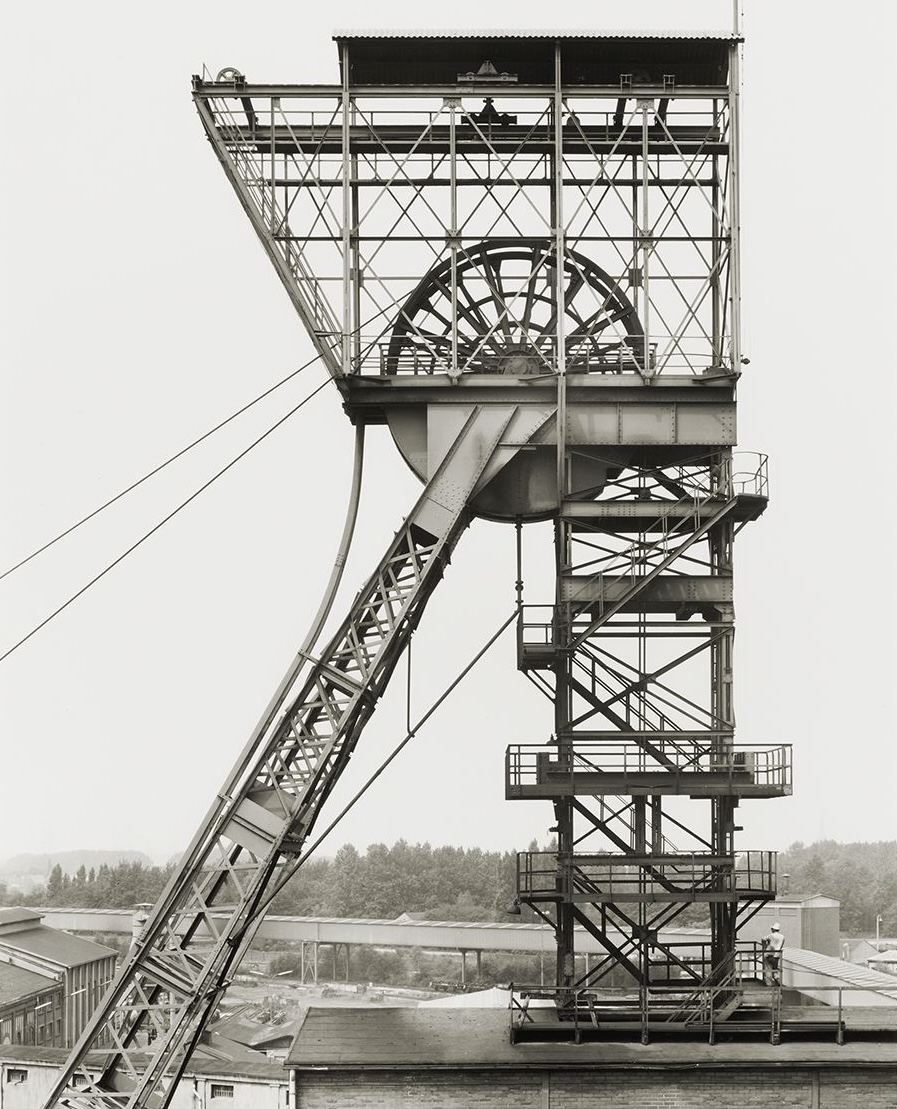
The camera enforced this discipline. Large-format equipment slowed the process. Tripods were positioned with deliberation. Orientation had to be discovered rather than assumed. A blast furnace was not approached as spectacle but as spatial problem: does it have a front? A back? Complex structures required multiple views to be grasped. Simpler, symmetrical forms—water towers—could resolve in one. Thin chimneys were abandoned; they could not occupy the frame with sufficient presence. What appears detached in the finished prints is the result of sustained negotiation. Discipline made comparison possible.
The turning point came when multiple cooling towers were placed side by side. Seen together, they did something a single photograph could not. Similarity exposed variation. Proportion became legible. Repetition ceased to mean sameness. In that moment, the photograph stopped functioning as documentation and began functioning as part of a system. The grid was not a display decision. It was a structural invention. In that moment, the photograph stopped being an image and became infrastructure.
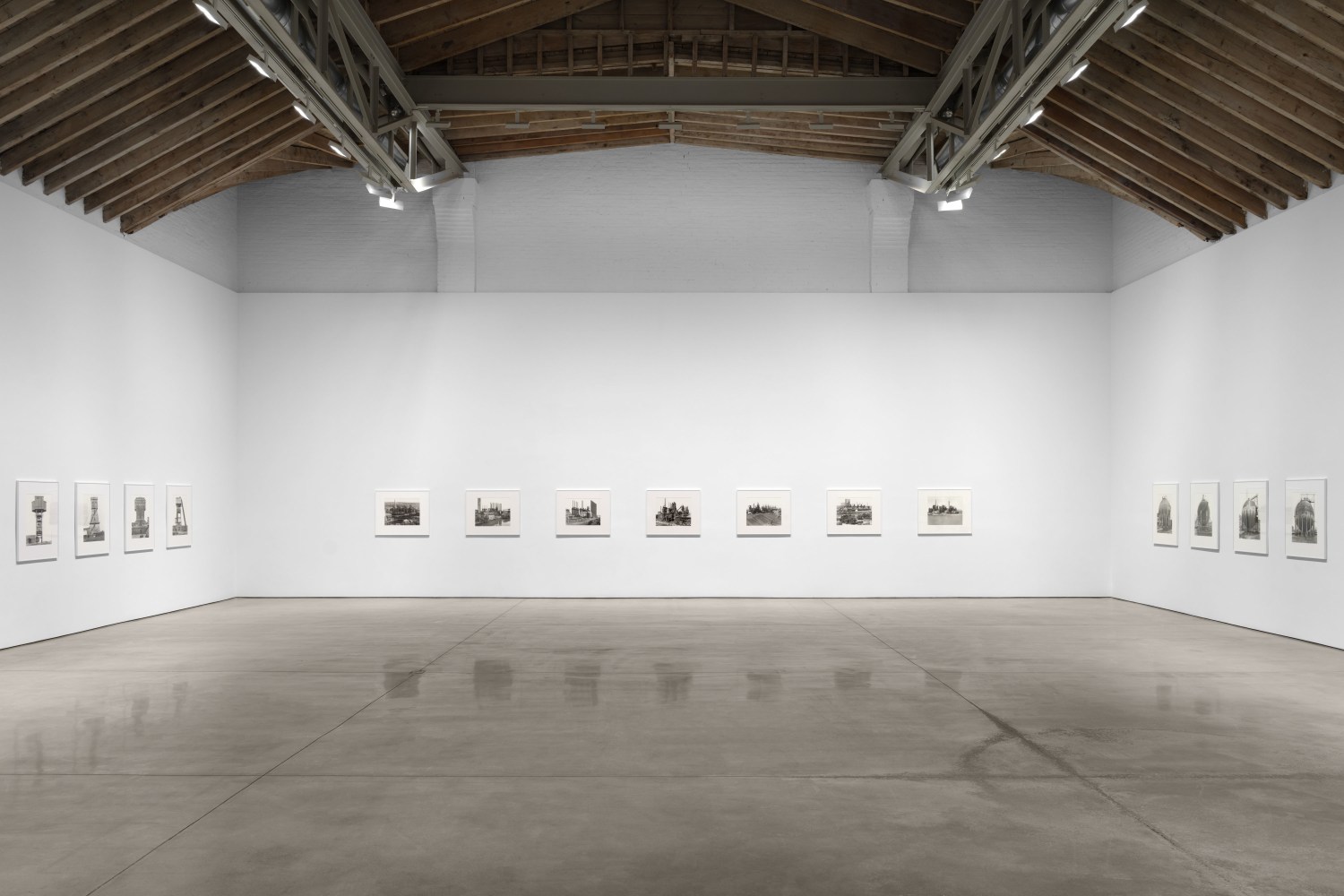
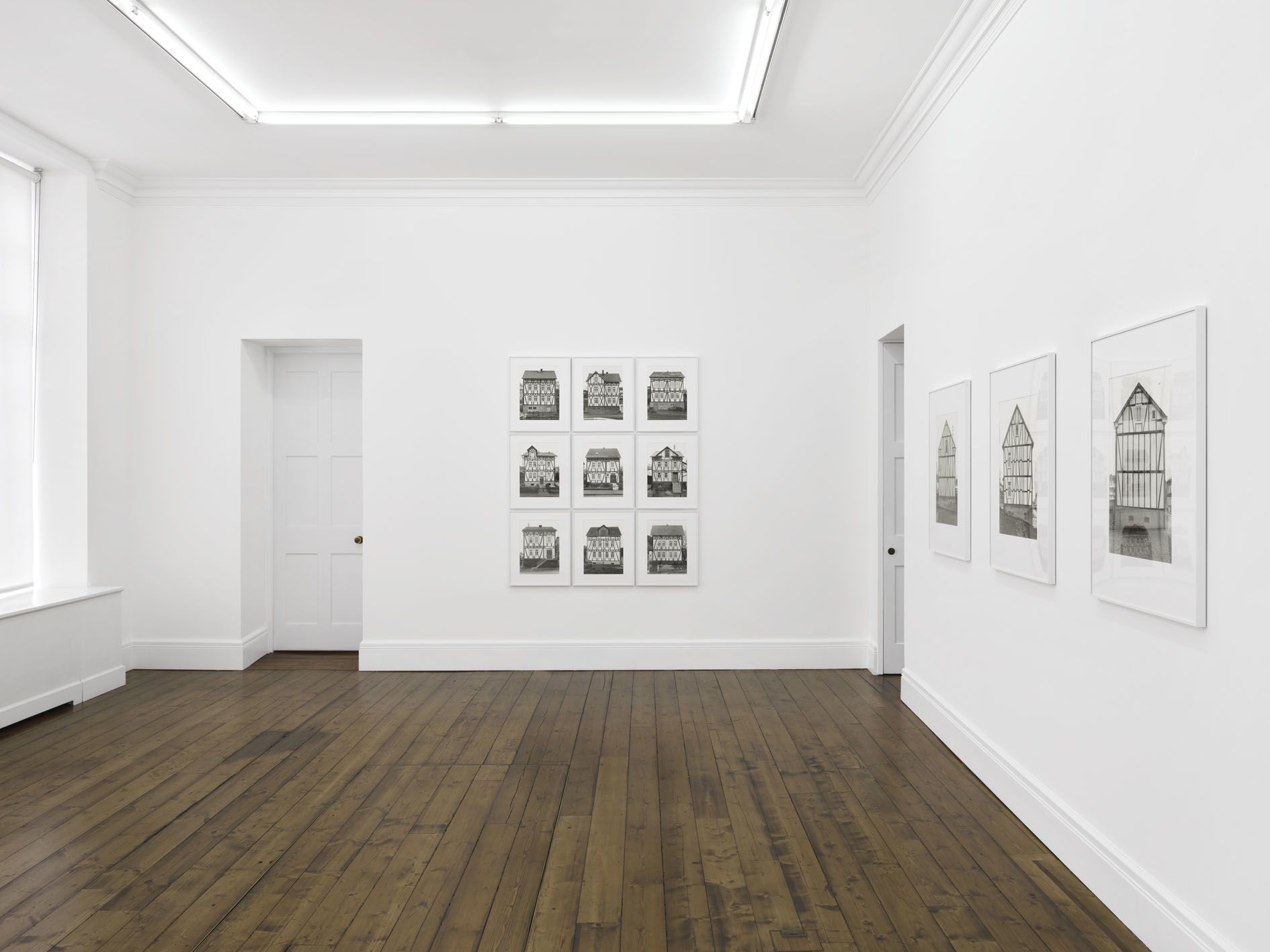
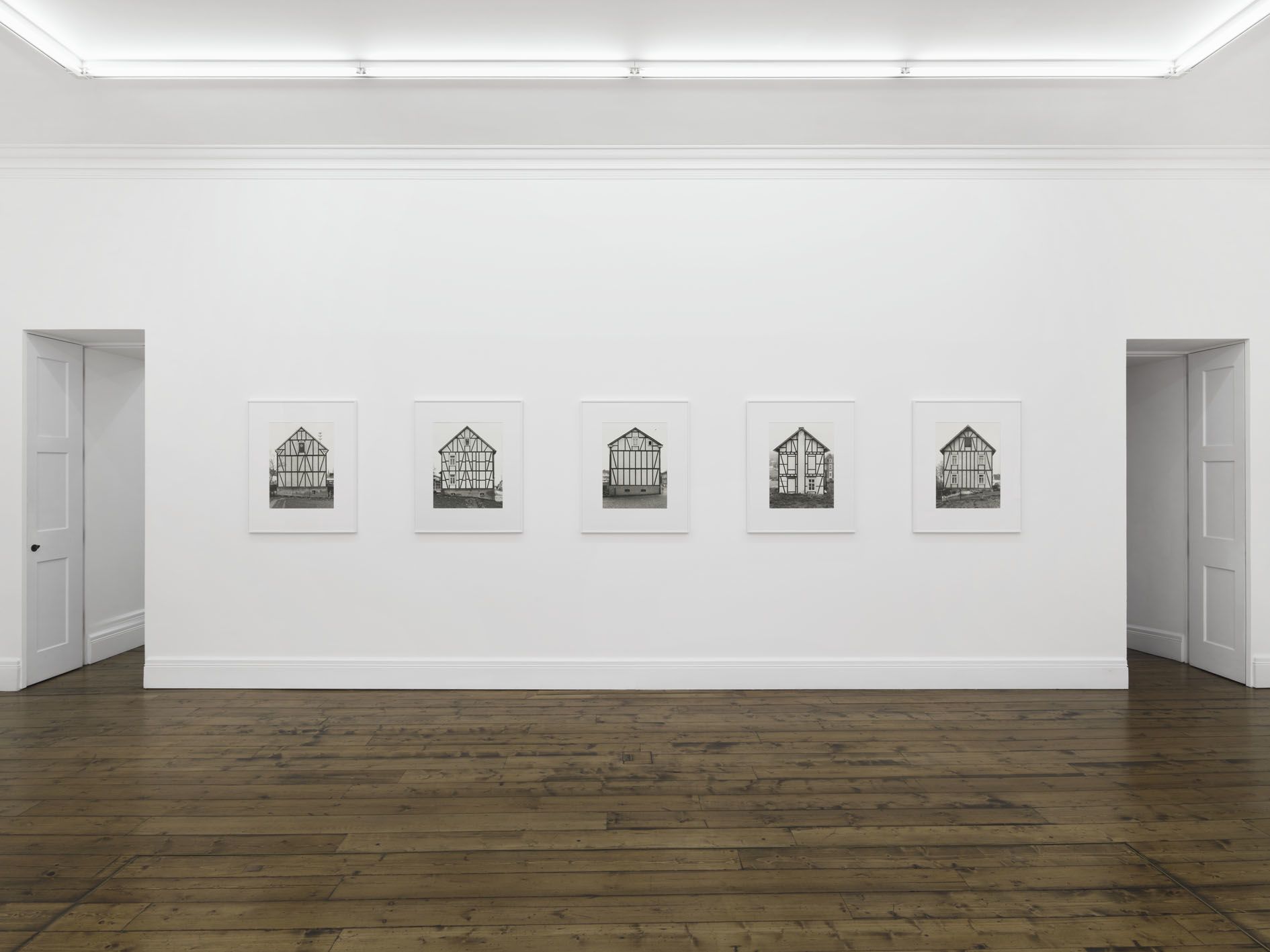
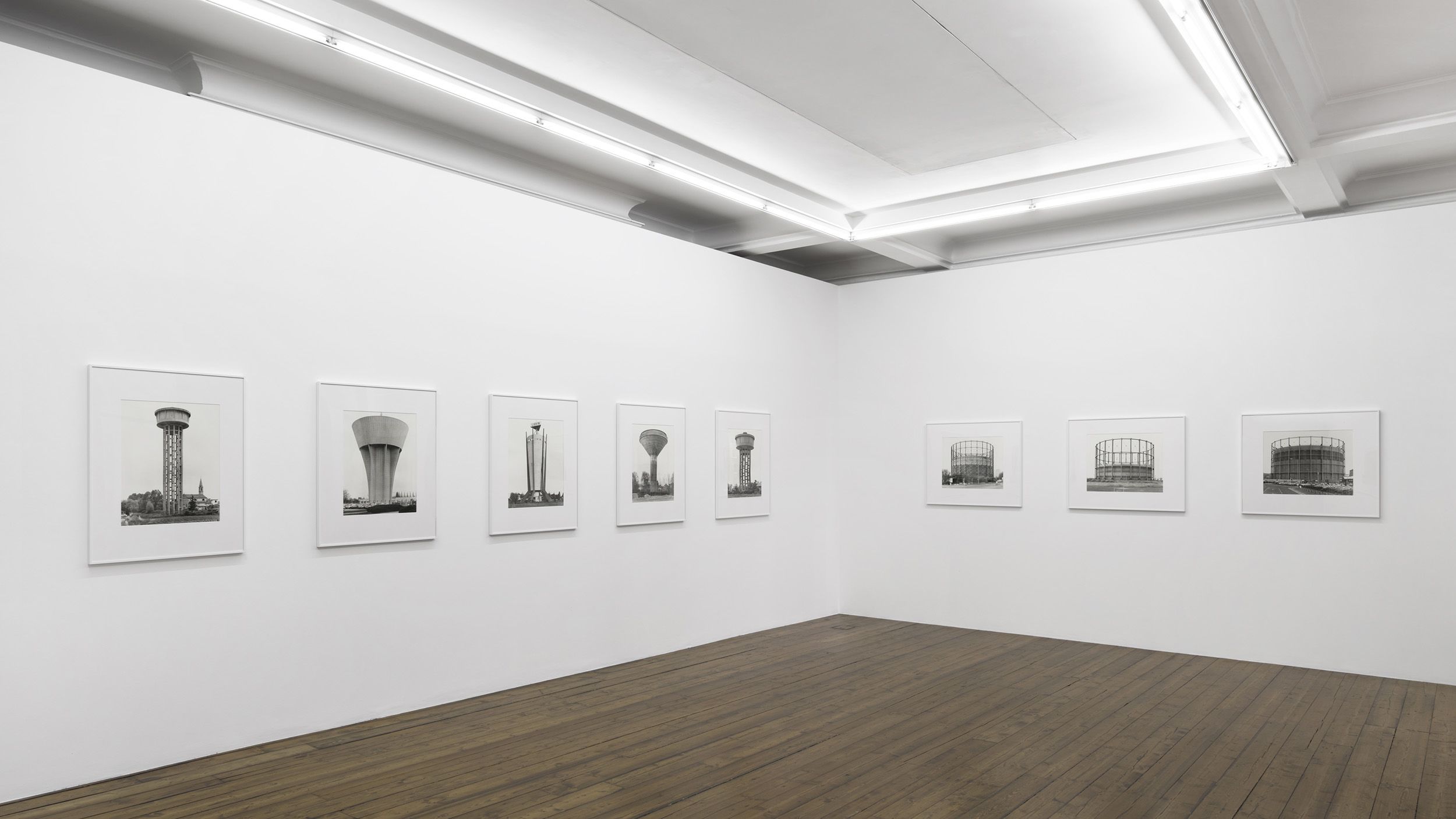
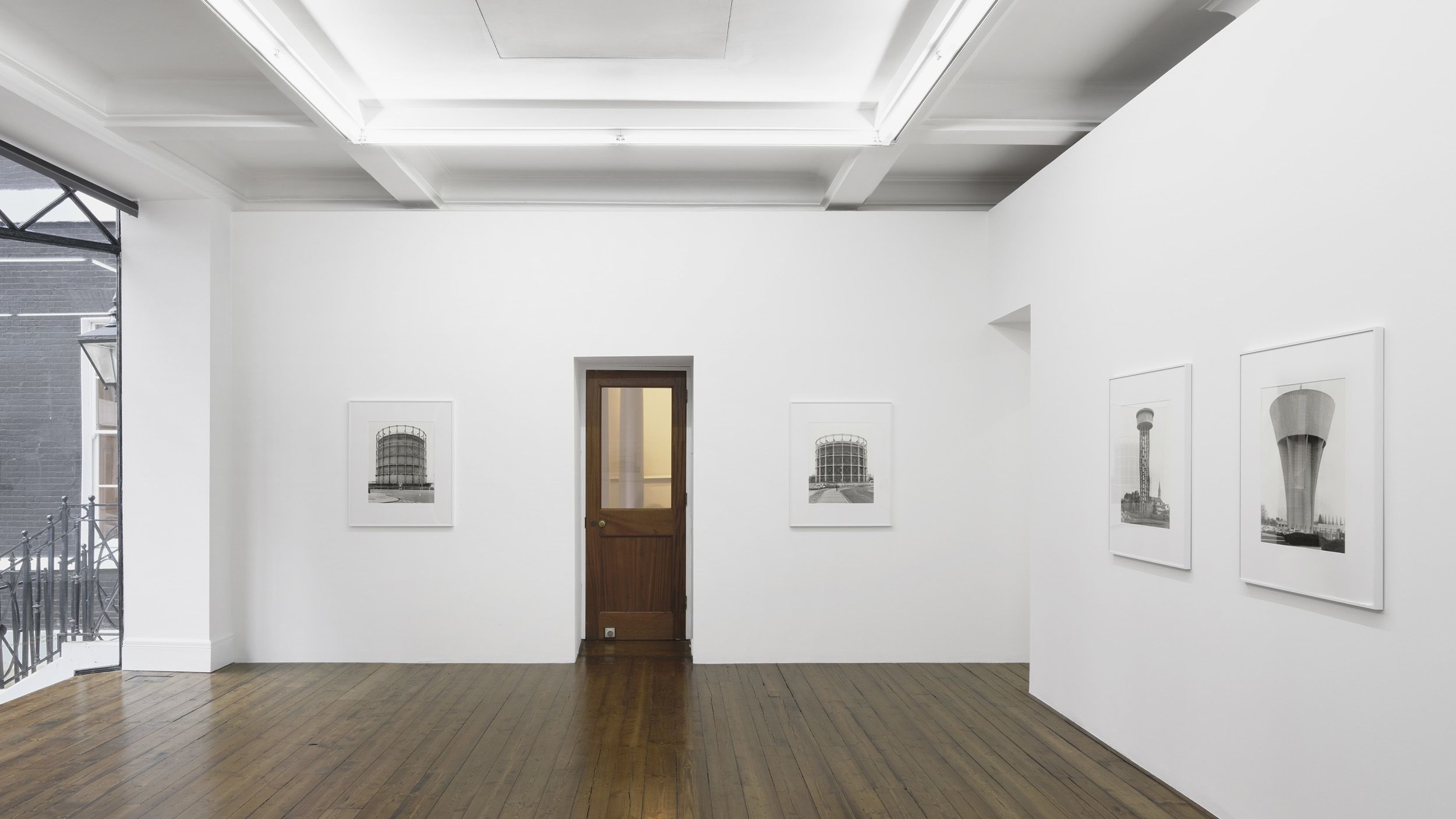
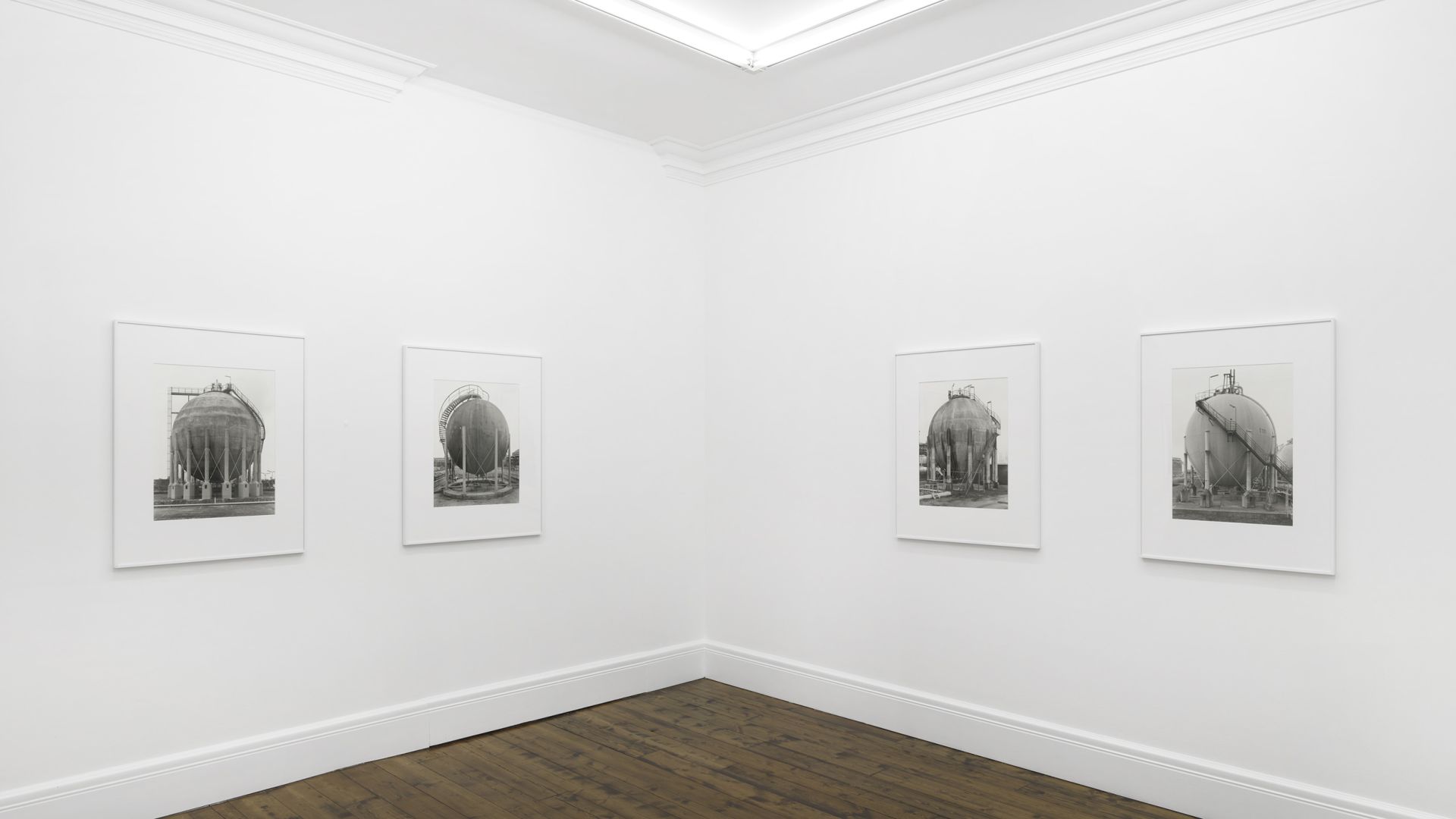
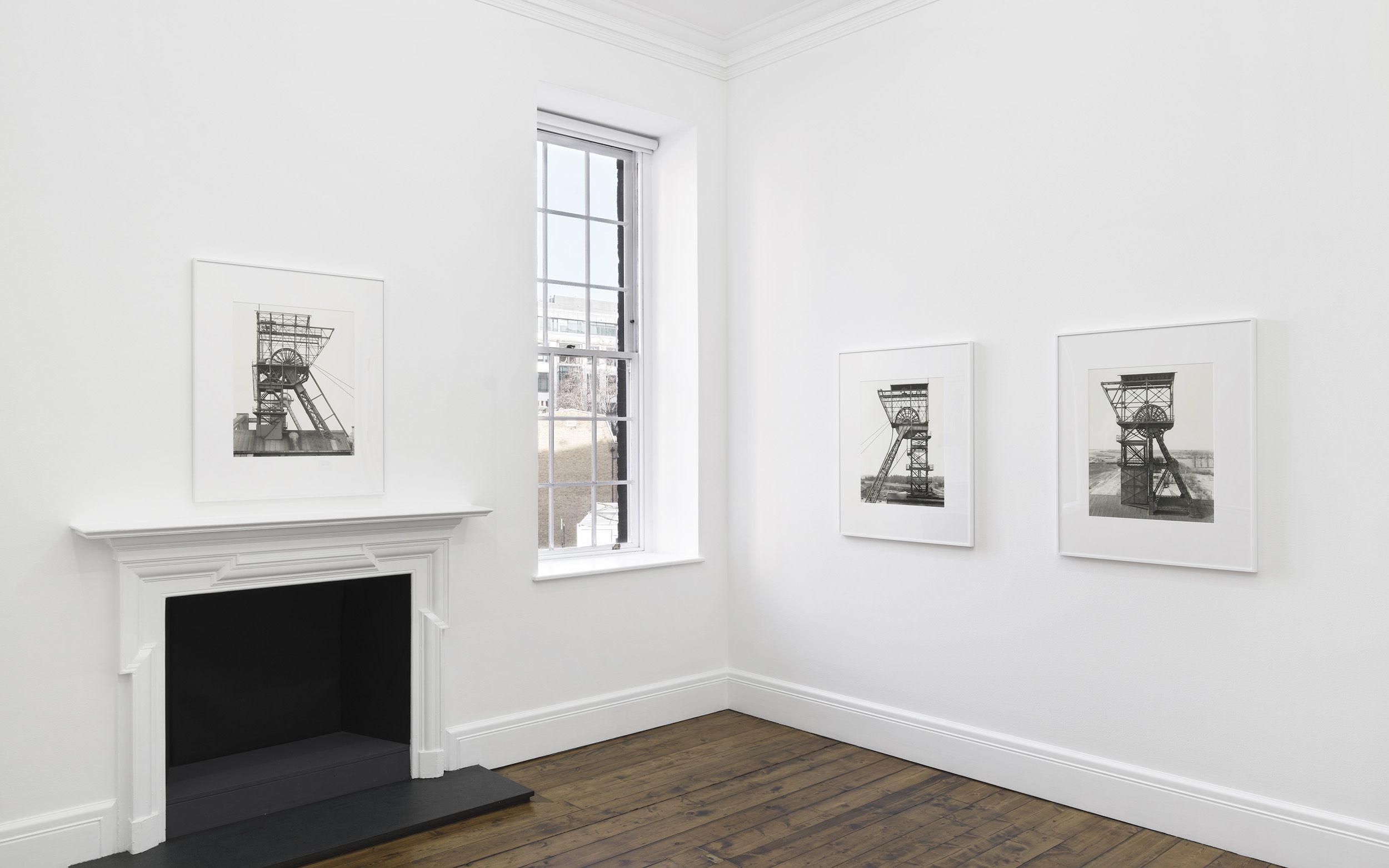
In Bernd & Hilla Becher at Sprüth Magers, London, that invention still governs how the work operates. No single photograph dominates. Each image gains clarity through its neighbor. A slight shift in base, a change in ladder placement, a difference in curvature—these register gradually as the eye moves laterally across the grid. The experience is less about contemplation than calibration. You do not advance through a narrative. You move across a field of variation.
The neutrality that once seemed austere becomes active. By suppressing atmosphere, the Bechers created the conditions for difference to surface. The grid does not flatten the buildings into sameness; it reveals their evolution. Structures built under constraint—economic, technical, regulatory—appear not as monuments but as accumulations of decision.
This insistence on relation feels particularly pointed now. In a culture accustomed to singular images—cropped, isolated, circulating independently—the Bechers’ method resists fragmentation. The Bechers did not document industry. They engineered a way of seeing that makes spectacle structurally impossible. Meaning does not reside in any one photograph. It accumulates through adjacency. The eye slows. It begins to measure. Measurement, here, is not analysis. It is resistance.
The industrial structures they photographed were often designed to last only a few decades. Many no longer exist. What persists is the discipline they constructed: a way of seeing that privileges comparison over spectacle, variation over drama.
The buildings disappeared. The method remains.
The Bechers photograph industrial structures under nearly identical conditions so that adjacency can operate. What first appears uniform begins to shift as the eye moves across the grid. Slight differences in proportion, angle, and construction surface gradually. Repetition does not flatten form; it sharpens it through comparison.











1. Installation view: Bernd & Hilla Becher, Sprüth Magers, London, 20 February–28 March 2026. Artwork © Bernd & Hilla Becher. Photo © Ken Westoby / Fine Art Documentation. Courtesy Sprüth Magers.
2. Bernd & Hilla Becher, Framework Houses – Street Side, 1970–73. 9 silver gelatin prints. Each: 40 × 30 cm (15 3/4 × 11 7/8 in). Each (framed): 56 × 46 cm (22 × 18 in). Overall (framed): 172 × 142 cm (67 3/4 × 56 in). Artwork © Bernd & Hilla Becher. Courtesy Sprüth Magers.
3. Installation view: Bernd & Hilla Becher, Sprüth Magers, London, 20 February–28 March 2026. Artwork © Bernd & Hilla Becher. Photo © Ken Westoby / Fine Art Documentation. Courtesy Sprüth Magers.
4. Bernd & Hilla Becher, Preparation Plant, Breaker Llewellyn, USA, 1974. Silver gelatin print, 50 × 60 cm (19 3/4 × 23 5/8 in). Artwork © Bernd & Hilla Becher. Courtesy Sprüth Magers.
5. Bernd & Hilla Becher, Preparation Plant, Siège Blegny Trimbleu, Liège, B, 1992. Silver gelatin print, 50 × 60 cm (19 3/4 × 23 5/8 in). Artwork © Bernd & Hilla Becher. Courtesy Sprüth Magers.
6. Installation view: Bernd & Hilla Becher, Sprüth Magers, London, 20 February–28 March 2026. Artwork © Bernd & Hilla Becher. Photo © Ken Westoby / Fine Art Documentation. Courtesy Sprüth Magers.
7. Bernd & Hilla Becher, Framework House, Hagener Straße 37, Wilnsdorf, D, 1970. Silver gelatin print, 60 × 50 cm (23 5/8 × 19 3/4 in). Artwork © Bernd & Hilla Becher. Courtesy Sprüth Magers.
8. Bernd & Hilla Becher, Framework House, Wiesenstraße 35, Siegen, D, 1970. Silver gelatin print, 60 × 50 cm (23 5/8 × 19 3/4 in). Artwork © Bernd & Hilla Becher. Courtesy Sprüth Magers.
9. Installation view: Bernd & Hilla Becher, Sprüth Magers, London, 20 February–28 March 2026. Artwork © Bernd & Hilla Becher. Photo © Ken Westoby / Fine Art Documentation. Courtesy Sprüth Magers.
10. Bernd & Hilla Becher, Water Tower, Quarto D’Altino near Venice, I, 1986. Silver gelatin print, 60 × 50 cm (23 5/8 × 19 3/4 in). Artwork © Bernd & Hilla Becher. Courtesy Sprüth Magers.
11. Bernd & Hilla Becher, Water Tower, Morlanwelz, B, 2009. Silver gelatin print, 60 × 50 cm (23 5/8 × 19 3/4 in). Artwork © Bernd & Hilla Becher. Courtesy Sprüth Magers.
12. Bernd & Hilla Becher, Water Tower, Liévin, F, 2012. Silver gelatin print, 60 × 50 cm (23 5/8 × 19 3/4 in). Artwork © Bernd & Hilla Becher. Courtesy Sprüth Magers.
13. Installation view: Bernd & Hilla Becher, Sprüth Magers, London, 20 February–28 March 2026. Artwork © Bernd & Hilla Becher. Photo © Ken Westoby / Fine Art Documentation. Courtesy Sprüth Magers.
14. Bernd & Hilla Becher, Gas Tank, Hornsey, London, UK, 2009. Silver gelatin print, 60 × 50 cm (23 5/8 × 19 3/4 in). Artwork © Bernd & Hilla Becher. Courtesy Sprüth Magers.
15. Bernd & Hilla Becher, Gas Tank, Tower Hamlets, London, UK, 2009. Silver gelatin print, 60 × 50 cm (23 5/8 × 19 3/4 in). Artwork © Bernd & Hilla Becher. Courtesy Sprüth Magers.
16. Installation view: Bernd & Hilla Becher, Sprüth Magers, London, 20 February–28 March 2026. Artwork © Bernd & Hilla Becher. Photo © Ken Westoby / Fine Art Documentation. Courtesy Sprüth Magers.
17. Bernd & Hilla Becher, Gas Tank, Wesseling, D, 1992. Silver gelatin print, 60 × 50 cm (23 5/8 × 19 3/4 in). Artwork © Bernd & Hilla Becher. Courtesy Sprüth Magers.
18. Bernd & Hilla Becher, Gas Tank, Wesseling, D, 1992. Silver gelatin print, 60 × 50 cm (23 5/8 × 19 3/4 in). Artwork © Bernd & Hilla Becher. Courtesy Sprüth Magers.
19. Installation view: Bernd & Hilla Becher, Sprüth Magers, London, 20 February–28 March 2026. Artwork © Bernd & Hilla Becher. Photo © Ken Westoby / Fine Art Documentation. Courtesy Sprüth Magers.
20. Bernd & Hilla Becher, Winding Tower, Zeche Friedrich der Große, Herne, D, 1978. Silver gelatin print, 60 × 50 cm (23 5/8 × 19 3/4 in). Artwork © Bernd & Hilla Becher. Courtesy Sprüth Magers.
21. Bernd & Hilla Becher, Winding Tower, Zeche Radbod, Hamm, D, 1982. Silver gelatin print, 60 × 50 cm (23 5/8 × 19 3/4 in); 91.5 × 75 cm (36 × 29 1/2 in) framed. Edition of 5. Artwork © Bernd & Hilla Becher. Courtesy Sprüth Magers.
22. Bernd & Hilla Becher, Winding Tower, Puits Bruay No. 7, Bruay, F, 1979. Silver gelatin print, 60 × 50 cm (23 5/8 × 19 3/4 in). Artwork © Bernd & Hilla Becher. Courtesy Sprüth Magers.
Cover: Bernd & Hilla Becher, Preparation Plant, Groesfaen Colliery, Bargoed, UK, 1966. Silver gelatin print, 50 × 60 cm (19 3/4 × 23 5/8 in). Artwork © Bernd & Hilla Becher. Courtesy Sprüth Magers.
All images © their respective rights holders.
Image rights & attribution →