

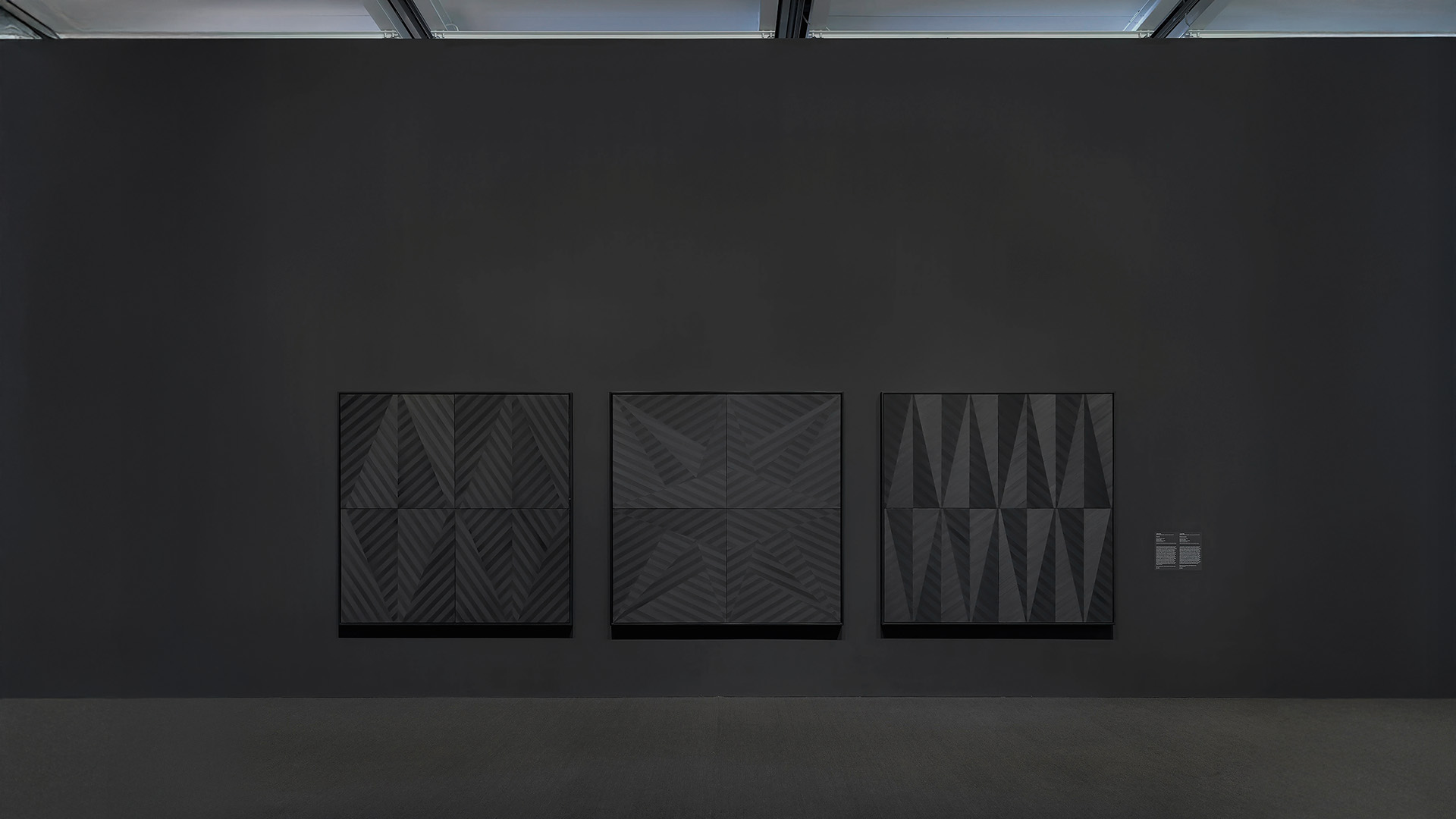
James Little’s practice is organized around interval as a governing principle. From the outset, painting functions not as composition but as a calibrated system in which color, scale, and repetition are subjected to non-negotiable constraints.
Early works engage chromatic intensity through disciplined sequencing. Color is deployed in bands and fields that test optical rhythm, not effect—measured, repeated, and regulated until sensation gives way to structure. These paintings do not seek expression; they examine how color behaves when held inside fixed relations.
Over time, this logic tightens. Chromatic range is progressively reduced, redirected, and eventually suspended. The shift to black and white does not signal austerity or negation, but concentration. With color removed as a variable, interval becomes fully legible, and the work’s underlying structure is revealed with greater precision.
Across all phases, Little treats painting as a site of accumulated decisions. Surface records labor. Repetition is never decorative, but procedural. The work insists on clarity achieved through restraint, positioning painting as a self-contained system rather than a vehicle for narrative, symbolism, or identity.
James Little is a painter whose work is defined by disciplined systems of interval, proportion, and repetition. Beginning with chromatic abstractions and progressing toward black-and-white compositions, his practice treats color as material rather than expression. Across decades, Little’s paintings articulate structure through accumulated decisions, restraint, and clarity, positioning painting as a self-contained system governed by rules rather than narrative or symbolism.
