

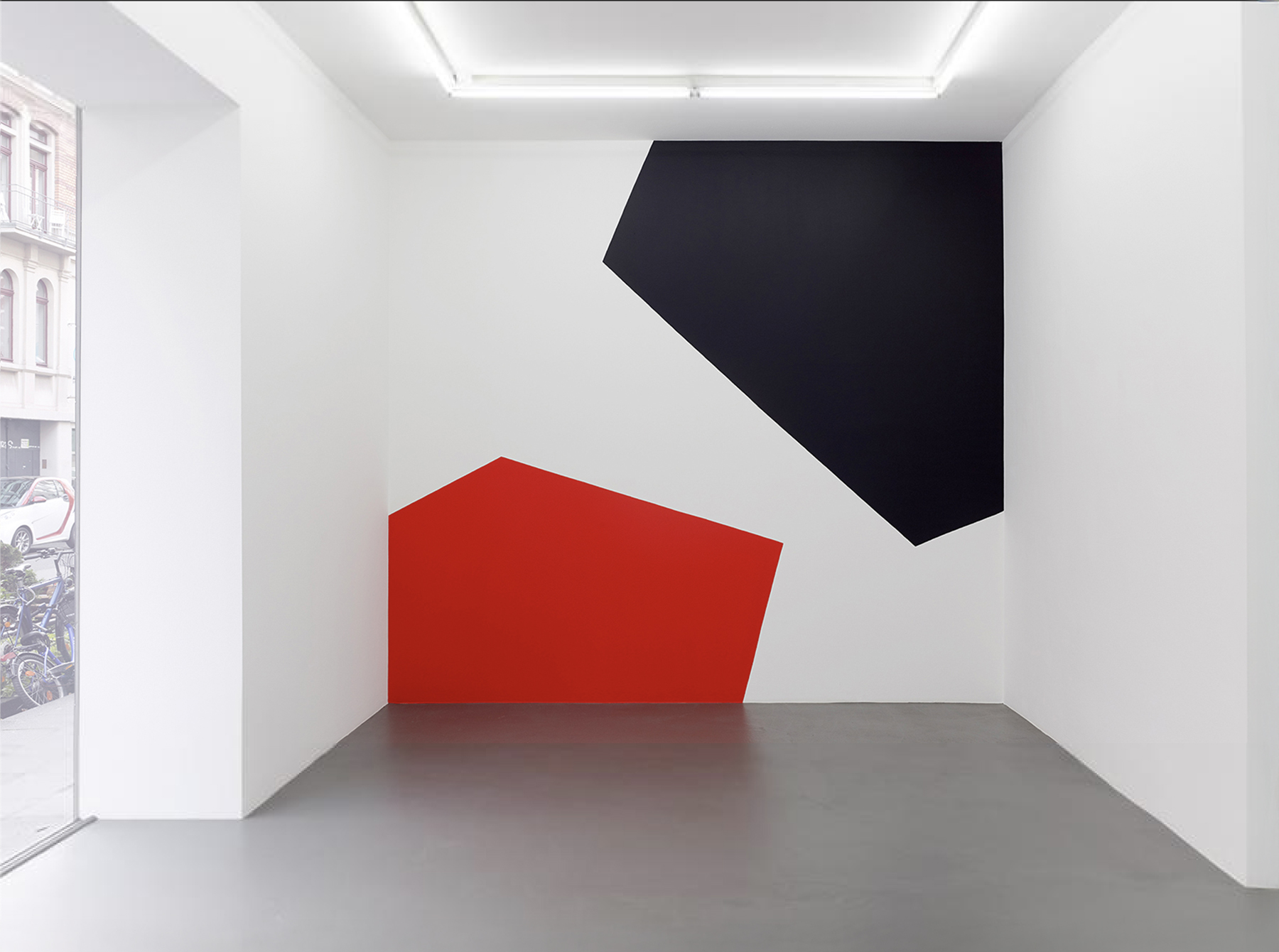
Lutz Fritsch builds a world where color becomes a spatial instrument. His sculptures do not represent form; they register orientation. Geometry is reduced to arcs, rings, bars, and frames — but these shapes are not minimal objects. They function as signals within space, recalibrating how the body understands distance, edge, and horizon.
Working primarily in lacquered steel and architectural scale, Fritsch inserts intense monochrome forms into urban and natural environments. Orange, red, yellow, and blue operate less as expressive color than as chromatic vectors. They cut across landscape, interrupt skyline, and frame perception. A circle placed in a river becomes both marker and measure. A vertical column placed at architectural threshold becomes a hinge between interior and exterior. Color clarifies boundary.
His practice emerged in dialogue with Minimalism and postwar abstraction, yet it resists both industrial neutrality and symbolic narrative. Where Minimalism emphasized objecthood, Fritsch emphasizes relation. The work does not sit; it situates. It does not dominate; it repositions the viewer within a field of calibrated alignments.
Across public commissions and gallery installations alike, the logic remains consistent: simple geometric units, precisely scaled, placed with deliberate restraint. Meaning does not arise from image or metaphor but from spatial encounter. The viewer’s movement completes the structure. Orientation replaces illusion.
Fritsch’s sculptures operate as infrastructure for perception. They establish axes, thresholds, and directional cues within environments that might otherwise dissolve into neutrality. What appears reductive is in fact strategic. Color here is not atmosphere. It is decision.
Lutz Fritsch is a German sculptor known for large-scale geometric sculptures that use bold monochrome color to activate public space. Working primarily in lacquered steel, Fritsch creates circles, arcs, and vertical forms that function as spatial markers rather than expressive objects. Often associated with Minimalism and postwar geometric abstraction, his work explores how color, scale, and placement recalibrate perception in urban and architectural environments. His public sculptures across Europe demonstrate how simple geometric forms can redefine orientation, boundary, and spatial awareness.
