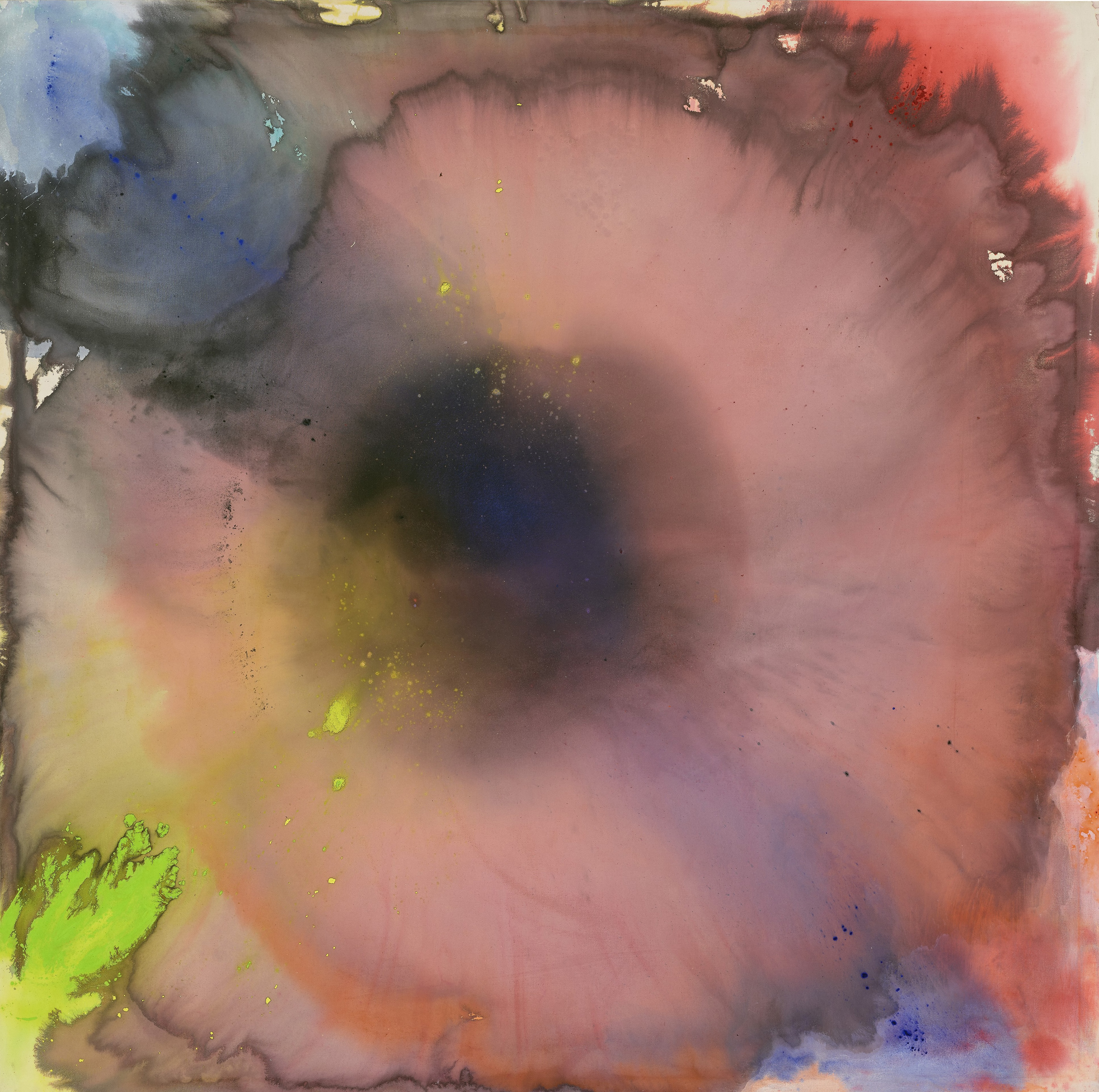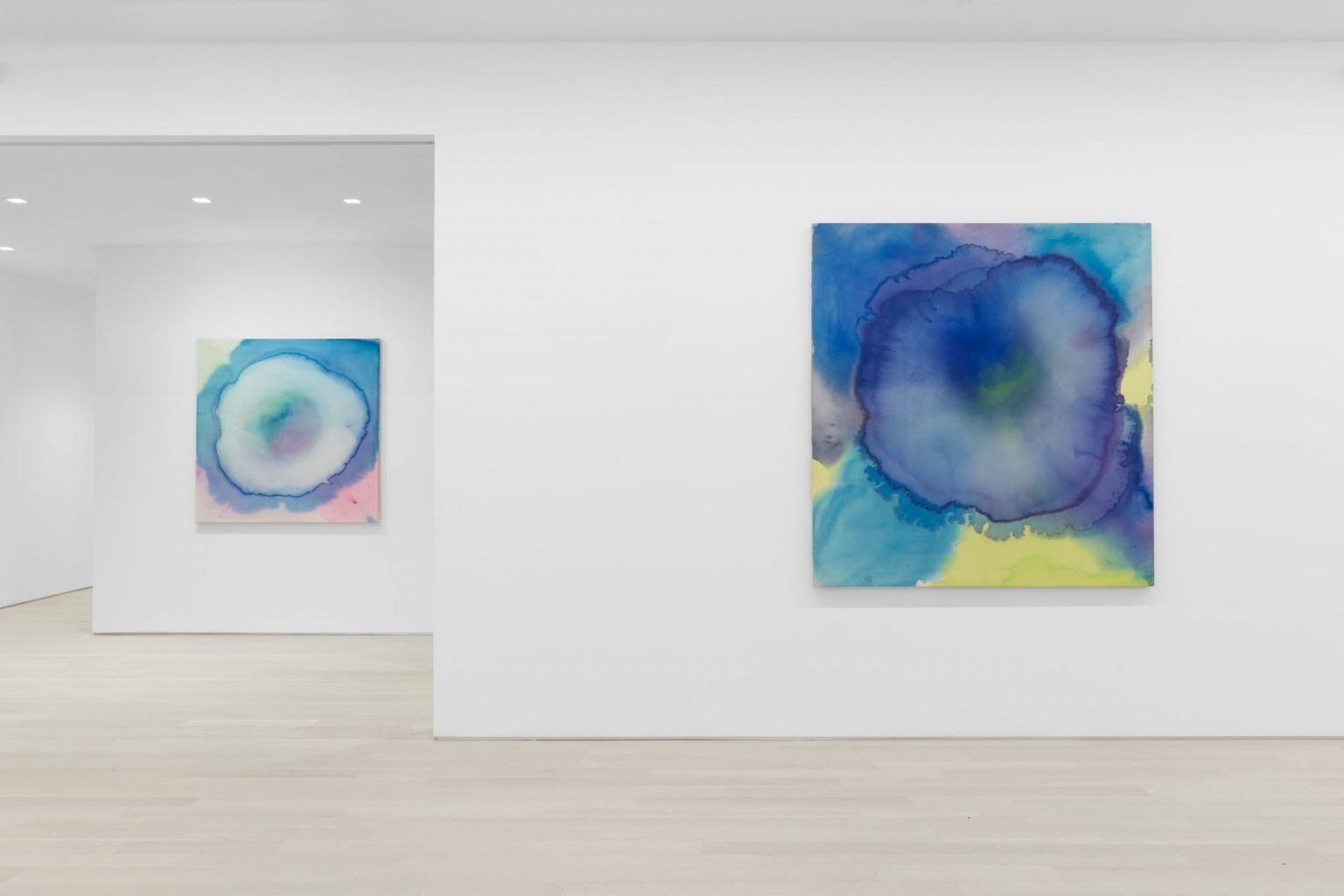
Vivian Springford (1913–2003) developed a singular abstract practice rooted in disciplined gesture, Taoist philosophy, and sustained observation of natural systems. Although her late chromatic paintings are often described as atmospheric or chance-based, they are the result of decades of methodical preparation rather than spontaneous action.
Beginning in the late 1950s, Springford worked intensively on paper, producing hundreds of studies on rice and mulberry paper. These works functioned as rehearsals: arcs, coils, and weighted curves repeated until absorbed into muscle memory. Gesture in her work was trained, not improvised — aligned more closely with East Asian calligraphy than with gestural abstraction.
This disciplined foundation informed all subsequent phases of her practice. The rice paper mountings of the early 1960s, long regarded as calligraphic experiments, can be understood as early aerial landscapes — abstractions of urban grids, terrain, and water seen from above. That orientation deepened after her travels, particularly to Yellowstone, where geothermal pools became the structural source for her chromatic paintings. These works are not symbolic abstractions but sustained studies of natural energy systems: expansion, diffusion, pressure, and depth.
Later series — including the Expansionists, Assemblages, Scuba works, and Cosmos paintings — extend this logic across different registers of scale, from geological force to immersion and dissolution. Across her practice, form does not express emotion but organizes perception. Color functions structurally, edges dissolve to sustain depth, and composition operates as a continuous system rather than a singular event.
Seen as a whole, Springford’s work is not a sequence of stylistic shifts but a unified investigation into how disciplined process can translate the dynamics of nature into painting.
Vivian Springford (1913–2003) was an American abstract painter whose work combined disciplined process with sustained observation of natural systems. Often associated with her late chromatic paintings, Springford is frequently misread as a gestural or chance-based painter. In fact, her abstractions emerged from decades of rigorous preparation, including hundreds of studies on rice and mulberry paper where gesture was rehearsed and internalized. Influenced by East Asian calligraphy and Taoist philosophy, Springford understood mastery as balance rather than expression. Her paintings translate forces observed in nature—flow, expansion, pressure, and depth—into structured fields of color. From early paper studies to expansive canvases inspired by aerial landscapes and geothermal formations, her practice forms a continuous investigation into how disciplined process can render natural energy visible.
For archival material and primary documentation, see vivianspringford.com.