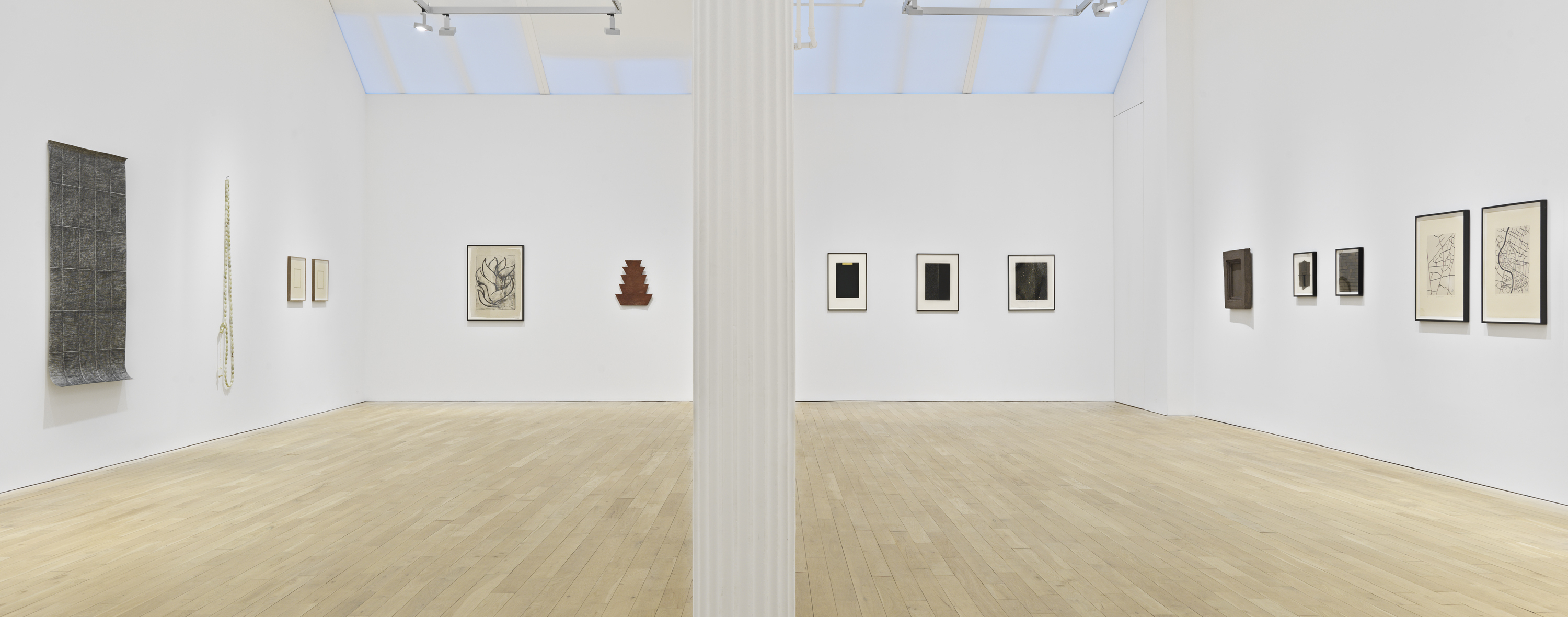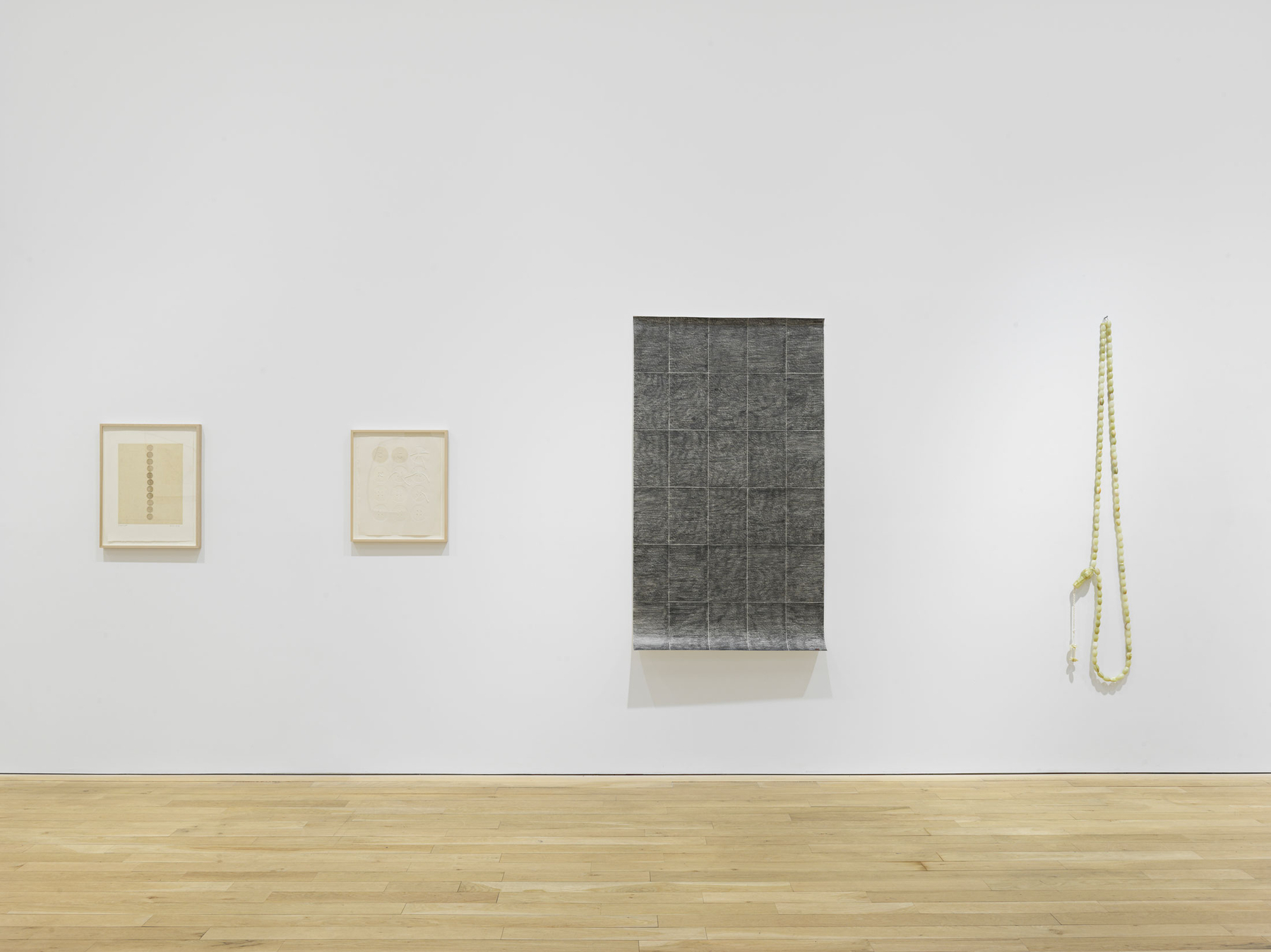
Zarina’s work is built from restraint. Across prints, drawings, and sculptural works on paper, she developed a language in which line, proportion, and surface operate as primary structural elements. Rather than describing places, her work constructs them—spaces held through boundary, interval, and quiet calibration.
Born in Aligarh, India, Zarina lived across multiple geographies throughout her life, including Thailand, Japan, France, Germany, and the United States. This sustained experience of movement and displacement shaped her practice, but never in an illustrative or autobiographical way. Instead of narrative, she turned to abstraction as a means of order. Her works translate the conditions of migration—loss, memory, orientation—into systems of measurement and containment.
Printmaking became central to her method. Working primarily in woodcut and intaglio, Zarina embraced the discipline of the medium: carving, pressure, repetition, and the resistance of material. Lines are incised rather than drawn, producing forms that feel deliberate and irreversible. The physical act of cutting becomes a structural decision—edges matter, margins hold weight, and empty space carries consequence.
Her compositions are spare. Single rooms, corridors, staircases, or floor plans appear as pared-down diagrams, often reduced to outlines or modular grids. These are not architectural depictions but spatial propositions. Walls become limits, doors become thresholds, and the page functions as a site where space is measured rather than filled. What remains unsaid—the blank paper, the quiet intervals between lines—is as active as the marks themselves.
Language enters her work cautiously. Words appear in Urdu, English, or Arabic, but never as explanation. Instead, text behaves like form: aligned, centered, or held at the edge of the page. Titles such as Home Is a Foreign Place or Letters from Home operate less as statements than as spatial anchors—phrases that locate the work emotionally without overwhelming its structure.
Zarina’s use of materials reinforces this sense of discipline. Handmade paper, gold leaf, ink, and pigment are treated with care and economy. Surfaces remain tactile but controlled, allowing slight variations in tone and pressure to register without becoming expressive gestures. The work avoids spectacle, favoring steadiness and duration over immediacy.
Across decades, her practice remained consistent in its commitment to clarity. Rather than evolving through stylistic change, it deepened through repetition—returning to the same forms, the same scales, the same measured decisions. This persistence gives her work its quiet force. Meaning accumulates slowly, through sustained attention rather than dramatic shift.
Zarina’s work stands as a model of non-assertive presence. It does not demand interpretation or impose emotion. Instead, it offers structure as a form of care—spaces where memory, distance, and belonging can be held without resolution. Through line, boundary, and restraint, her work makes room for contemplation, allowing space itself to become the subject.
Zarina was an Indian-American artist known for geometric woodcuts and embossed paper works that reflect memory, migration, and belonging.