


Dan Flavin’s work is often encountered as an experience — immediate, immersive, difficult to ignore. But in this exhibition, what holds is something quieter: a set of conditions that must be kept — repeated and maintained.
Here, that experience remains present, but it does not seem to be the work’s primary concern.
What holds the exhibition together is not light as sensation, but light as a way of attending to architecture. The fluorescent units are familiar, almost standardized. What varies is the room itself — its corners, seams, openings, and planes — and how these elements receive, interrupt, or quietly redirect illumination.
The fixtures do not behave as singular objects. They function as components within a set of conditions that remain remarkably steady. If a lamp is replaced, nothing essential is lost. What matters is not the individual unit, but the arrangement it sustains: placement, angle, spacing, and contact with the wall. Authorship feels dispersed, held lightly by the structure rather than asserted through material presence.
This becomes especially clear in the corner works. Corners do not absorb light evenly. They compress it, fracture it, allow it to linger unevenly. The work does not correct these irregularities. It seems to rely on them. Light does not smooth the space; it listens to it.
Moving between rooms, the exhibition does not unfold as a progression. Each installation holds its own position, shaped by the specific limits of its setting. Thresholds do not announce transition so much as register difference. Perception shifts, but nothing accumulates. The work does not ask to be completed by movement or resolved through comparison.
What might initially read as minimal reveals itself, over time, as carefully maintained. Structure precedes expression, but without force. The work depends on the room’s willingness to hold a set of instructions — to keep alignments intact, distances measured, conditions consistent. Institutions do not so much present these works as tend to them.
Light, here, does not dramatize space or invite interpretation. It rests against surfaces, tests their edges, and remains. The work persists through attention to its conditions — quiet, exacting, and sustained.
In this exhibition, light does not behave as a discrete object to be encountered or completed. It functions as a condition held in place by architecture — shaped by walls, corners, and distances rather than by the fixtures themselves.
The work remains stable not through preservation of materials, but through the careful upkeep of spatial instructions. Replacement does not disrupt continuity; attention sustains it. What holds is not accumulation, but consistency — a system maintained over time.
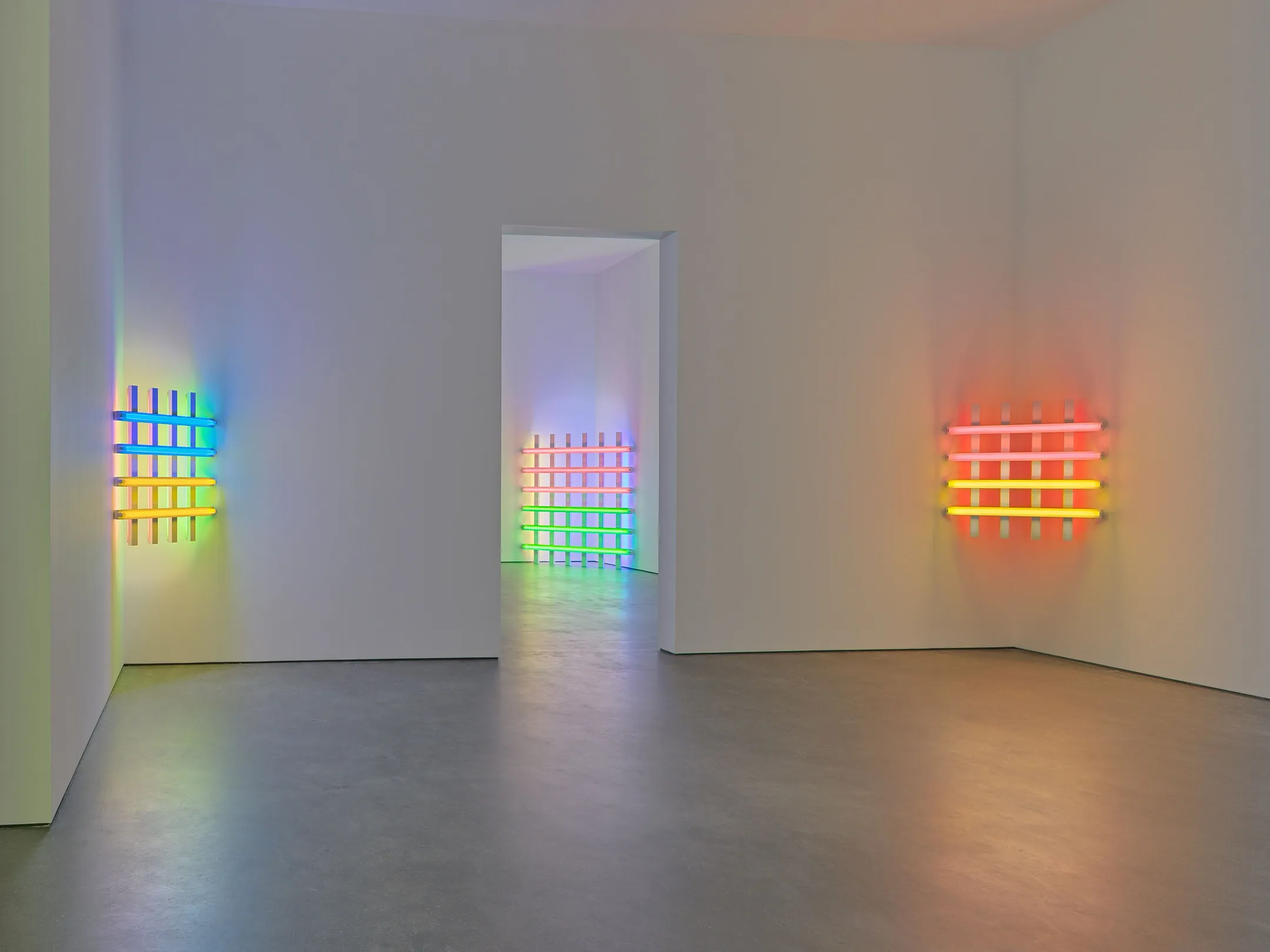

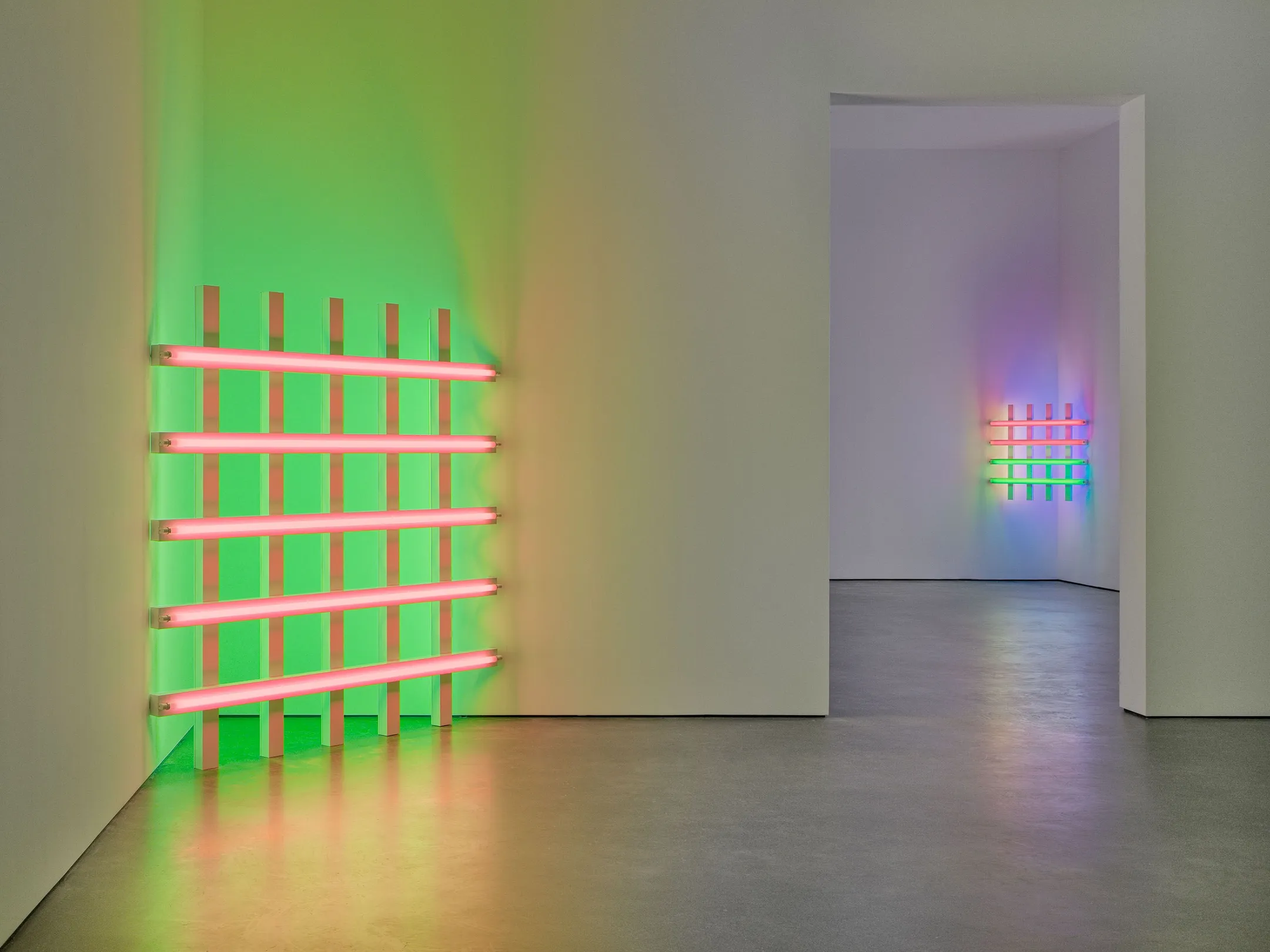

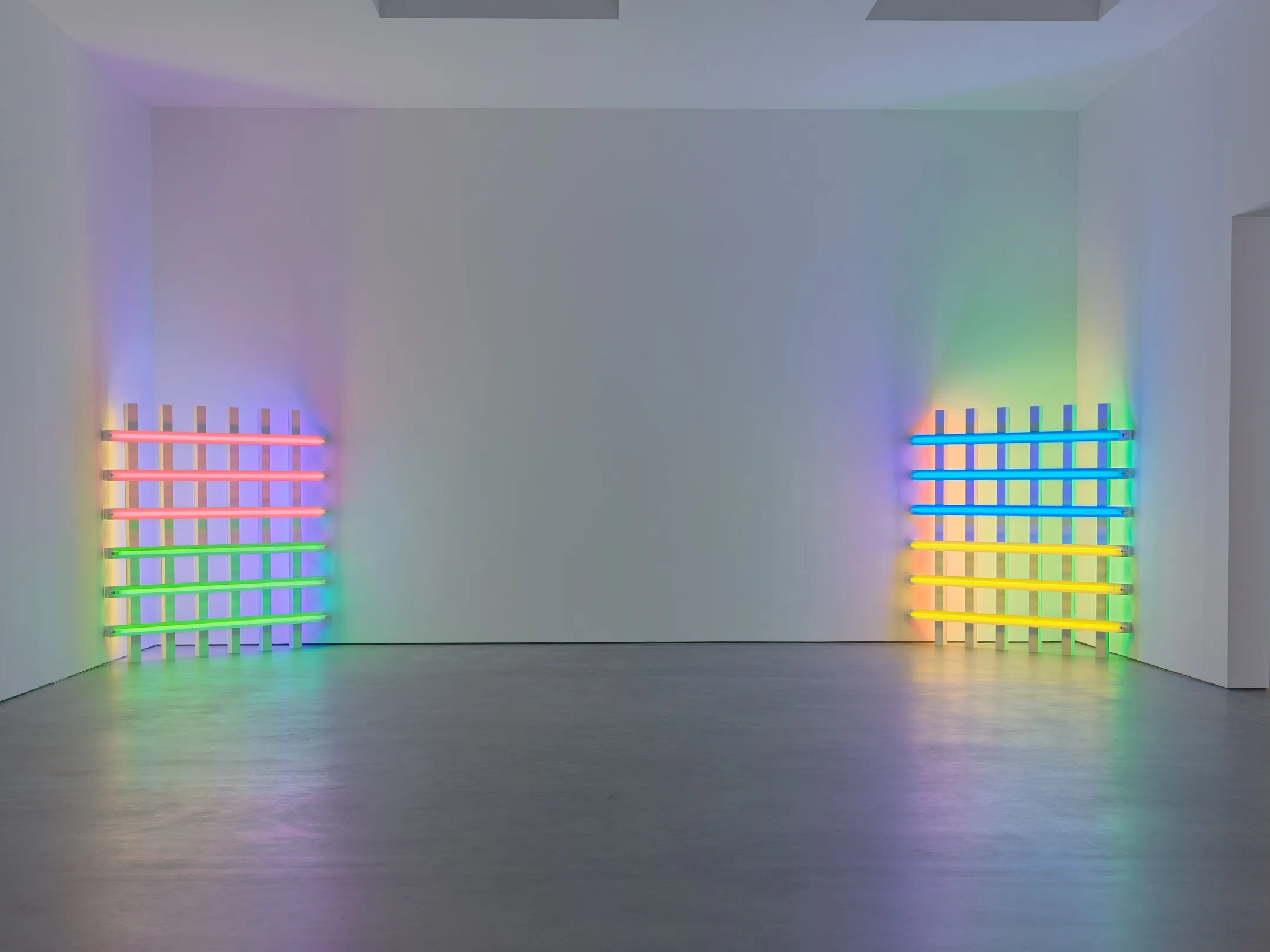

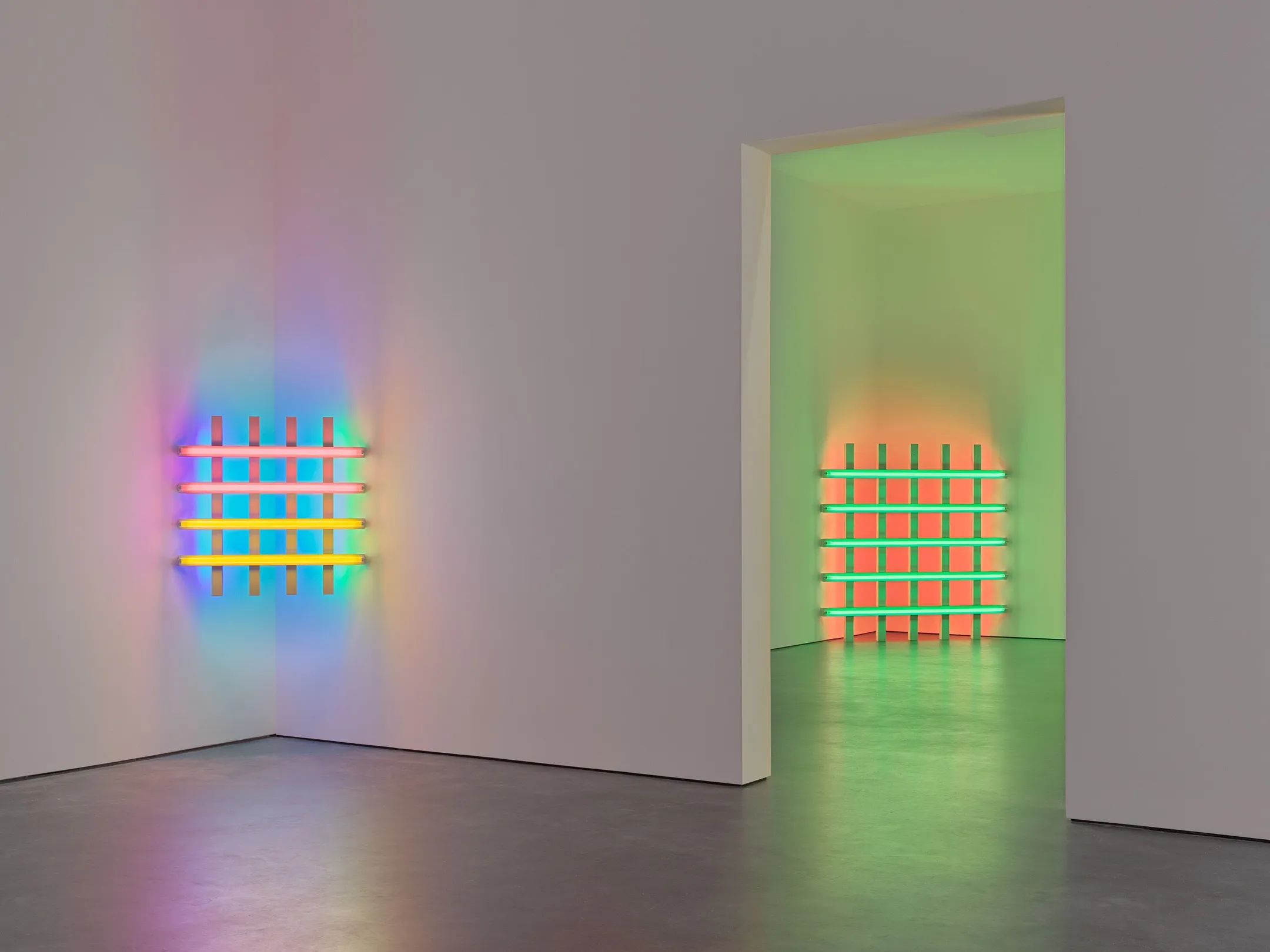


1. Installation view: Dan Flavin, Grids, David Zwirner, New York, 2026. © David Zwirner.
2. Dan Flavin, untitled (for you, Leo, in long respect and affection) 4, 1978. Blue, yellow, pink, and green fluorescent light, 4 ft (122 cm) square across a corner. Edition of 5. Edition 2: Collection of the Modern Art Museum of Fort Worth, museum purchase. © Estate of Dan Flavin / Artists Rights Society (ARS), New York.
3. Installation view: Dan Flavin, Grids, David Zwirner, New York, 2026. © David Zwirner.
4. Dan Flavin, untitled (for you, Leo, in long respect and affection) 3, 1978. Pink, green, yellow, and blue fluorescent light, 4 ft (122 cm) square across a corner. Edition of 5. © Estate of Dan Flavin / Artists Rights Society (ARS), New York.
5. Installation view: Dan Flavin, Grids, David Zwirner, New York, 2026. © David Zwirner.
6. Dan Flavin, untitled (for you, Leo, in long respect and affection) 1, 1977. Pink, green, yellow, and blue fluorescent light, 8 ft (244 cm) square across a corner. Edition of 3. © Estate of Dan Flavin / Artists Rights Society (ARS), New York.
7. Installation view: Dan Flavin, Grids, David Zwirner, New York, 2026. © David Zwirner.
8. Dan Flavin, untitled (to Mary Ann and Hal with fondest regards) 2, 1976. Green and pink fluorescent light, 8 ft (244 cm) square across a corner. Edition of 3. © Estate of Dan Flavin / Artists Rights Society (ARS), New York.
9. Installation view: Dan Flavin, Grids, David Zwirner, New York, 2026. © David Zwirner.
10. Dan Flavin, untitled (in honor of Leo at the 30th anniversary of his gallery), 1987. Red, pink, yellow, blue, and green fluorescent light, 8 ft (244 cm) high, 24 ft (732 cm) wide across a corner. Edition of 3. © Estate of Dan Flavin / Artists Rights Society (ARS), New York.
11. Dan Flavin, untitled (for you, Leo, in long respect and affection) 3, 1978. Pink, green, yellow, and blue fluorescent light, 4 ft (122 cm) square across a corner. Edition of 5. © Estate of Dan Flavin / Artists Rights Society (ARS), New York.
Cover: Dan Flavin, untitled (in honor of Leo at the 30th anniversary of his gallery), 1987. Red, pink, yellow, blue, and green fluorescent light, 8 ft (244 cm) high, 24 ft (732 cm) wide across a corner. Edition of 3.
Edition 1: Panza Collection, gift to Fondo per l’Ambiente Italiano, 1996, on permanent loan to the Solomon R. Guggenheim Foundation, New York.
Edition 2: Princeton University Art Museum. Gift of the Schorr Family Collection (Herbert Schorr, Graduate School Class of 1963; Lenore Schorr; Andrew J. Schorr, Class of 1987) in honor of Allen Rosenbaum.
Edition 3: San Francisco Museum of Modern Art. Phyllis C. Wattis Fund for Major Accessions.
© Estate of Dan Flavin / Artists Rights Society (ARS), New York.
All images © their respective rights holders.
Image rights & attribution →