


A grocery bag carries geometry it was never designed to hold. The creases left by handling, the folds made under the pressure of ordinary use, the seams that record how the material was assembled—these are not compositional decisions. They are the record of time passing through matter. In the Brown Paperbag Drawings (2025), Dorothea Rockburne opens those bags, flattens them, and repositions their surfaces until the geometry embedded within them becomes visible. She does not impose structure. She reveals what was already there.
This is the culminating gesture of a practice that has always been asking a different question from the one usually attributed to it. Rockburne is not asking how mathematical systems can be embodied in material. She is asking how time itself produces structure within it. The distinction matters. One approach moves from system toward matter—finding physical form for abstract relationships. The other moves from matter toward system—finding in the behavior of physical things the order time has left behind.
The title of the exhibition names this precisely. Time Measures Itself. Not the artist measuring time. Not mathematics providing the measure. The material carries its own temporal record, and geometry emerges from that record once the conditions for its visibility are established.
Rockburne encountered the mathematician Max Dehn at Black Mountain College in the early 1950s, an experience often described as the origin of her interest in geometry. Dehn did not teach geometry as a system of fixed forms. Instead he introduced ways of thinking about how structures develop through proportion, how systems unfold through growth, and how patterns in nature remain dynamic rather than static. Rockburne absorbed not a set of mathematical tools to apply to painting but an understanding that the world’s structure unfolds from within—that form is something discovered rather than designed.
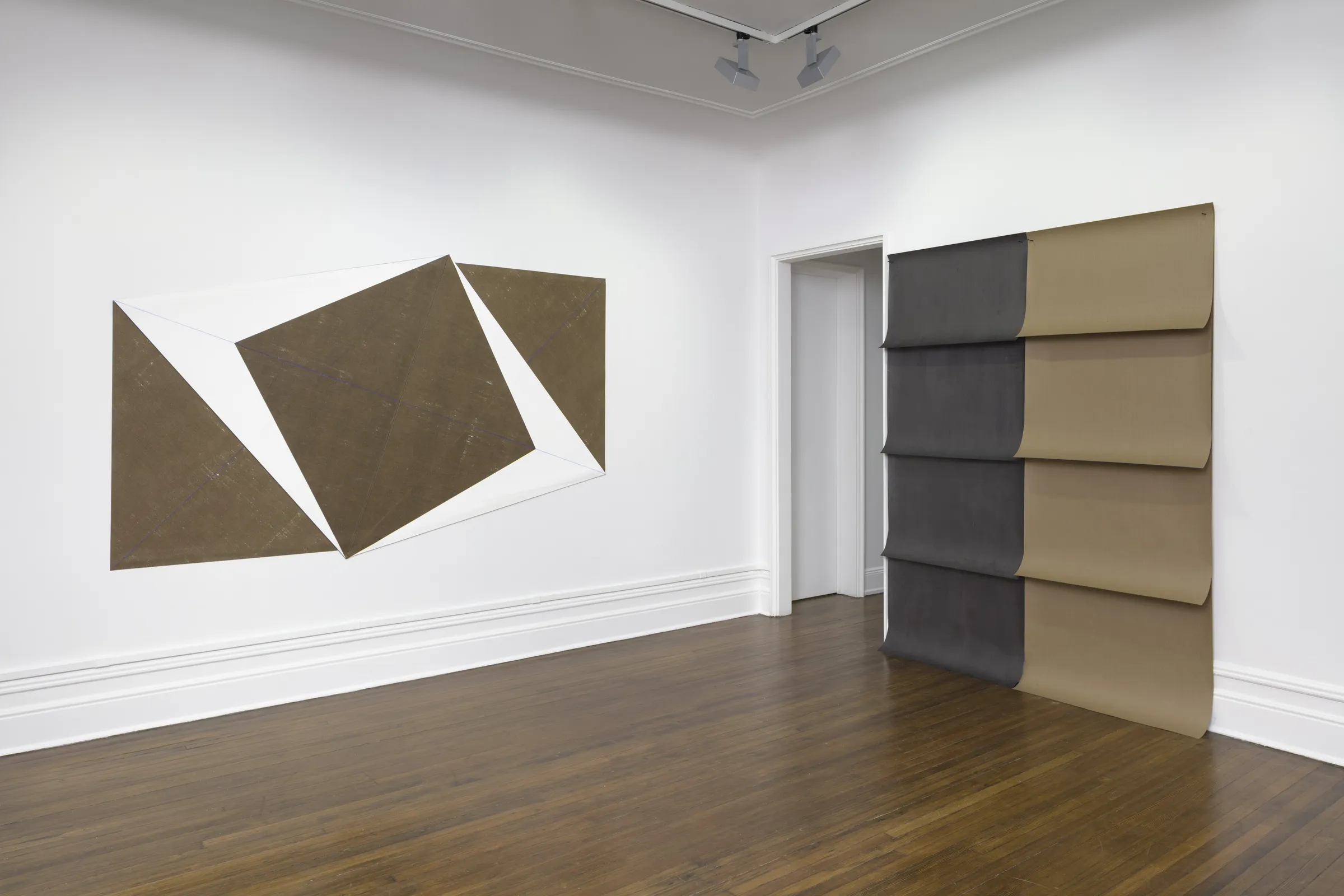
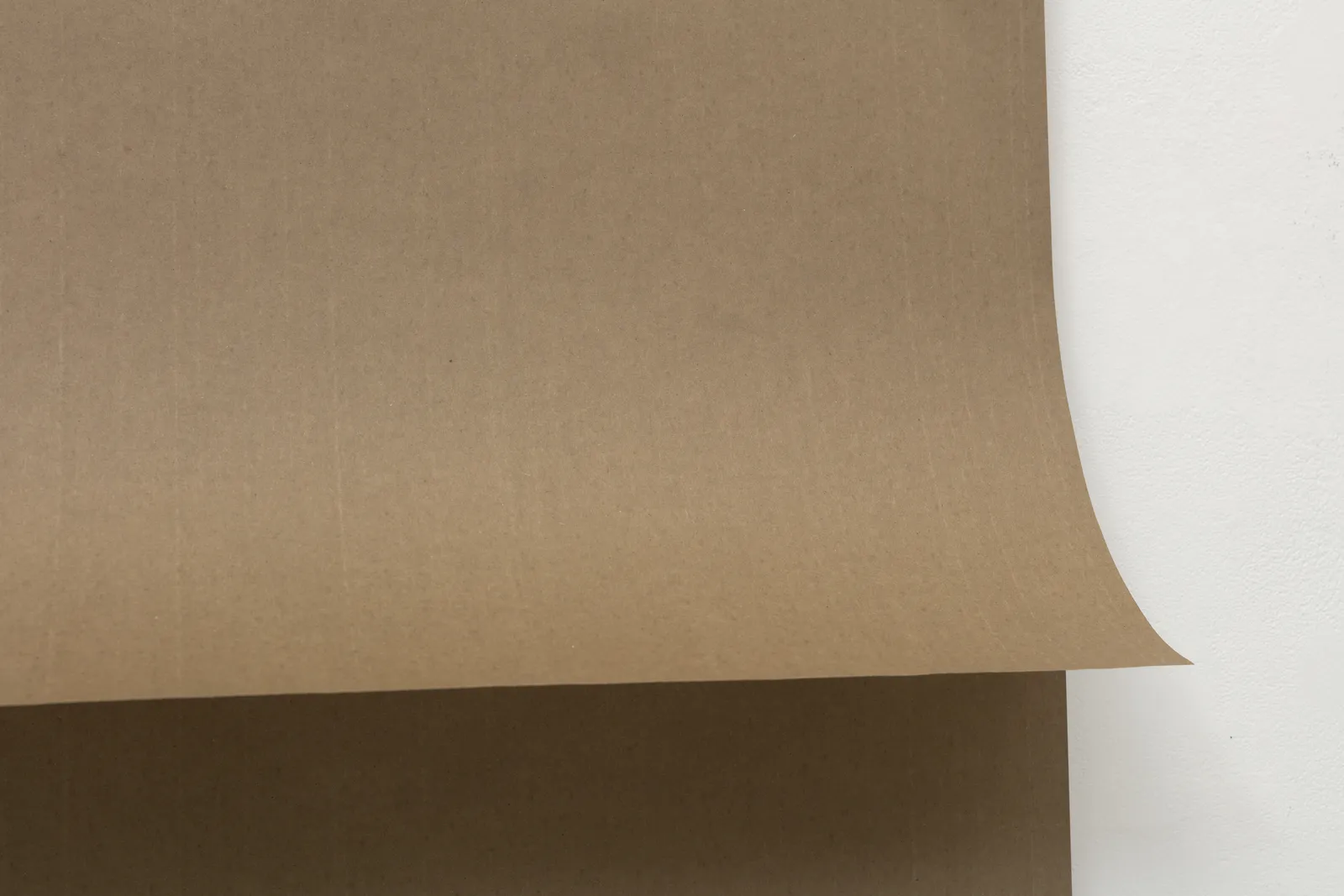
One of the earliest works in the exhibition, 2, 4, 6, 8 (1969–70), shows this thinking beginning to take material form. Sheets of industrial brown paper hang vertically from a shared top edge, their weight pulling downward against the wall. Each sheet extends farther than the one before it, lengthening in measured intervals. Dense graphite darkens the left half of each surface while the right remains untreated. Geometry here is not drawn as a diagram. It emerges from sequence, gravity, and the paper’s own response to being suspended—the material finding its form through the forces acting on it rather than through the artist’s hand. The work unfolds less like a composition than like a system in motion.
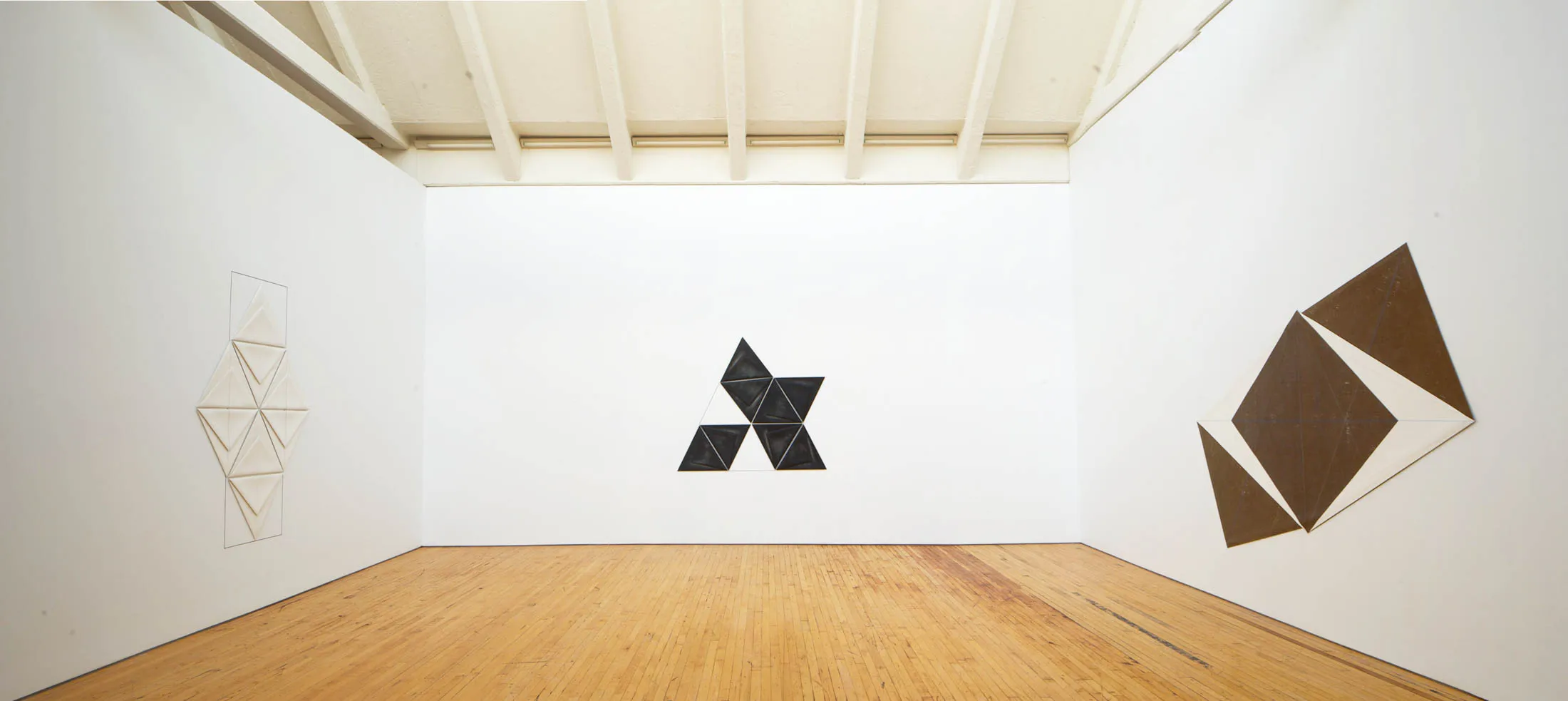
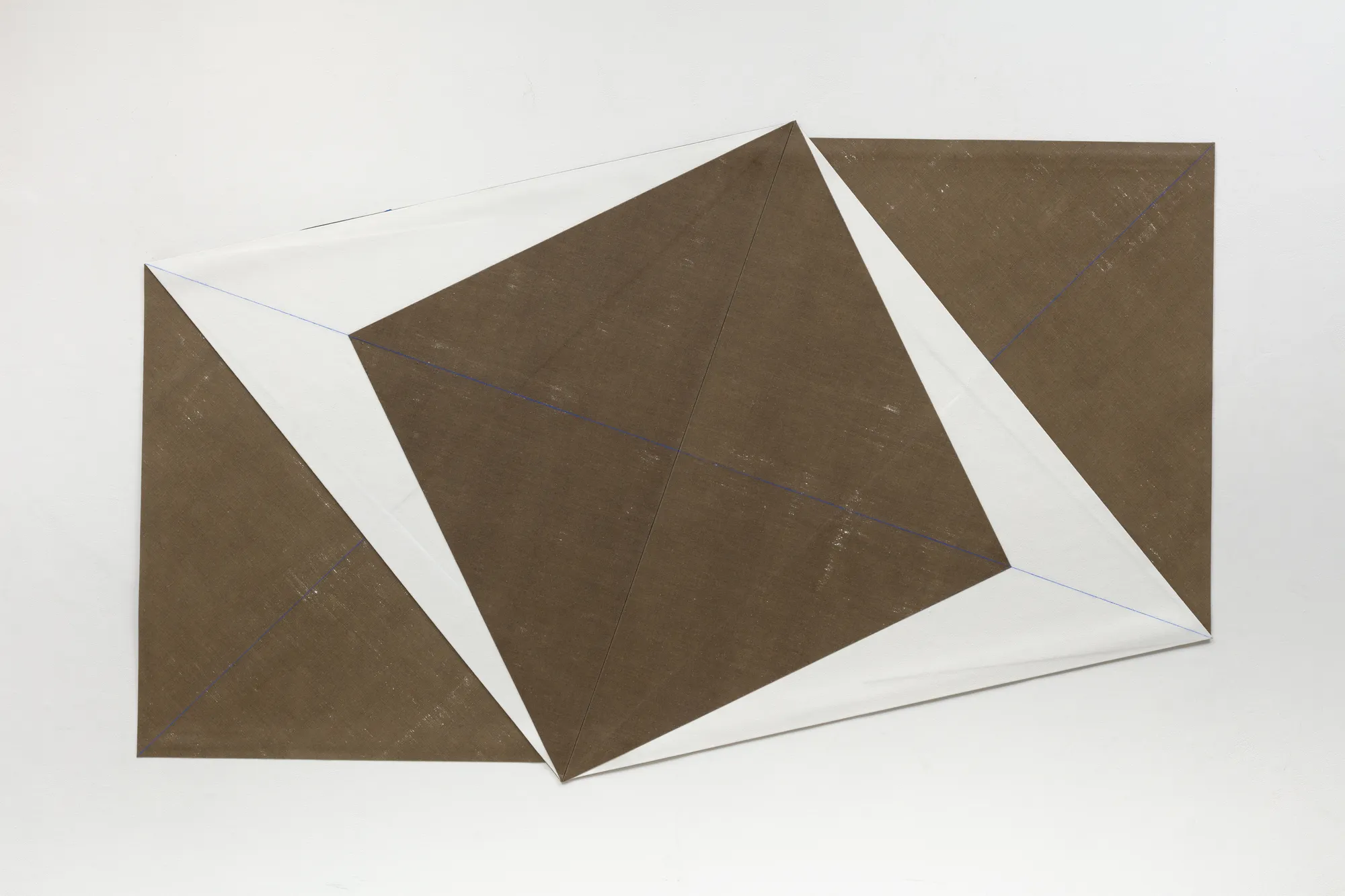
The Golden Section Paintings of the mid-1970s extend this investigation into proportional systems. Works such as Golden Section Painting: Triangle, Square (1974) and Golden Section Painting: Square Separated by Parallelogram with Diamond (1974–76) derive their structure from the Golden Ratio. This proportional relationship appears across architecture, natural growth patterns, and historical forms not because it was codified once and transmitted but because it describes something fundamental about how structure organizes itself through time. Rockburne works with it on those terms.
In these paintings the geometry never settles into stability. Triangles press against squares. Parallelograms interrupt the surface. Diamond forms appear to rotate within the field. Balance remains, yet the relationships stay active as the eye moves through the work. Chalk, varnish, and gesso preserve the physical trace of their making, allowing the surface to register the time of its production.
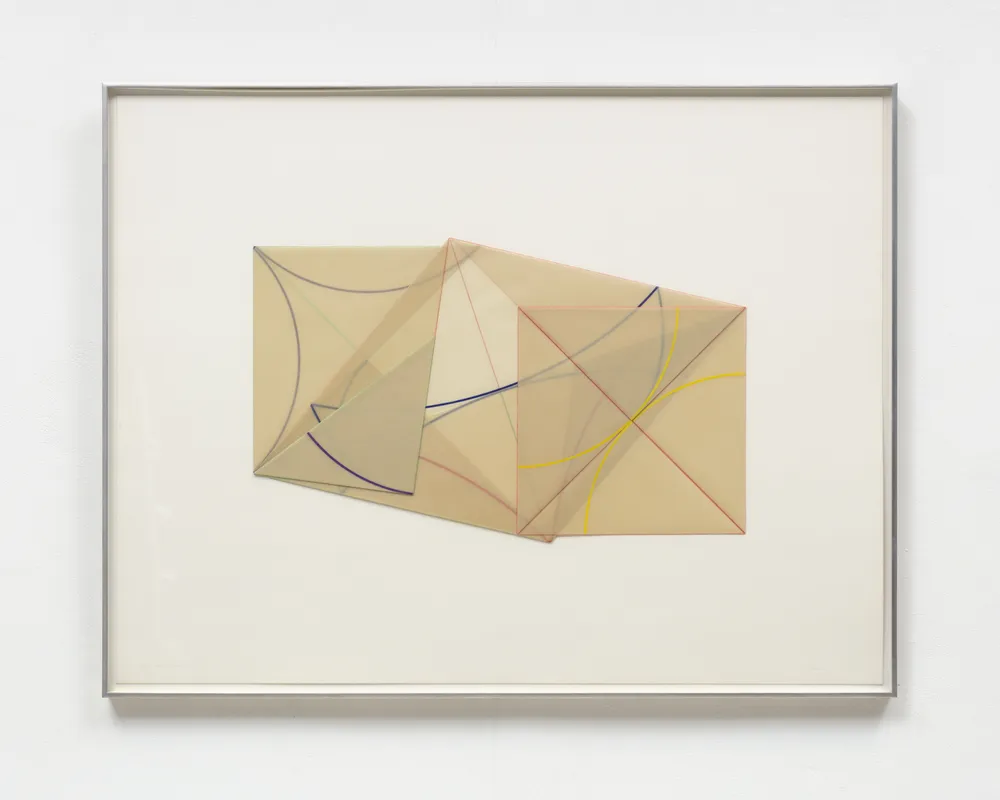
A related sensibility appears in the vellum works from the late 1970s, including Musician Angel: Parallelogram, Diamond (1979–81) and Study for Discourse (1978). Translucent vellum supports lightly drawn arcs and intersecting lines that suggest geometric construction without fully resolving it. These forms hover between diagram and movement, as though the geometry were still unfolding—caught in the act of becoming rather than presented as a finished system.
For decades, Rockburne moved from system toward matter. In the Brown Paperbag Drawings, matter becomes the system.
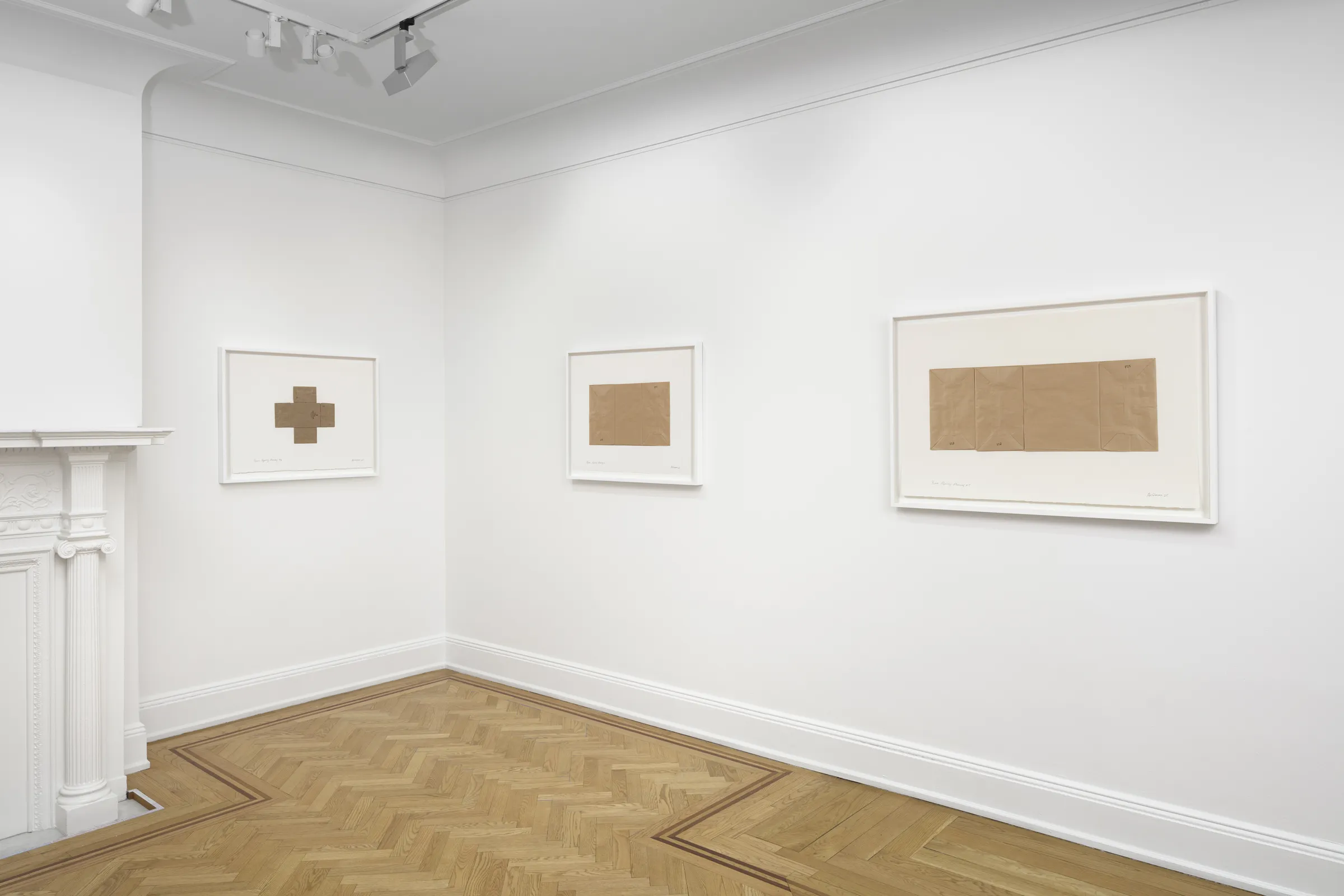
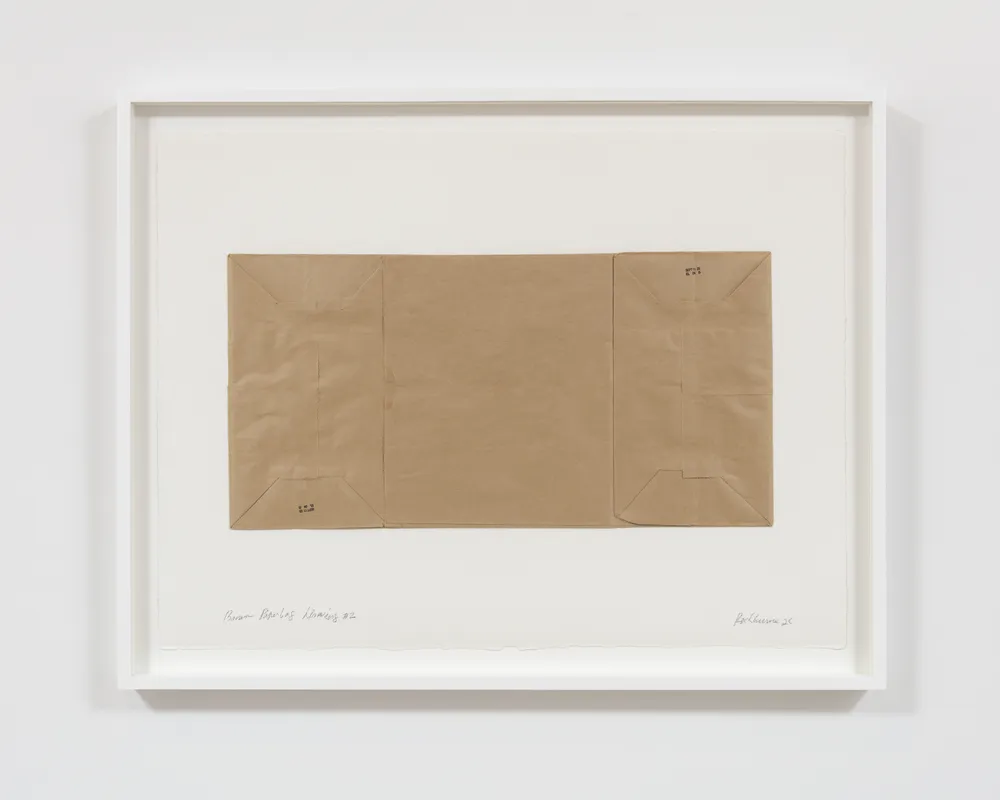
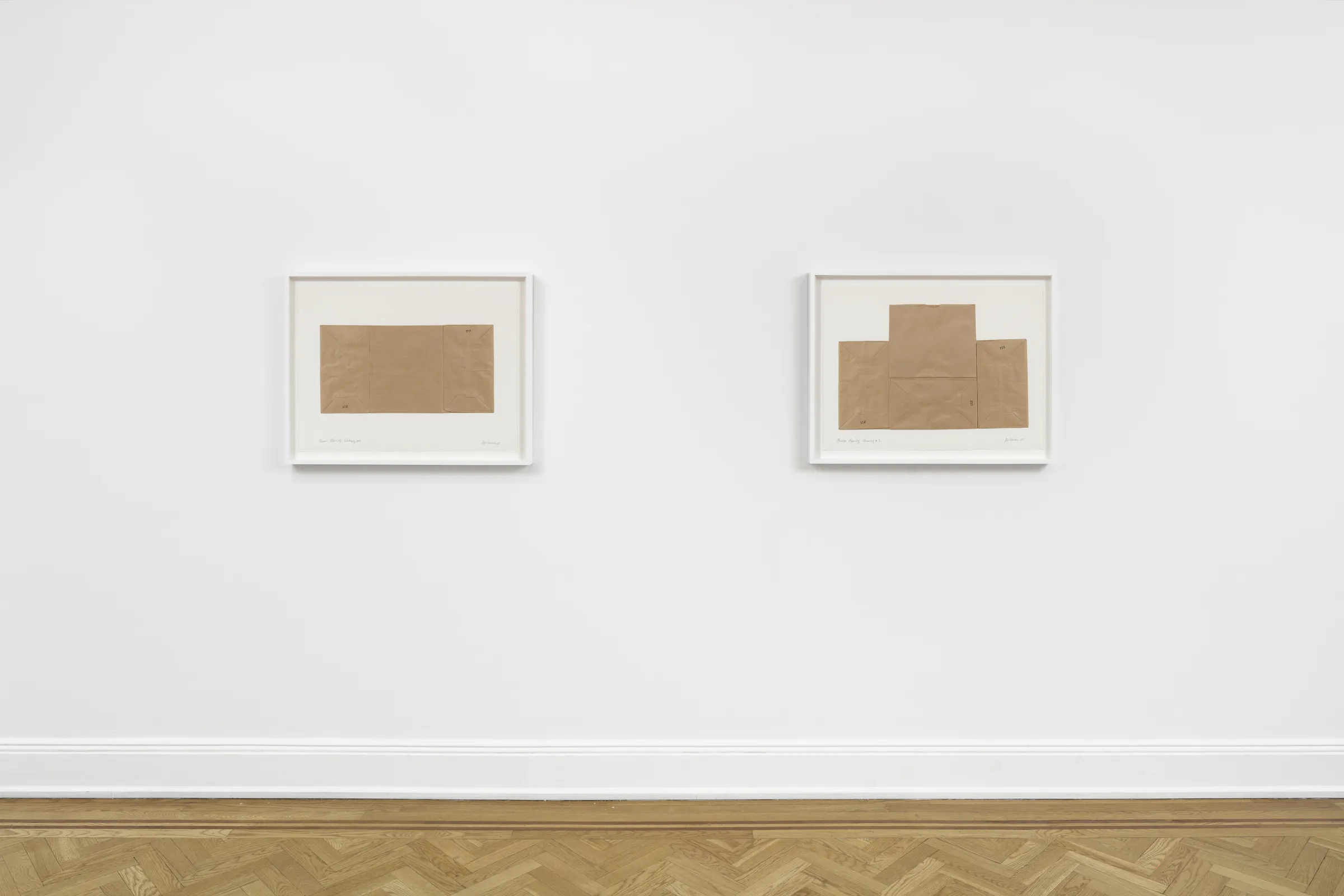
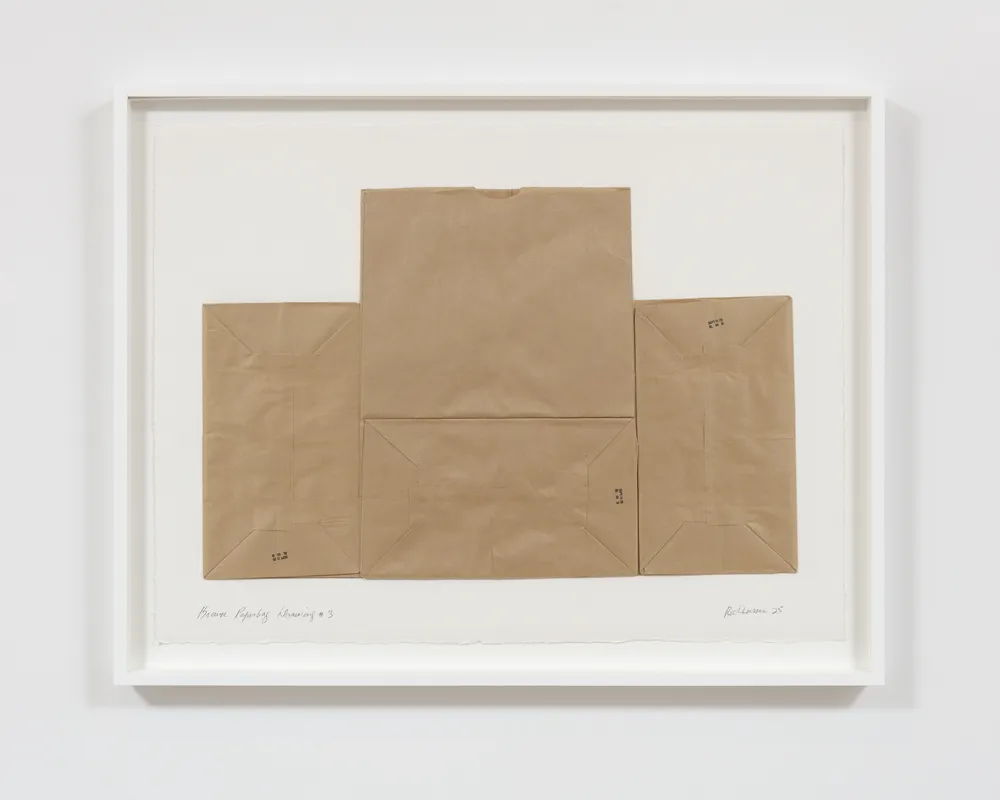
Ordinary grocery bags have been opened, flattened, and arranged across the surface of the sheet. Their seams, folds, and creases carry the history of use—marks produced by hands that were never thinking about geometry. Once unfolded and repositioned, those creases reveal a structural order already embedded in the material. Rockburne has often remarked that every material has its own voice. Here she listens rather than directing.
Each fold introduces a directional tension. Each seam establishes a new alignment. Together they generate a field of subtle pressures—the entire composition held in a balance that shifts as the eye moves from one element to the next. The geometry is not imposed. It is what time left behind in the material during the ordinary course of its use—and what becomes visible once Rockburne creates the conditions for its appearance.
Rockburne has said that she knows a work is finished “when I no longer look at it—it looks at me.” In these drawings that reversal becomes palpable. By relinquishing control to the material’s own structure, the work begins to assert its own presence. Geometry appears less as something directed by the artist than as something the material was already holding.
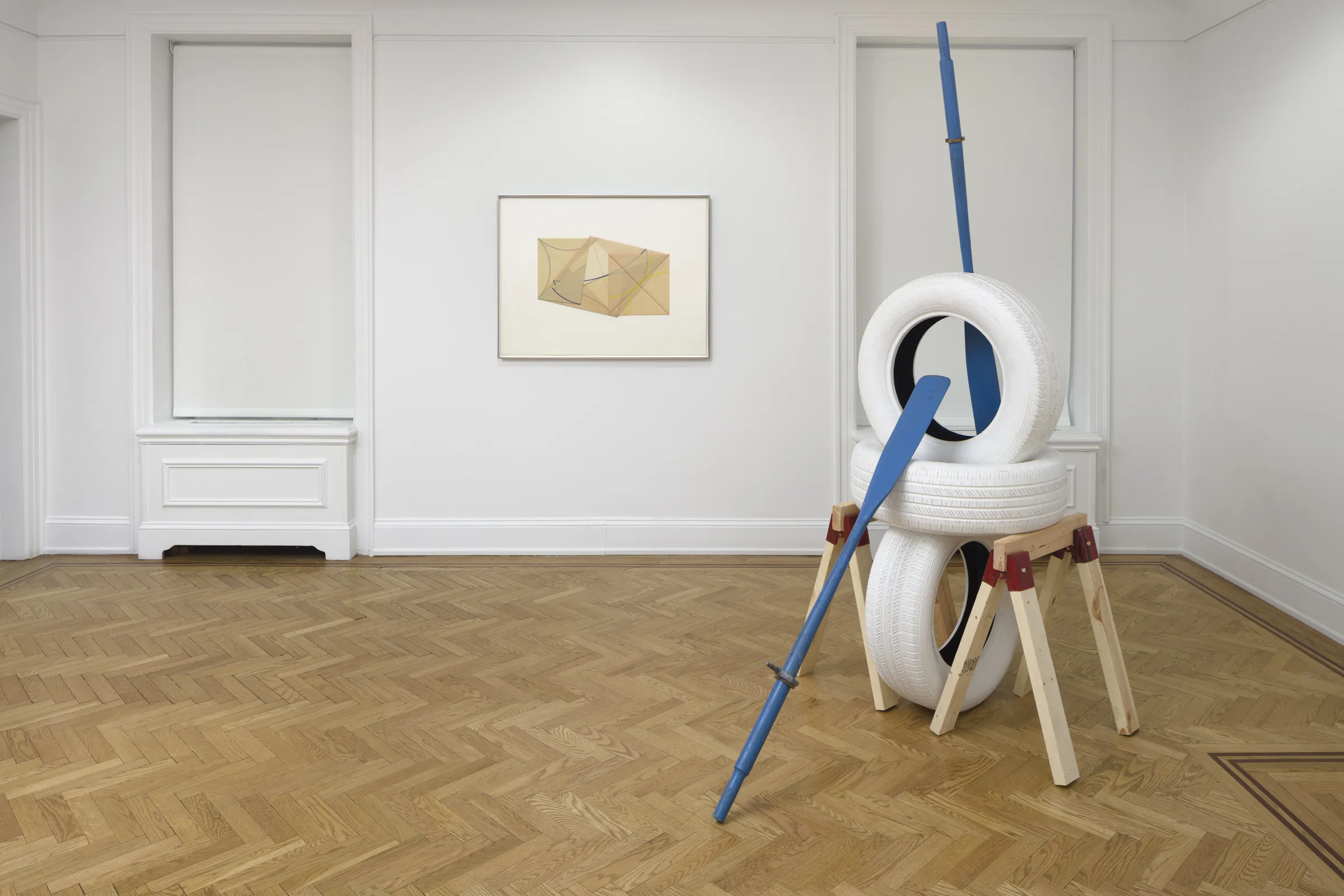
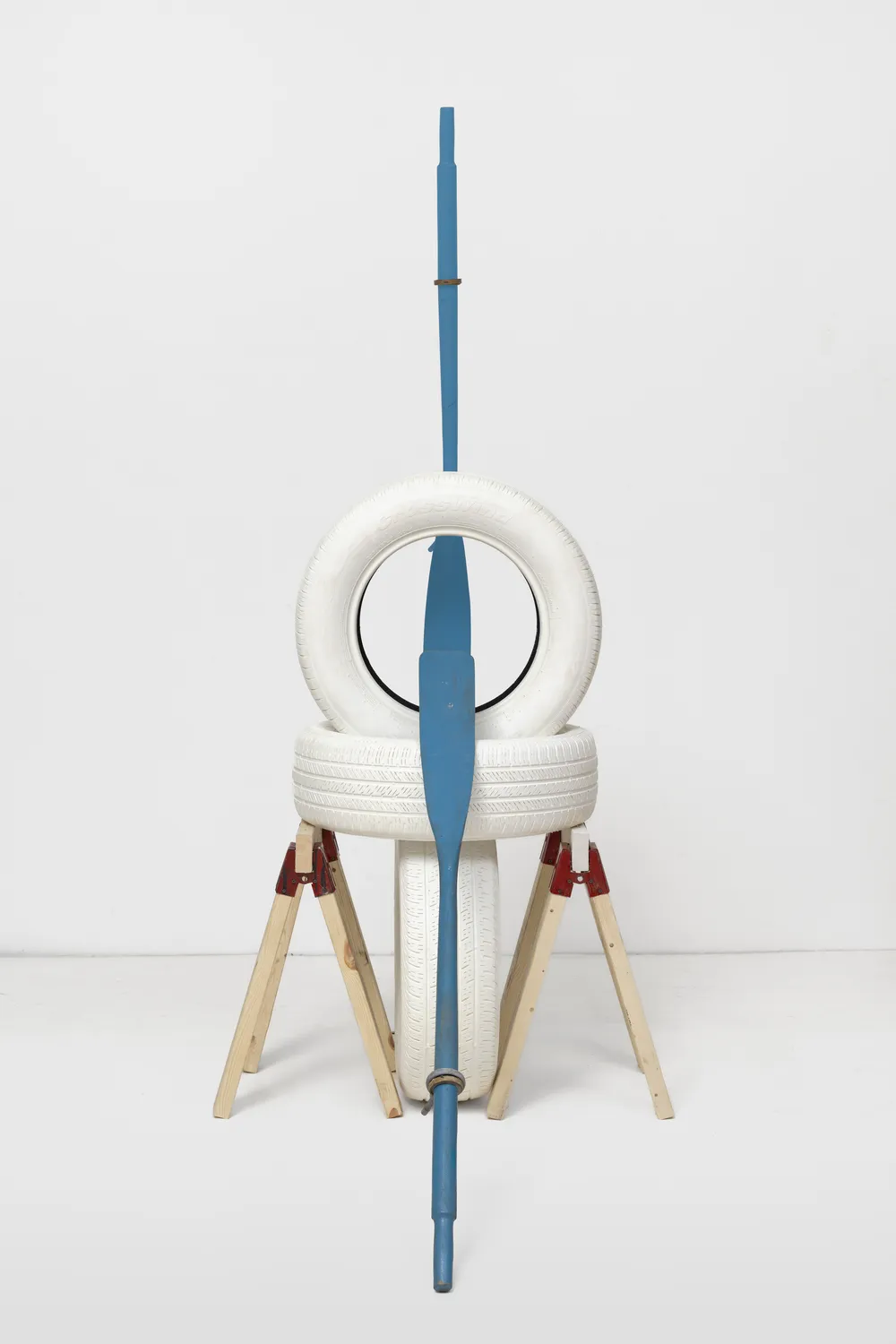
Infinity (2025/26) extends this logic into three dimensions. It is not an assemblage; it is a test of how preexisting geometries interact when brought into relation. Painted tires, vintage oars, saddle horses, and bricks each arrive with their own structural logic—circular tension in the tires, directional thrust in the oars, load-bearing geometry in the saddle horses. Rockburne does not fabricate these forms. They come embedded in the materials themselves. As the elements are brought together, a spatial system emerges from relationships never originally intended to produce one.
Across the exhibition, what appears is not a sequence of stylistic phases but a sustained investigation that the most recent works make fully legible for the first time. From the measured sequences of 2, 4, 6, 8 to the proportional tensions of the Golden Section Paintings, from the translucent vellum works to the revealed geometries of the Brown Paperbag Drawings, each body of work explores how structure already present in the world can become perceptible through painting.
Rockburne has described wanting to make work so beautiful it hurts. Beauty for her is not decoration but the signal that relationships have come into balance—that the structure time has embedded in matter has become visible. In the Brown Paperbag Drawings and in Infinity, that signal arrives quietly and completely. The artist withdraws. The material’s own geometry emerges. Time measures itself.
Dorothea Rockburne’s work investigates how structure emerges through material rather than being imposed upon it.
Early works such as 2, 4, 6, 8 (1969–70) and the Golden Section Paintings explore proportional systems derived from mathematics, allowing geometry to unfold through gravity, sequence, and surface rather than through diagrammatic construction.
In the Brown Paperbag Drawings (2025), this logic reverses. Ordinary grocery bags carry creases, seams, and folds produced through everyday use. Once opened and repositioned, those marks reveal a latent geometry already embedded in the material.
Across five decades of work, Rockburne’s practice suggests that relational order is not something the artist invents but something time leaves behind in matter. Painting becomes a way of making that hidden structure visible.
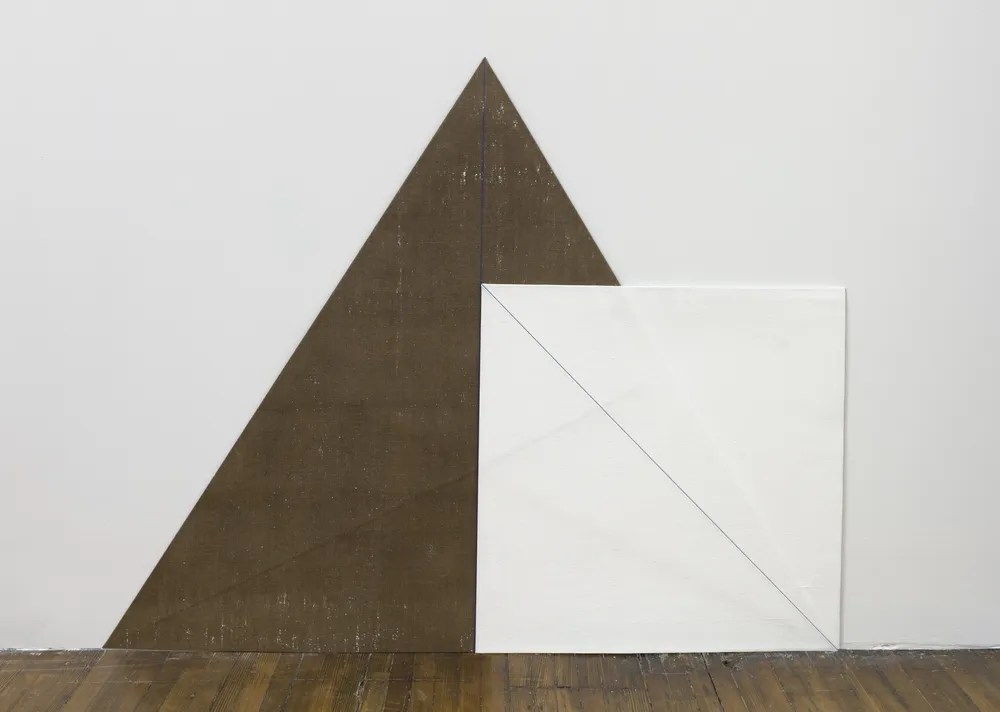


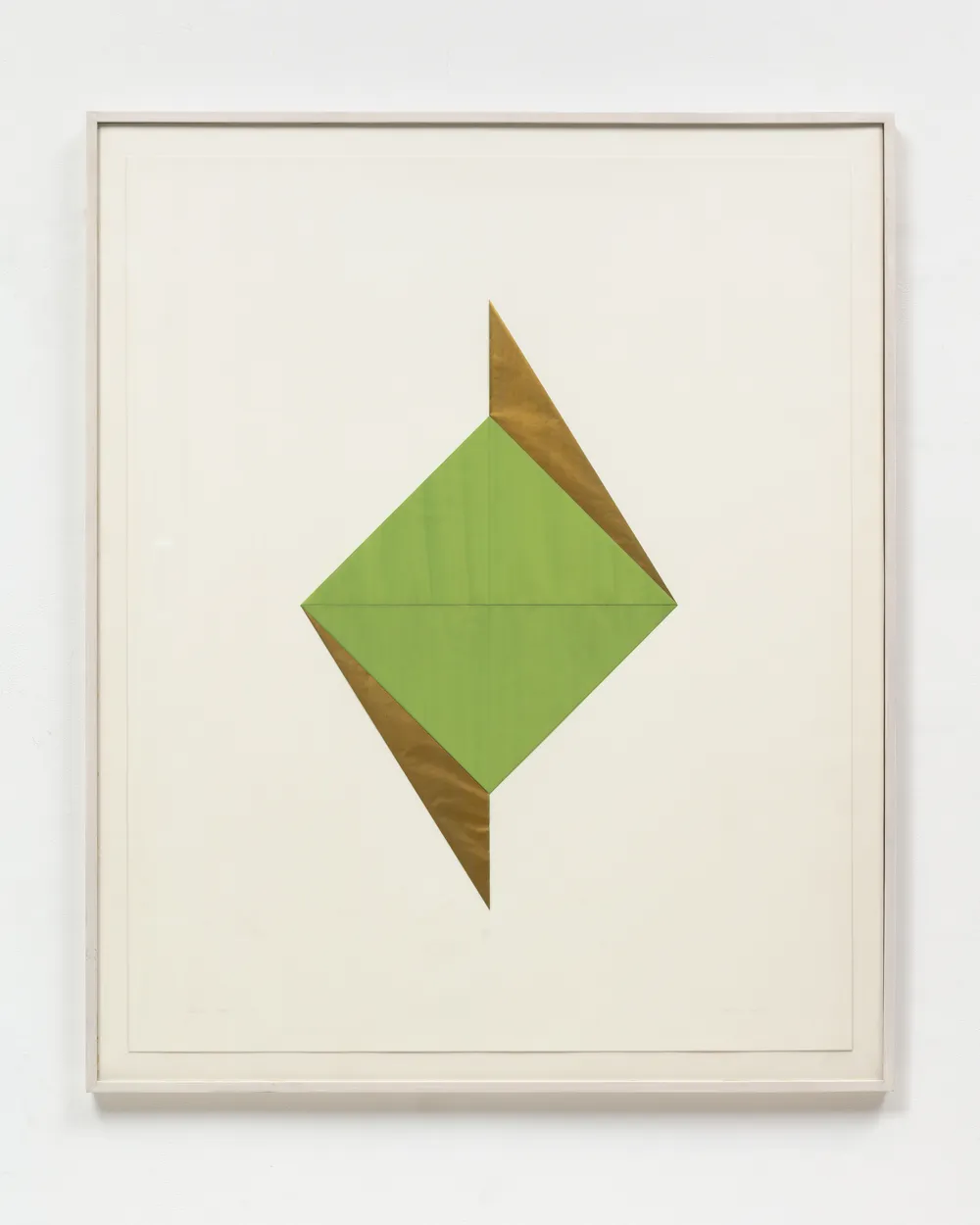
1. Dorothea Rockburne, Golden Section Painting: Triangle, Square, 1974. Chalk, varnish, and gesso on linen, 54 1/2 × 67 in (138.4 × 170.2 cm). Artwork © Dorothea Rockburne. Courtesy David Nolan Gallery, New York.
2. Installation view: Dorothea Rockburne, Time Measures Itself, David Nolan Gallery, New York, February 25 – April 18, 2026. Artwork © Dorothea Rockburne. Courtesy David Nolan Gallery.
3. Dorothea Rockburne, Brown Paperbag Drawing #4, 2025. Brown paper bags on paper, 22 3/4 × 30 in (57.8 × 76.2 cm). Artwork © Dorothea Rockburne. Courtesy David Nolan Gallery.
4. Dorothea Rockburne, Brown Paperbag Drawing #2, 2025. Brown paper bags on paper, 22 3/4 × 30 in (57.8 × 76.2 cm). Artwork © Dorothea Rockburne. Courtesy David Nolan Gallery.
5. Installation view: Dorothea Rockburne, Time Measures Itself, David Nolan Gallery, New York, February 25 – April 18, 2026. Artwork © Dorothea Rockburne. Courtesy David Nolan Gallery.
6. Dorothea Rockburne, Brown Paperbag Drawing #3, 2025. Brown paper bags on paper, 22 3/4 × 30 in (57.8 × 76.2 cm). Artwork © Dorothea Rockburne. Courtesy David Nolan Gallery.
7. Dorothea Rockburne, Golden Section Painting: Square Separated by Parallelogram with Diamond, 1974–76. Chalk, varnish, and gesso on linen, 64 1/8 × 104 1/2 in (162.9 × 265.4 cm). Artwork © Dorothea Rockburne. Courtesy David Nolan Gallery.
8. Installation view: Dorothea Rockburne, Time Measures Itself, David Nolan Gallery, New York, February 25 – April 18, 2026. Artwork © Dorothea Rockburne. Courtesy David Nolan Gallery.
9. Dorothea Rockburne, 2, 4, 6, 8, 1969/70. Graphite on brown paper, 96 × 72 in (243.8 × 182.9 cm). Artwork © Dorothea Rockburne. Courtesy David Nolan Gallery.
10. Detail: Dorothea Rockburne, 2, 4, 6, 8, 1969/70. Graphite on brown paper, 96 × 72 in (243.8 × 182.9 cm). Artwork © Dorothea Rockburne. Courtesy David Nolan Gallery.
11. Dorothea Rockburne, Musician Angel: Parallelogram, Diamond, 1979–81. Watercolor on vellum, 56 1/8 × 48 1/8 in (142.6 × 122.2 cm). Artwork © Dorothea Rockburne. Courtesy David Nolan Gallery.
12. Dorothea Rockburne, Study for Discourse, 1978. Colored pencil on vellum, 34 1/2 × 44 1/2 in (87.6 × 113 cm). Artwork © Dorothea Rockburne. Courtesy David Nolan Gallery.
13. Installation view: Dorothea Rockburne, Time Measures Itself, David Nolan Gallery, New York, February 25 – April 18, 2026. Artwork © Dorothea Rockburne. Courtesy David Nolan Gallery.
14. Dorothea Rockburne, Infinity, 2025–26. Vintage oars, painted tires, saddle horses, wood, and bricks, 93 × 40 1/2 × 60 in (236.2 × 102.9 × 152.4 cm). Artwork © Dorothea Rockburne. Courtesy David Nolan Gallery.
Cover: Dorothea Rockburne, Golden Section Painting: Triangle, Square, 1974. Chalk, varnish, and gesso on linen, 54 1/2 × 67 in (138.4 × 170.2 cm). Artwork © Dorothea Rockburne. Courtesy David Nolan Gallery, New York.
All images © their respective rights holders.
Image rights & attribution →