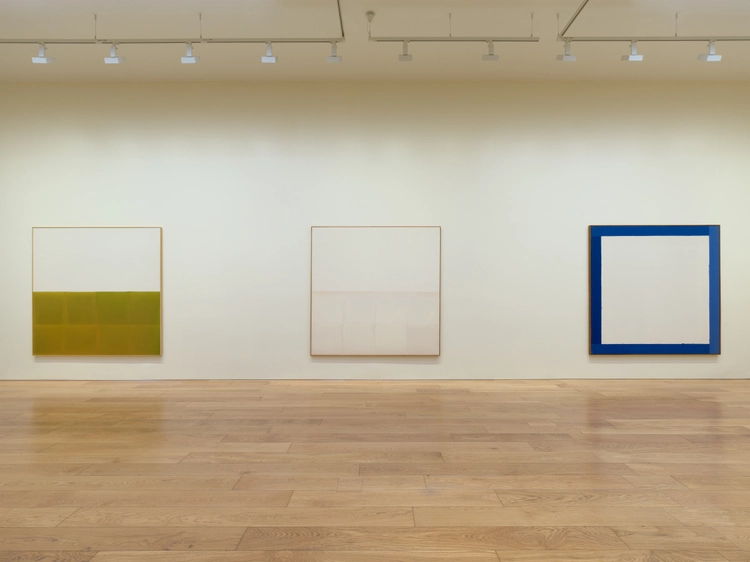
James Bishop’s work operates through restraint as a governing structure rather than a stylistic choice. His paintings are built from muted chromatic fields and finely calibrated tonal shifts that resist resolution, emphasis, or compositional hierarchy. Color does not function as expression, but as a measured condition—held in balance through proportion, interval, and edge pressure.
Across Bishop’s practice, difference emerges incrementally. Slight adjustments in tone, density, and surface relationship register over time rather than immediately, requiring sustained attention rather than recognition. The paintings do not direct the viewer’s gaze or announce internal divisions; instead, they hold a continuous field in which presence and withdrawal coexist. What appears minimal is, in fact, highly regulated—each surface stabilized through decisions that limit variation while allowing tension to persist.
Bishop’s abstraction demonstrates how structure can remain active without assertion. His paintings sustain intensity through reduction, maintaining coherence through understatement rather than contrast or gesture. In doing so, the work proposes a model of abstraction where duration, calibration, and quiet modulation become the primary means by which form holds.
James Bishop was an American abstract painter known for his restrained use of color, subtle tonal modulation, and sustained surface tension. Working primarily with reduced chromatic fields, Bishop developed a practice in which difference emerges through proportion and incremental variation rather than contrast or gesture. His paintings resist compositional hierarchy and expressive emphasis, instead maintaining equilibrium through finely calibrated shifts in tone and density. Often associated with post-Minimal and reductive abstraction, Bishop’s work occupies a distinct position defined by understatement, duration, and structural restraint. His paintings demonstrate how abstraction can sustain intensity and coherence through reduction, allowing color and surface to function as systems of quiet regulation rather than expressive display.