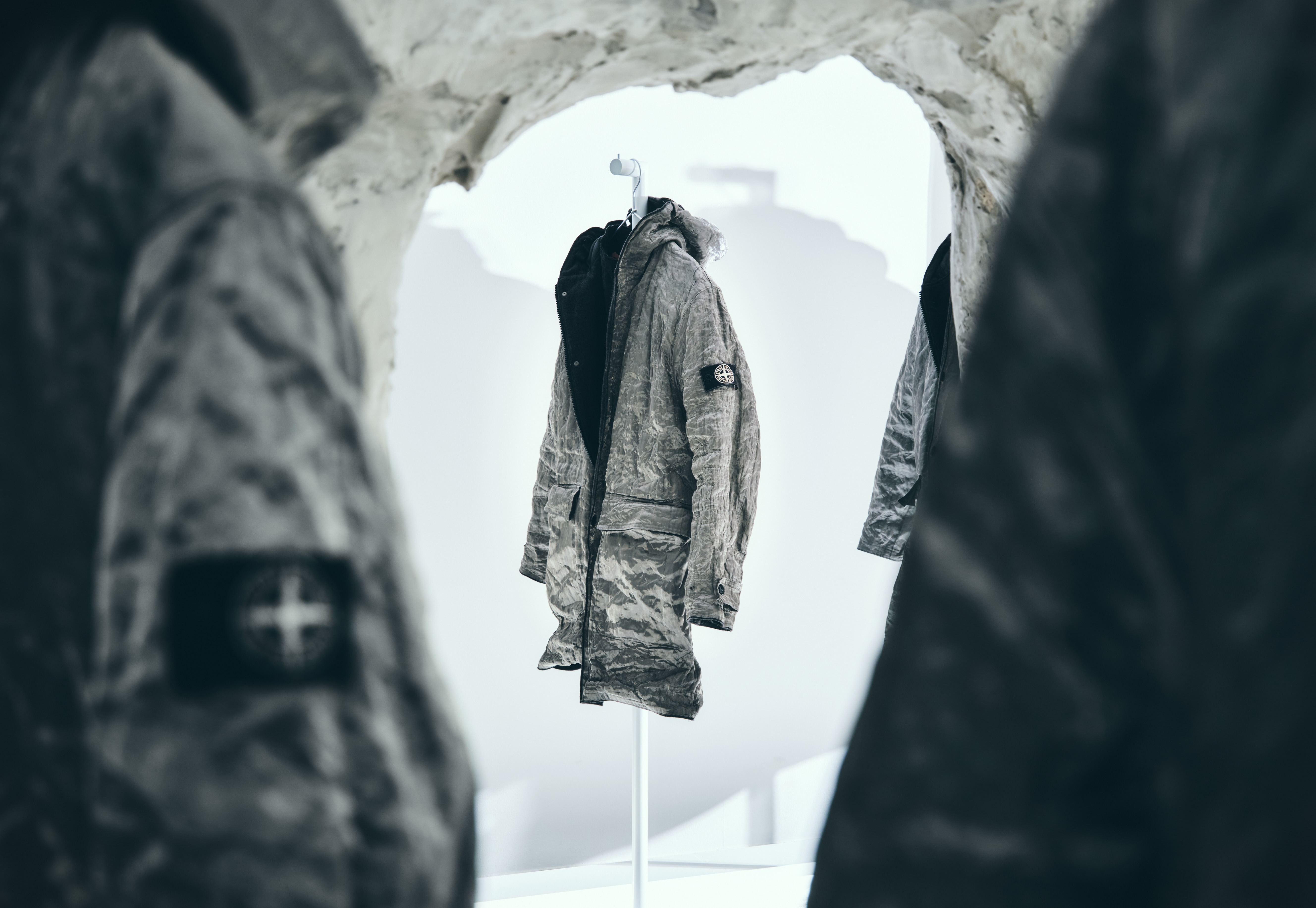
The hand goes where it always goes and finds nothing there. An ordinary jacket has stopped being enough; the garment has moved the object somewhere else. Retrieval happens by drop instead of search. Removal no longer means taking the jacket off and setting it down; the shell swings to the shoulder and remains in the body's orbit, still active, still available. Nothing dramatic has happened. A small sequence has changed. Then another. After enough repetition, the body stops noticing the shift. Everything that still asks to be used the old way begins to stand out.
The garment doing this belongs to ACRONYM, and ACRONYM was built by Errolson Hugh, who did not come to clothing through fashion. Trained in industrial design, he founded the studio in 1994 with Michaela Sachenbacher — not as a label but as a design agency, building garments and systems for other companies for eight years before putting its own name on anything. When the first ACRONYM collection appeared in 2002, it carried the agency's assumptions rather than fashion's: the garment as a solved problem, the collection as a system release, no show, no seasons in the fashion sense, no explanation.
The image world around ACRONYM is real: the tactical fantasy, the permanently ready body, the jacket that seems to belong in a game before it belongs on anyone. But the games are not outside evidence. When the garments crossed into Deus Ex and Death Stranding, Hugh helped design the crossings. They show less that an image was borrowed than that the system could be translated into worlds built around readiness, inventory, loadout, and transition. The fantasy and the function came from the same process.
The J1A is where the system announces itself. In the demonstration video that introduced the J1A-GT, Hugh walks the garment through its sequences: not a better shell but a garment conceived around deployment, transition, and return — a sortie system, in the sense the sequences themselves propose. A jacket with features still belongs to the ordinary contract of clothing: it goes on, it keeps out what it keeps out, it carries what it carries. The J1A asks more, and its mechanisms have names. Gravity Pocket. JacketSling. EscapeZip. These names are not branding laid over function; they are the grammar of the garment's sequence. Each names a change in action: retrieval, suspension, exit. Ownership is not enough. The garment has to be learned.
The learning takes months, and it does not feel like learning. The hand goes first to where it used to go. Nothing is there. Retrieval shifts. The phone drops into the hand by gravity instead of being searched for. The jacket moves to the shoulder instead of being put down. Repetition flattens the novelty, and then one day the direction of strangeness reverses: going back becomes the strange part. Ordinary jackets start to feel slightly broken — too slow, too passive, still asking the body to search where it has learned only to respond.
Most of the garments are black, and when they are not — the RAF greens, the olives — the surfaces stay just as blank. The blankness is easy to misread as severity, as uniform, as the costume of the fantasy. It is doing something else. The surface gives the eye almost nothing to resolve, so that what surfaces instead is use: the hand reaching, the body turning, the shell becoming a sling, the pocket delivering by gravity. Operation becomes the visible layer, because nothing else is competing for the eye.
Live with more than one of the garments and a further thing comes into view. The operational units recur. The J101-GT is a different silhouette, not a variation on the J1A, and it carries JacketSling, AuxZip, EscapeZip, and Interops — suspension, rapid release, modular attachment, and variable access turning up again in a body cut for other purposes, the way a standard section moves through different structures. The recurrence is not that every piece carries the same hardware; it is that the same operational logic — suspend, release, attach, vary the access — is composed again from the catalogue's named parts. What at first looked like a wardrobe reveals itself as an inventory of elements. The pieces are not singular. The unit comes before the object, and the object is one state of the unit.
At the edge of that inventory sits a garment that asks the body for less. The J97 falls between shirt and jacket, and it keeps a removable JacketSling — but not the fuller retrieval, release, and interoperability sequence that runs through the J1A. The protocol does not disappear here; it relaxes. Not every ACRONYM garment demands the same months of relearning.
None of this became the public language of ACRONYM, because the public language formed around what could be photographed.
A product image can show the black shell, the pocket, the zip, the sling, the hardware. A specification sheet can list the membrane, the taped seam, the articulation, the storage. A fit photograph can show the wearer inside the silhouette. These are not false readings. They are simply the parts of the garment that survive circulation.
What does not survive is the relearning. No image can show the months in which a hand stops searching and begins responding. No product page can show the moment another jacket starts to feel too slow. The work's deepest operation takes place after purchase, after wear, after repetition — inside one body, over time.
So the category formed around the visible layer. Techwear named the feature because the feature was what the camera could carry. It named hardware, blackness, weather, performance, utility. It missed the sequence. It missed the body being retrained. It missed the garment becoming itself after it had already been bought. A garment built to suppress visual incident so that use can surface is the worst possible subject for an economy that circulates images — and the category won anyway. The category arrived through a camera, and the camera stopped at the object.
The proof is the copies. Feature-for-feature imitations of these garments exist at a tenth of the price — garments assembled directly from the category's vocabulary, the spec sheet made cloth. If the filing were correct, the copy would be the same garment; the listed features match. Every wearer knows it is not, and the category cannot say why. What the copy reproduces is the portable layer — specification, silhouette, hardware, naming, image — and what it cannot reproduce is the thing the category has no word for. The copy is the cheap proof of a boundary: the visible vocabulary crosses for a tenth of the money, and the sequence does not cross at all.
The first-week photograph runs the same failure from the other side. The garment is worn for the image at the moment when it is least itself. It has not yet altered the body. The hand has not relearned. The sequence has not settled. The image records ownership before operation — the garment in the state before it becomes itself.
The desire underneath the category is real, and it deserves better than its photograph. Equipment, readiness, competence — the wish for objects that do more than appear. The category sells that desire its own image back. The people inside the desire are not the error. The filing is.
A copy is the cheap case. It proves the visible vocabulary can travel for almost nothing, and it can be dismissed exactly because it is a copy — a leaking jacket wearing the spec sheet. The harder question is what happens when the transfer is authorized, technically fluent, and made between two practices that understand one another. If the boundary the copy exposed is real, it should hold there too — where nothing can be blamed on bad faith or cheap manufacture, and the partner is as serious as the maker.
That case exists, and it has already been run. From 2008, Hugh designed Shadow Project — ACRONYM's long collaboration with Stone Island, the Italian company whose own history sits deep inside technical clothing. The collaboration was serious, sustained, and mutually fluent, and Stone Island's garments are, by any measure, supremely good equipment. What crossed the table was a method of composition. Both practices build garments as modular systems — named, interoperable elements assembled into a grid — and Shadow Project built its own: its documented categories run PROOF, RESIST, AUGMENT, a vocabulary and a grid of its own making, not a set of terms borrowed from the other house. ACRONYM's proprietary mechanism names do not appear in Shadow Project's language. What crossed was the way of organizing a garment as composable, named parts, and the pieces looked, immediately and correctly, like the meeting of the two houses. By every sign the category can read, the transfer succeeded.
The garments themselves show what did not cross. The specific sequence system described in this essay — JacketSling, Gravity Pocket, EscapeZip, the interoperable access that reorders how a hand reaches and a body turns — did not cross as a complete protocol. Shadow Project developed real technical intelligence: its own materials, its own dye and finish research, its own grid. What it did not receive was the layer that only appears through months of use — the retrained hand, the recurring bodily sequence a wearer has to construct for itself.
So the crossing sorts into three layers, not two. The copy carried the signs — specification, silhouette, hardware, image — for a tenth of the money. The collaboration carried more: a modular system of composition, a grid of named parts, across the table to a serious partner. Neither carried the completed bodily sequence. That is the layer the camera cannot reach, the copy cannot assemble, and even an authorized, fluent collaboration does not receive — because it is not a sign or a system but a thing a body has to build for itself, over months, in use.
One objection is worth closing, because every serious tool retrains its user — a knife, a camera, a climbing harness. But generic habituation predicts relearning, not this relearning. The claim here is not that ACRONYM alone changes a body's habits; it is that its named mechanisms compose a recurring, deliberately engineered sequence across distinct garments — the recurrence J101-GT shows and J97 bounds — and that this particular sequence cannot be inferred from quality alone.
In 1967, in Frankfurt and Offenbach, Charlotte Posenenske began fabricating sculpture from standard sheet steel and cardboard — square tubes, produced industrially, in series without limit. She had trained in Stuttgart under Willi Baumeister and spent her twenties in stage design, and the stage never quite left the work: space was something bodies acted inside, built for use rather than contemplation. The Vierkantrohre were delivered not as finished sculptures but as elements — standard sections the owner, not the artist, assembled into whatever configuration the space and the occasion required. Museums that show the work today rebuild it differently each time. That is not a curatorial liberty. It is the instruction. The sculpture is not waiting for one correct arrangement. A straight run, an elbow, a passage, a stack, a corner condition — each is a valid state of the same work.
Her work was filed by the same operation. The galvanized surfaces, the hard geometry, the industrial finish — the tubes were taken for minimalism, surface as purity, the factory as an aesthetic position. The reading treated the withholding as a look, because the look was what circulated. What the tubes actually proposed was that the maker's work could end at the element, and that the form the elements took was someone else's decision, made later, elsewhere, without her.
In 1968 she published a short statement in Art International. The works, she wrote, were made in series — not variations on an original but standard elements, like products; she priced them at fabrication cost, and she left their arrangement to the owner. The statement said out loud what the tubes had been proposing all along: her authority ended at the element. Configuration, placement, meaning — the finished state — belonged to whoever came after. The same year, she stopped. She left art entirely and spent the rest of her life as a sociologist, studying industrial labor. The work continued to be rebuilt, differently each time, without her, exactly as designed.
The jacket does not make that decision. Hugh hands over nothing at the level of design. The garment arrives overdetermined — every pocket ordered, every sequence engineered, more decided at the point of delivery than almost any garment in production. Posenenske transfers configuration; ACRONYM transfers protocol. One work becomes sculpture when its elements are arranged elsewhere. The other becomes fully operative only when a body learns its sequences. The relearning is not a side effect. It is the second completion. The garment is finished in the pattern room, then completed again by the body that learns it — past the maker, in use, over months, in ways no specification anticipated. The finished state belonged elsewhere.
The change announces itself only when another jacket is worn. The hand searches again. The object does not arrive. The body feels the delay as a fault. The months of relearning were never a warm-up; they were the work arriving — the part of the garment no image recorded and no category could name, and the part its wearer owns most completely, having made it.
And the months were priced. Posenenske set the handover at fabrication cost and left the configuration to anyone with the elements. ACRONYM rations it — the drop, the sellout, the resale premium, the price of admission to the months themselves. Two practices located the work past the object. They made opposite decisions about who would be allowed to reach it.
The design was the maker's. The completion was the body's. The permission was priced.