

The runway was smaller than the world around it.
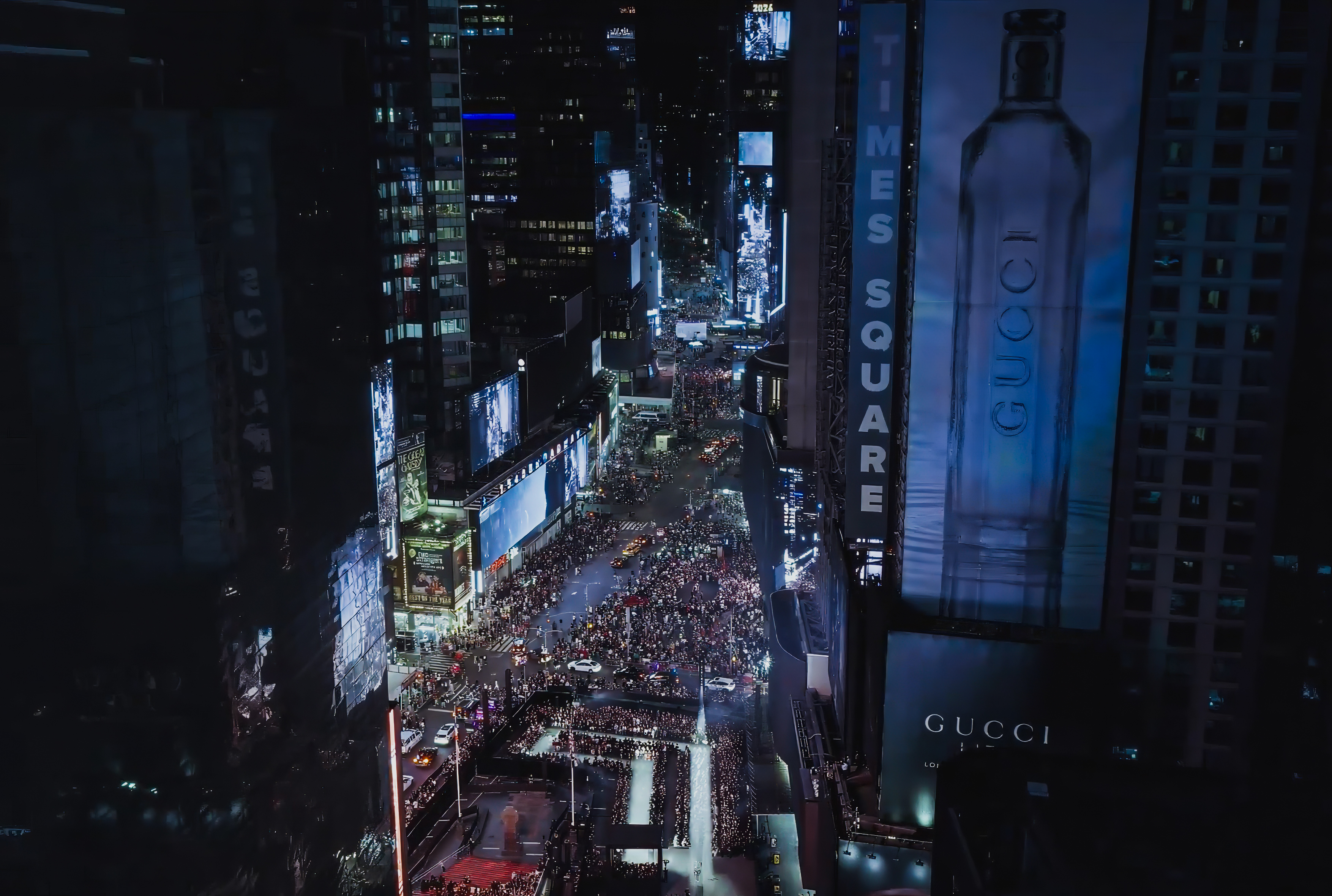
From above, Times Square looked the way it usually looks at night — a basin of light shaped by Samsung, Gucci, Wicked, Little Shop of Horrors, the brand-fields rearranging themselves across the screens. Through that basin, a black corridor had been cut, narrow as a service road. Inside the corridor, rows of seated bodies. Outside it, the city continued: theater crowds, taxi traffic, the red staircase, the ordinary commerce of Seventh Avenue.
Above the corridor, Gucci rose in light. Gucci Acqua. Gucci Automobili. Palazzo Gucci. Gucci Life. Names for water, cars, hotels, longevity, high jewelry, lifestyle — a house expanded into forms the clothes had not yet earned. Some of them existed. Much of it did not. From the street, the difference barely mattered. The signs looked complete. The world looked available.
The guests sat between barricades, facing each other across the strip of pavement. Behind them, the Marriott Marquis. Above them, four stories of moving image. On one side, Hadestown glowed red. On another, Gatsby held its yellow light. None of it was the show. All of it was the show. The audience had been seated inside the advertisement of what they had already been told to want.
The screens had been doing the work for an hour before the first model appeared. Atmospheres. Aspirations. Lifestyles. Water you could swim in. Cars you could be driven in. A hotel you could sleep in. Jewelry, hospitality, longevity, the house extended into every register of a life. The world was finished. The clothes had not begun.
Then the first look entered.
A black suit, black shirt, black shoes. Hair falling across the face. A body narrowed into a vertical line under the screens. In the hand, a small red object — the only color, held low, bright enough to interrupt the discipline of the look. The clothes were quiet, but the setting would not let them be private. The suit moved through Times Square already watched, already enlarged, already caught between restraint and display.
This is where the screens stopped working. Not literally — they kept glowing, kept cycling through the names of the house. But their work had ended. What they could announce, they had announced. What they could not do — make a body in public feel worth watching, make an object on that body feel worth wanting — only the object itself could do.
Gucci has never been short of visibility. Its authority depends on something harder: an object, on a body, in public, making wanting visible without making it feel foolish.
Under the screens, the clothes had to begin that work.
Sixty-three models crossed the blackened pavement inside the walls of Times Square. The show notes named a social cast: stockbrokers in pinstripes, ladies who lunched in shearling, skaters in soft tailoring, socialites in gowns and pantsuits. The runway moved through public roles — suits, leather, fur, denim, evening, boots, logo bands, structured bags returning across looks. Demna called it a garment vocabulary. The phrase was exact because vocabulary is plural and usable. But a vocabulary only works when the words still name things.
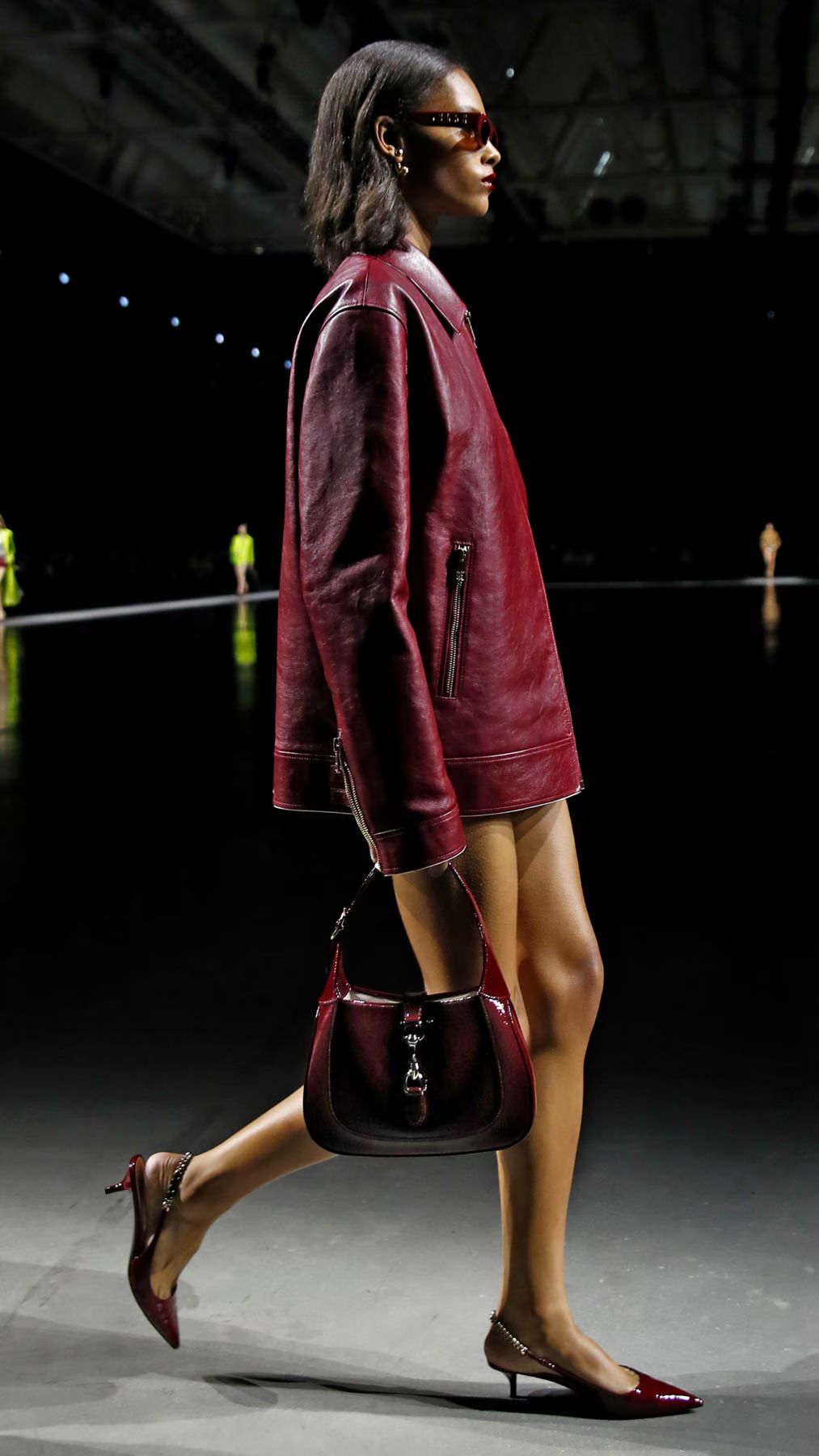
Another look made the tension more explicit. Grey leather, glossy under the screens. A brown fur coat heavy across the shoulders, draped rather than worn. Dark glasses removing the face as an easy point of entry. A structured bag held against the body. The leather hardened the figure into a slick vertical line; the fur brought back an older luxury signal, but as weight rather than comfort. The bag returned the look to Gucci’s public grammar: object, hand, surface, recognition. The tension sat on one body — Demna’s pressure around the figure, Gucci’s need for an object that could be wanted in public.
The show did not simply place spectacle against product. It placed spectacle first, then asked the clothes to make it credible.
Gucci does not need to be seen. Gucci has been seen for a decade. The brand climbed above ten billion euros in annual revenue in 2022, then fell sharply through 2024, with 2025 still marked by decline. The contraction happened while Gucci remained fully visible. Sabato De Sarno’s Ancora red drove a spike in burgundy search and almost no movement at the till. The signal traveled at the speed of the internet. The bag did not. No object became necessary enough to carry the signal.
Gucci is the house where wanting has to be seen.
Being seen wanting is not neutral. A luxury object carried in public does not only announce ownership. It exposes desire to judgment: too eager, too loud, too new, too costumed, too obviously bought in order to be seen. Gucci’s strongest objects have historically managed that risk. They did not make wanting private. They gave public wanting a form that could be read as style, confidence, inheritance, glamour, ease. The Bamboo bag, the Jackie, the Horsebit loafer, the Ford shirt and belt did not hide desire. They licensed it. They made it possible to want visibly without appearing foolish for wanting to be recognized.
This has been Gucci’s operating structure for decades. The Bamboo bag did not become Gucci only because it was made. It became Gucci through the bodies that carried it into public recognition. The Jackie did not gain force through withdrawal; it became legible because Onassis carried it through enough photographs to alter the noun. The Horsebit loafer gathered its authority through public wear, through Kennedy, Gable, Grant, and the long repetition of a shoe recognized because it had already entered the visible life of men who were watched. The Gucci object does not enter circulation when it is made. It enters circulation when someone is seen wanting it.
Scarcity can make an object harder to get. It cannot, by itself, make the object worth being seen wanting. Hermès clarifies the difference. Its mythology gathers around acquisition: the wait, the relationship, the allocation, the fact that access itself becomes part of the object’s meaning. The object can withdraw because withdrawal is already the drama. Gucci works differently. Its mythology gathers around display: the photograph, the body, the public use, the moment when someone is seen wanting the object and the object becomes legible through that wanting.
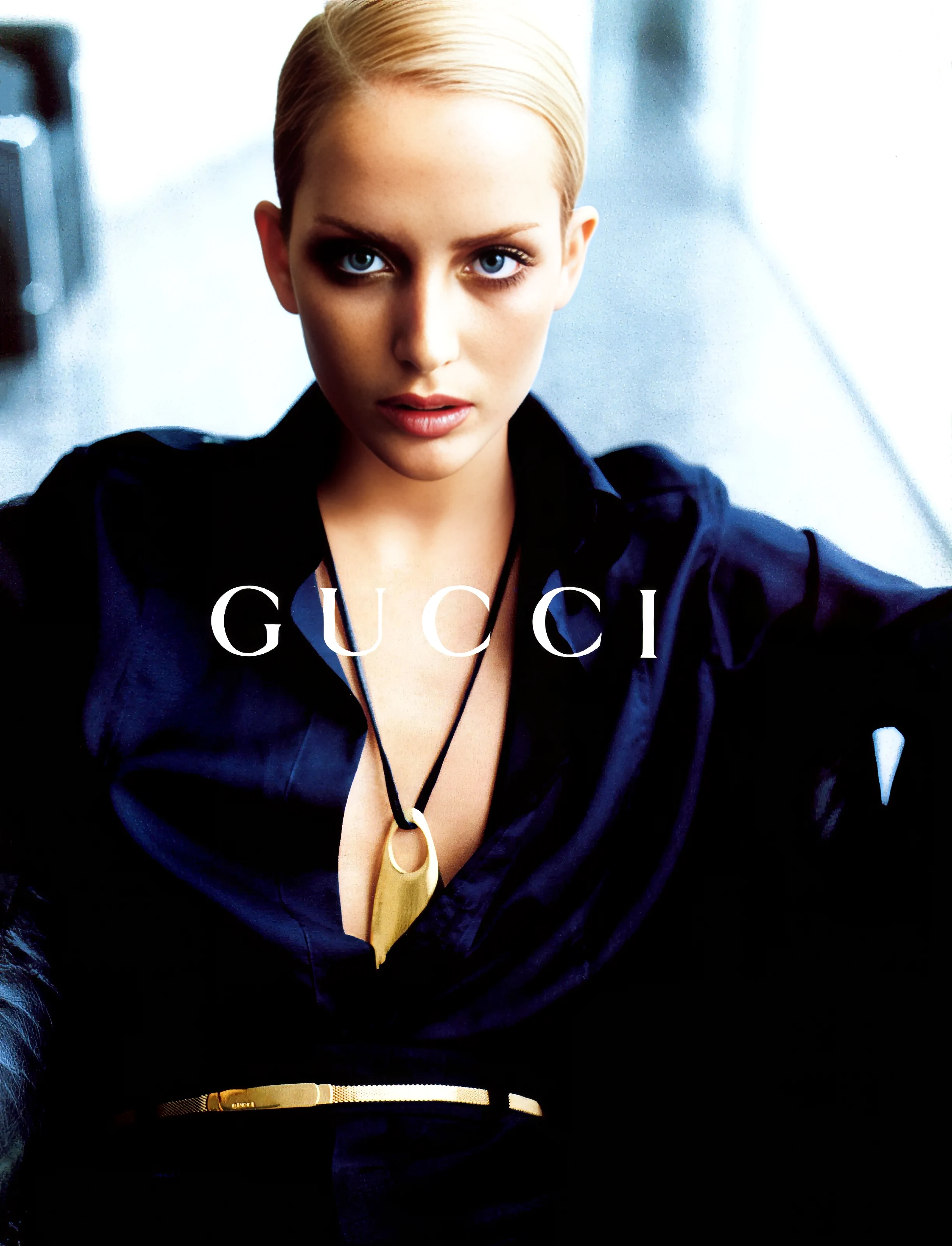
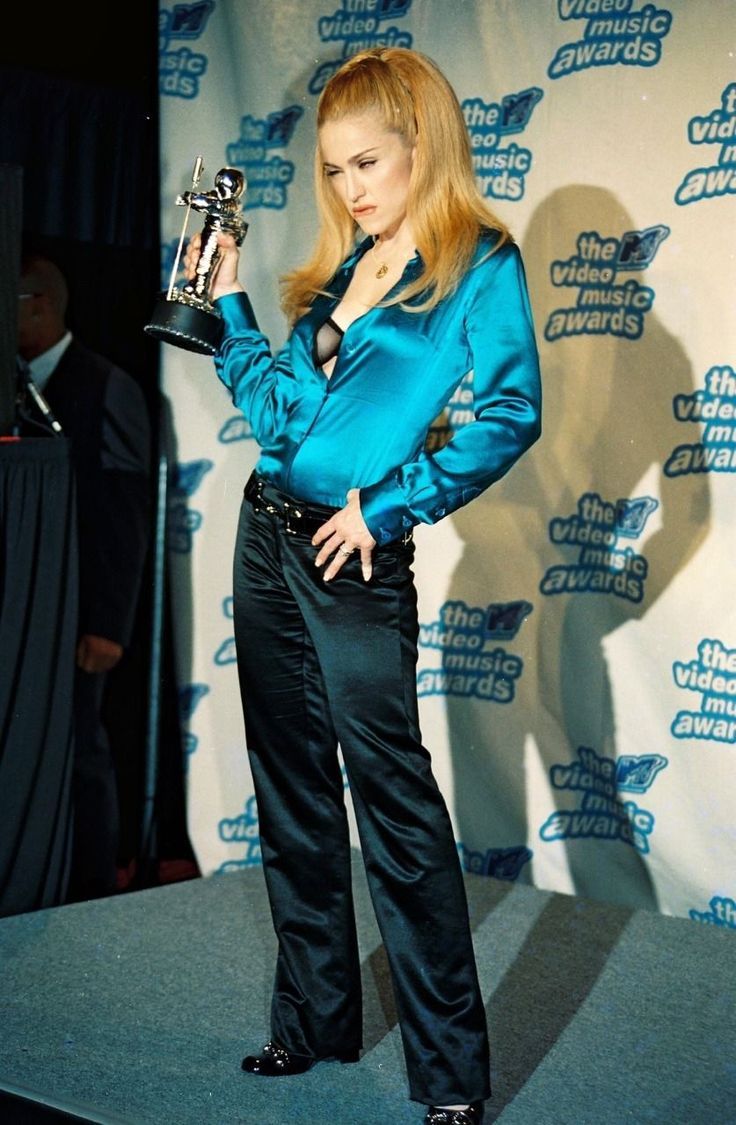
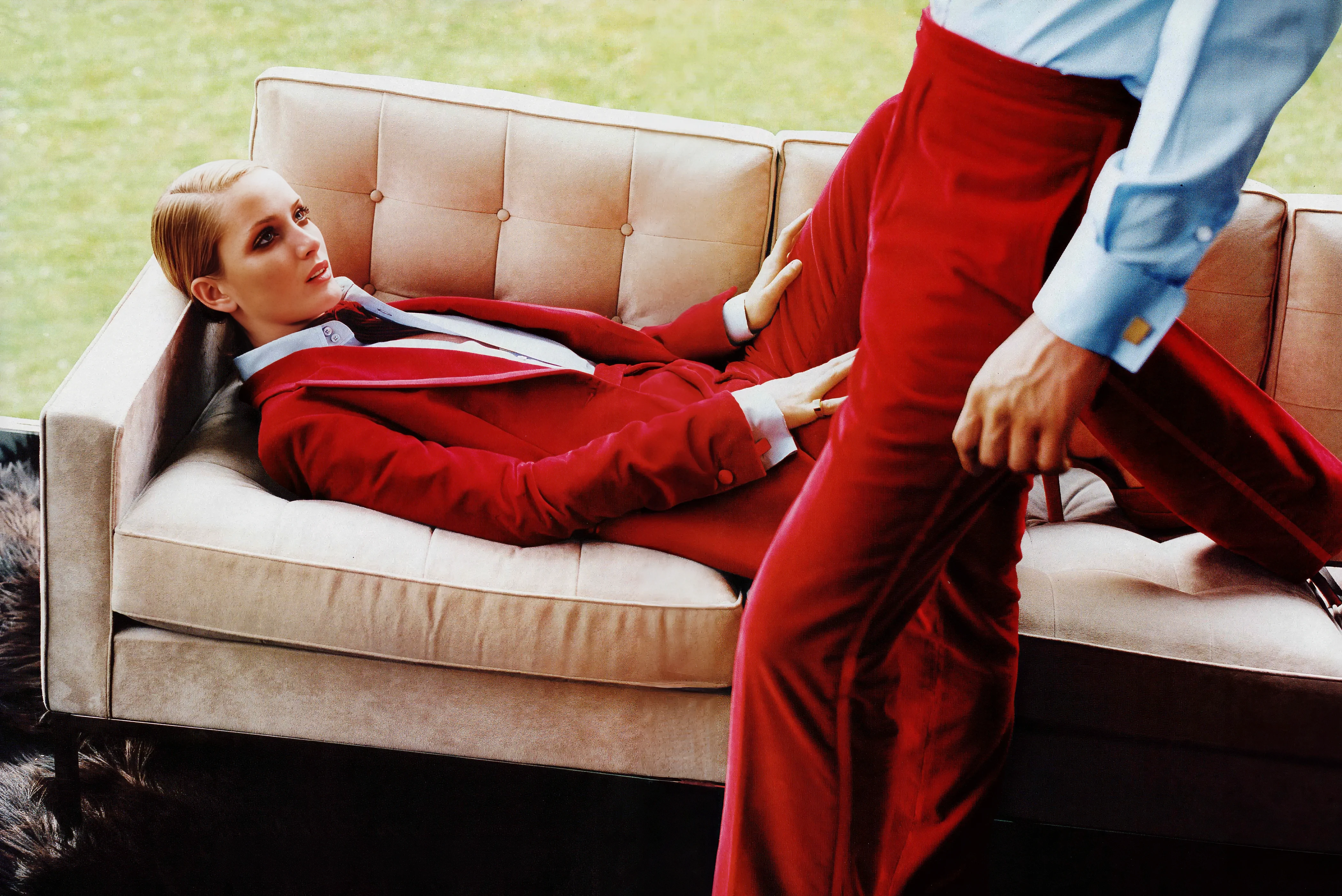
Tom Ford understood this. Madonna at the 1995 MTV Video Music Awards in the Fall 1995 satin shirt and horsebit belt was the house’s revival becoming public: a body visibly wanting, and a wardrobe behind it for that wanting to attach to — trouser, shirt, loafer, belt, bag.
Michele worked the same law from the opposite side: the archive ransacked into a single look, print over print, the Princetown loafer in fur, gender held open as structural feature. A wardrobe legible from across the room, and for years legibility was the engine. But saturation runs into its limit faster than restraint runs into its own. By 2022 the customer had read the Michele Gucci enough times to stop wanting to be seen reading it.
Sabato came in after, with quiet sensuality and Italian craft — Ford’s outline without Ford’s voltage. Restraint at Gucci does not stabilize the house; it deactivates it. There is no Hermès-shaped customer waiting underneath, no quiet-luxury chassis behind the noise. Ancora red traveled. The bag, the loafer, the coat that should have carried the color into store traffic did not. Sabato produced a color. The color was not a wardrobe.
Demna arrives after both lessons are visible: restraint cannot stabilize Gucci, and Balenciaga’s wrongness cannot simply be moved into the house.
Balenciaga had allowed him to run two engines at once. One was wrongness: the leather copy of the IKEA Frakta bag, the Triple S, the destroyed sneaker, the bog-mud show, the garbage-bag pochette. The other was desire: the Hourglass, the Le City revival, the Rodeo campaign, the late tailoring, the return of couture through Cristóbal’s cocoons, chemises, and architectural shoulders. Inside Balenciaga, the wrongness made the noise and the desire made the money.
Demna’s first Gucci moves have been an attempt to assemble the body that could activate the house again. La Famiglia, in September 2025, began with character before clothes: thirty-seven archetypes in framed portraits, Gucci understood first as a social cast. Generation Gucci moved into the archive, not as nostalgia but as research into the last conditions under which the house had been wanted. Primavera brought the question back to the body: a black coat opened over leather, a GG belt fixing the waist, a small bag held close, pointed shoes turning the body into a hard line rather than a soft image. By Times Square, the question had moved outward. The body had been proposed; now the object had to enter public life.
Tom Brady walked the show in black leather: a belted biker jacket, matching leather trousers, black boots, the surface catching the Times Square light in hard flashes. A former NFL quarterback photographed across thirty years inside the most witnessed sport in America moved through Times Square wearing a proposition that could not be read as ironic and could not be read as private. Wanting was the content of the look. The leather had to be wanted, and Brady had to be visibly wanting it, for the gesture to count as Gucci. But even that remains an image until the leather, the bag, or the shoe can leave the runway and enter someone else’s public life.
The screens were persuasive. The casting was built to circulate. The runway moved through public roles with the confidence of a designer trained by archetypes. All of that belonged to Saturday: the test of whether Gucci could still produce visibility at scale. Sunday asked something else. The strength of the first test could not answer for the second.
On Sunday morning, the day after Brady walked, Gucci opened a New York capsule across five Manhattan points of sale — small leather goods, shoes, jewelry, handbags — and redecorated the Fifth Avenue and Wooster Street flagships to the Cruise aesthetic. The invitations were brass keys in aged leather sleeves, a callback to the gilded ones that, in the eighties, opened Gucci’s Galleria above the Fifth Avenue store. The capsule’s keys were ordinary. They were the front door.
The Sunday opening asked actual customers to convert the world on the screens into a thing they would carry home in a paper bag past the doormen, past the photographers, past the line of people who had come to look and not buy.
The runway image can only take the question so far. The object has to be tested in public life: whether the bag walked out on Sunday, whose arm it was on, and whether the person carrying it wanted to be seen carrying it. The billboards had performed Gucci’s hardest argument — that the house could still be a world. The shelves had to perform the colder one: that the world could survive as an object in public.
That is Gucci’s exposure. Hermès can withdraw into access. Balenciaga could survive through wrongness. Quiet luxury can disappear into a customer who does not need to be seen. Gucci has no such retreat. Its desire was never private enough to hide. It has to become visible on a body, in public, without collapsing into costume, signal, or joke.
Demna has staged the world. The object now has to survive the street.
Gucci cannot borrow quiet, borrow wrongness, or withdraw into scarcity. Its objects have to make public wanting feel desirable again: a bag, shoe, coat, or body becoming wanted because someone is willing to be seen wanting it.





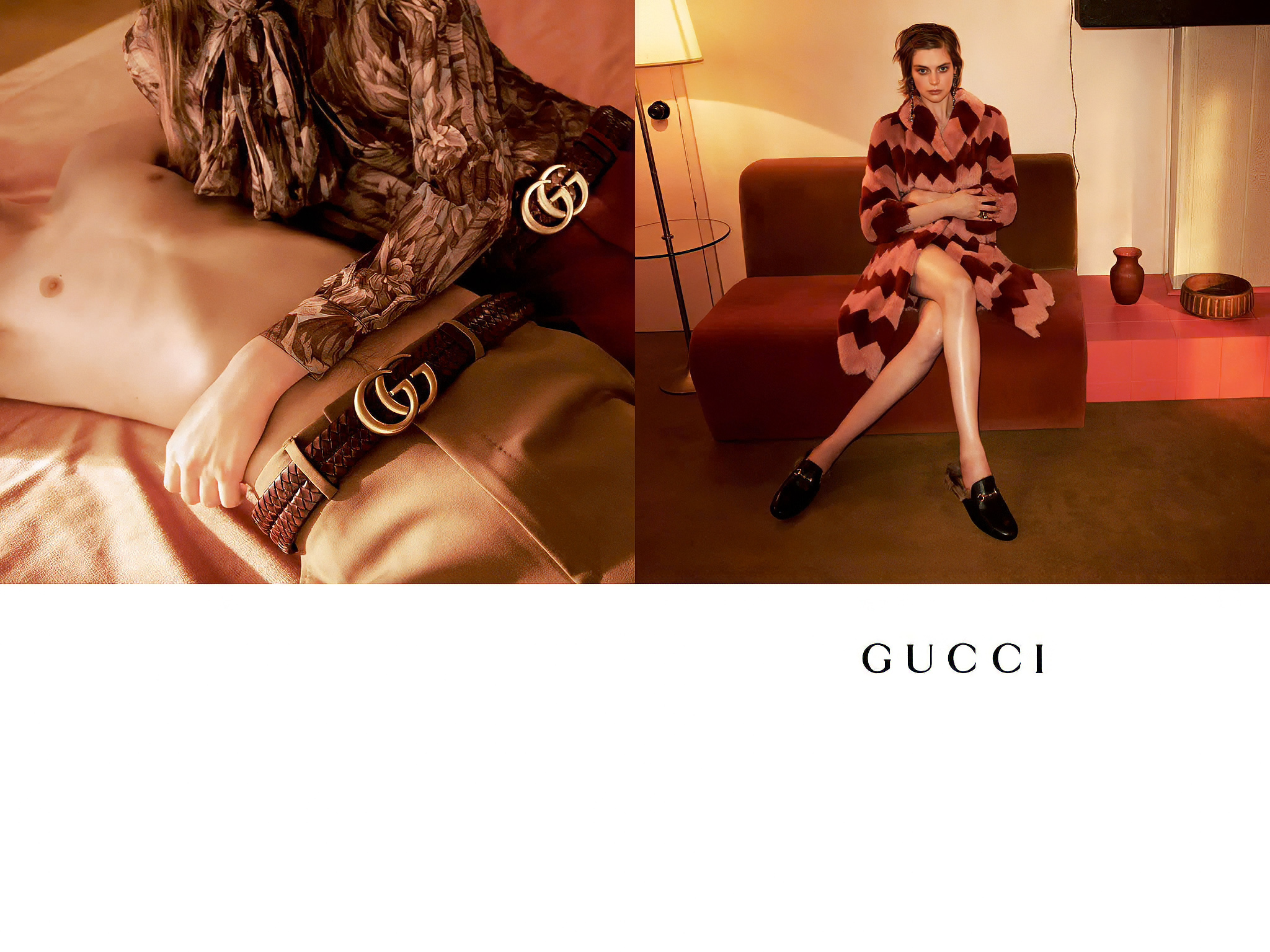
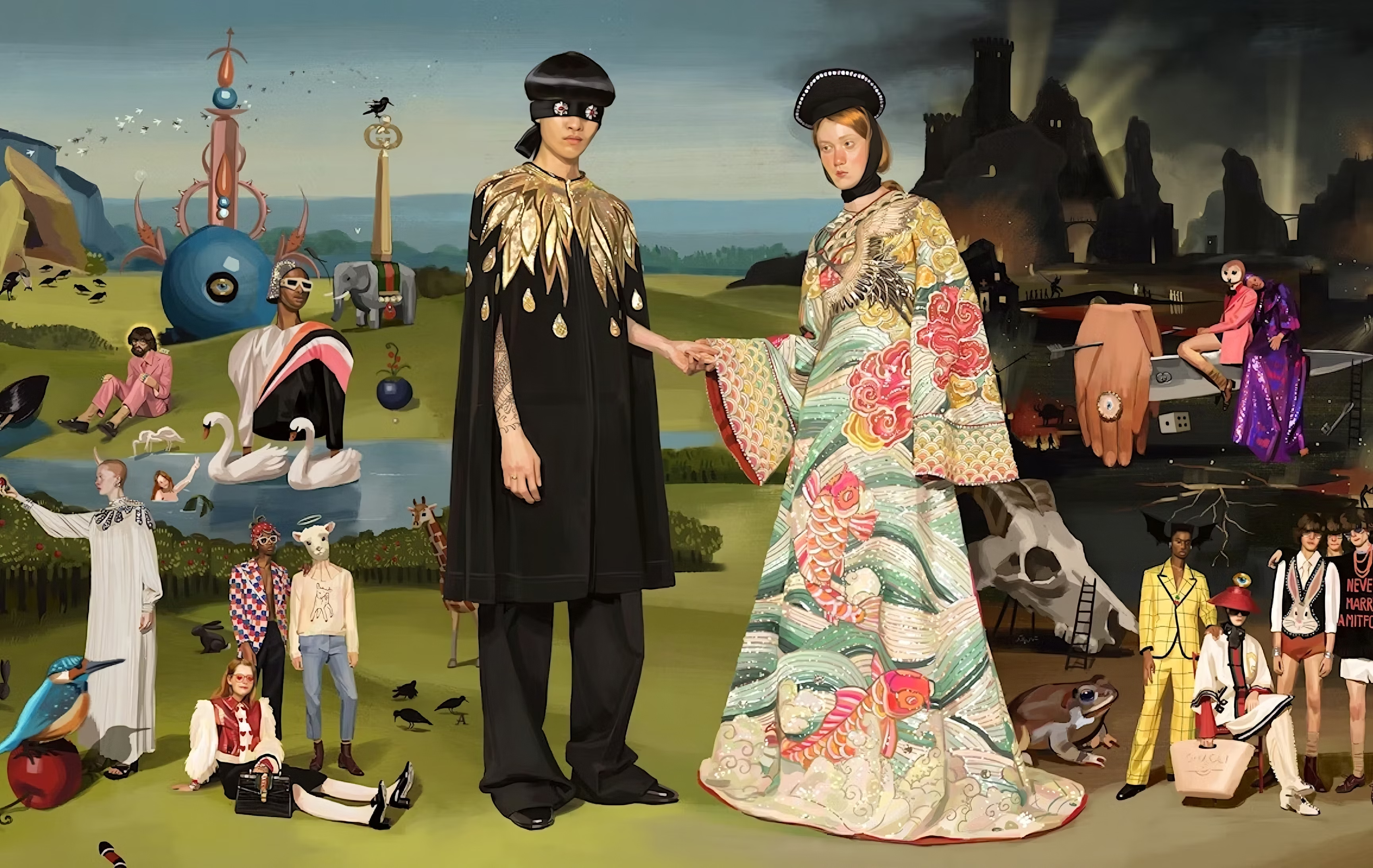
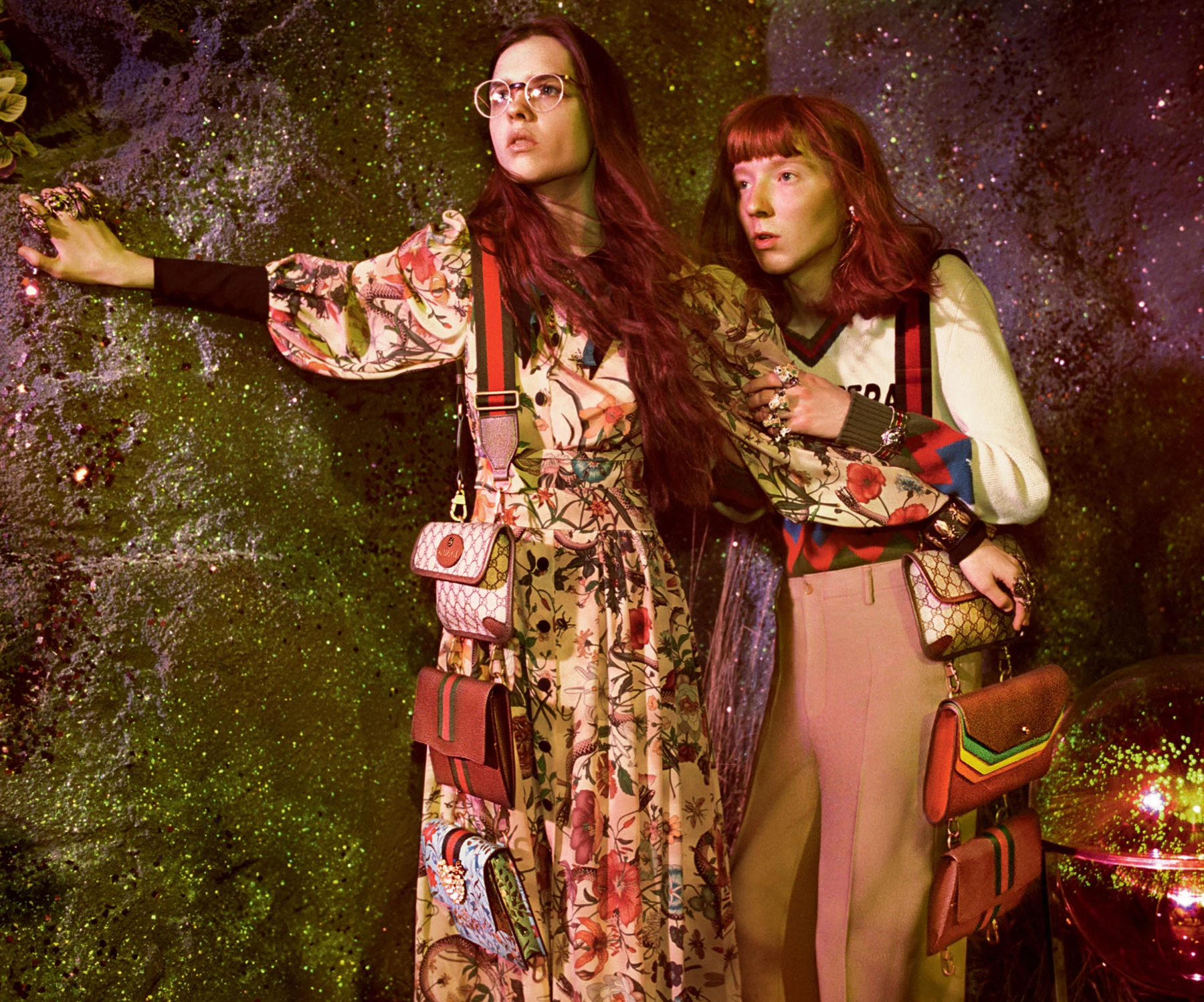

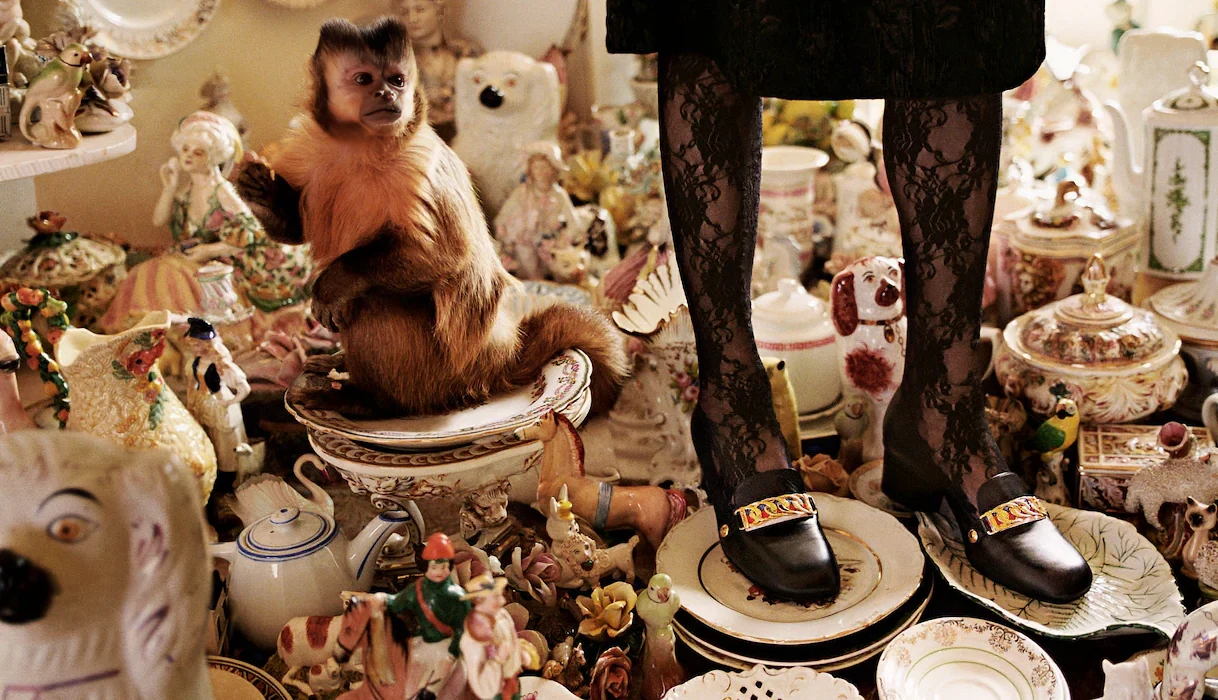

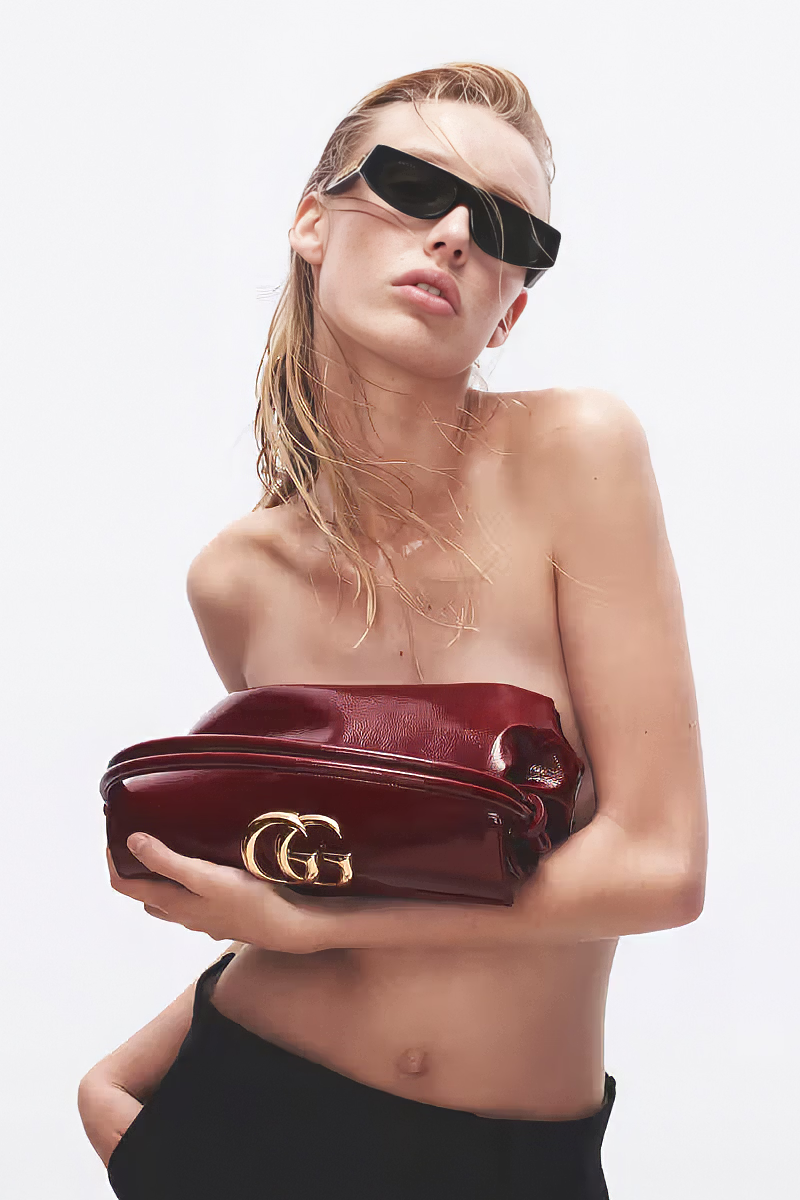


Cover: Gucci Cruise 2027 campaign video still. Demna closes the loop by making Gucci appear first as system of circulation: video, city, campaign, and public image. Creative direction: Demna. Directed by Björn-Erik Aschim. Video still: Courtesy of Gucci.
All images © their respective rights holders.