

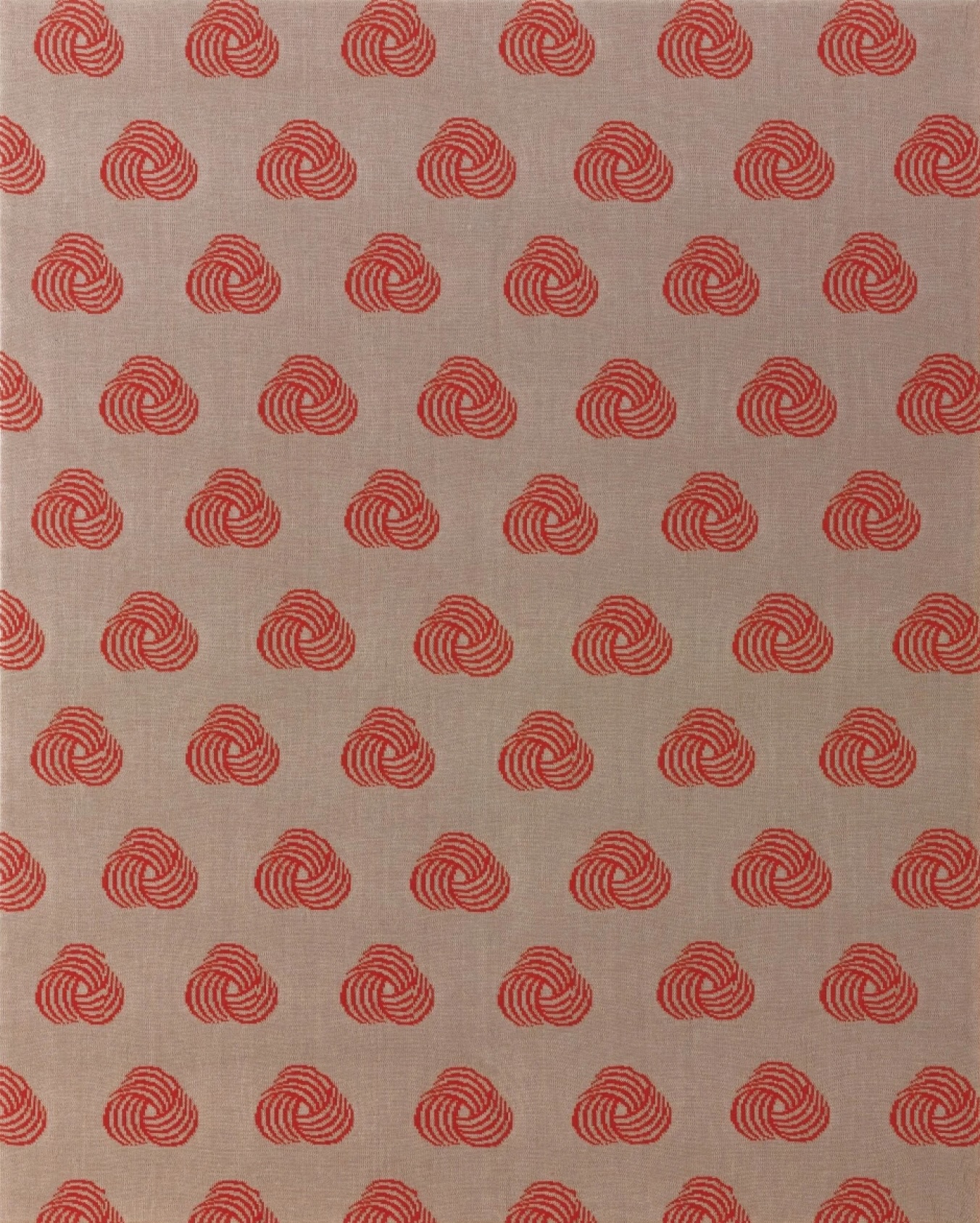
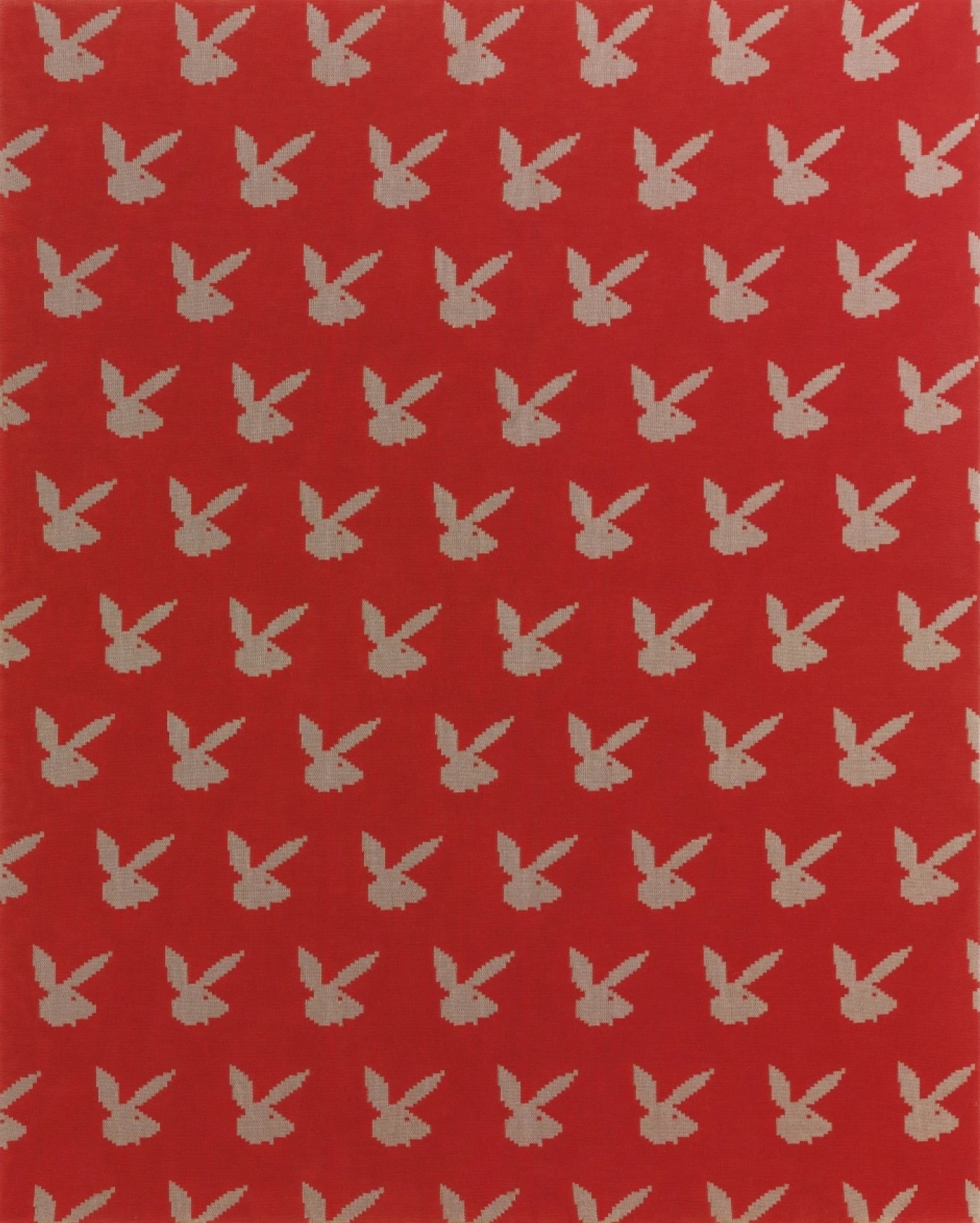
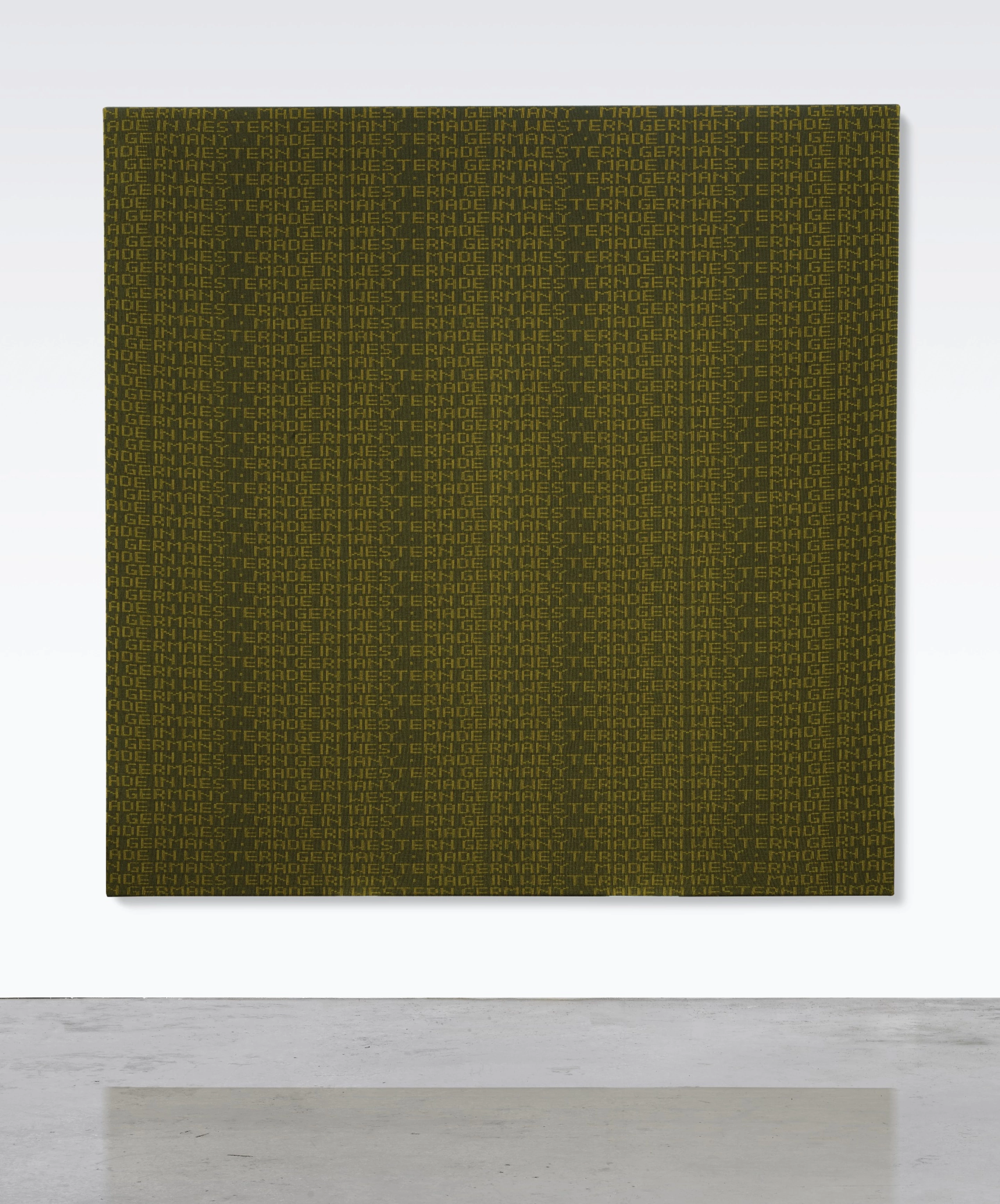
A Playboy bunny and a hammer and sickle sit in the same wool. One is a logo of appetite, the other a sign people have lived and died under. Near them, a Woolmark promises the quality of a fiber; elsewhere, Made in Western Germany reduces a country to a stamp of origin. Rosemarie Trockel's machine-knit pictures from the mid-1980s bring these marks into the same soft field, stretched and hung at the scale of painting. The first fact is not that wool has entered painting. It is that the signs are allowed to sit together.
They should not be. A Woolmark is a seal of material quality, an assurance about fiber. A Playboy bunny is an erotic commodity, a logo of a particular appetite sold back to its market. A hammer and sickle is a political emblem, a demand for allegiance that has cost lives. A country-of-origin stamp is an administrative fact, a customs category. In the world these signs do not sit together. They make competing claims, and a person standing inside any one of them — for whom the hammer and sickle is not a graphic but a loyalty — cannot also stand inside the others. They are made of incompatible commitments.
That incompatibility is easy to miss, because the old rescue story arrives quickly. A machine-knit panel stretched over a frame, hung at the scale and height of painting: here, it appears, is the old domestic material brought in from the cold, the labor of women lifted out of the house and onto the wall where it can finally be seen as art. Untitled (Woolmark / Playboy Bunny) from 1985, the trademark works that followed, Made in Western Germany from 1987 — they look like a correction being made to art history, a debt being paid. The frame says painting. The material says everything painting had excluded. Through these works, it is easy to arrive ready to admire a rescue.
On Trockel's surface the marks are made of the same yarn. They become interchangeable, equal in weight and texture and tone, and the equality looks like a property of the knitting. Wool makes the mistake easier. It brings the signs close, gives them a shared softness, makes even the harshest emblem appear touched, as if the same hand had passed over the hammer and sickle and the bunny and softened both. But the pictures are machine-knit. The nearness they offer is not the nearness of a hand. It is a nearness produced for a viewer, intimacy without participation, and it arrives feeling natural — bodily, already given — before anything about it can be questioned.
Only from a position outside all four loyalties — outside the fiber market, outside the appetite, outside the politics, outside the customs house — can the four be seen as one kind of thing. The machine-knit surface gives the viewer that position before the viewer has noticed that a position was needed, or granted, or that it might belong to someone in particular. This is the work the knitted pictures keep underneath the rescue they seem to offer. They do not yet announce it. They keep it.
So the verb in the rescue story is wrong. "Elevation" assumes a hand whose touch confers worth, a maker restoring value to a despised material by the dignity of craft. Trockel removes the hand. The pictures are designed and produced by machine; what survives is the look of touch — the warmth of wool, its softness, the suggestion that someone sat with it — while the touch itself has been engineered out. She has described taking wool out of the "house and home" context where the women's exhibitions of the 1970s had kept it, and reworking it through a neutral process of production. The category that devalued the material is real, and the work moves against it; but it does not answer devaluation with redemption. To redeem the sign would be to admit it, at last, into value — and admission is exactly what these pictures hold up to the light. They attack the system that assigned wool its low place without pretending that the assigning of value can be escaped. The feminism here is not a rescue. It is the harder observation that value is granted from somewhere, to someone, by someone, and that being let in is not the same as being free.
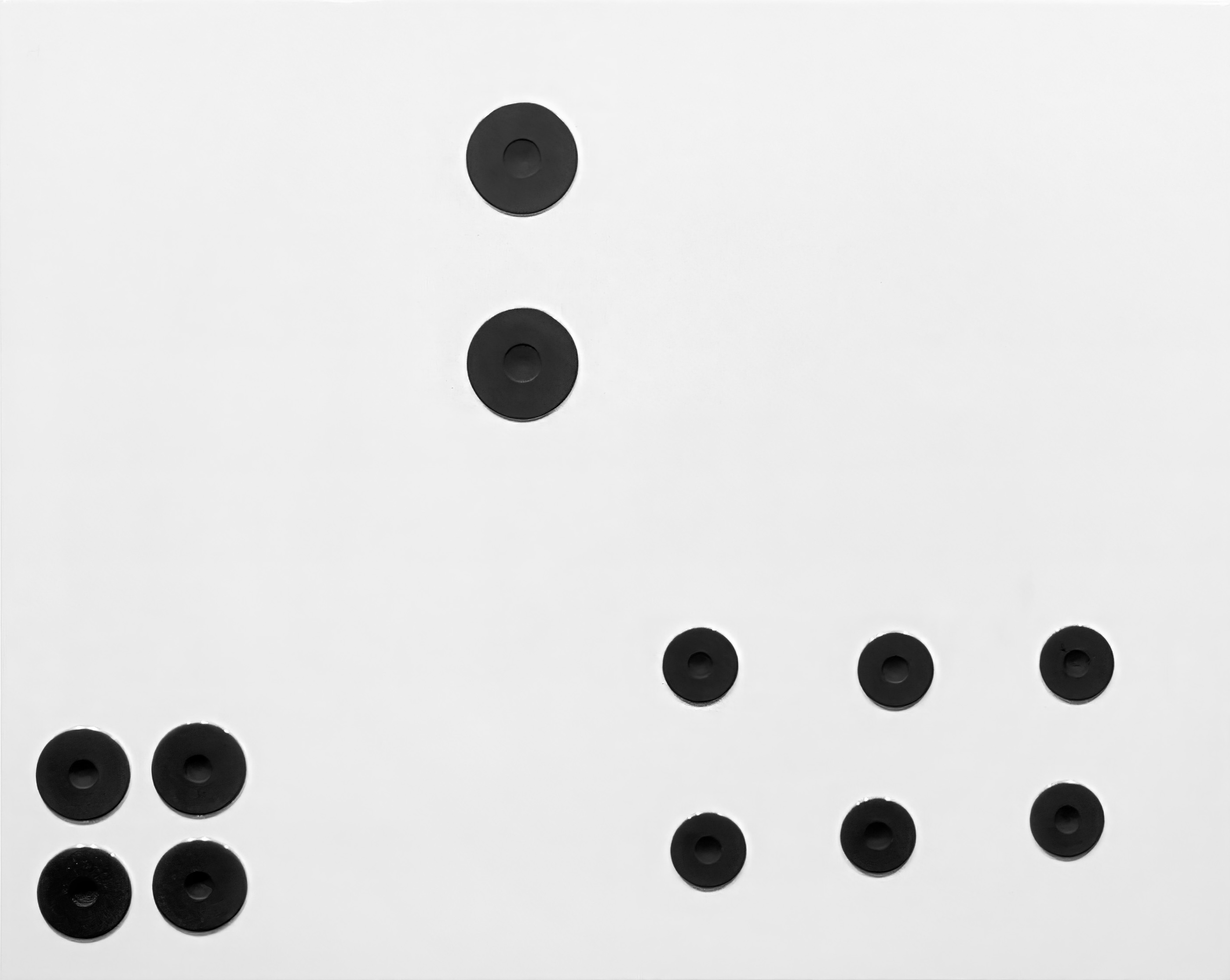
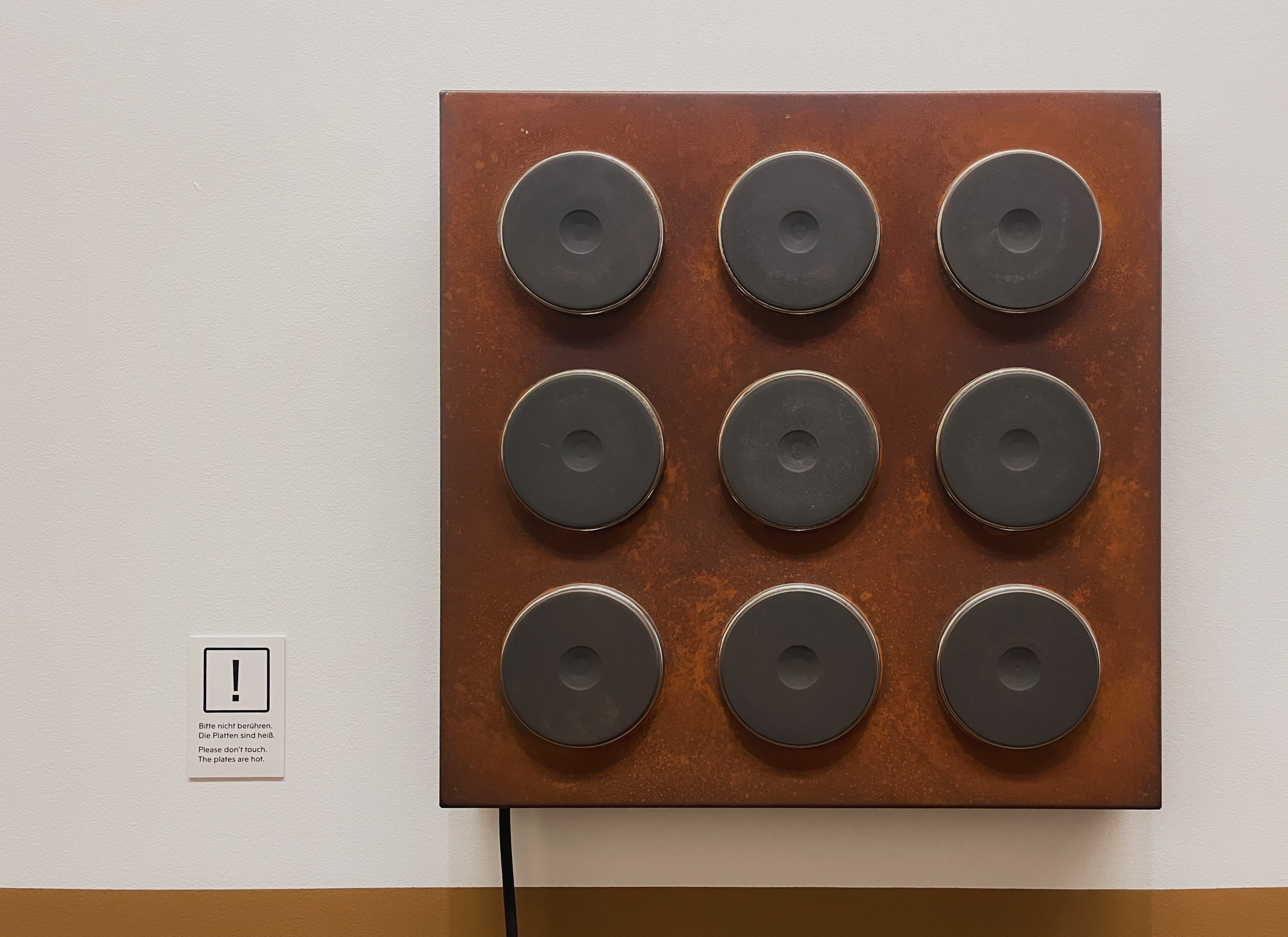
The surface soon loses wool but keeps the one-sided relation. In the Herdplatten works Trockel used electric cooktops, among them a steel cube fitted with hotplates, the burners turned to face the room. A cooktop is designed for a body standing in front of it, operating heat from one side; its form assumes an operator at a fixed position, reaching in. Lifted onto a wall or set as a cube and stripped of current, it stops cooking and starts behaving like sculpture — a grid of dark circles, a surface adjacent to the Minimalist box. The function is gone. What does not go is the one-sided relation built into the design. The plates still face outward, still imply the body that would stand before them and work them. The body has been removed; the position remains. The cube is not a comment on women's labor and not a feminized grid. It is an operating surface with the operator subtracted. Appliance, cube, and cooker settle into one geometry, with nothing left to do with yarn.
For Documenta X in 1997, that position became architecture. Trockel and Carsten Höller built A House for Pigs and People in the Karlsaue park: one low concrete structure, divided by a long pane of glass. On one side, a sow and her litter lived in clean and even comfortable quarters. On the other side stood the visitors of the exhibition. The glass between them was mirrored on one face. People could watch the pigs. The pigs, looking toward the people, saw only their own enclosure returned to them. The two halves shared a single architecture; the structure granted them equal standing as inhabitants. But the looking ran one way. Equality was given as housing and withheld as vision, in the same object, at the same moment.
The mirror does not introduce a new idea. It makes literal the one that the wool had been keeping. The knitted pictures had already needed a viewer positioned outside the signs in order for the signs to appear equal; the house simply builds a wall out of that need and silvers it. After the glass, the earlier works cannot be seen the way they were. The trademark pictures are no longer only incompatible signs made to share a surface. They show that the sharing required a place to stand, and that the place was never neutral, only unmarked. The hotplate stops being an appliance that has turned into a grid and becomes the seat of an operator, kept warm after the operator is gone. What looked like leveling had been a view. The glass does not argue this. It is a sheet of mirrored glass in a concrete wall, and the argument is already inside it.
The question of who counts had been named years before. In 1993, at Anders Tornberg Galleri in Lund, Trockel titled an exhibition Every Animal Is a Female Artist. The title bends Beuys's democratic promise — every man is an artist — and lets animal and female cross into the category he had thrown open and, in his bearing, kept watch over. It is a category shift, made without ceremony. Her relation to Beuys was never opposition; she was drawn to him and put off by his authority at once, and the title carries both, admitting new occupants to "artist" while noting that someone had been standing at the threshold deciding who counts.
In 2005 the Museum Ludwig staged Post-Menopause, and the exhibition arrived with a catalogue raisonné — of the wool works and works related to wool. A catalogue raisonné fixes a body of work: it settles authenticity, dates, sequence, the place of each object in the whole, the authority by which a thing is or is not by the artist. Here that instrument did not stay quietly behind the career. It framed the exhibition, attaching the apparatus that stabilizes Trockel's value to the value it underwrites. "That simple experiment grew into my trademark," she has said of the knitting, "which I really didn't want." The system of value formed around her, more or less without her consent. The thing that fixes her becomes part of what can be looked at.
In A Cosmos, the exhibition she organized with Lynne Cooke in 2012, Trockel hung her own work among botanical drawings, anatomical models, the objects of self-taught makers, and — on the second floor — three loosely brushed abstractions made by an orangutan named Tilda, from the Cologne zoo. She had acquired the three paintings, framed them in Perspex, assembled them into a single triptych, and given it a title: Less sauvage than others. The paintings are credited to Tilda. The assembled work is Trockel's. "I just think of it as abstract art," she said of them. "Of course it's not intentional, but it doesn't matter so much to me."
It would be easy to stop at the surprise of the animal, and to miss the title doing its work in plain sight. Less sauvage than others is comparative. It does not only let an orangutan's marks into abstraction; it ranks them — less savage than something, than someone, than some implied field of other makers who were the standard all along. The question the triptych leaves is not whether an animal can paint. It is who is positioned to say that the painting is less savage, and less savage than whom. The category had been opened in Lund; here the opening comes with a measure, and the measure is held from one side. Intention does not matter, she says, and she is right that it does not — because the judgment was never going to be the painter's to make.
The viewer is not outside this arrangement. To see the works as equivalent is already to occupy a side.
Trockel’s wool signs, hotplates, animal works, mirrors, and institutional frames make incompatibles appear equivalent. But the equivalence is never neutral. To see it is already to occupy a side.




Cover Image: Carsten Höller and Rosemarie Trockel, Ein Haus für Schweine und Menschen (A House for Pigs and People), 1997, installation view at documenta X, Kassel, 1997, © Bernhard Rüffert / documenta Archiv.
Photo: Aïcha Revellat.
All images © their respective rights holders.
Image rights & attribution →