

Playful forgives the skirt. It forgives the brief, the cardigan, the apron. It forgives everything, which is why the word matters. It does not erase the wrongness. It gives the wrongness a name under which it can be wanted.
The word does not arrive by mistake. Miu Miu has always made its lightness deliberate: the lurid sock, the bow placed just outside obedience, the logo turned small and absurd on a knit brief, the refusal to let seriousness harden into solemnity. Playful is an available word because the clothes invite it. So do girlish, instinctive, irreverent. None of them is entirely wrong. They are simply generous. They offer the kindest possible name for what the clothes are doing.
Generosity can be a way of not looking closely. But a Miu Miu look is built out of consequence. The skirt is too short. The underwear is too visible. The cardigan seems too slight for the body inside it. The office code has been worn a half-step away from its own purpose. The apron has entered a room where labor has already been converted into image. Each of these is a small failure of dressing. Embarrassment here is not a feeling hidden inside the wearer. It is the social condition of being seen to have dressed wrong.
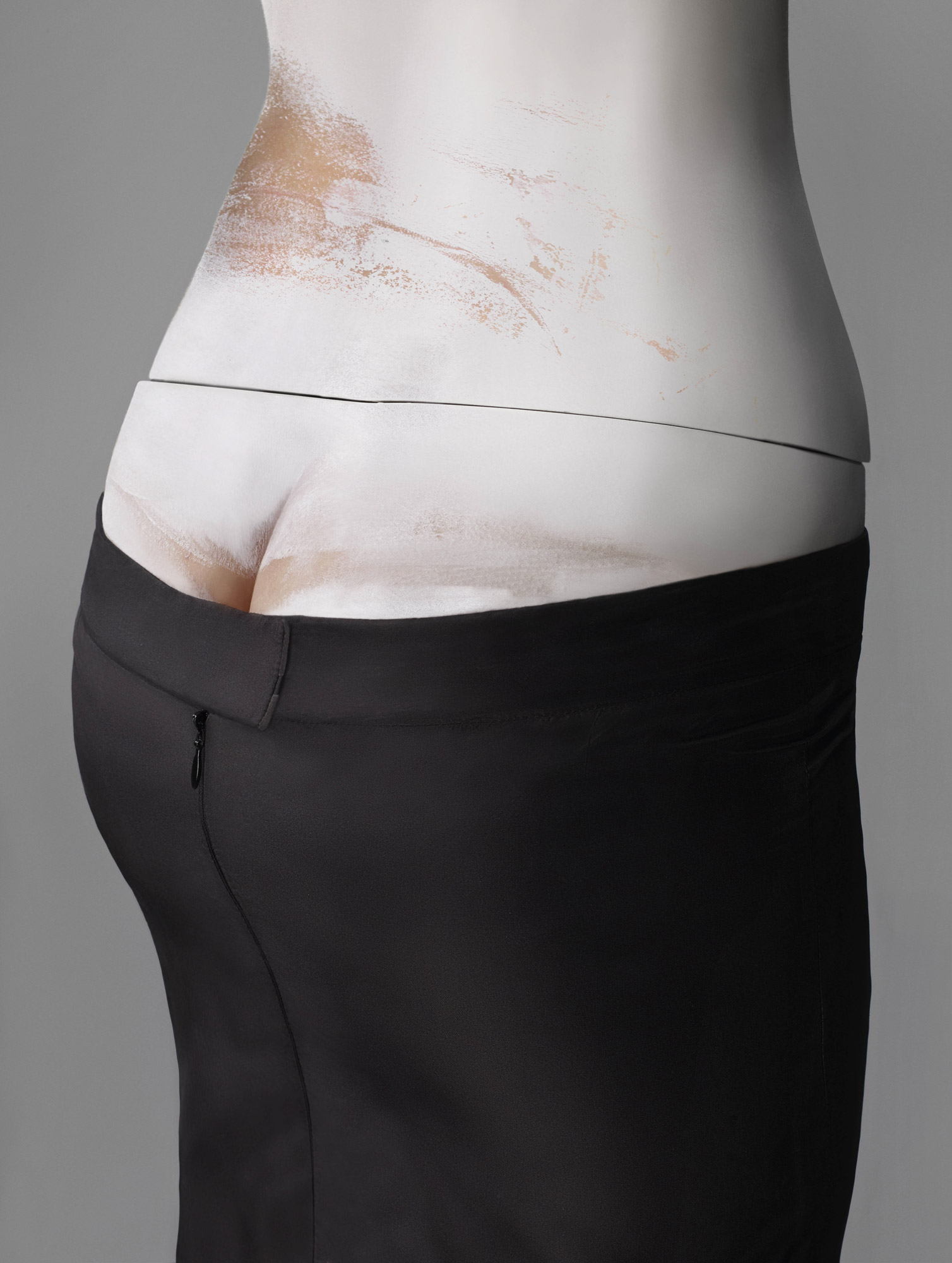
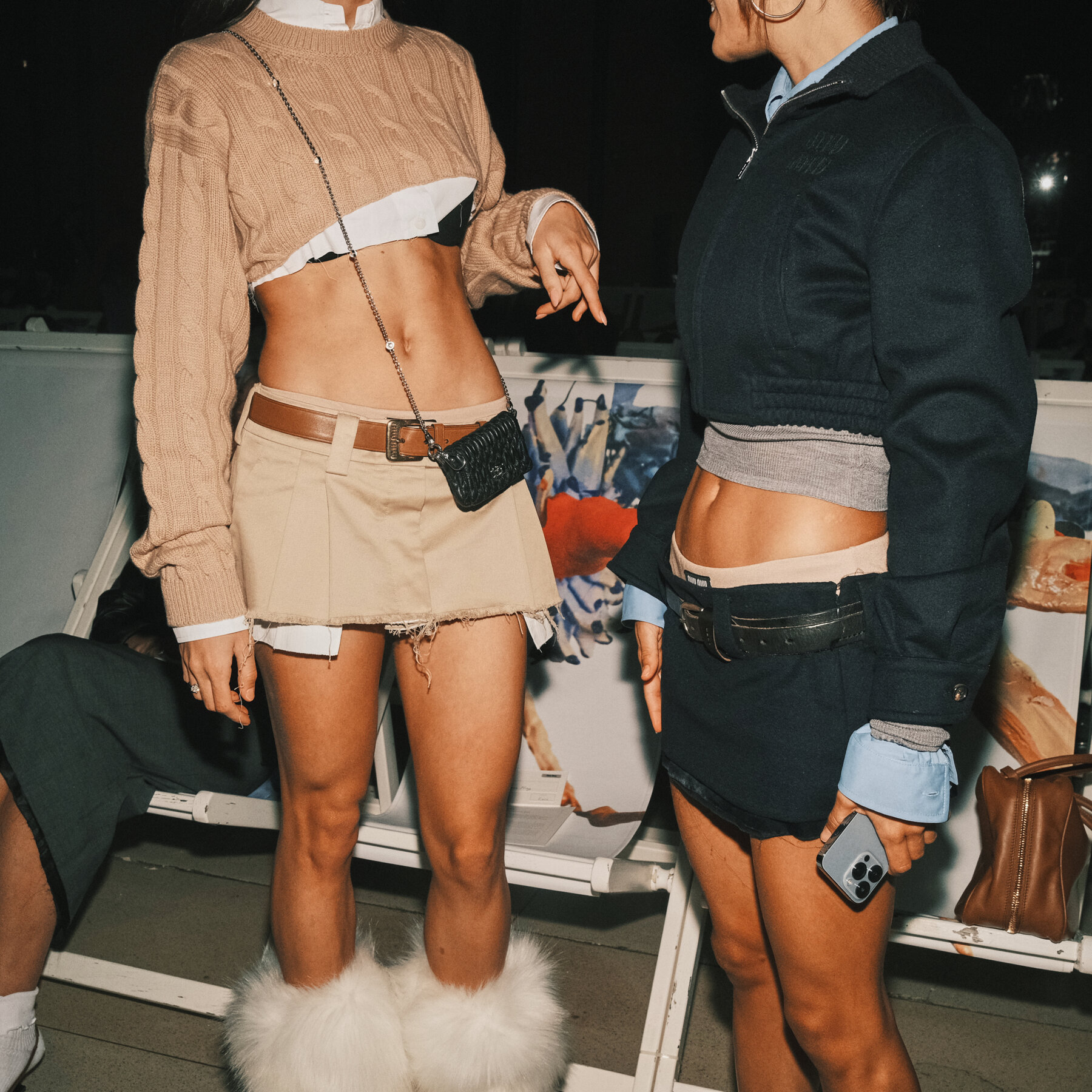
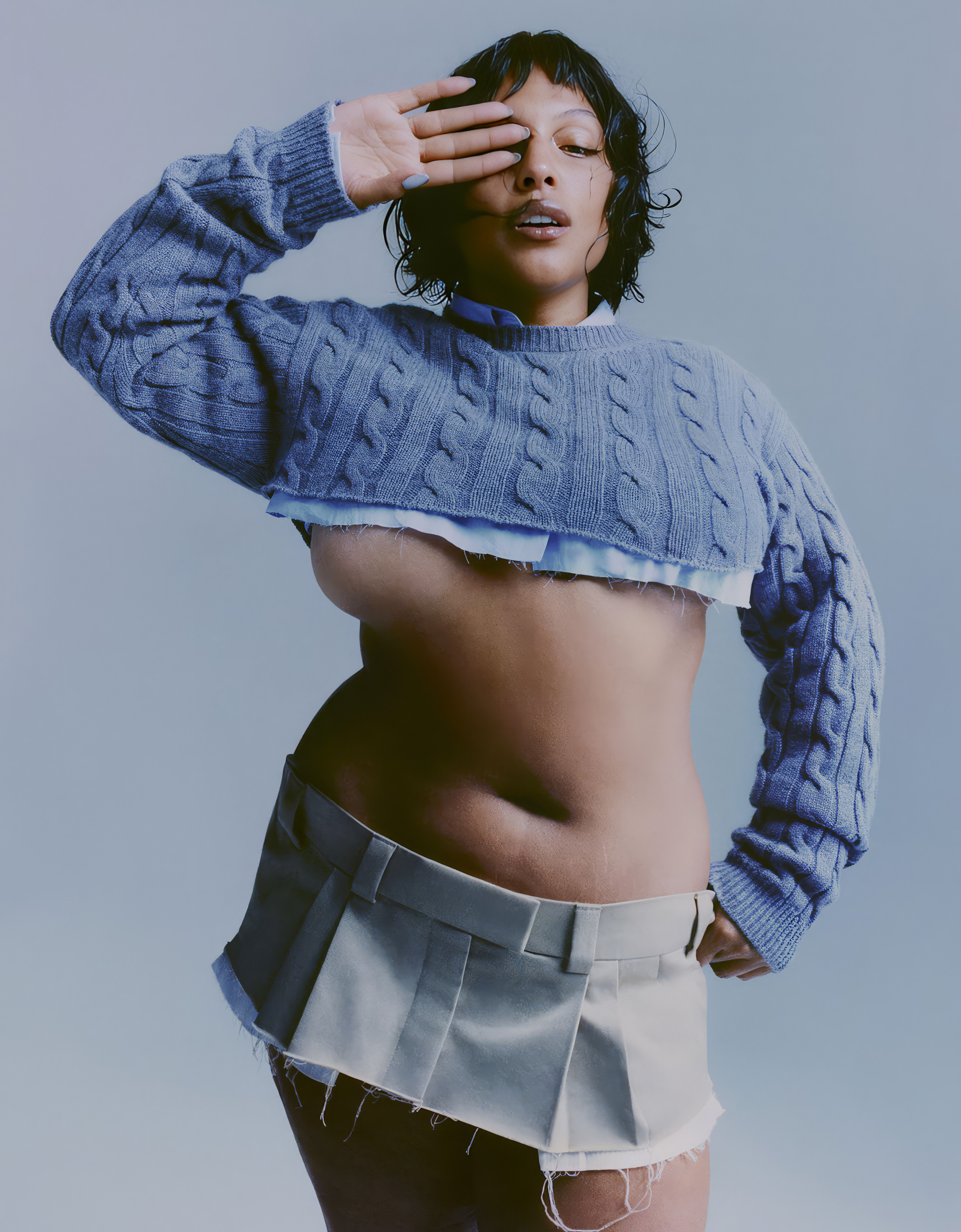
The Spring 2022 micro-mini, from the collection Miu Miu called Basic Instincts, has usually been remembered through its shortness. It was short, almost absurdly so, with the linings visible below the hem. But shortness was only the first fact. The more important one was alteration. The skirt looked less designed from nothing than taken from something already known and cut down in public. The photograph carries the same logic into the frame: the body is shown cropped at the rib and the thigh, head removed, presented as torso-evidence. The cut into the cloth and the cut into the image are the same gesture. The frame is already participating in the mistake.
The house’s own language for the collection matters because it refuses the fiction of accident. Miu Miu described everyday archetypes reduced, carved into, altered in their relationship to the body; raw edges and exposed construction were left visible to commemorate the spontaneity of those actions. The garment was not pretending to be finished in the old sense. Its finish was the evidence of interference. The hem was not a border. It was a record of where the cut had stopped. But the fray is even. The raw edge is consistent, deliberate, expensive. This is not damage in the raw sense. It is controlled evidence of damage — a garment performing woundedness while remaining immaculate.
A pleated school skirt is one of fashion’s most legible objects, and its legibility is the point. It places the body inside a category before it becomes an image: student, institution, routine, one of a set. Its protection comes from that limit. The skirt tells the viewer what kind of body is being seen, and what kind of attention should not yet be brought to it.
In Basic Instincts, that object was made newly unstable by the violence of reduction. Miu Miu kept the skirt recognizable enough to hold its code — still pleated, still legibly the uniform — and shortened it past its own composure. The wrongness was not added later by the body, the runway, or the caption. It was already there in the construction, in the raw edge, in the lining made visible where it should have been hidden. The garment that existed to limit what it could say had been cut, in public, until it said the thing it was built to prevent.
The skirt has been finished around its own interruption. What makes it desirable is not rawness alone but the calm around it: a house willing to stand behind the cut and call it complete. The code that kept the body inside a protected category has been opened just far enough to lose its protection while keeping its reference — the uniform still legible, the shelter it provided gone. The garment appears wounded, but the wound has already been protected.
Fall 2023 turns from the cut to the frame.
Miu Miu titled the collection Ways of Looking, and again the house’s language was unusually clear. The collection treated viewpoint as intervention. Transparent chiffon opened windows onto garments normally kept underneath; stockings were exposed; the hidden layer entered the visible order of dress. The season did not simply show skin. It reorganized what counted as public.
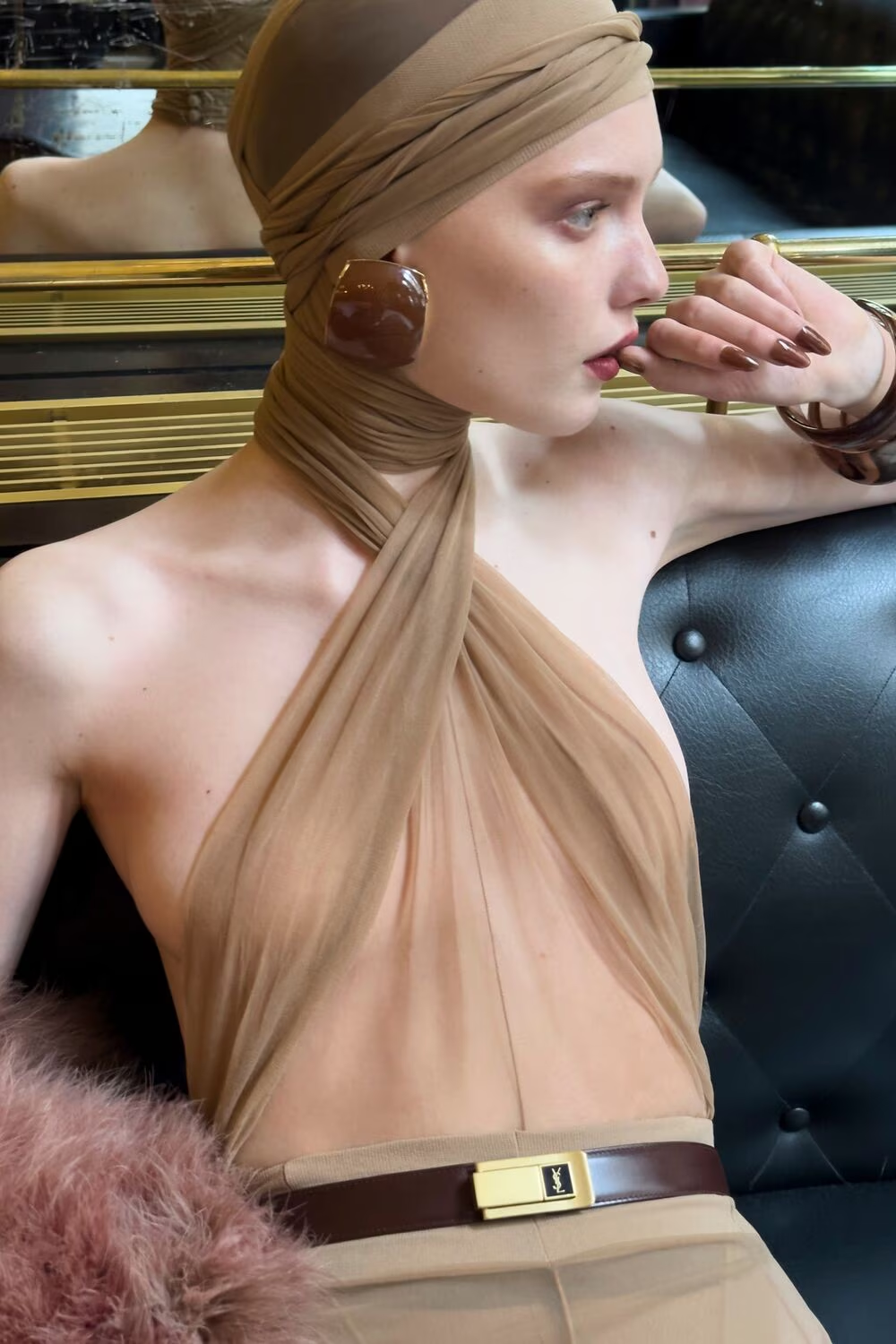
Emma Corrin closed the show in a soft camel knit, sheer tights, heels, and an embellished brief worn where trousers or a skirt would ordinarily complete the look. The under and over of dressing is one of the oldest social arrangements clothing keeps. Underwear is meant to remain under: it is the layer that lets the outer layer count as public, the private boundary that makes a person dressed rather than exposed. The brief on the runway was the same category of object that, almost anywhere else, would not yet count as dress. Here it did — and it was not plain. It was jeweled, crystal-encrusted at the exact site of exposure. The frame does not merely permit the underlayer to go public. It appraises it. What the reversal exposes is not simply the body, but the boundary that normally makes the body manageable in public — moved, calmly, by the frame that was supposed to protect it.
The same runway opened with Mia Goth in a buttoned grey cardigan over a sheer black-dotted skirt, the logo waistband and tights showing through, sheer black hose, controlled, almost severe. If Corrin’s closing look turned the body’s inside outward, Goth’s opening look did something the skirt and the brief had not. It put the mistake inside correctness itself.
There is now nothing visibly wrong. No hem is cut. The cardigan belongs to the costume of being taken seriously: capable, prepared, in command of the codes. Its protection is ordinary legibility. It lets the person wearing it be read as competent before she is read as exposed.
The cardigan is correct, buttoned to the collar. But the skirt beneath it is sheer — the logo waistband and the tights show through, and correctness turns out to be see-through. And the image does the rest: on the runway the look walks upright; in the editorial the same competent costume is put on the floor, kneeling, reclining, the body placed where competence cannot follow. Nothing has gone wrong with the clothes. The wrongness has been introduced by the picture, and by the terms under which the picture asks the role to be read. The signs a woman uses to disappear into competence are the signs made to misfire. The mistake has stopped being something done to a garment and become something done to a role.
If the mistake lived only in youth, the structure would end here. It does not. The garment that follows reaches backward and changes everything before it.
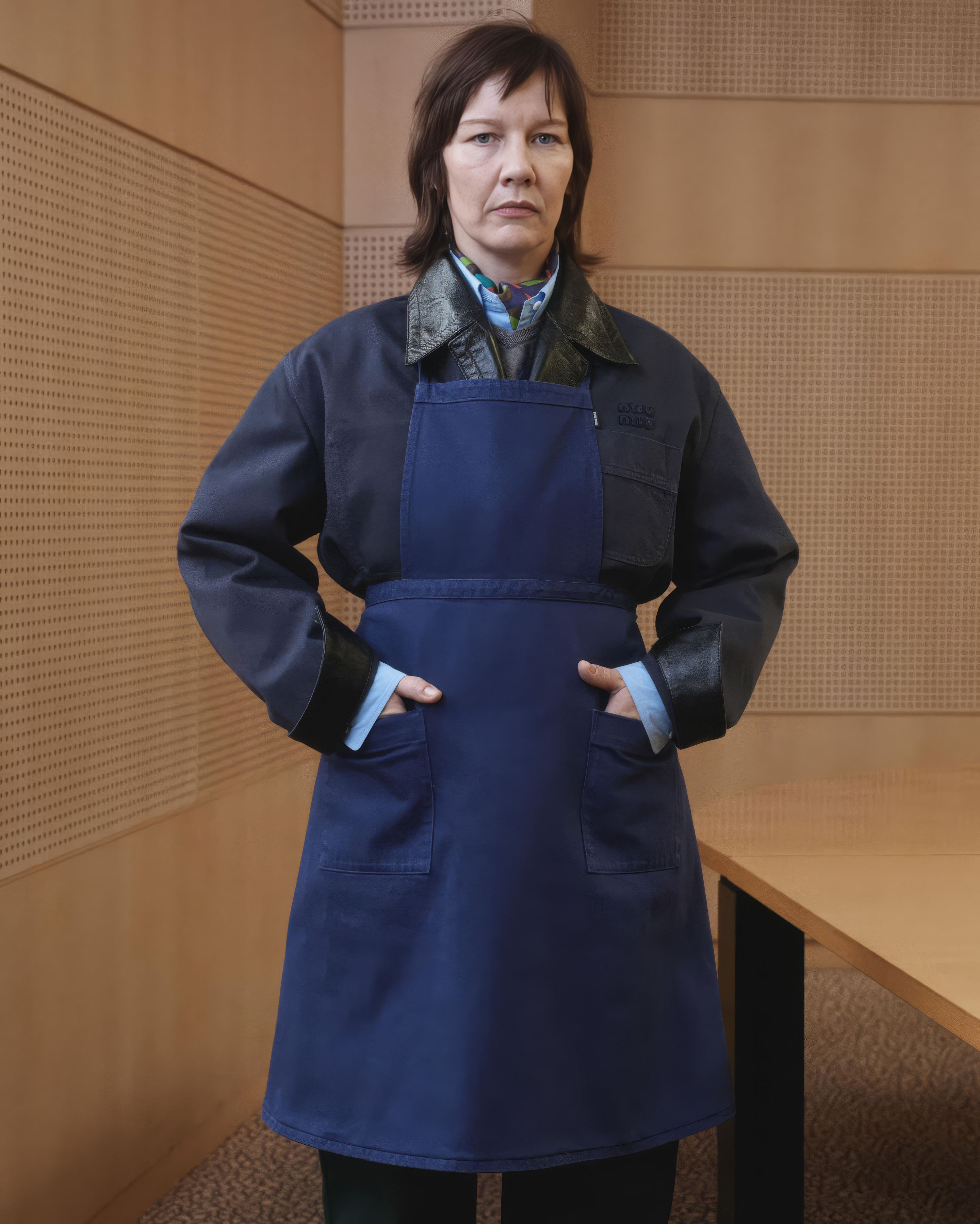
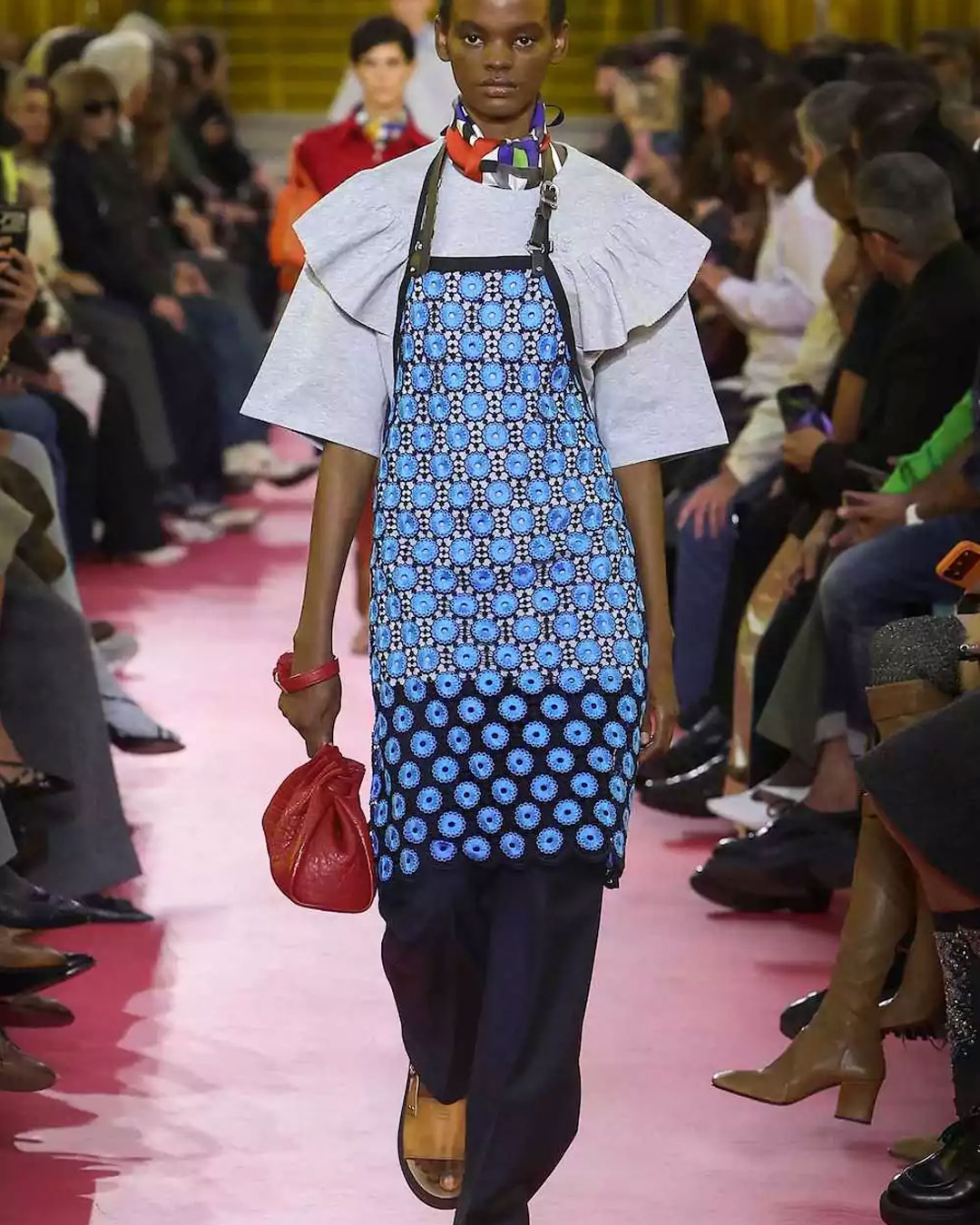
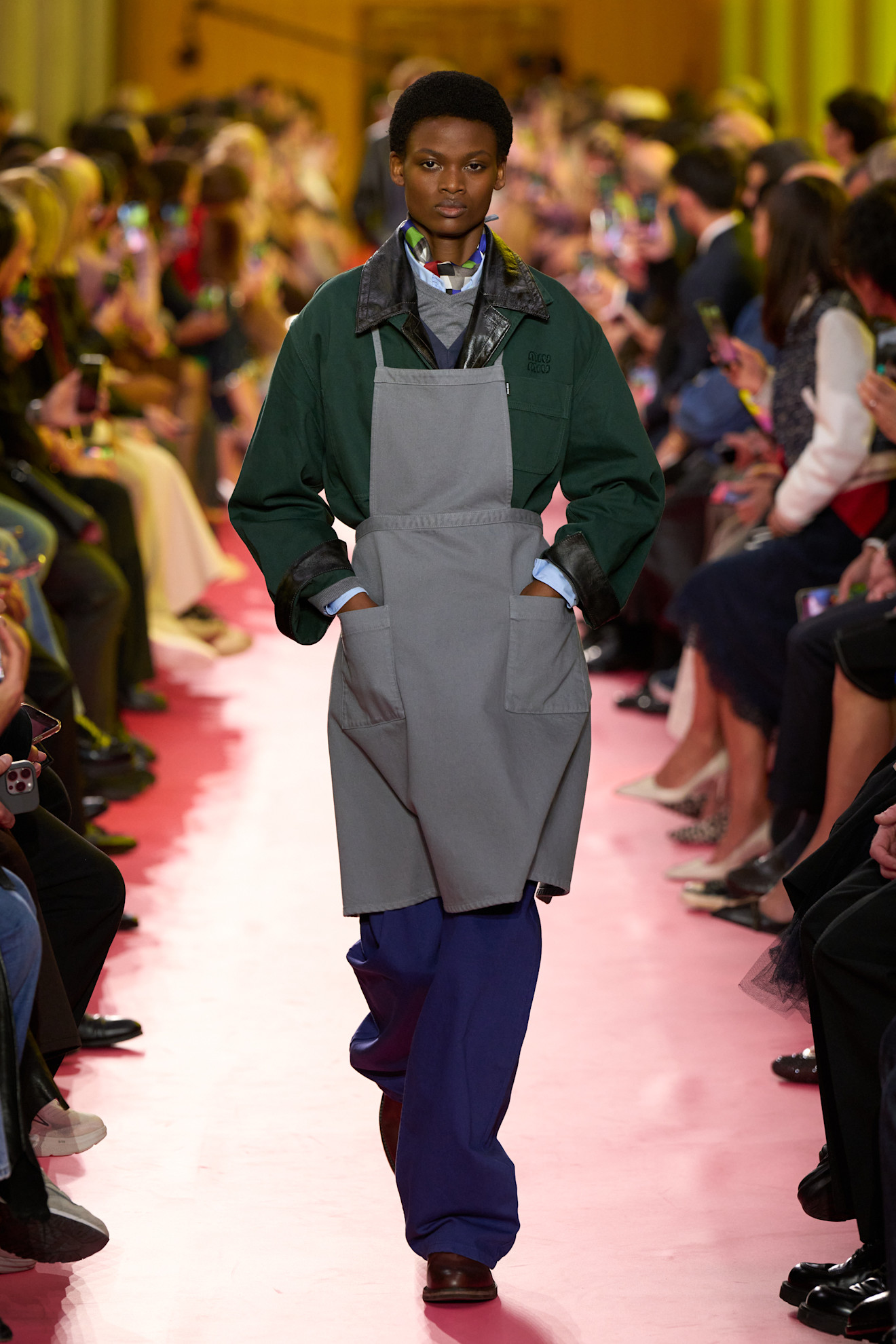
For Spring/Summer 2026, shown in the autumn of 2025, Miuccia Prada built a collection around the apron. Sandra Hüller opened the show in a deep-blue working apron over leather-collared workwear. The first body on the runway was placed inside labor before the collection could be mistaken for youth. Milla Jovovich walked it; so did Richard E. Grant. The casting was adult, mixed, and outside the schoolgirl alibi.
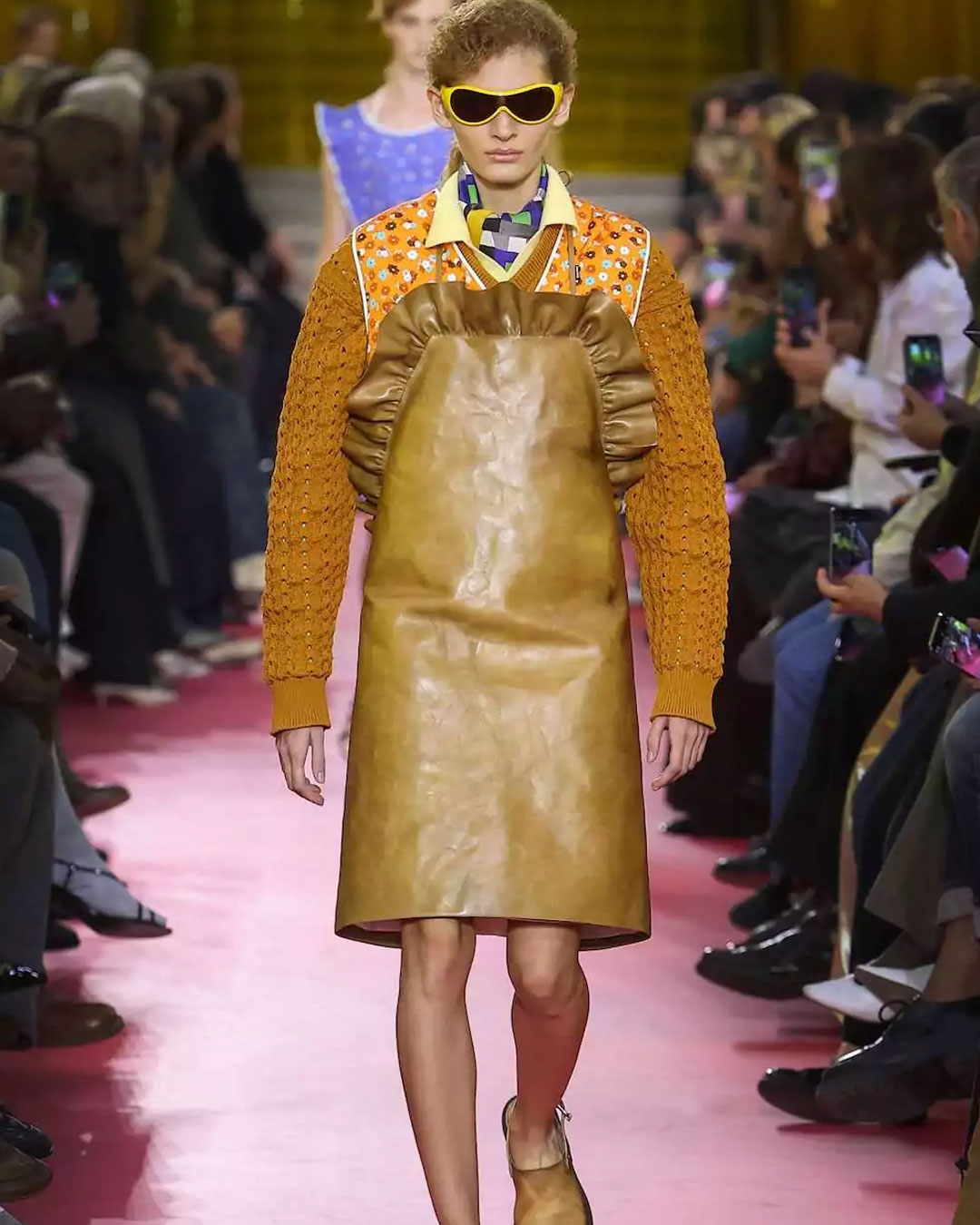
The apron matters because it begins as a garment of disappearance. It is worn so that something else can remain clean: the dress beneath it, the room around it, the person being served, the image of order that labor makes possible. Its work is to receive what the valuable garment is not supposed to show — stain, handling, grease, dust, use. An apron is visible, but only as the sign that another kind of work is happening underneath attention. It stands between the body and the labor, takes the mark so the valuable thing stays unmarked, and asks to be noticed only as evidence that the real work is being kept elsewhere.
Miu Miu carries that object into the salon, where labor has already been converted into image and price. The mistake is not that the apron is badly worn. It is worn exactly as an apron should be worn: over the body, between the person and the work, ready to take the mark. The mistake is that the room has changed around it. What belonged to service now occupies the position of fashion. The garment made to protect value becomes the valuable garment. The object meant to absorb the stain is placed where nothing is supposed to look stained at all.
And the apron does not even stay an apron. In leather it stiffens into armor; in crystal it becomes a jewel, paved in stones, a thing that could not be worked in. Labor is not simply relocated to a new room. It is hollowed out of the garment and refilled — with treasure, with carapace, with everything an apron exists to keep at bay. The error is not in the cut, the exposure, or the wearing. It is in the economy that has received it. And once the apron can do what the micro-mini did, girlhood stops being a sufficient explanation. If a working apron, on an adult body, in a room of labor lifted into image, performs the same operation as the cut-down school skirt, then the skirt was never really about being young. It was about a correct object carried into the wrong economy, where its failure to belong could be protected and desired.
In spring 2022, Sam Rock photographed Paloma Elsesser for i-D’s Out of Body issue in the Miu Miu look of the moment: the Basic Instincts micro-mini and cropped knit. The image had the force of a breakthrough, and it should be held as one. Elsesser appeared in the actual garment of the season, not in a substitute, not in an apologetic translation. The power of the cover came from that claim. She was wearing the garment itself, not a translation of it.
Then there is the production fact, and it is the stylist’s own. Miu Miu does not make the skirt in Elsesser’s size. To make the cover, Carlos Nazario has said, they cut the skirt in half and added a panel of fabric to extend its back so that it would close around her body. The garment that began the season as a deliberate mistake in the cloth — cut down, raw-edged, sold in its altered condition — had to be cut a second time, and rebuilt, before this body could enter the same mistake.
Until now the protection has looked like a property of the clothes, something the house grants to a garment and a viewer. The Elsesser cover shows that the protection was never evenly available. The same ease that had moved through skirt, brief, cardigan, and apron is produced differently here. For most of the bodies the runway imagined, it is produced invisibly, in the cut of the sample, and arrives looking like nature. For a body the garment was not made to fit, the same ease has to be sewn by hand, in halves and panels, after the fact.
The cover is not diminished by this. The condition of the cover becomes visible. Elsesser’s body was not the mistake; the mistake was in the dressing all along, too short and too cut and too deliberately unfinished. The mistake was always the skirt’s. What the cover reveals is that the system rations embarrassment — that it decides whose body is permitted to perform the error as ease and whose body must be cut and rebuilt to enter it, and that the second labor is the one kept out of sight. Miu Miu gives embarrassment the appearance of ease. That ease is never natural. It is made: in the cut, in the styling, in the casting, in the editorial frame, in the price, in the authority of the house, and, when the assumed body is absent, in a panel of fabric added so the image of ease can survive.
The mistake was the garment’s. The embarrassment was the material. The permission was the system’s.
Miu Miu does not simply make mistakes desirable. It builds a system in which embarrassment can be performed as ease: the skirt too short, the brief too visible, the cardigan too correct, the apron misplaced, the cover rebuilt so another body can enter the look. The mistake belongs to the garment. The permission belongs to the system.



Cover Image: Miu Miu, L'Été Summer 2025 Ad Campaign (Song Ah Woo), 2025. Photo: Siân Davey. Courtesy Miu Miu © Miu Miu 2025.
All images © their respective rights holders.
Image rights & attribution →