

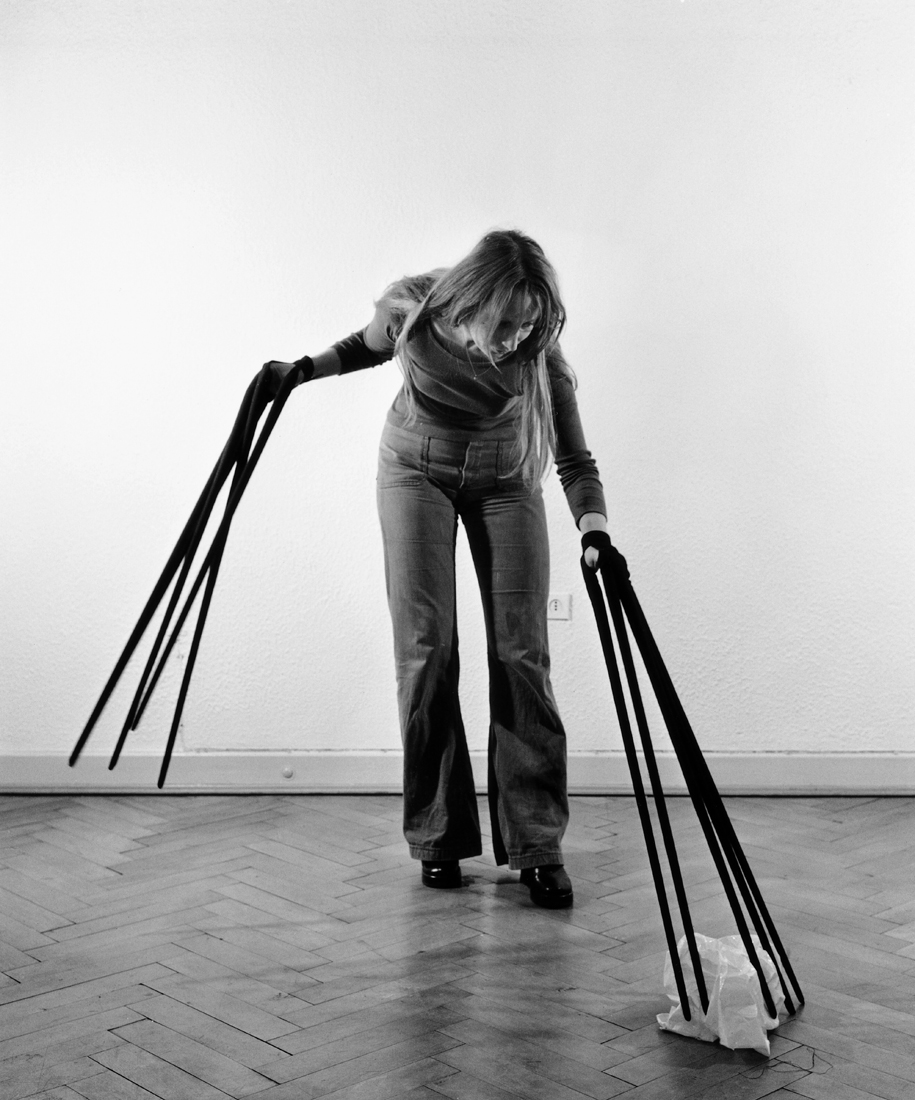
Two black gloves, each finger drawn out into a slender wooden rod nearly a metre long, strapped at the wrist. Inside them, a hand. The wearer flexes, and the rods flex with her, scraping a wall, lowering toward the floor, lifting toward a paper ball or crumpled white object she cannot quite hold. The object is Finger Gloves, made in 1972. The photographs make the device look like reach. In use, it does the opposite: it installs a length of measured wood between the skin and whatever the skin was reaching for, and it holds that length there, fixed, for as long as the gloves are worn.
Horn was precise about what the device was for. Wearing it, she said, she could feel, touch, and grasp while keeping a certain distance from the objects she touched. The lengthened fingers, she noted, intensified the sense of touch in the hand; she could feel herself touching, see herself grasping, and control the distance between herself and the objects. Feeling, seeing, grasping, and distance are named as separate things, and the last governs the others. The hand is not extended toward contact. It is fitted with an instrument for holding contact at a chosen remove, and for watching itself do so. The gain in reach is paid for in contact.
Extension is the available word, and it carries a promise larger than these gloves. To extend the body is usually to imagine reach restored: a farther touch, a returned function, a body brought closer to what it could not hold. Horn accepts the promise only long enough to reverse its terms. The gloves are longer fingers, but length here is not arrival. Length is the interval the body now has to negotiate, made visible and made governable. The reaching is real. The work’s material is the gap that stays.
Shown empty, the gloves do not collapse into remains. Horn made them to be exhibited without a wearer — laid out in a case, an object in their own right alongside the films of their use. They are complete as instruments because the body is not enough to complete them. From the first work, the apparatus is already half-detached from the person it was built around, already pointing toward the day it will operate with no one inside it.
Before the gloves reach toward a wall, Einhorn, from 1970, fixes the body into vertical distance. A standing figure is strapped into a pale harness in a field, a single white horn rising from the head into open sky. The apparatus does not meet anything. It touches only the body that carries it: strap to torso, strap to thigh, strap to head. The horn extends the figure upward and arrives nowhere. Before Horn’s devices reach, they fasten. The body is sealed into an apparatus before the apparatus can pretend to overcome distance.
The hand inside the first gloves was not a neutral one. Illness, a long confinement, an enforced removal from ordinary contact press on the early work, but the apparatus does not turn them into recovery. The work is not the story of a damaged body learning to reach again. It takes interrupted contact as its given and declines to repair it. The apparatus does not nurse the distance back toward closeness. It gives the distance a working form.
In Arm Extensions, from 1968, a standing figure’s arms are wrapped and lengthened in red fabric that runs all the way to the floor, where it anchors. The arms appear extended. They are, in fact, immobilised. Horn described them as isolation columns, the body crosswrapped like a mummy, until all movements became impossible. The extension and the paralysis are the same act. To lengthen the arm to the ground is to pin it there.
In this first form, extension is isolation. The reach that looks like contact is the mechanism of its foreclosure. Later works charge the distance with desire, threat, and play, but the first condition is bare. What the museum vocabulary calls a body extension is also a structure for separating the body from the world it appears to reach.
The prosthesis was already a known object when Horn took it up, and it came with a cultural promise. The century had taught itself to imagine the added limb as repair: reach restored, function returned, the body brought back to ease. Horn’s extensions speak that language only long enough to expose what the promise hides. Nothing here is rehabilitative. The lengthened arm does not recover its grasp; it loses it to the floor. The lengthened fingers do not close the hand’s relation to the object; they make the relation measurable. What presents itself as restored contact turns, under the slightest pressure, into delay, measurement, or paralysis. The optimism the prosthesis was built to carry is precisely what these objects withhold.
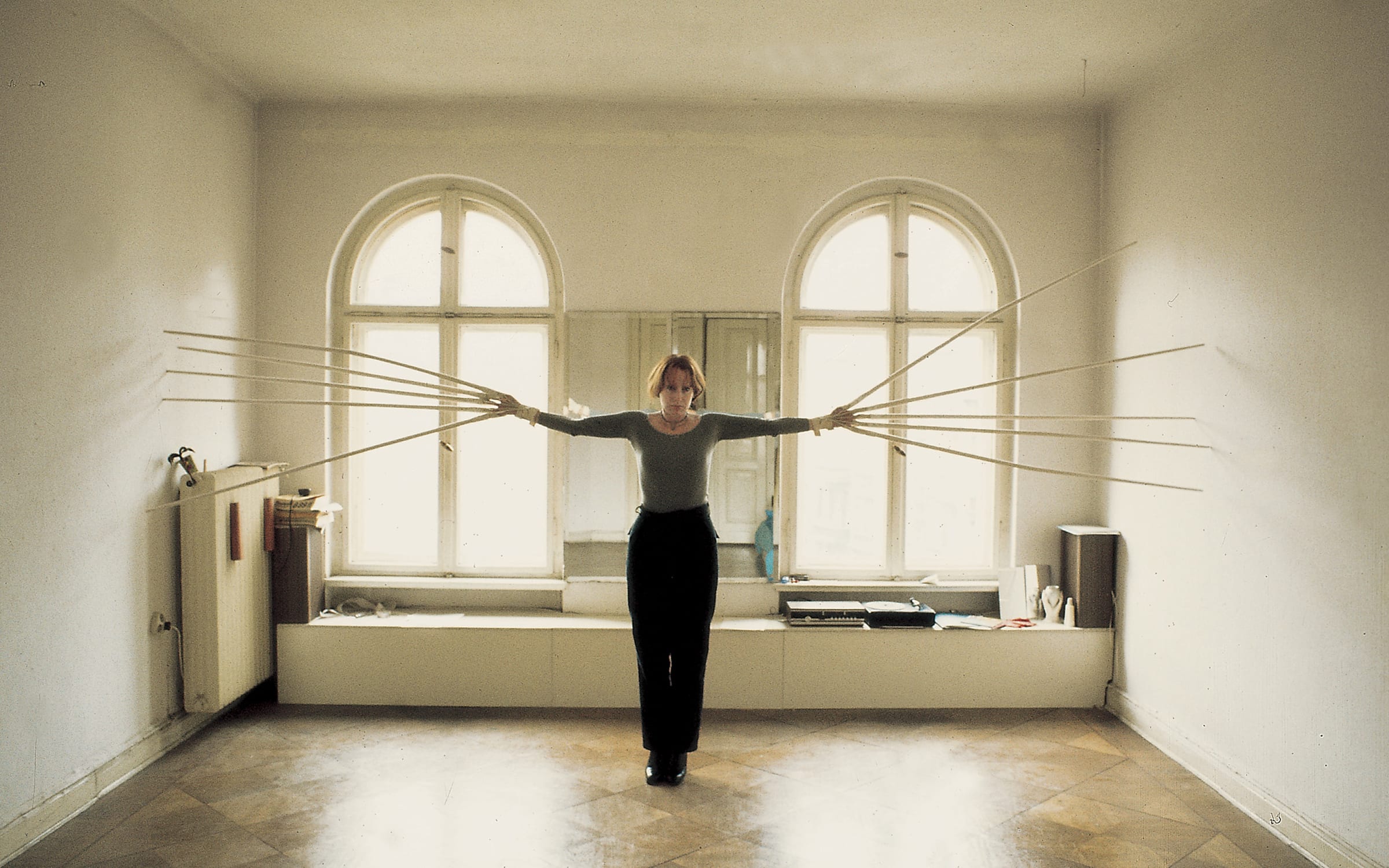
The Berlin Exercises in Nine Pieces, filmed in 1974 and 1975, are a series of studio actions performed with body apparatus. In the first of them, Scratching Both Walls at Once, the held length becomes audible. Horn built a longer pair of finger-rods, keyed exactly to the width of her studio. Standing at the centre, arms at full span, she could touch both walls at the same time, and she walks the length of the room scraping both surfaces as she goes. The film is one of the few with sound; what is heard is the architecture being taken as a measurement.
The gesture gauges rather than embraces. The body becomes a calibrated instrument the exact size of the space it occupies, and the contact it makes is the contact a ruler makes — registering an interval, not closing it. Extended to the walls, the arms stop being limbs and become a measurement. Another of the nine exercises is titled Keeping Those Legs from Touching Each Other. The series governs non-contact as deliberately as contact; holding two things apart is the same discipline as measuring the span between two walls. Distance has become the quantity the work is built to handle.
Bare studio walls make the procedure visible. There is no dream-logic here and nothing surreal, whatever the feathers and horns elsewhere might invite one to say. The rods are cut to a known length, the room is a known width, and the action tests one against the other until the body has confirmed, by scraping, the dimensions of where it stands. Whatever strangeness the result carries is the output of measurement, not of reverie. Horn’s instruments are precise before they are anything else.
Kiss of the Rhinoceros, from 1989, changes the temperature of the gap. A circle of steel and aluminium nearly five metres across is bisected into two motorised arms, each tipped with a metal horn. The arms swing slowly together and slowly apart, an unbroken cycle. At the open phase, fully separated, the two arcs hang as a drawn shape in the air. At the closed phase the horns rise to meet at the top of the circle, and at the apex, where they nearly touch, an electrical charge arcs across the last of the gap.
What crosses is current, a discharge that requires the gap in order to happen at all. Were the horns simply to meet, there would be no arc, only closure. The distance is held open because the charge lives in it. Duchamp’s bachelor machine hovers nearby, but Horn makes the structure move and spark. The held distance has become something other than isolation: a charged interval, erotic and dangerous, where everything happens because nothing arrives.
Even in 1972, the apparatus has begun to take over the body’s acts. Pencil Mask, from that year, is a head harness studded with pencils that project from the face; the wearer draws by moving her head against a wall. The mark is real, but the hand has been taken out of it. Drawing has been routed through an appendage that has nothing to do with drawing, which means the gesture has been detached from the organ that owns it and reassigned to an apparatus. The face cannot reach the wall, so the pencils reach it instead, and the scribbled field is the only evidence that contact occurred at all.
This is also where Horn parts from the body art she is usually filed beside. The body appears exposed, strapped, masked, filmed, and then keeps losing authority to rods, pencils, and motors. It appears in order to hand its acts away.
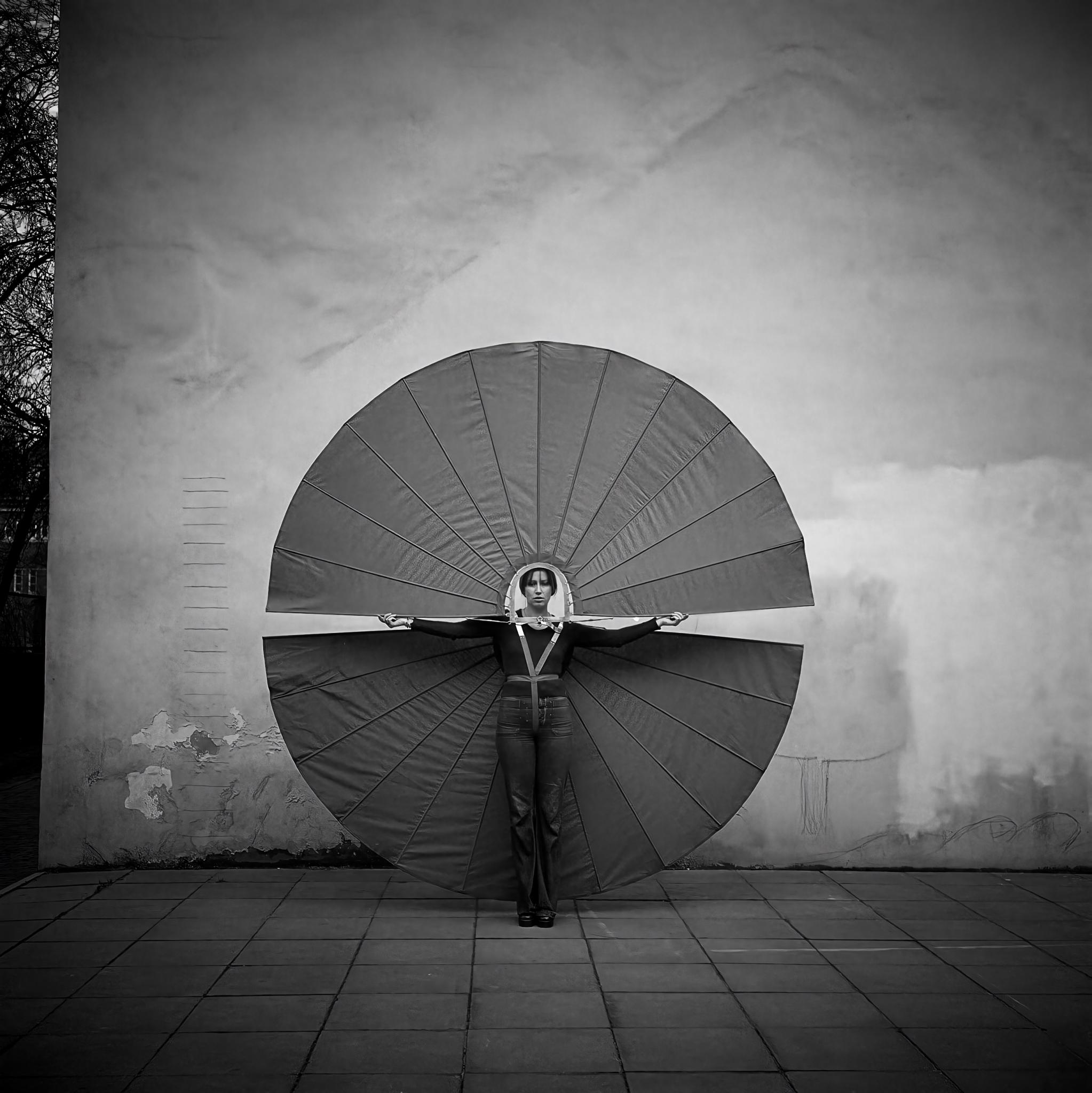
The circular fan works make that handoff visible before the machines take over completely. In one image, the body stands at the centre of a dark opened fan, arms stretched across the diameter, the apparatus forming a nearly complete disc around it. The figure is not reaching outward so much as being held as the hub of a radius. In another, the body has disappeared and the circular feathered form remains upright on its own, a pale wooden centre surrounded by a ring of off-white feathers. The interval survives the wearer. With the body gone, the apparatus keeps its circle intact, proving that the distance belonged to the device and not only to the person inside it.
Detached once, it can be detached completely. By 1988, in the Painting Machine, the reassignment is finished: brushes on hinged metal arms dip into paint, snap back, and throw their marks across wall and floor on an automated cycle, with no head and no hand anywhere in the circuit. The painter has been replaced by the machine that performs the painter’s motion. The act continues; the body has been let go of.
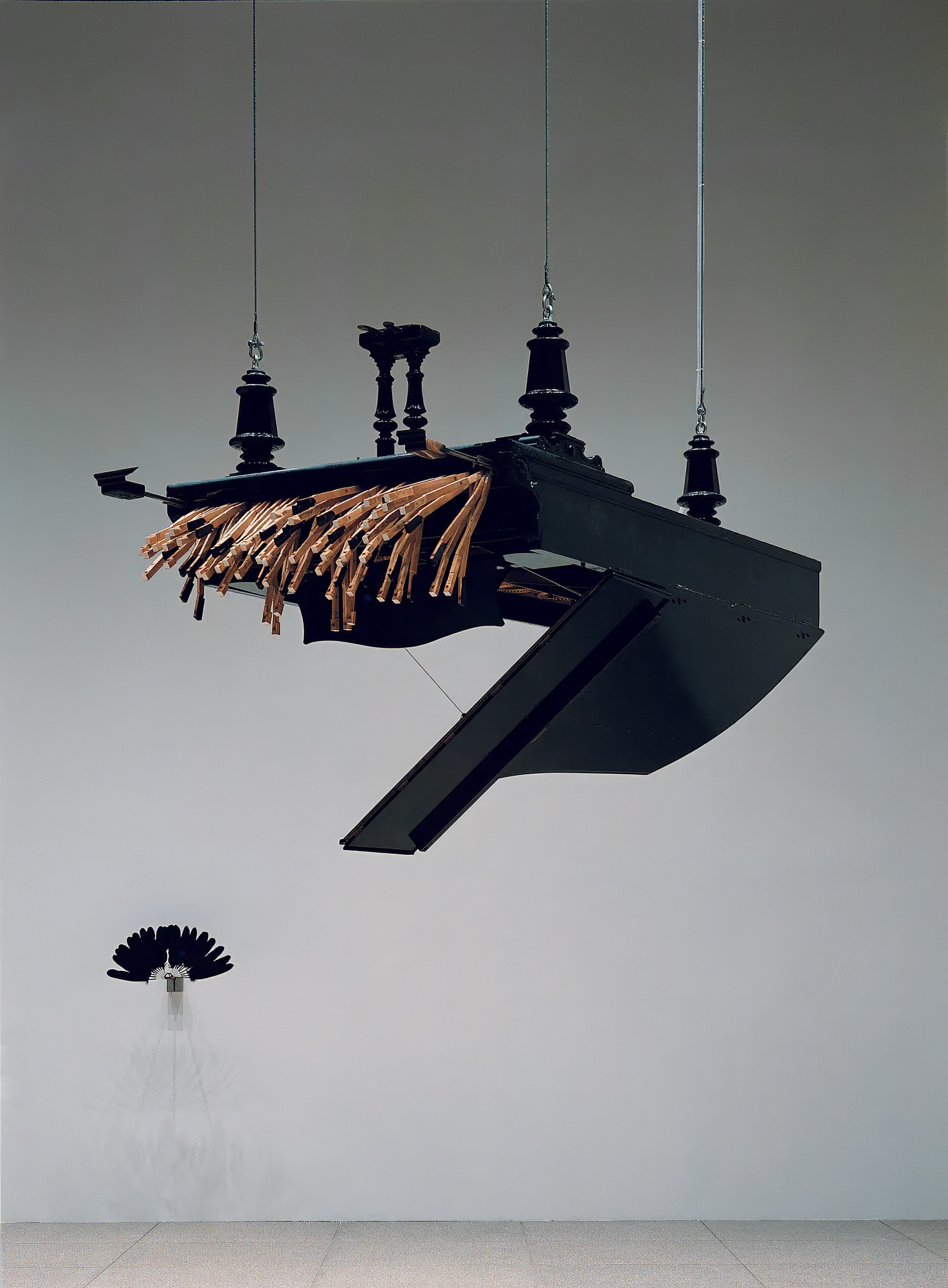
The end of that movement hangs from the ceiling. Concert for Anarchy, from 1990, is a grand piano suspended upside down overhead, out of any player’s reach. Every few minutes a mechanism inside it fires: the keys are thrust violently out of the keyboard and hang in the air, the lid drops open onto the strings, the whole instrument convulses into noise — and then, slowly, it draws the keys back in and closes itself, like something withdrawing into a shell, until the next time. The instrument of touch faces no possible player.
The piano is the body’s surrogate, and it performs the one act most dependent on contact — music, made at a keyboard, by hands — with the hands abolished and the keys, the very point of touch, ejected into empty space. Horn liked to say her machines tire, that a stopped machine is not broken but only resting, that it is part of their life to faint. Melancholy is available here, almost too available — the upside-down piano as a lonely thing performing its sadness. The piano may be allowed that much, but melancholy is not its structure. What looks like an instrument keeping a person’s company is distance preserved in working order.
Rosalind Krauss, unpersuaded by the cult that grew around Horn, called the machines surrogate performers and meant it as a charge. The description is exact; only the verdict needs reversing. The surrogate names the work’s subject more exactly than the charge intended. A performer who could be replaced by an apparatus, and then dispensed with entirely, is the destination the sequence has been travelling toward since the gloves first put a measured length of wood between the hand and the wall.
Contact was never waiting at the end of the extension. It was held in the interval the extension made operational. The extended body does not overcome distance. It learns how precisely distance has been built in.
Horn’s gloves, extensions, masks, machines, and instruments do not restore the body to contact. They give the gap a mechanism. The more the apparatus reaches, the more precisely distance remains.
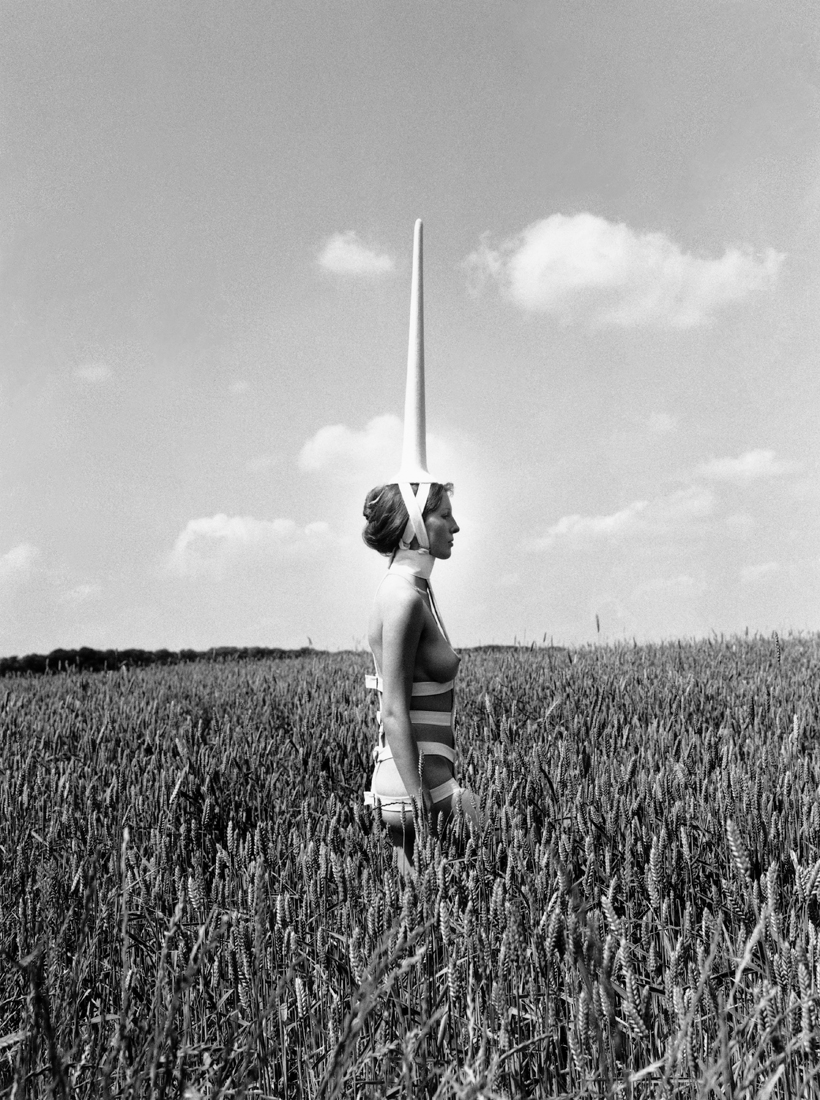



Cover Image: Rebecca Horn, Einhorn (Unicorn), 1970. Photo: Achim Thode © VG Bild-Kunst, Bonn 2024.