



The small grey canvas on the long wall is the painting the familiar account of Cho Yong-Ik has already described, and described correctly. 94-612 is a little under a metre tall. Its field is dark grey, streaked faintly sideways, and across it about two hundred and fifty pale drops sit in rows, each pointed downward like a seed. Along one side of every drop runs a dark crescent, and the crescent does the work: with it, each pale shape reads as a small opening in the grey, a scoop with a lip, as if something had gone into the surface and left a lighter layer beneath it showing. Close to, the rows waver. From across the room the surface reads as a field that has been opened, evenly, several hundred times.
The familiar account of Cho’s repeated marks says this is what happened. Since 2016, when a retrospective in Seoul and a survey in Hong Kong returned him to view, the description has been stable: a layer of colour laid over another, the upper layer worked while it could still be moved, so that each mark brings the layer underneath into sight, and the action repeated across the canvas. Korean reporting names a finger, a knife and a brush; English gallery texts tend to say thumb. The text on the wall here calls the mark subtraction as much as addition, and the word Dansaekhwa is usually somewhere nearby. For 94-612 none of this needs correcting.
19-841 hangs directly beside it, the same size to within a few millimetres and from the same year. Its field is off-white, crossed by a dark grey crosshatch that follows the weave, so that the surface reads as a fine grid. On it sit a hundred and ten drops, or near it: white, smooth, pointed down, larger than their neighbours, and at the lower tip of each a dark grey smudge, soft-edged, like a blot. Inside the drops the crosshatch stops. Everything the surrounding surface is made of ends at the drop’s edge, and the drop is plain white.
The description of making has one sentence for both paintings, and it is probably right for both. It cannot tell them apart, and the eye can. In 94-612 the pale shapes go in. In 19-841 they sit on top. The white drops read as things lying on the surface, laid on, the way a white paste would lie on cloth, and the smudge at the tip reads as something under them, a stain they have been set down over.
A light patch on a darker surface can be a change of colour in the surface itself, the way a pale thread runs through a dark cloth. It can be a place where the surface goes back, a hollow with the lighter layer at its floor. Or it can be something lying on the surface, with its own edge and its own top. The painter’s action does not settle which. The finished surface does, through how dark the field is, whether its texture continues into the patch or stops at the edge, and what appears along that edge.
The two paintings keep the same basic arrangement: the same shape of unit, the same downward point, each drop separate from its neighbours, and in each a dark accent on one side only. What changes is the field, dark and streaked in one, pale and crosshatched in the other. In the dark field a pale shape with a dark edge along one side reads as a depression with a lip. In the pale crosshatched field a smooth white shape reads as a cover, because the texture that is everywhere else is missing inside it, and the smudge at its tip reads as beneath it because the smudge is soft and the drop is hard-edged.
The pair is not exact. 94-612 carries more than twice as many drops, and smaller ones, with the accent along the side rather than at the tip. Those differences belong to the unit; the change in what the unit is to the eye, hollow in one painting and thing in the other, travels with the field. Within each painting the reading holds across the whole surface. A single mark could produce the effect locally.
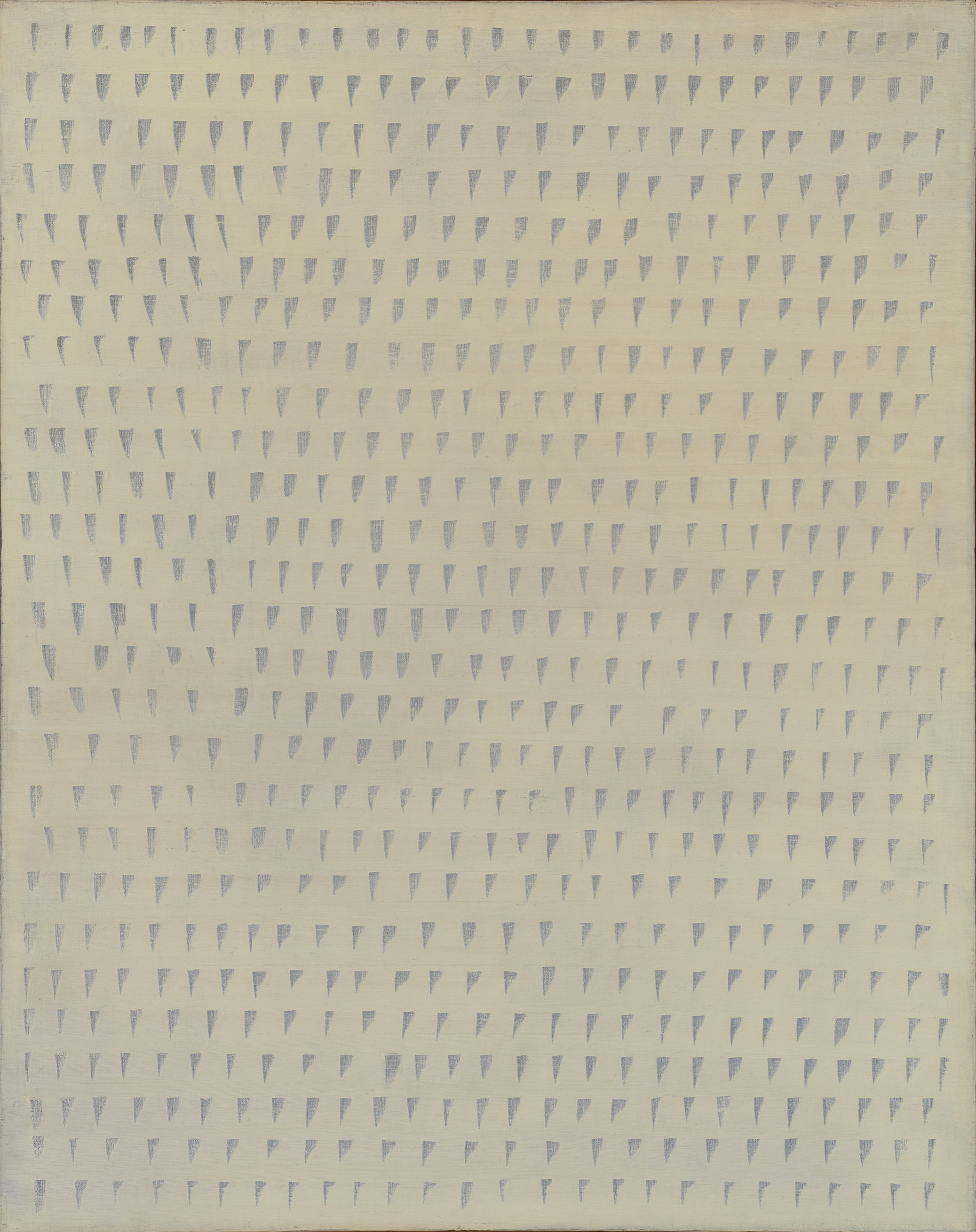
Past a further pair of small works and a window niche, alone on the wall, is 74-5, the earliest repeated work on view and the only one whose marks are darker than what surrounds them. The field is warm cream, uneven, yellower toward the top. The marks are grey wedges, square-topped or hooked at the top, tapering downward, several hundred of them in rows that hold and columns that drift, and they run nearly to the edges, closer than any of the later canvases allow. Inside each wedge, fine vertical lines of grey alternate with cream, and the wedge looks combed. There is no dark edge. There is no lip.
Two paintings back, an expectation formed: a repeated unit on a Cho canvas is a light place where the surface was opened, and the opening is where the depth is. 74-5 breaks it. The wedges do not read as holes and they do not read as things; they read as marks, grey drawn on or into the cream, a rubbed trace flush with the surface. Whatever the action was, it did not bring depth with it. Depth arrived in 94-612 because the surface there supplied it, in a dark field and a dark crescent. Here the surface supplies a pale field and a fine striation, and nothing goes in.
Across these paintings it can read as an opening, a thing laid on top or a trace held flat within the field, distinctions that neither chronology nor the action itself explains.
In a 2016 interview, Cho described the layers running both ways. In some works, he explained, a dark layer went down first and white over it, and the marks were made through the top; in others a bright colour came first and a dark one over it, with the same action. He described a procedure that could run in either direction and still be called one thing. What each direction gave the eye he did not say, and the paintings on this wall do not give one answer. Which order 74-5 was painted in, and with what, is not on record.
74-5 is a 1974 canvas met here after two from 2021, and the order of the walk implies nothing about where the work was going; walked the other way, the pale field would still supply no depth.
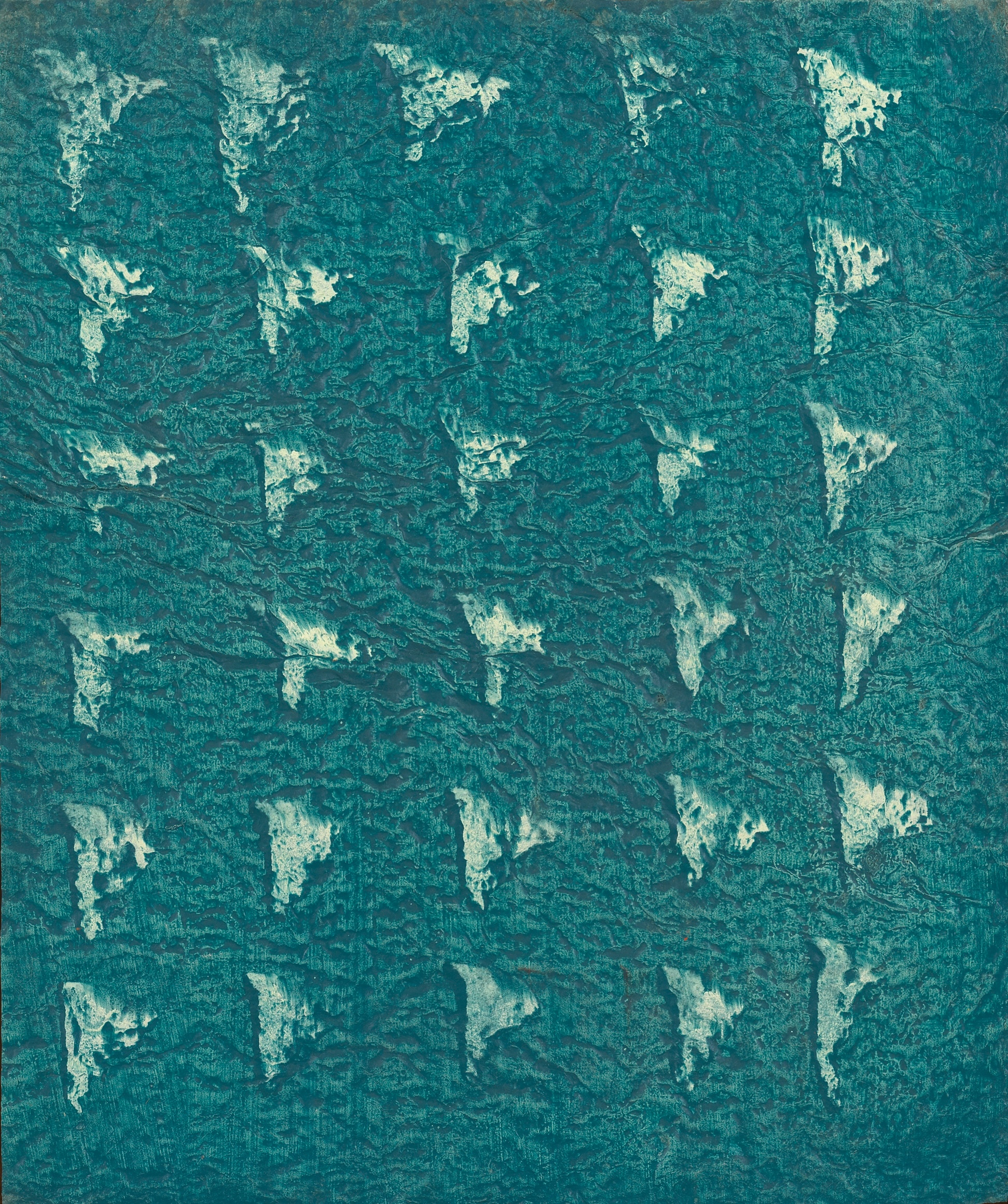
From here the wall turns to paper. Four small works hang as a block, two over two, captioned by the gallery Revealing the void. In 3613, top left, teal has been laid over a surface crumpled into ridges across the whole sheet, and thirty ragged pale flags sit where the teal is absent, flecked with teal in their hollows. The creases run straight through them. Ridge and furrow continue from field into flag and out the other side, and only the colour changes: one continuous crumpled relief that is teal nearly everywhere and cream in thirty places. The red, mauve and green sheets around it do not all read the same way.
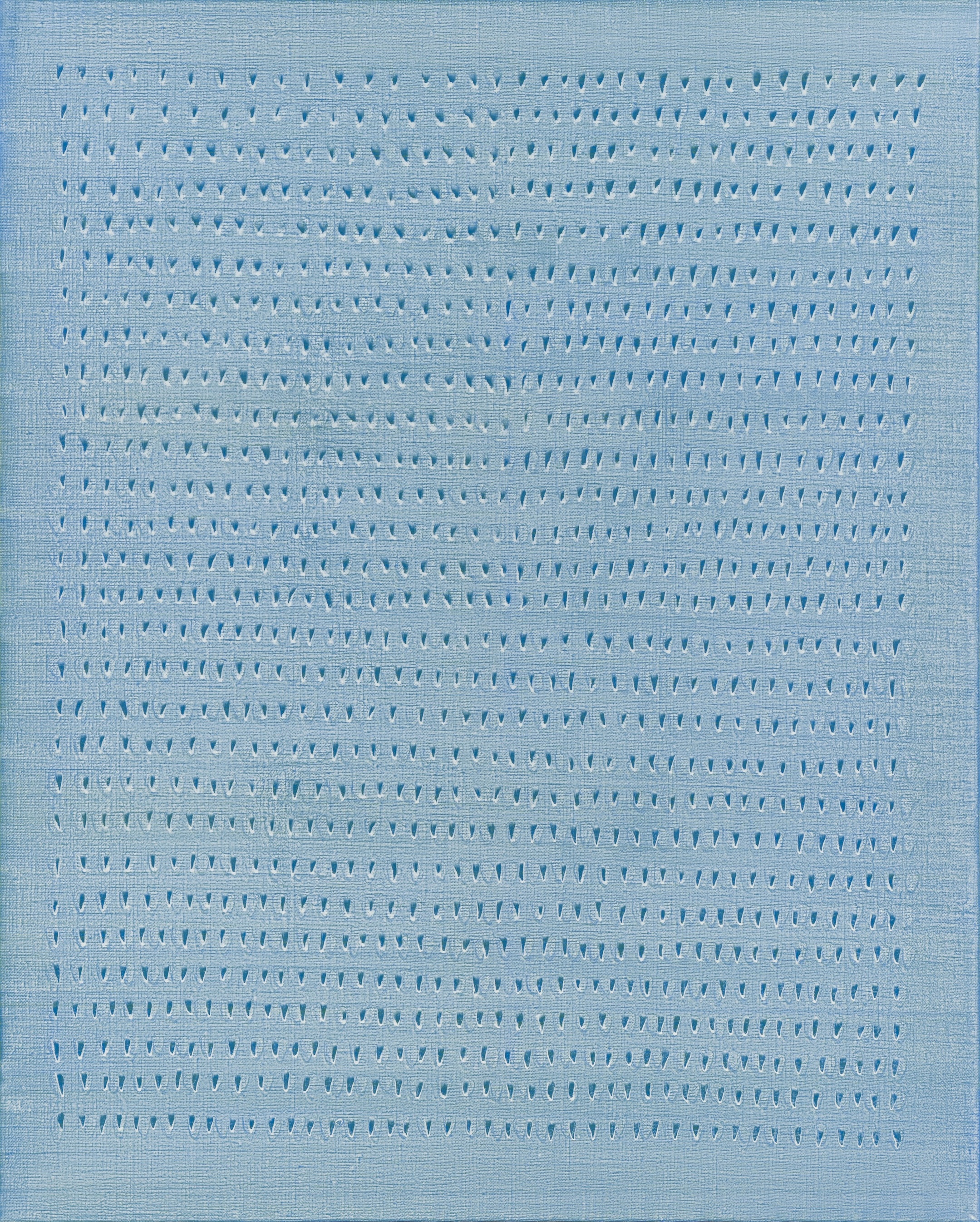
Then 17-129, the same format as 74-5 and with it the largest canvas on the wall, and the one painting here that will not settle. The field is pale sky blue with a coarse weave running through the whole of it. On it, in about thirty-three rows that stop well short of the edges, sit nearly a thousand tiny drops, each with a white part and a deeper blue part toward its tip, the weave visible in both. Which of the two colours lies on top cannot be recovered from any distance. The deeper blue could be a hollow in the pale field and the white its rim; the white could be something lying on the cloth and the blue its shadow; both could be lying flat, two colours meeting on the weave. In 94-612 the dark field and the crescent gave every drop the same reading at once. Here nothing does: the blue field is too pale to make the white a lip, the weave runs through both colours alike, and neither colour has an edge the other lacks. The reading stays open across the entire surface, and the repetition, which two paintings back made a reading belong to the whole canvas, here makes the openness belong to it.
The description of making fits this painting as well as it fits anything on the wall: a small mark repeated, one colour brought to sight in another. It has nothing to say about what the eye then does with it.
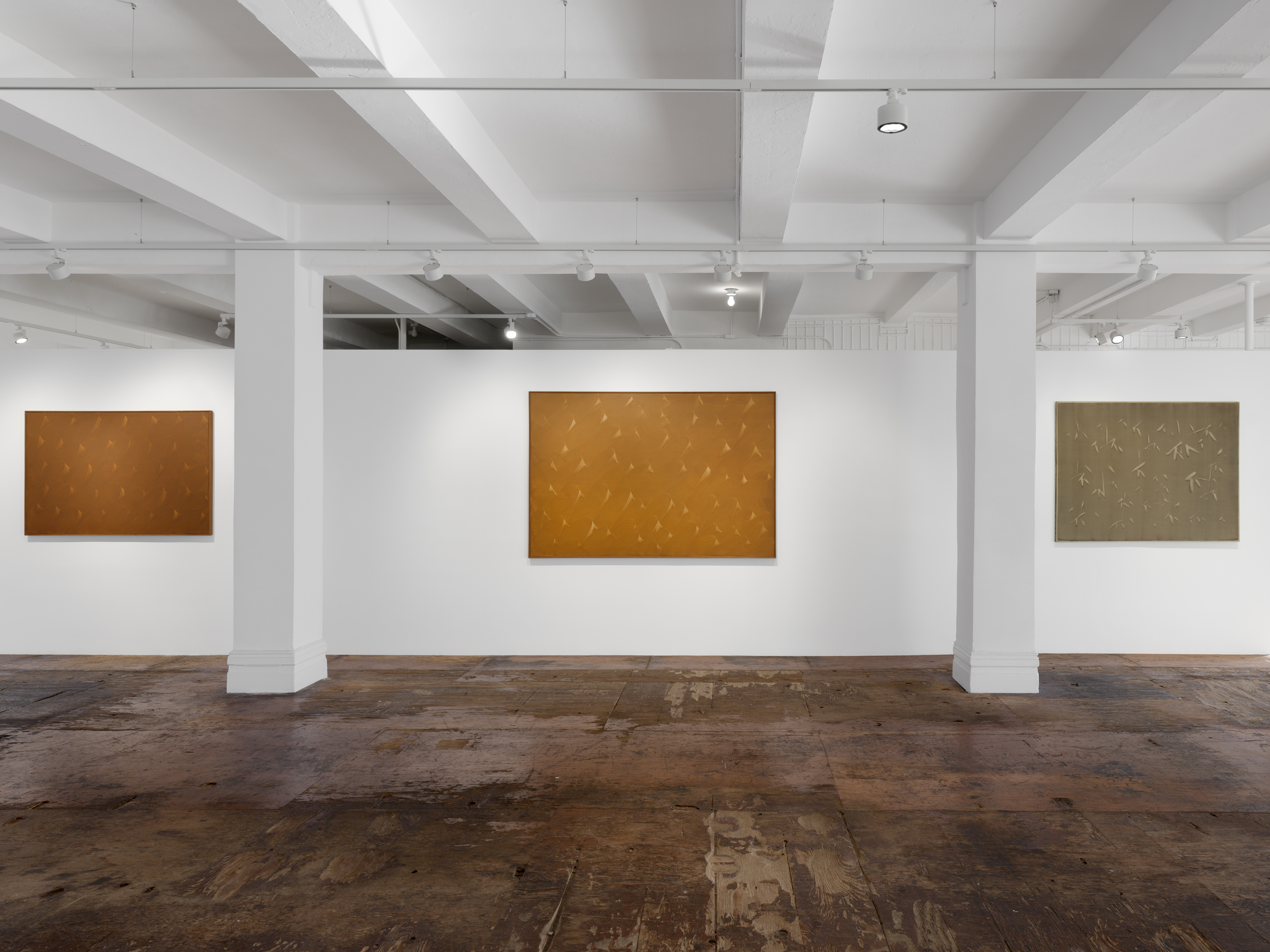
Across the room, between two columns, a partition faces the long wall with three canvases from 1986, 1987 and 1993. In Work 86-0818, ochre has been laid in broad diagonal sweeps, and where each sweep ends a pale yellow hook flares out, tapering, with fine parallel striations. Nothing separates the hook from the sweep: the ochre pales into it without a break, and the striations of the one run on into the other. The hook reads as the place where the field itself goes light.
In 93-9, pale cream blades taper and feather along one edge of a warm grey-taupe field, in loose clusters, some joined by thin stem-like lines. The shared downward alignment of the arrays across the room has gone, and so has the separateness. The blades begin to read together. The gallery reads bamboo leaves and the character for not; either way, the eye has begun to group what the earlier paintings kept apart.
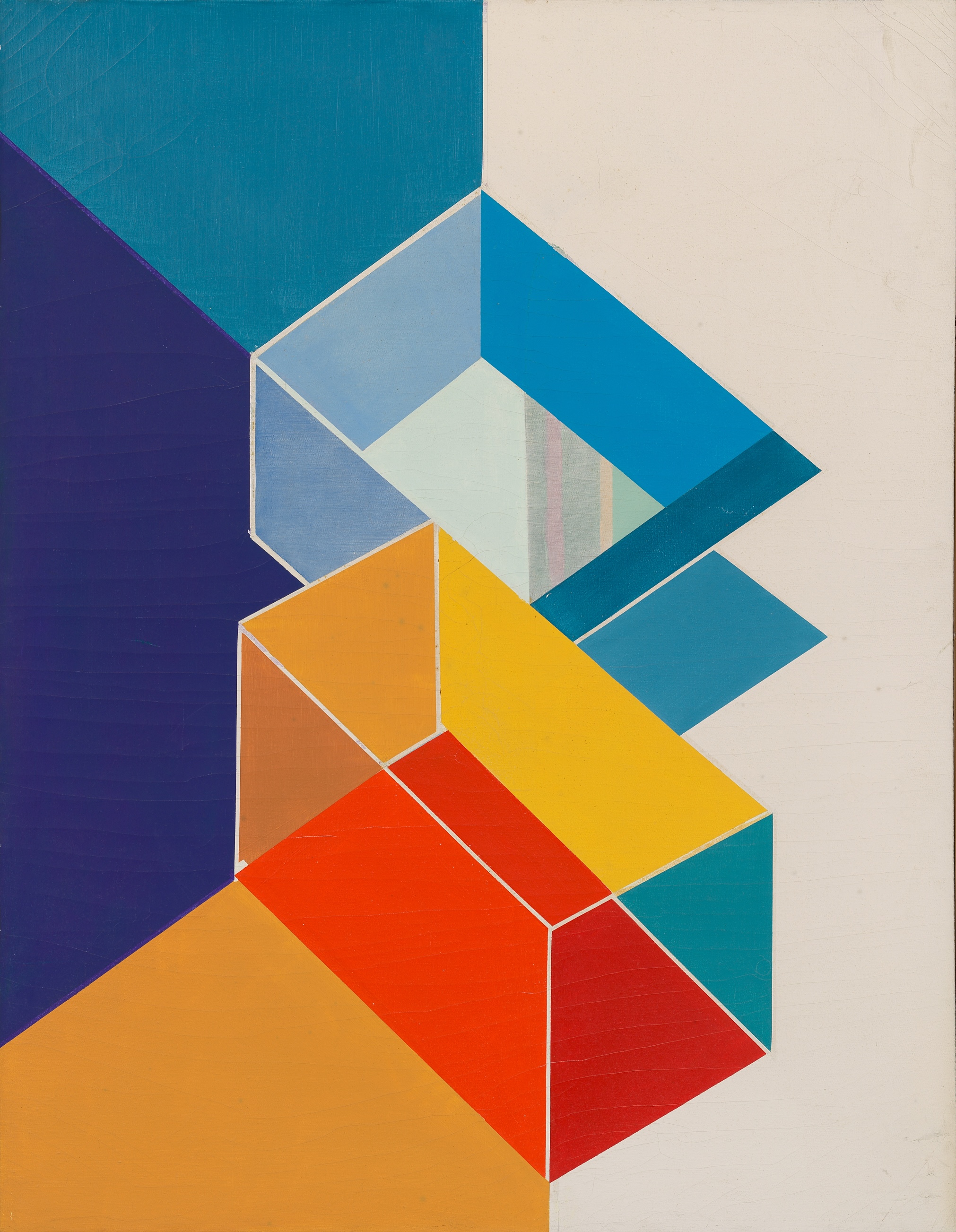
Back across the floor, 17-129 hangs directly beside the two 1968 canvases, with no break between them. In 68-113 and 68-112 there is no repeated unit. Prisms and bands of navy, teal, sky blue, orange, red and yellow interlock; the boundaries are hard, or drawn once with a thin cream line that may be paint and may be canvas left bare; cream areas with the weave showing sit between the colours and read as cloth left uncovered.
Three paintings from the end of the wall, the account the essay began with is still intact. It was right about 94-612, and it remains, as far as the record goes, nearly all there is to say about the making: two layers of unequal value, the upper worked before it set, a finger or a knife or a brush, and no source to say which tool, in which order, on which painting. The blue painting belongs to that account too. What it gives the eye is nearly a thousand small boundaries with the weave on both sides of each and no side securely on top, hung beside two canvases in which every edge was drawn once. The sentence about what was done to the surface would read the same for the grey painting near the other end of the wall, where every drop has its lip, and for this one, where none does. It has been standing in for a sentence about the paintings. On this wall it stops at the blue one.
Cho Yong-Ik’s repeated marks are usually described through the action that produced them: one layer of colour worked through another, the gesture repeated across the surface. At Kiang Malingue, that account remains intact. What changes is what the marks become to the eye. A pale shape can appear as an opening, sit on top of the surface, remain flush with it, or refuse to settle at all. The action may be continuous. Its pictorial result is not.


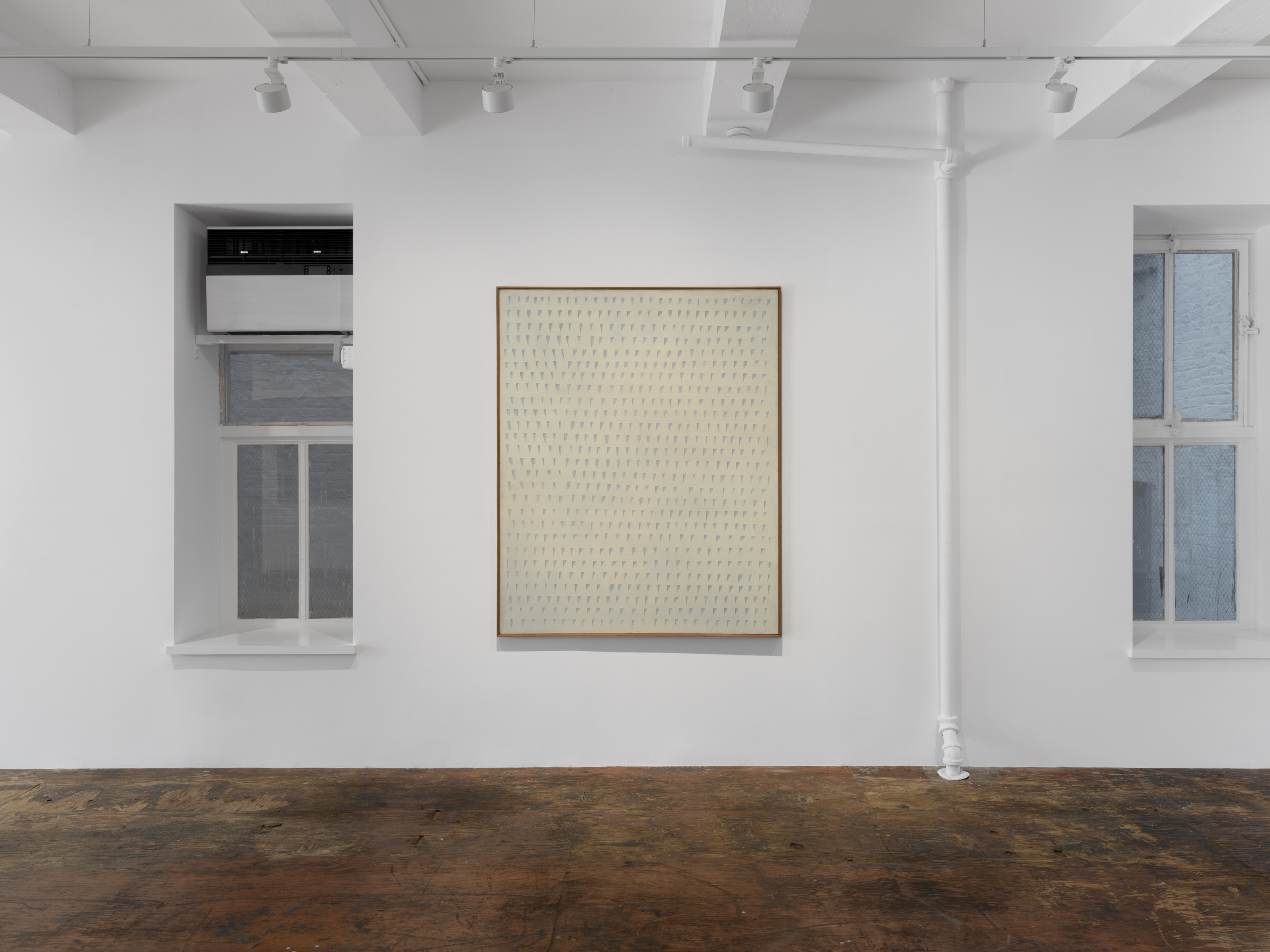

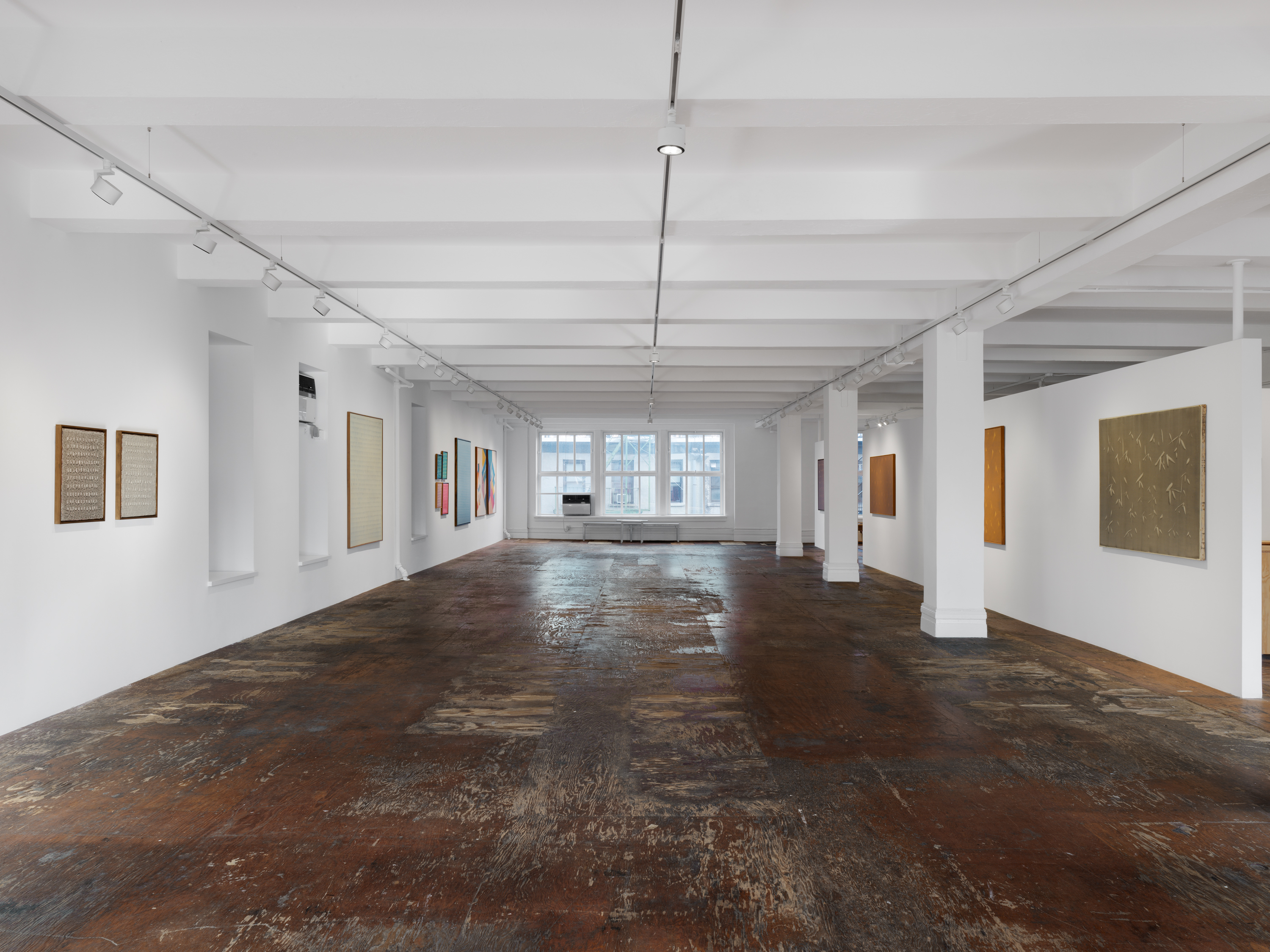



Cover Image: Installation view, Cho Yong-Ik: The Irreducible I, Kiang Malingue, New York, 18 September–31 October 2026. © Cho Yong-Ik. Courtesy Kiang Malingue. Photo: Dan Bradica.