

Posenenske began with four plain statements.
Her square tubes had already been in production for a year. The things were already built. Her manifesto set down in print what had already become the condition of the work, and did so in the year she stopped making art.
The order matters. Variability comes first, but simplicity and reproducibility are what make it possible. She calls the works “components of a space,” compares them to building elements, and says they can be rearranged into new combinations or positions. The alteration is left to the consumer, who participates “again and anew” in the creation. The consumer arrives only after the component, because participation requires something already fixed. There is nothing to rearrange until the elements are alike enough to combine.
The Vierkantrohre — square tubes in galvanized sheet steel, proportioned like industrial ventilation ducts — had gone into production in 1967 as standard elements: made in series, without limit, identical within their type. Posenenske determined the element — geometry, gauge, finish, the rules of its series. She did not determine the form any installation would take. Whoever received the tubes arranged them, and the arranging was not a permission granted alongside the work but a condition built into it.
Start anywhere a run stops. The end of a Serie D element remains open: a square cross-section of sheet steel cut and folded back, a rim of bolt heads around the opening, nothing capping it. Every documented run in the photographs consulted here ends the same way — thirteen photographs, six decades of installations, not one closed end among them. The runs stop; nothing finishes them.
The bolts are doing more than joining element to element. They run along the tube’s own seam, around the rim of the opening, down the inside of the mouth where the miter folds catch the light. The same hardware that fastens a flat sheet into a tube then fastens tube to tube — the same bolts, at the same spacing, equally exposed inside and out. That continuity makes the distinction harder to see than it first appears. Making an element and combining elements are different acts; one was hers alone, one was released. But the object does not mark them as different. The boundary between what she fixed and what she released is not given by the material. She decided it.
From the same set of types come very different arrangements: a symmetrical V balanced free on the floor at the joint where its two open-ended runs meet and rise apart, a vertical run climbing a wall, a sprawl of ducts crossing a gallery, a column rising to meet a ceiling.
Serie DW makes the same logic easier to see because the material changes while the system holds. Corrugated pasteboard replaces galvanized steel, and the joint is re-engineered rather than copied: wide flanges built as doubled strips, large pale plastic bolt heads at sparse spacing, the corrugation flutes exposed on every cut edge. The elements grow toward architecture while the material drops toward packaging: light, cheap, and — the manifesto says it directly — meant for consumption. Nothing about the system changes. What changes is how little the substance now insists on permanence, which is to say how far the logic of series had been allowed to run.
Past the propositions the manifesto widens without changing direction: series rather than single pieces, because a series could be the first run of a mass production; elements approaching architectural dimension, less and less recognizable as artworks, carrying the objective character of industrial products. The artist of the future, she wrote, “should have to work with a team of specialists in a development laboratory.”
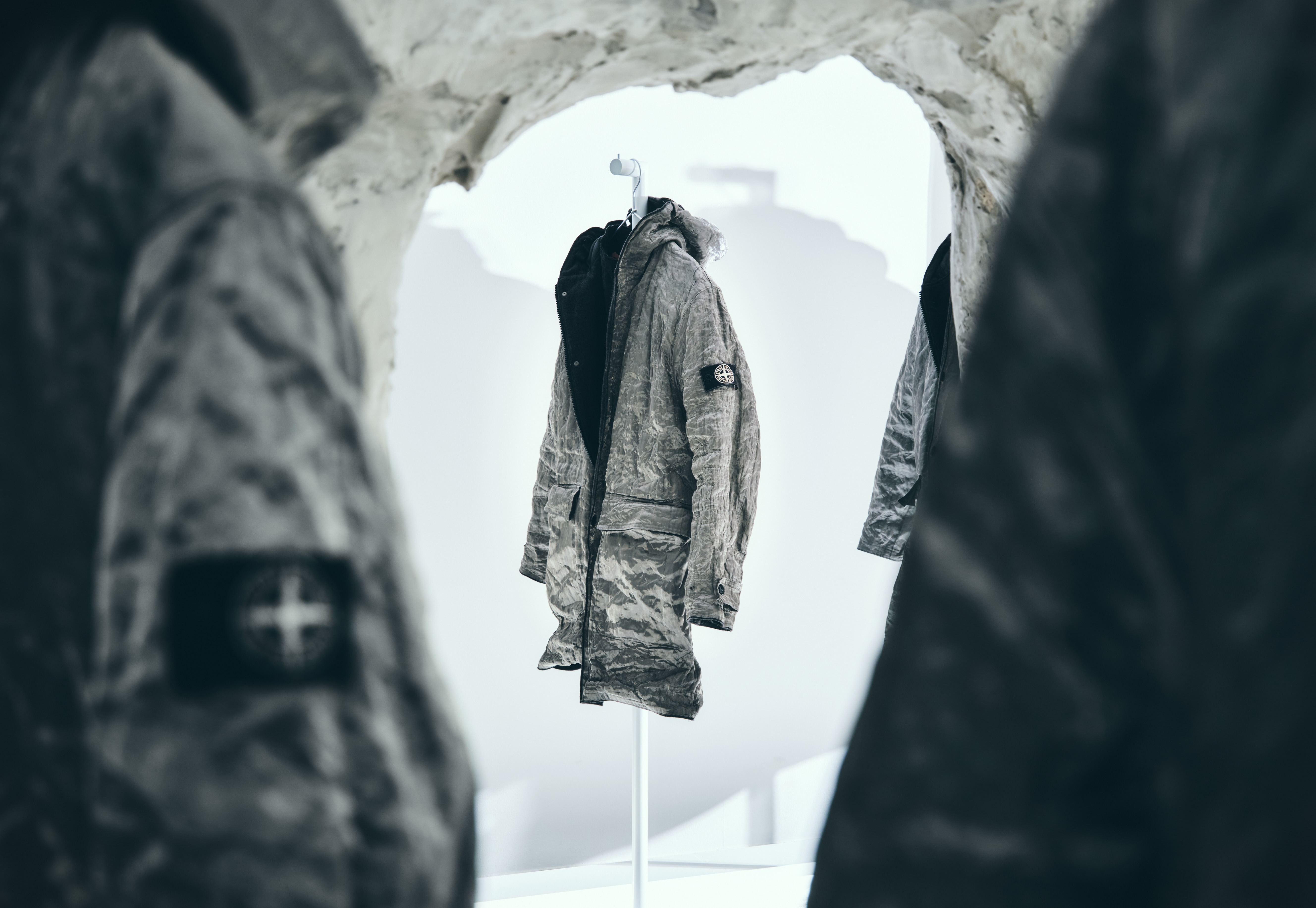
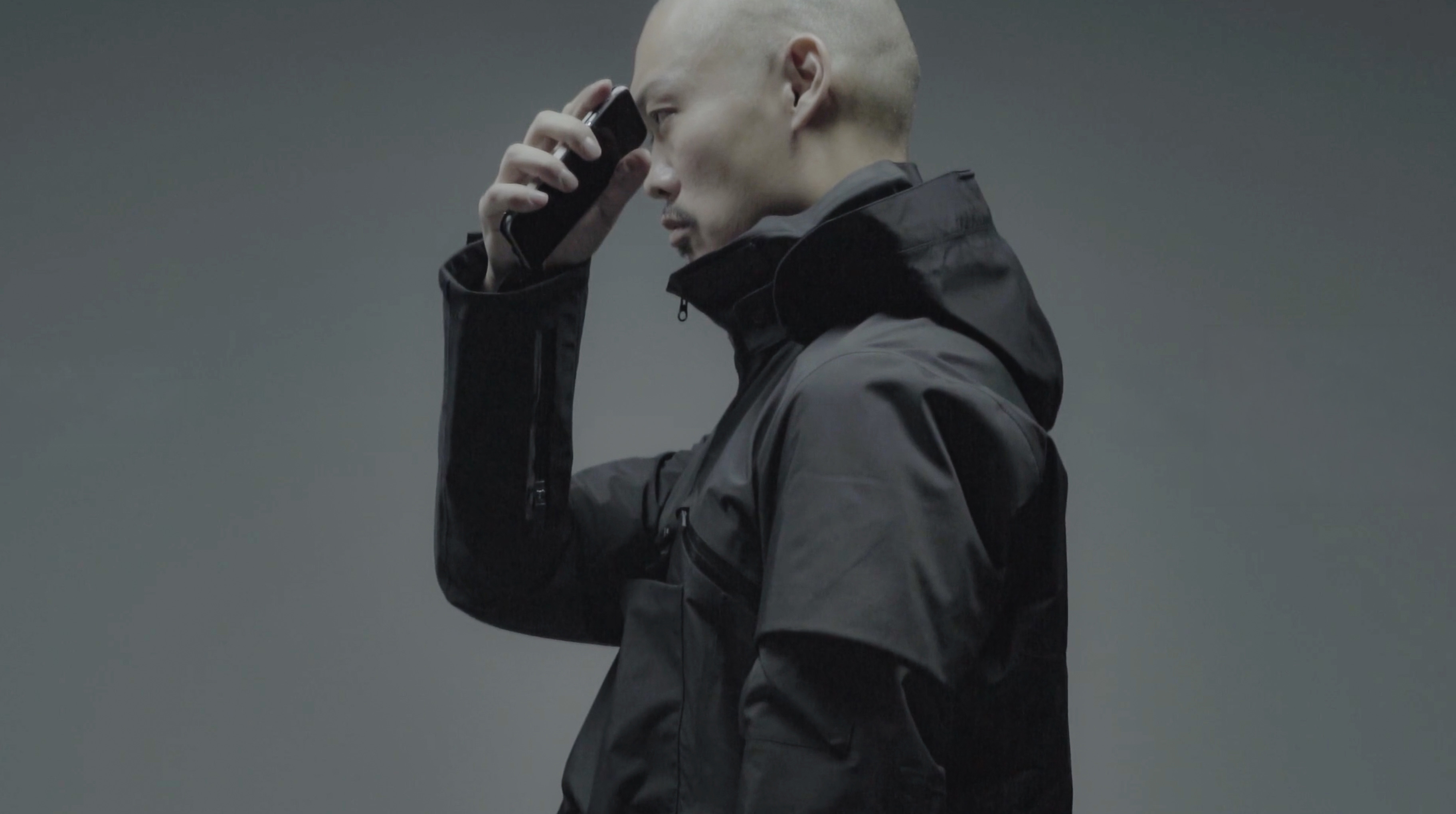
Errolson Hugh and Michaela Sachenbacher founded ACRONYM in 1994, and for its first eight years it had no line of its own: a design agency, solving other companies’ garment problems to other companies’ briefs. The first collection under the studio’s name appeared in 2002. What survived the agency period was its habit of mind — the garment as a coordinated set of problems and permitted actions, not a look. The J1A is the origin garment of that habit; the J1A-GT is the one read here. Little on its surface announces what is inside it: a shell in black or the gray-green called RAF green, no graphics, no logo field, nothing on the cloth asking to be read. Its vocabulary sits elsewhere — an authored set of named operations built into the garment.
Posenenske declared the handover in print, in plain terms, in the same year she stopped making art. After 1968 the statement remained to specify what could continue without her — and even its name was not hers to settle. She would have said statement. The field said manifesto.
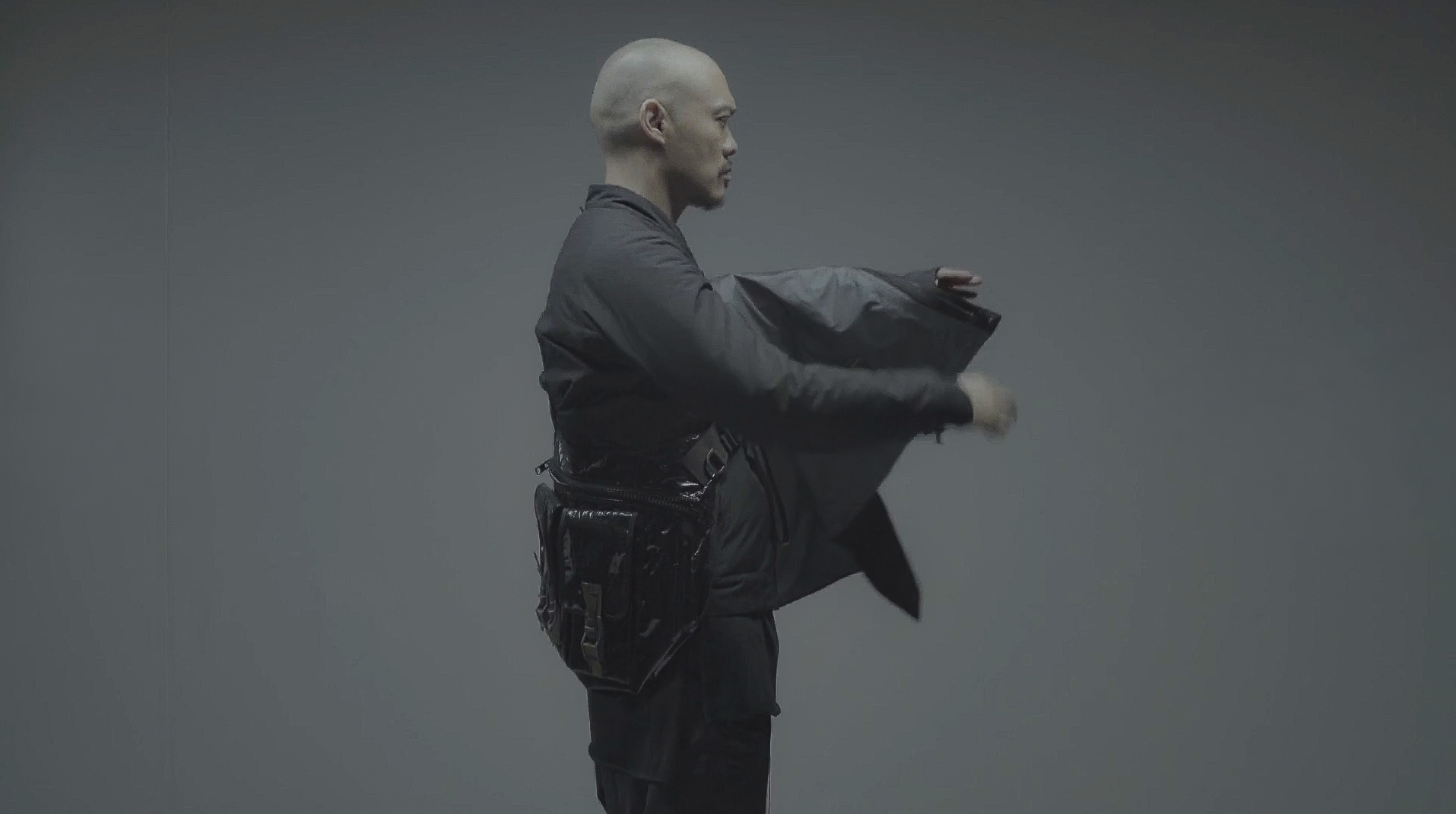
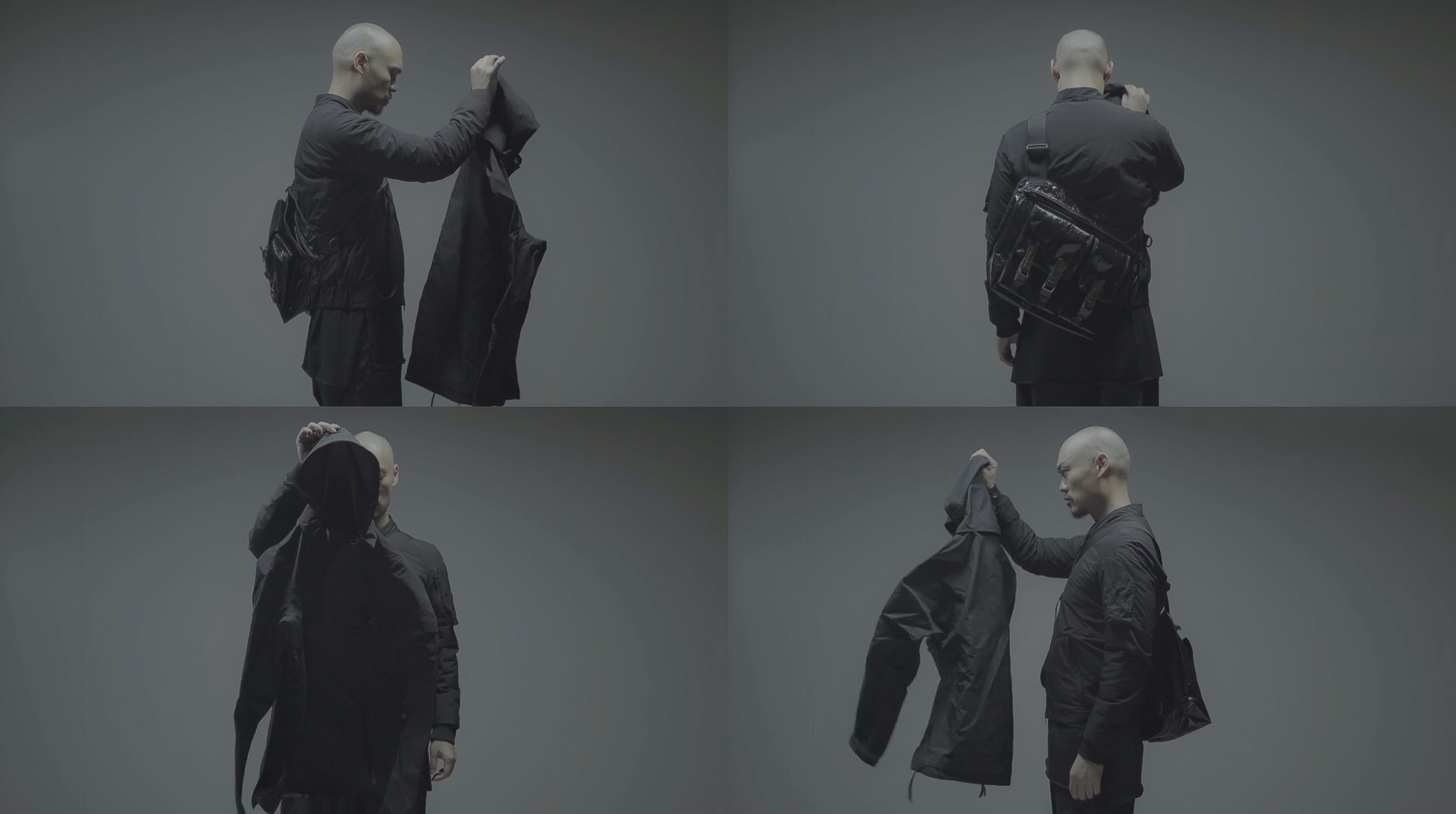
The studio filmed its vocabulary instead. Acronymjutsu was a series, not an event: films that began in 2011 and ran through 2016, directed throughout by Ken-Tonio Yamamoto, carrying a recurring credit that assigned action design to the studio. The credit was exact because movement is what had been designed. The J1A-GT film is the close reading of the practice, and it is the record through which the operations are read here.
Hugh wears his own jacket, and the acts arrive as movement before they arrive as names. A zip and a snap release along the sleeve and a phone drops by its own weight into his hand — the operation the studio calls the Gravity Pocket. The shell comes off the torso in seconds through a practiced doffing and hangs across his back from an internal strap behind the collar, off the body and still in its orbit — the JacketSling. One pull opens the collar in an emergency — the EscapeZip. The hood stows and deploys. One operation opens into the next, performed as a continuous discipline, not demonstrated as a list.
The names come afterward. They sit above the movements and make them citable — across garments, across films. Each mechanism is engineered once and repeated; the mechanism, not the garment, becomes the standard unit, doing the work her element types do. What the film never does is assign. It names the operations and shows their relations, and nowhere in it — nowhere the garment speaks at all — is a wearer told the offer is his to settle.
The difference begins with where each vocabulary lives. Hers is external to every realization. It resides in determinations — geometry, gauge, finish, the rules of the series — and the elements themselves, between exhibitions, are stock. A combination that has never been built does not exist yet; it costs nothing, weighs nothing, occupies no one. Unused possibility, in her system, waits in storage.
The studio’s vocabulary has nowhere to wait. The J1A-GT contains its offered operations materially: mechanisms sewn into every unit whether or not a given wearer will ever use them. Unused possibility here is carried — as seams, hardware, manufacturing complexity, retail price, and points of failure. A mechanism nobody uses still had to be engineered, still adds cost at the register, can still break.
The residue separates differently on each side. On the zinc, what remains is contact. Bare galvanized sheet takes the touch of whoever handles it: on the upper faces of one documented configuration, hand smudges sit where the elements were gripped. One installation’s handling, and only that.
The jacket keeps something cumulative. Hugh has described, in interview, reading garments returned to the studio through their wear: pockets gone soft where a hand kept arriving, the sling’s path pressed across a shoulder, each shell an account of which offered actions one particular body selected, over and over, until the cloth recorded it. Contact on one side, habit on the other; they do not weigh the same.
By 2019 that habit had been documented at length. An owner who had worn the jacket across different conditions published a long-form review, and what it reports is a settlement. The sling had become routine. The Gravity Pocket no longer held a phone; it had been reassigned to cards. Several mechanisms had gone unused. Another garment had emerged inside the one he bought: the operative garment, the one functioning in a life, produced by selection rather than delivered by design. The review records the discovery underneath — he had bought, and permanently carries, an offer nobody told him was his to select from.
A year later, a journalist on a hotel terrace watched Hugh arrive with the jacket slung across his back — the author of the offer settled, like his customer, into a subset of his own vocabulary. Of everything the shell proposes, the sling is what his body kept.
That settlement changes the garment without changing the repertoire. The J101-GT is another silhouette on another body, yet the JacketSling and EscapeZip recur across it. The repeated operations belong to the repertoire — the layer of the practice larger than any one garment, the one the house restates and tunes.
The J97 makes the tuning visible. In its release film, the garment sits between shirt and jacket; its sling is removable; its offer is narrowed to a smaller set of proposed actions. The subtraction shows that the demands of a full shell were never features accumulating because they could. There is something deliberate to remove.
The removable sling does not undo the asymmetry. It was designed, manufactured, and delivered as part of the offer; what a wearer can lift out, the house first decided to build in as liftable. Location at delivery is forced; permanence after delivery is designed. A garment cannot externalize its whole offer and still arrive as a garment. What the house controls is the composition of the offer — how much of the vocabulary remains permanent, how much becomes removable, how much is withheld.
Posenenske’s vocabulary continues differently. Estate-authorized fabrications of the Vierkantrohre extend the series under certificates issued by the estate. Dia acquired more than 150 newly fabricated elements. New elements may be made; new configurations may be mounted; arrangements may appear that she never saw. Even recent installations balancing elements on corners and edges introduce no new theatrical logic: the same unplinthed, tipped stance stands in the 1967 documentation. Fabrication continues; determination does not. What remains fixed is the element itself. The certificate polices that boundary.
Some of ACRONYM’s vocabulary has also left the studio, and what survives the transfer separates its layers. Versions of actual pieces later crossed into Deus Ex and Death Stranding — operations designed for physical bodies carried into fictional ones, because what was carried was a set of actions, and fictions require actions too. A more exact test began in 2008, when the studio started working on Stone Island’s Shadow Project.
Shadow Project organized itself through its own PARSEQ grid, not through ACRONYM’s, and ACRONYM’s proprietary names do not appear in the Shadow Project materials examined here. What crossed was quieter and more structural: the modular habit of composition, and at least one complete operation — a chest pocket that empties, gravity-assisted, into a lower reservoir. The operation traveled; the noun stayed home. Nor was the receiving line empty:
The transfer leaves three layers visible. The names do not travel. The method and individual operations can. What is not documented, in the garments examined here, is the third layer — the same recurring offer restated across silhouettes and held open toward a wearer’s resolution. Shadow Project received tools. The record does not show a second house making the proposal. That is not a shortfall; it is a measurement. It locates what the practice keeps most its own.
The question of control returns to Posenenske. No one may alter the determinations of her system; extension continues inside rules that stay fixed, with a certificate policing the difference. ACRONYM’s repertoire can change, but the change remains with the house — the offer restated whole or composed downward. Hugh has described the aim, in interview, as a full-spectrum garment. A spectrum is a span of possibility, and the span is authored. The wearer does not extend it; he collapses it into the subset he will actually live in.
The manifesto follows its own logic into money, and so did she. The work, it argues, should be repeatable, objective, economical; the series could be prototypes for mass production. The practice made the argument literal. The series from B through E were produced in unlimited edition and sold at cost — production plus overhead — with assembly left to those who bought or displayed the elements, whom she called consumers.
The economic decision extends the handover already built into the work: no rarity, no premium, no original for value to gather around. Her name for what she was refusing is in the manifesto too — art as a product of temporary topicality, a minute market in which prestige and prices rise as the supply grows less topical. In 1968 she accepted where the sequence had been descending all along. She stopped making art and turned to sociology, leaving the works to continue under the conditions she had set — and the manifesto closes on the admission that it was painful to face that art could not contribute to solving urgent social problems.
ACRONYM authored an industrial character with equal deliberation — technical textiles, engineered hardware, operations standardized to the point of nomenclature — and holds it inside the opposite economics. Limited production. Drops that sell out. Resale premiums standing between a would-be wearer and the offer. What that gate prices is not the resolution; no sum buys the resolution, because only a wearer can perform it. What it prices is admission to the repertoire — permission to begin selecting.
Posenenske had somewhere to exit to — a discipline waiting — and the work ran on without her because no single arrangement contained the possibilities of the system. ACRONYM has no equivalent destination. Whatever portion of its repertoire the house chooses to offer has to arrive materially inside the garment before a wearer can resolve it. The nearest thing on record is the J97, and it is not an exit. It is tuning: the offer composed downward with its authorship kept — a sling removable because the house built it liftable, the shell’s architecture still sewn in.
Charlotte Posenenske’s unused possibilities wait in storage, as standard elements that others arrange. ACRONYM’s are sewn into every jacket, carried as mechanisms a wearer may use, reassign, or ignore. Both place completion beyond the maker, but only one declares the handover; the other prices admission to a vocabulary the wearer must learn to select.

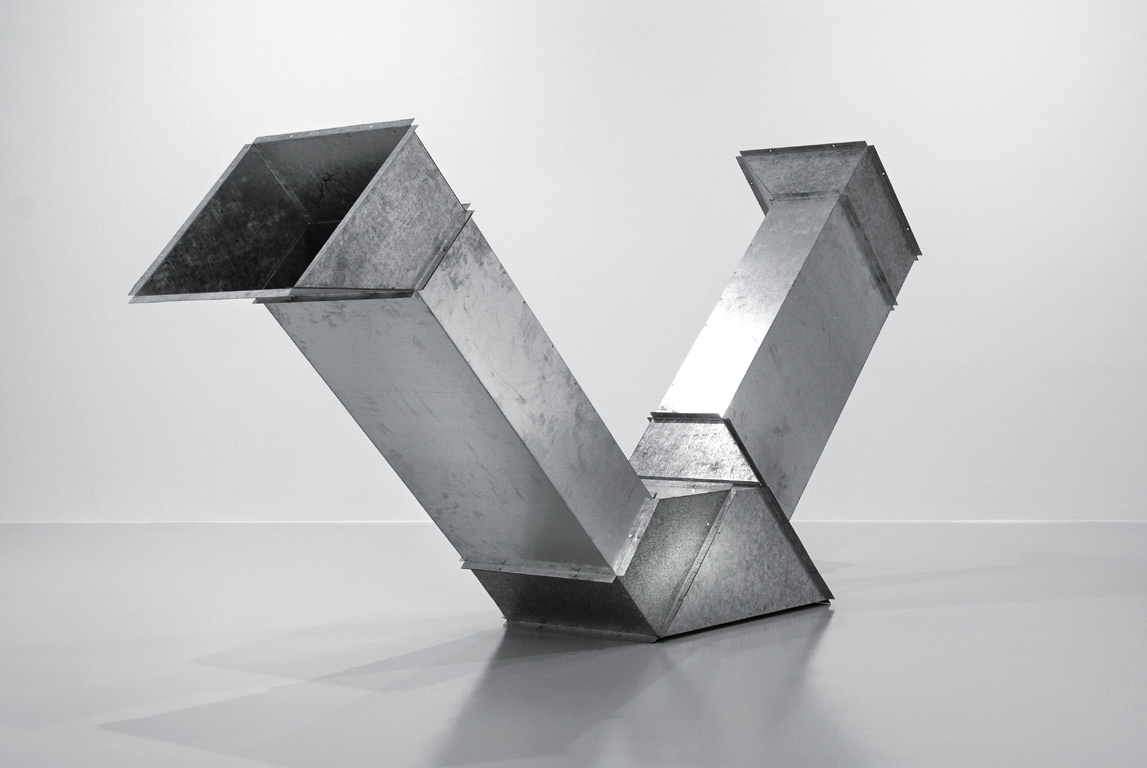

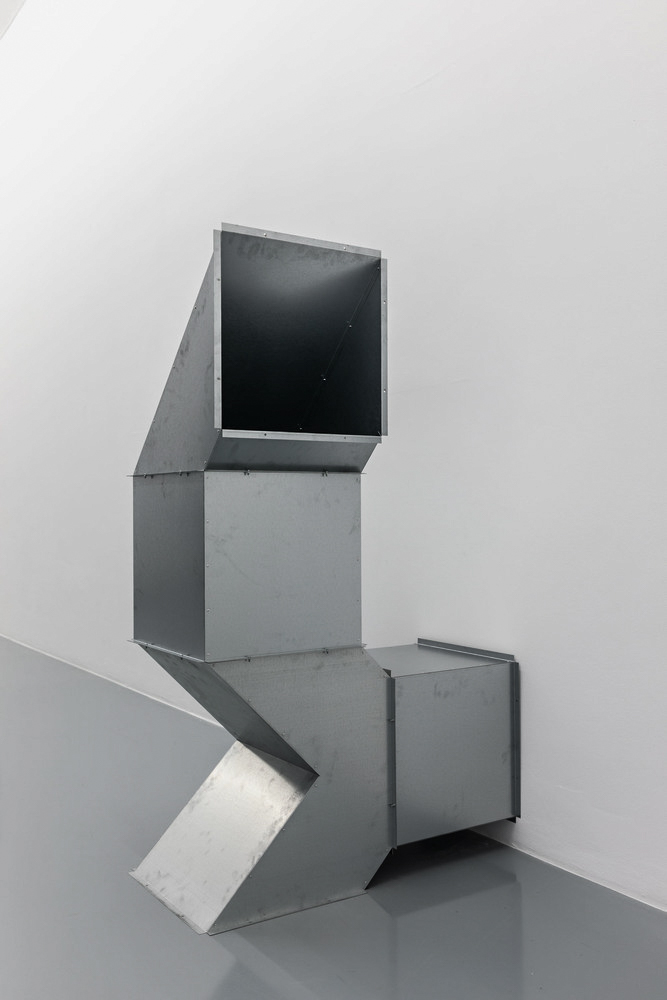





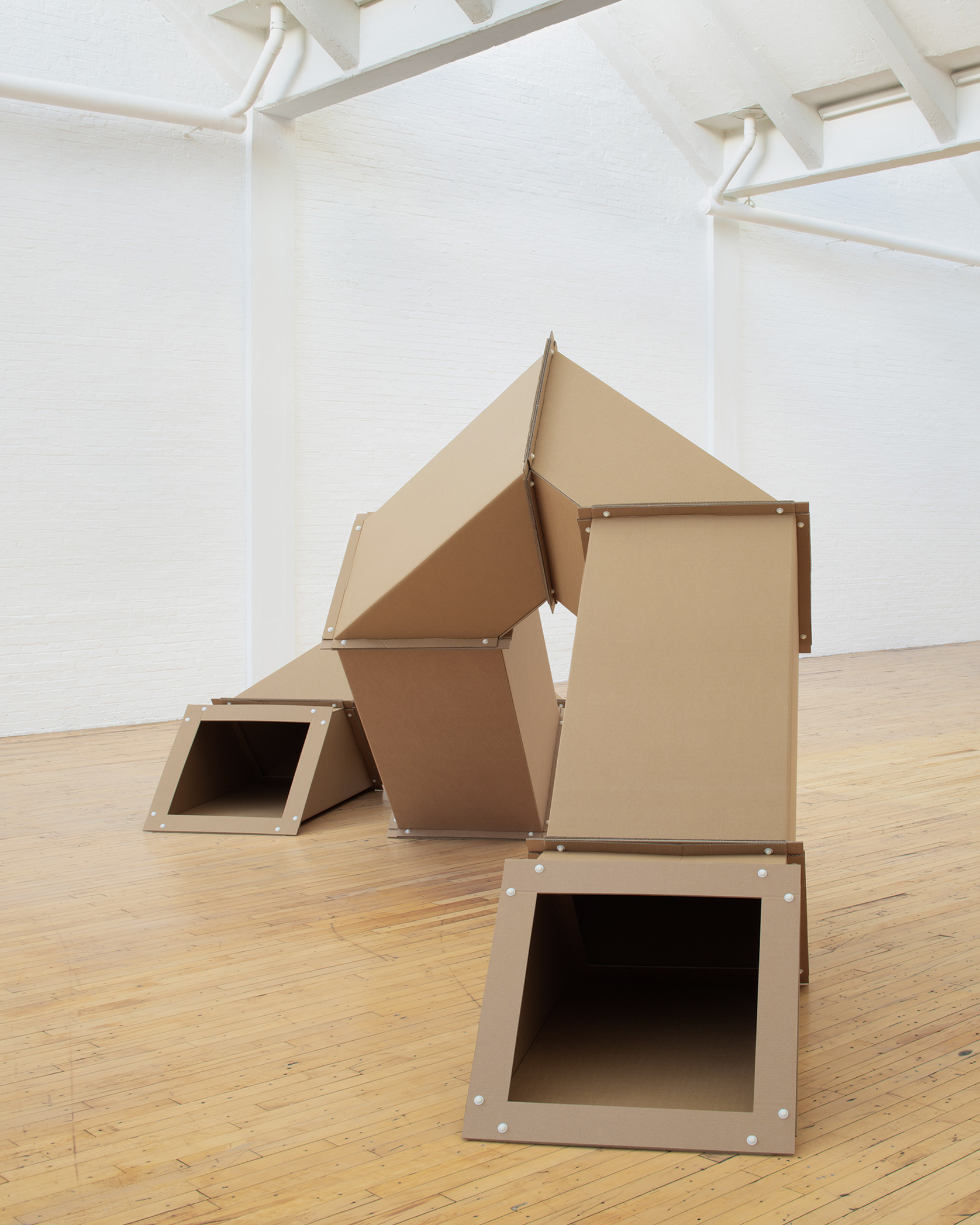
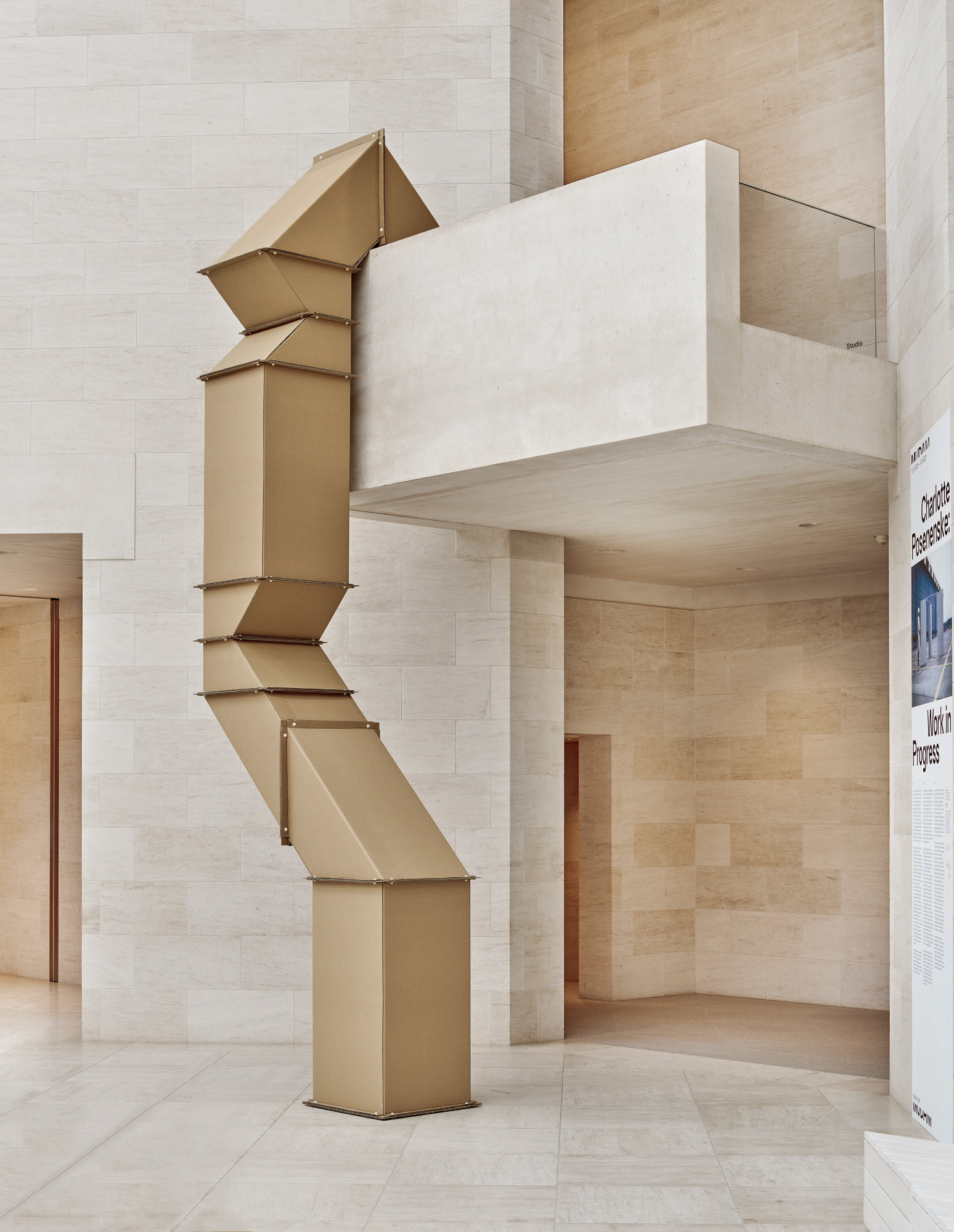
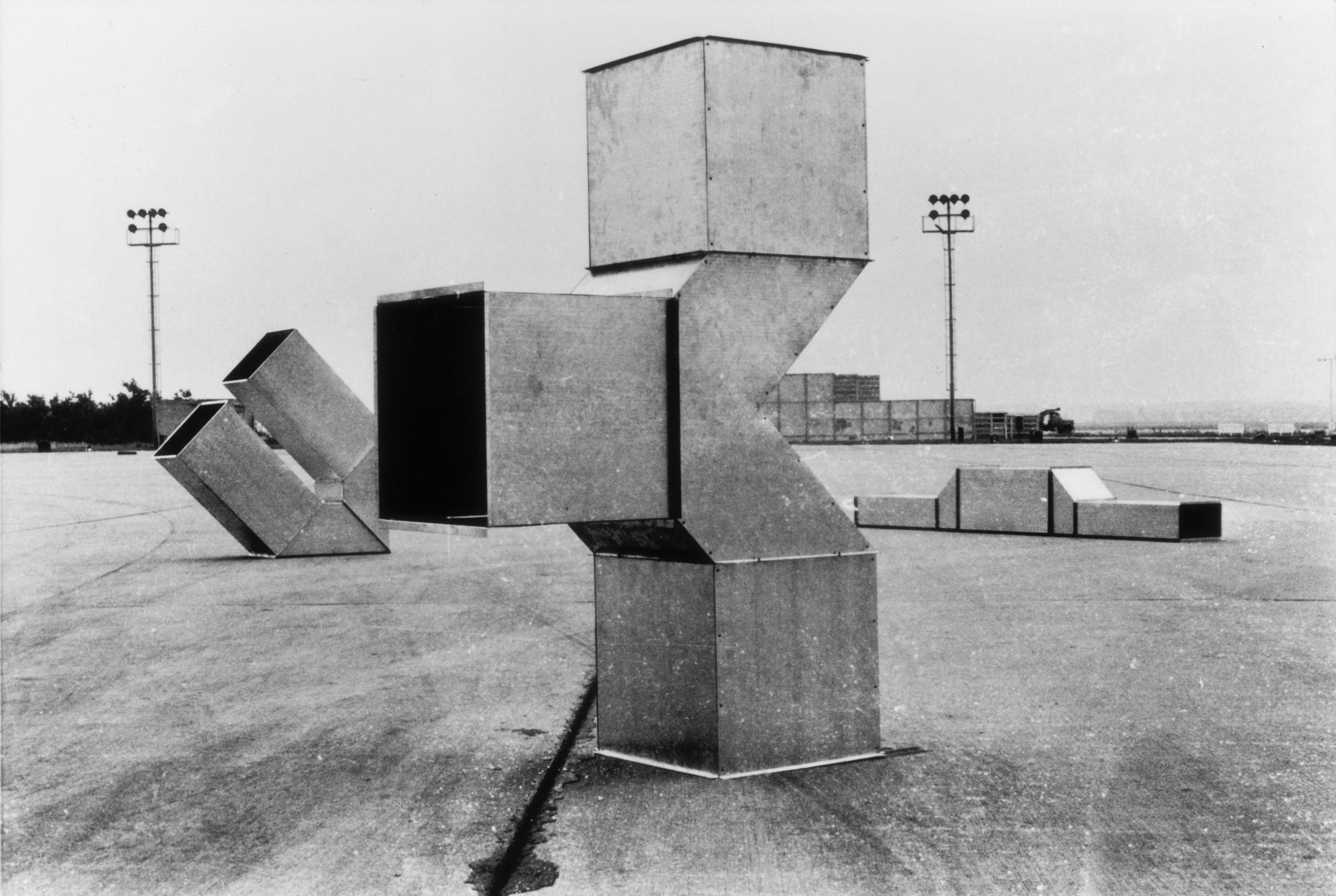

Cover Image: Charlotte Posenenske, Vierkantrohre Serie D (Square Tubes Series D), 1967. Installation view, Artists Space, New York, 2010. Galvanized sheet steel. Configured by the staff of Artists Space. Photo: Daniel Pérez. Courtesy of the Estate of Charlotte Posenenske, Frankfurt, and Mehdi Chouakri, Berlin. © Estate of Charlotte Posenenske / Burkhard Brunn, Frankfurt/M.
All images © their respective rights holders.
Image rights & attribution →