

The race had ended thirty-one years before the jacket was made for it. The Mille Miglia ran twenty-four times between 1927 and 1957, an open-road race the length of Italy, and then it stopped. What left Brescia in May 1988 was its historical return — revived at first every second year, annual from 1987, entry governed by a car’s relation to the original editions. Admission was a question of return: how directly a machine could be tied to runnings that had ended three decades before. Everything the period record preserves from that morning is people making a finished thing happen again.
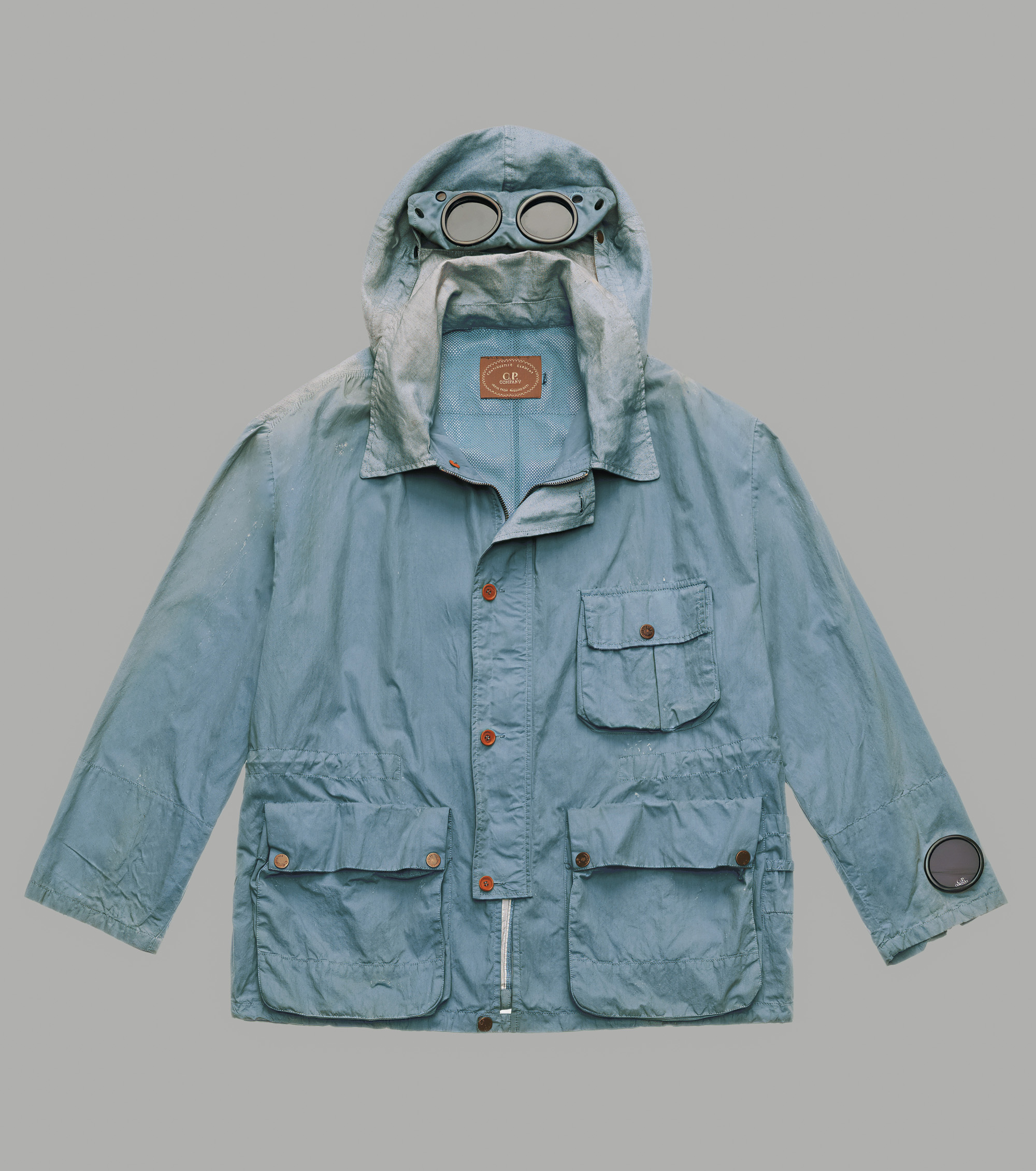
C.P. Company sponsored the 1988 running, and Massimo Osti made the jacket for it. Its occasion is printed on the chest — 1988, a year that dates the repetition, not the origin. The race’s patch sits above a bellows pocket. Two lenses are set into the hood. A smaller round window sits at the left cuff, over the place a watch is worn. The surviving accounts give the optics their driving jobs — eyes shielded at speed, the time read without releasing the wheel — and the jacket hardly needs the accounts to make its address plain. Everything on it faces the race.
Count what meets in this one garment: a resolved form; the lenses and the cuff window; a public event newly returned; a company’s name underwriting the day; and the founder’s judgment still close enough to hold every part together. Hold one now and it feels more real than any later Goggle Jacket before a single comparison is made. The feeling has never needed defending, because it is attached to something real. This is the jacket before the jacket became a family — before its components had been asked to carry anything beyond this event, this cloth, this use.
The photographs from the running show something the accounts do not. The jacket exists as event clothing before it exists as anything else. It circulates at its own debut — on body after body, worn and presented at once, inside the cars and out of them, creased by sitting, open at the collar, folded, hung, photographed through. The labour around it is divided. Where the day turns serious, helmets do the protecting and the hood lenses ride stowed between the shoulder blades; no wrist rises to be read through the cuff. The optics wait through a day that had other equipment for the danger. What the jacket held at Brescia was never demonstrated function. It was readiness — and the convergence that made readiness worth building. At the far edge of the record the garment is already in motion toward its next use, folded over a forearm toward another body, hung whole beside a race suit — already returning, before anyone had named return as a programme.
One more thing sits in the record, and it takes two years to arrive. The 1988 edition was cut in cream. The following May the race returned, and so did the jacket: the same architecture, its chest now printed 1989, in the light brown of unbleached cotton. And the brown was not a cloth. It was a dyeing event — different materials, natural and synthetic, some coated in polyurethane, dyed together in one bath, each taking the colour its own way, a harmony the house’s record calls otherwise impossible. One form, two consecutive Mays, two material outcomes. Variation sat inside the return from the first repetition, before the company had a word for it.
What the feeling proves is another matter — and within two years, the founder complicated the answer himself.
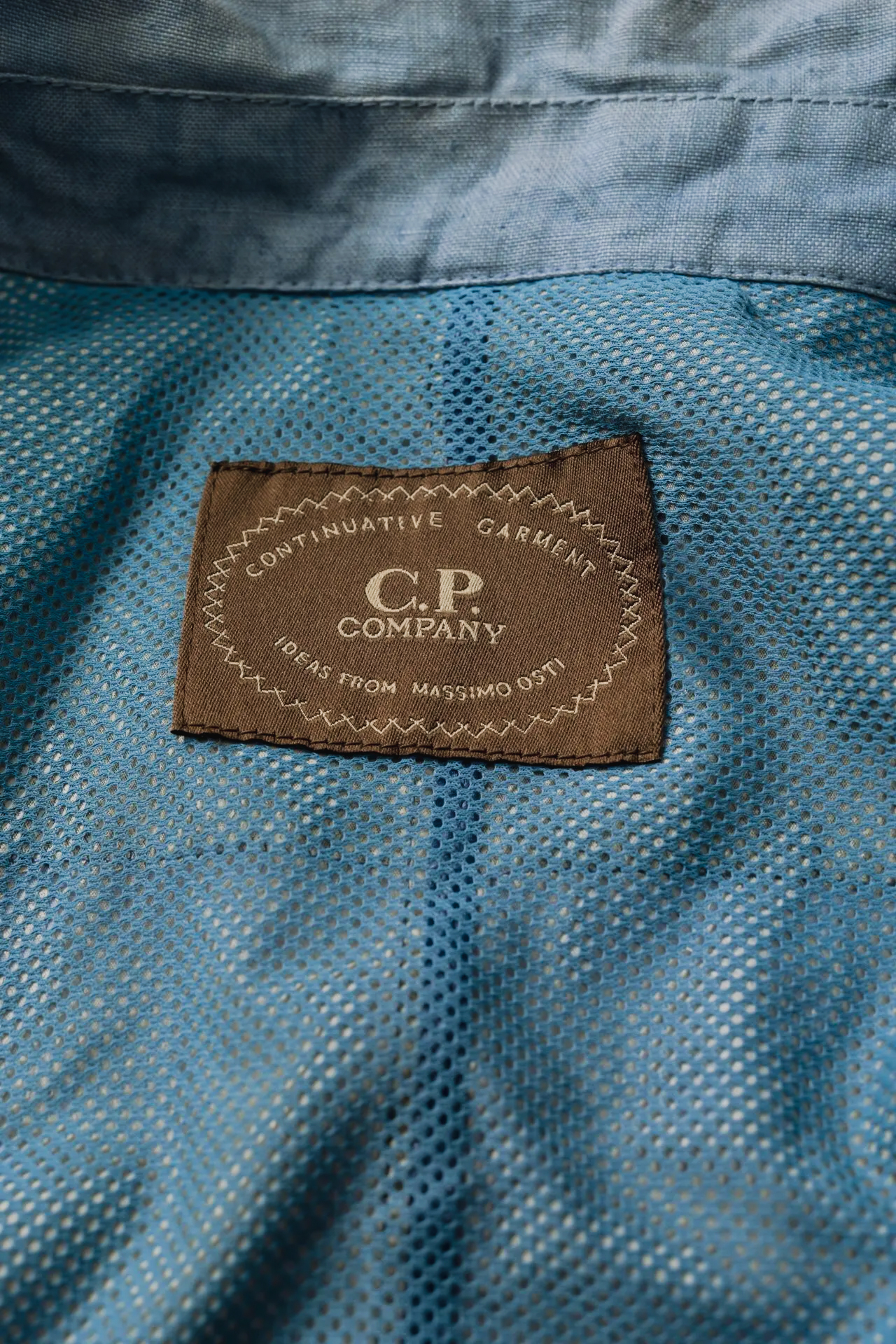
For Autumn/Winter 1990–91, C.P. Company gathered models already present in the collection — a field jacket, long and short parkas, a raincoat, a duffle coat, a quilted vest, shirts, corduroy trousers, chinos — and the Goggle Jacket, and named the range Continuative Garments. Each garment carried a hangtag that spoke for the research and manufacturing behind it at Crevalcore, and the archive records the intent in Osti’s own terms: to work in defiance of the dominant values of the fashion market. The market’s calendar is succession — each season expiring the last on schedule — and Continuative exempted certain garments from it by verdict. These had been judged worth making again, and the judgment, not the newness, was the product. Repetition, at this company, was not what happened when invention ran out. It was a position taken against the calendar — issued by the founder, about work of his own, while he was still making more of it.
The Goggle Jacket came back inside that range in a new cloth: 50 Fili gommato — the named cloth of the 1989 shell, now rubberized — garment-dyed through a double recipe that let the inner polyurethane coating partially absorb the colour, coating and cloth answering one bath differently across a single surface. The archive credits this 1990 version as the definitive one, the basis of the reissues that ran through the decade. Set it beside the two editions and the structure repeats at the scale of chemistry: one architecture, a third May, a third material outcome, the conditions fixed and the result allowed to land where the materials took it. The bath that colored the 1990 jacket happened once, to that jacket — the way each edition’s May had happened once to its cloth.
The form returned. The material event did not repeat. That is what the pair establishes, and it is what Osti’s filing declared without contradiction. Continuative guaranteed the architecture — the cut, the lenses, the cuff window — and guaranteed nothing further, because nothing further can be guaranteed. The programme never claimed to repeat meetings. It claimed to keep sending the form back out to where meetings occur. Filing the race jacket among the returning garments demoted nothing. It was the founder stating what a company can hold of its own best work: the form, which can be promised, and the meeting, which has to be found again each time the form arrives. In 1990 a judgment still stood at the center of the programme, deciding season by season what returned, in what cloth, to what occasion.
There is another jacket with a mask in it, and it was made by a designer who threw the house codes away on purpose. Moreno Ferrari arrived at C.P. Company in 1997, three years after Massimo Osti’s departure, and by 1998 had produced a collection that contained, on its face, no C.P. Company at all. Black nylon. No garment dye. None of the surface language the brand was known by. Years later, asked directly why he had abandoned the brand’s identity, Ferrari answered that he had not — that the identity was never the aesthetic. It was the procedure: look at what is happening in society, and make the garments answer it. That was what the founder had done, and that was what he did.
The moment he was answering was the approach of the millennium — the particular texture of that anxiety, machines expected to fail at midnight, cities understood as systems that might stop. Power, water, money, movement: infrastructure suddenly legible as infrastructure, and therefore as fragile. The fear had an unusual shape — no enemy in it, no weather: the built world going unresponsive at a known hour. Urban Protection answered that condition directly, and the line’s narrative, in the family’s own later telling, was blunt: do not worry, these garments will protect you.
The promise was partly theatre. No jacket protects anyone from a systems failure, and no one involved can have believed otherwise. It was also wholly sincere, and the two do not cancel. Ferrari was not joking and was not selling a costume; he was running the procedure at the scale the procedure demanded — reading a society’s nerve and engineering garments to the size of the nerve rather than the size of the rain.
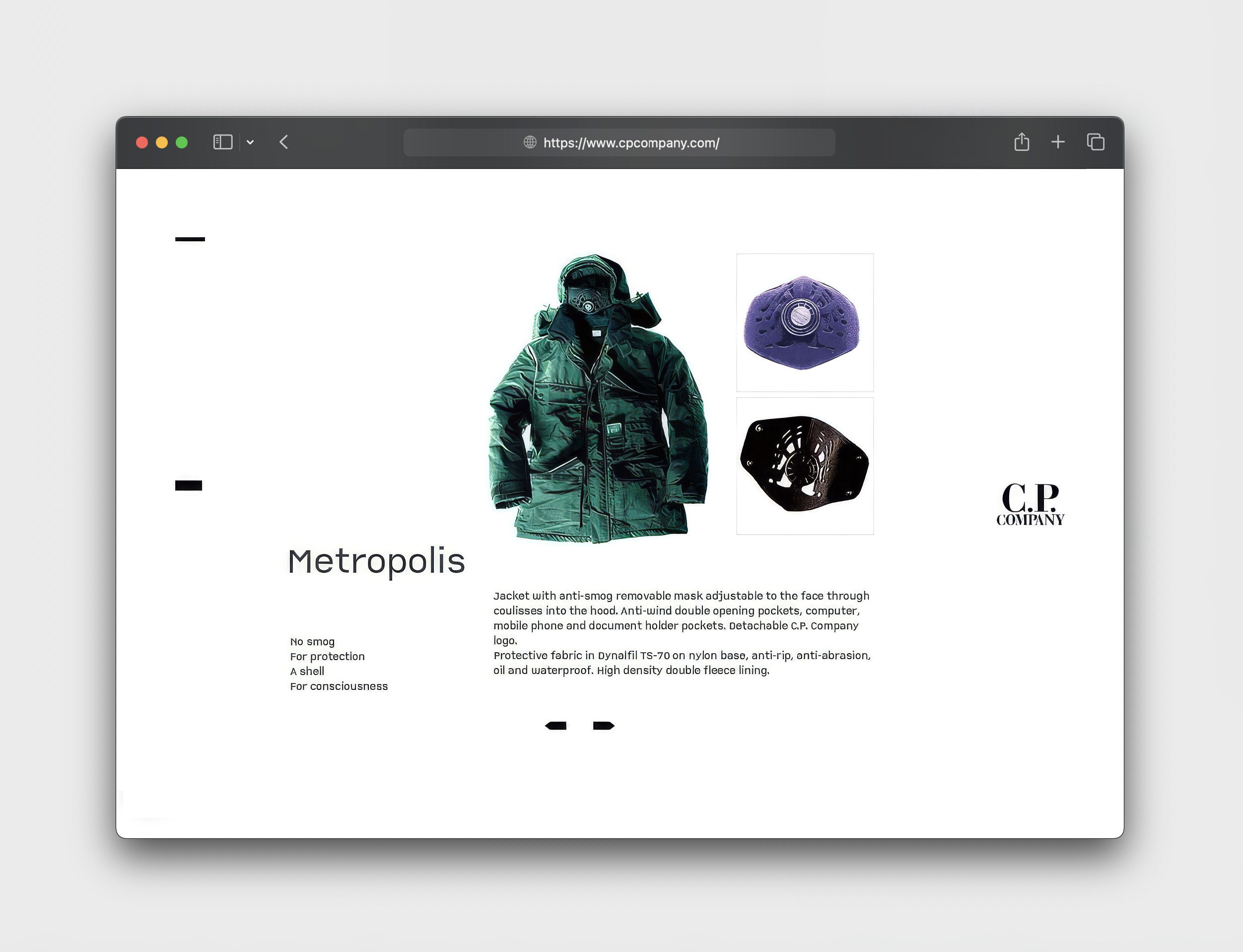
The line’s fullest garment is the Metropolis. Its shell is a matte technical nylon, Dynafil TS-70, resistant to rips and abrasion, to water and oil; behind it sits a dense double fleece. The front is a filing system: a multi-pocket array specified, in the house’s own language, for documents, a mobile phone, a pocket PC. Adjustable waist, Velcro cuffs, a detachable badge. To this point, a serious utility jacket with an office in it. Then the hood. Snap-fastened inside it is a removable air-filter mask that, deployed, covers the lower face. A later version adds a rectangular window sized for an identification card.
The garment removes the face and supplies identity again as a document. The mask withdraws the wearer from the air and from recognition in a single motion; the window offers the wearer back, on the garment’s terms, to whoever is entitled to ask. Read against the hood, the pockets stop being convenience: they carry documents and communication, not weather gear. This is a jacket for transit, for checkpoints, for exposure of a newer kind — a body moving through systems rather than through climate. Whether the filter met any respiratory standard is undocumented, and the question slightly misses the object. Osti, the house’s best reader once wrote, made objects that underlined a function and negated it at once. The mask is real enough to deploy and propositional enough to mean, and it does not choose between the two.
The condition was narrated first. The features followed from it. The mask exists because the world Ferrari proposed had bad air; the identification window exists because that world checked; the pockets exist because its inhabitants carried their lives in documents. Nothing on the jacket is there because a category asked for it.
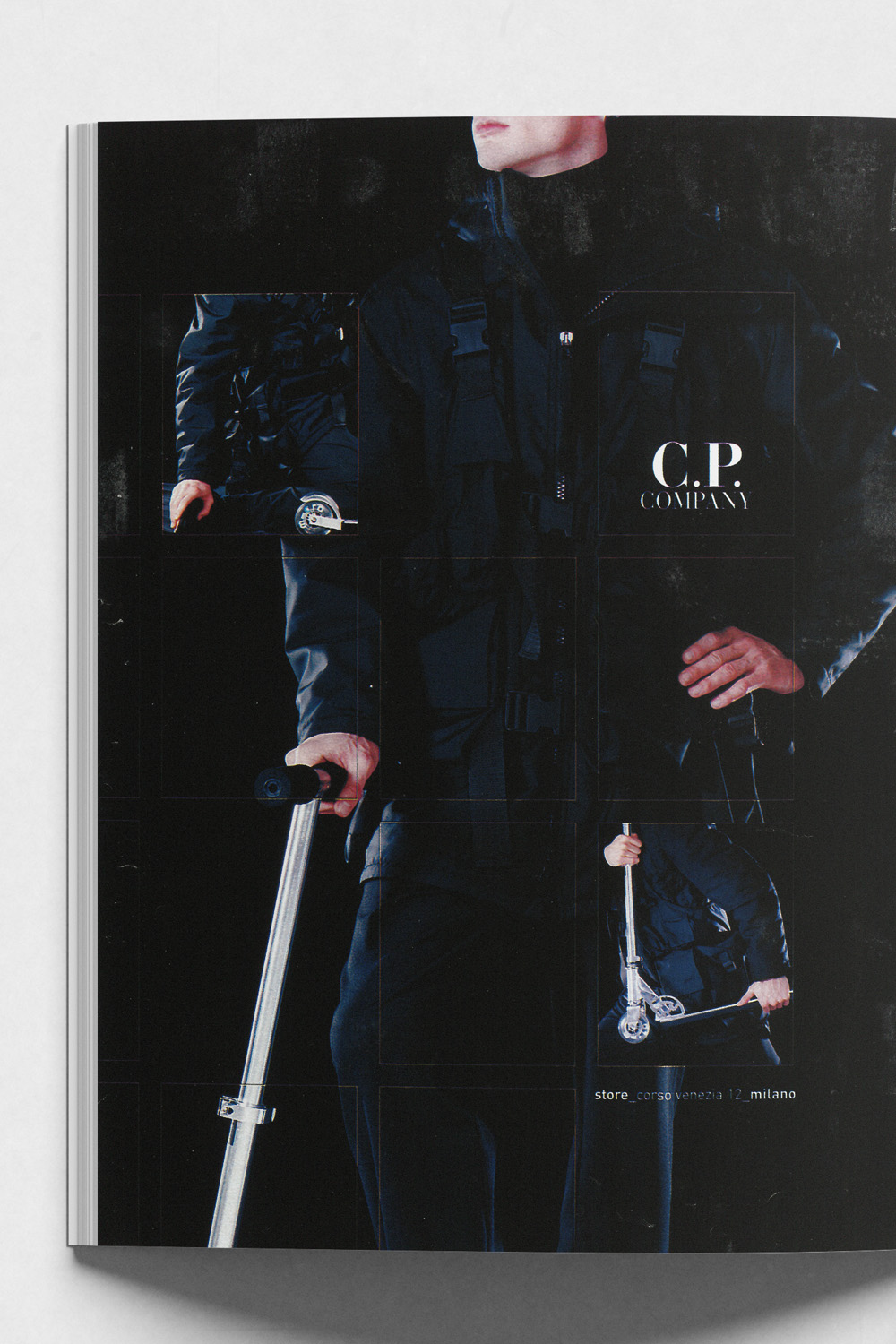
The order is legible across the whole line, because the line kept a grammar. The presentation was consistent across the print advertisements and the house’s early website: a model name; a short poem naming the condition; a specification; and, where a device entered the garment as a separate object, the device photographed alone.
Munch: “No panic, / A cry / As a bridge / For a better future.”
Life: “No noise / For inner life / A new womb / to listen to silence.”
Metropolis, in the Spanish advertisement: “Contra el smog / Para proteger / Una cáscara / Por la consciencia.”
Atlas: “From an ancient myth / A support / To man’s / Thoughts.”
Panic, noise, smog, movement, solitude, consciousness — each condition received a poem of its own. The world came first, named and versified; the garment arrived afterward, as an answer.
Beneath the changing poems, the same protective-fabric specification repeats. The worlds received titles. The fabric received a standard. Poetry above, specification below: the line was a common protective system receiving different social assignments, one per world.
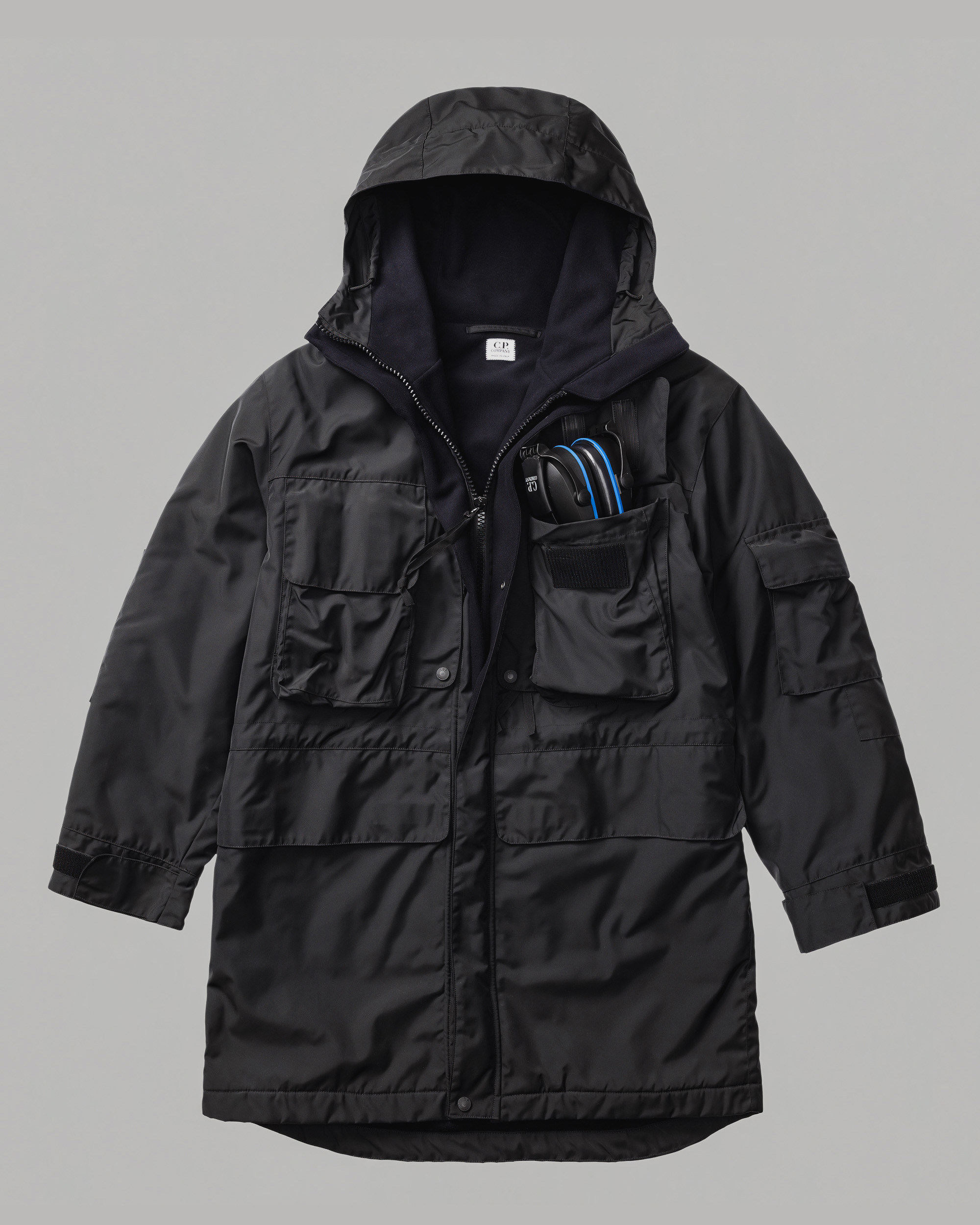
The portraits went to the equipment, and the marks on the equipment say where it came from. The folding scooter is a branded micro consumer scooter, over-printed with the model name and the line name — the line advertising itself on the thing it had bought. The torch is roll-marked CALIFORNIA, U.S.A. and screen-printed C.P. COMPANY. Life’s ear defenders carry two names: C.P. COMPANY added to the headband arm, Bilsom retained in the cup. The surviving retail carton confirms the source, but it belongs to the object’s later custody, not to the house’s period presentation. Ferrari’s intelligence was assignment — seeing what a bought object could do inside a narrated world — not the solitary invention of every apparatus, and the marks do not disguise the difference. The alarm and the mask carry no maker’s mark in the record consulted here, and their manufacturing status remains unresolved.
The devices led lives of their own, and shorter ones. Munch’s specification names a personal safety alarm, inserted into a dedicated pocket and activated by pulling a cord. The advertisement photographs it alone — a small body with a red panel and a lanyard. A period Japanese catalogue photographs it carried, partially inserted into the inner chest pocket, the lanyard emerging. The surviving garment has neither alarm nor cord. Three states of one separate object across three media: portrayed, carried, gone. The garment survives; the alarm does not.
Munch differs from its siblings by one further word. Its copy describes the fleece lining as detachable — staccabile — and the surviving example is the only one whose liner is a separate garment, with a pocket of its own. One word in the specification; one extra garment inside the garment.
Atlas locates its second state in language. The specification describes an inflatable and removable collar and names no valve, no pump, no breath, no supplied machine — the transformation asserted in the sentence, its cause absent. Rest locates its second state in the object: a black nylon rucksack mounted on a polished aluminium folding-stool frame, converted by the hands, the attachment solved with a metal hook and a wire link — hardware of a different order from the line’s chosen buckles, the solving left visible.
Two Metropolis examples survive to be set side by side, a winter and a spring, and the comparison sorts the garment into its halves. Everything touching weather changes: the polyamide shell gives way to a matte, creasing cloth of the cotton family; the black fleece to a pale open mesh; the label ground changes with the lining. Everything touching the world remains: the mask, the hood adjustment, the double-entry pocket architecture, the waist adjusters, the detachable house plate. The garment is seasonal; the proposition is not.
The article numbers say more than the advertisements. The winter example carries 33204E58, and the number places it in the house’s press release for the Autumn/Winter 2000–01 women’s collection — Urban Protection, in the release’s phrase, “re-elaborated for women.” The men’s example carries 29184E58/0: a different number, not a variant of the first. Same mask, same pockets, same adjusters; two addresses. No model name appears anywhere in the documentation held for the winter example, while the spring example names itself in script on the garment; the winter jacket’s address survives only in its paperwork.
The description was already mobile. Crossing into the Spanish advertisement, the Italian doppio pile pressato — double pressed fleece — became lana del Pirineo doble prensada: Pyrenean wool. As the parallel copy suggests, pile appears to have become Pirineo, and a synthetic acquired a mountain range. Antistrappo ed abrasione became antirroturas y quemaduras — abrasion became burns, and the fabric gained a hazard it had never been tested against. The composition label of the winter example answers the wool plainly: 100% poliestere. The garments were exact; their translations were already inventing, and every error improved the story. A line built on narrated protection was being re-narrated before it cleared the border.
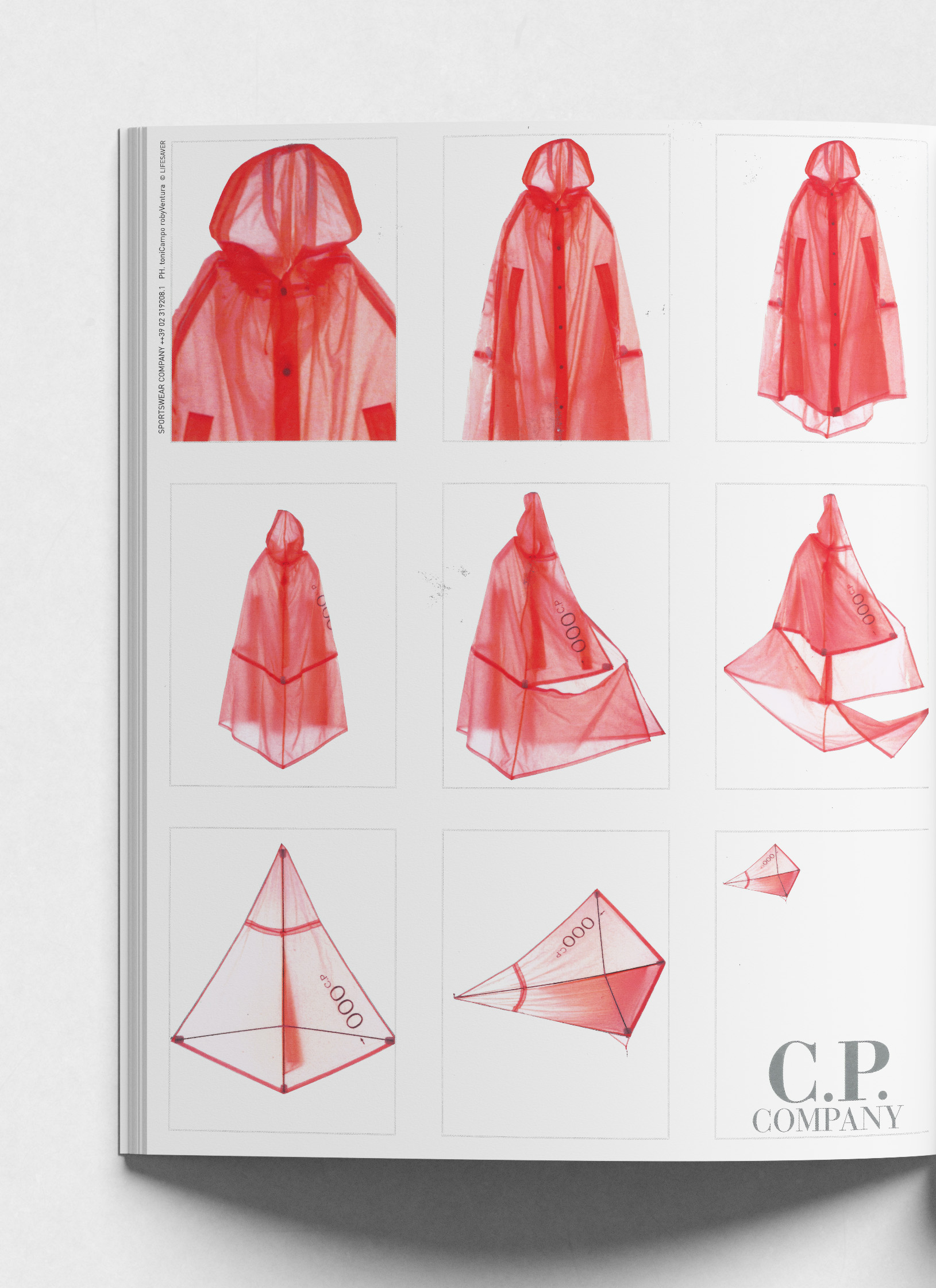
Two years later Ferrari showed how far the procedure could go when the question changed scale. The Transformables asked not what else could enter a jacket but what else a jacket could become. The Air-Mattress Parka is the range’s most fully documented object, in the house’s own archive language: a long hooded parka in bright blue polyurethane, waterproof, closed with magnets, that converts into an air mattress beneath a fine nylon-mesh tent held on a carbon structure — and accompanied by an air compressor and a small Mag-lite. The coat cannot become a shelter without the machine supplied alongside it; the garment is really a kit wearing one of its states, and even its closures were chosen for the second life — magnets fasten a coat and a bed with the same indifference, which buttonholes cannot.
Nothing documents anyone sleeping in it. The proposition is the point. Italian design’s institutions understood it as one: the project received the Compasso d’Oro in 2004, and examples entered museum collections. It was filed by the design world, which had a category for a coat that becomes a room, and not by menswear, which did not.
The millennium came and the machines held. The cities did not stop; the dread dissolved on schedule, at midnight, and took its world with it. The jackets stayed. The masks are still snap-fastened in the hoods, undeployed; the pockets still hold their offices; the poems still stand above the one repeating specification, naming conditions no one fears in quite that shape anymore.
Ferrari had inherited a procedure whose first programme, under the founder, was the return of a form across seasons. What he left inside the house was larger and stranger: a complete answer, built in full seriousness to a question that expired — waiting, in a house whose founding programme was return.
The house came back for it.
In Winter 2020, in a collection titled Next Landscape, C.P. Company returned to the Metropolis. The house’s own word for the operation was remastered.
The shell is constructed using Dyneema composite material, a translucent silver laminate whose fibre grid remains visible in the surface, a cloth that arrives already showing its own construction. Beneath it the pattern returns whole: four flap pockets, Velcro cuffs, a detachable hood, and, mounted inside the hood’s front edge on snap studs, a moulded black perforated mask. Hood down, the mask waits along the edge. Hood up, it closes over the lower face.
The mounting follows the original’s; so does the coverage. What is absent is the plastic filter piece the original carried at the mask’s front: this mask is moulded and perforated, with no filter housing. The studs receive a position, not an apparatus.
At the left chest, a clear rigid holder on a conference-badge clip, and in it a printed card: C.P. COMPANY / urban protection / METROPOLIS 020/1 / (Remastered). The jacket carries its own pass, at the height where a building would ask to see one.
The garment was accompanied by annotation on the outside as well. The garment bag, cut from the same composite family in black, is printed with a paragraph describing the jacket’s origin and purpose. The paragraph sits inside quotation marks the house never attributes — quotation marks ordinarily promise that someone said this, and here they enclose a voice with no name under it. One word is misspelled: warer, for wearer. The error survived production. The account went through production like a component — printed, cut, packed — and it carries a component’s kind of flaw. It makes historical claims the way a house speaks about itself afterward: an account, arriving late, signed by no one.
The bag annotates the garment before it is opened. The badge annotates it while it is worn. An object can come back in more than one way. A pattern can be recut, and that is manufacture; the house did something further. It returned the jacket inside its own caption — the bag speaking before the zip is drawn, the badge speaking at the chest for as long as the jacket is on a body — so that at no point between the bag and the body does the object stand unexplained. The original carried equipment for a wearer. The remaster carries, besides the equipment, an account for a reader. What returned in Winter 2020 was the jacket and the house’s description of the jacket, issued as one thing.
The returned jacket carries no lens. It required no founder-era sign to certify whose history it belonged to.
When a house returns to a jacket its founder never made, what has it inherited? The remaster alone cannot answer: returning a pattern proves only that the object can be made again. The answer arrived when the Metropolis became a series.
Across the line, the series name now appears on the sleeve: C.P. COMPANY / METROPOLIS SERIES. The construction remains tonal, and the interior labels name the cloths — MetroShell, Nano Titanium, HyST, Pertex — evidence that the house continues to organise material development through named systems. Where the remaster displays its construction in the surface, the later garments keep their material identities inside, on labels. A tonal discipline repeats, with the sleeve identifier and the labelled cloth. The Metropolis does not. No mask — the hood-up photography shows the face open, and one garment, a knee-length coat, has no hood at all — and the ID window, the badge, the document-pocket array, and the detachable hood go with it.
What persists is the address. The house’s page language for the line: “Technical performance wear as an interface between body and city.” The sentence names no component. It names a relation — a body, a city, something between them — and a relation can be answered by garments that share no parts. It would have fit the remaster, mask and all; it fits five garments that carry none of the remaster’s equipment. What the house inherited was the authority to keep asking what a Metropolis garment should be now. Nothing about the five claims that authority. They exercise it.
One of the five makes that authority visible in construction. The Pertex garment is a half-zip anorak carrying two zips more than an anorak needs. Each begins at a shoulder, runs down the front of the armscye, passes under the arm, and climbs the back to meet its own beginning — a complete circle around each arm. The circle is the labour: the zip is engineered to pass beneath the arm and return to its beginning, finishing both the sleeve edge and the vest armhole before either state is chosen. Opened, the sleeves come away entirely, and the zip tapes stand revealed as the finished armhole edges of a hooded vest. Neither state is the ruin of the other; the vest was cut into the anorak from the start, its edges finished before the first wearing. Where the remaster returned an object and the Series released a name, this garment produces a second garment out of the first — and it does so without documents. The labels name the cloth. The pulls are unmarked. Nothing cites a designer, a year, or an earlier work. A transformable operation has re-entered the Metropolis line without needing to announce itself as an archive reference.
The name continued by becoming less specific. The jacket returned first; what continued afterward was the permission to use its name for another answer.
The race still leaves Brescia each year. The jacket was made for a return. What it holds is the meeting that could not be repeated.
The collector’s intuition is right for the wrong reason. Early C.P. Company garments feel singular because they record a convergence of event, material, judgment, and occasion that cannot be manufactured twice. Massimo Osti answered that problem by separating what could return from what could not. A company could send a form back into the world, but not the meeting that first completed it.
After his departure, Moreno Ferrari inherited neither the founder’s materials nor his visual language, but the procedure of reading a changing world and allowing garments to answer it.
When C.P. Company later returned to Ferrari’s Metropolis line, it demonstrated that a house can inherit more than its founder. The essay follows how return becomes the mechanism through which a design practice survives its own objects.
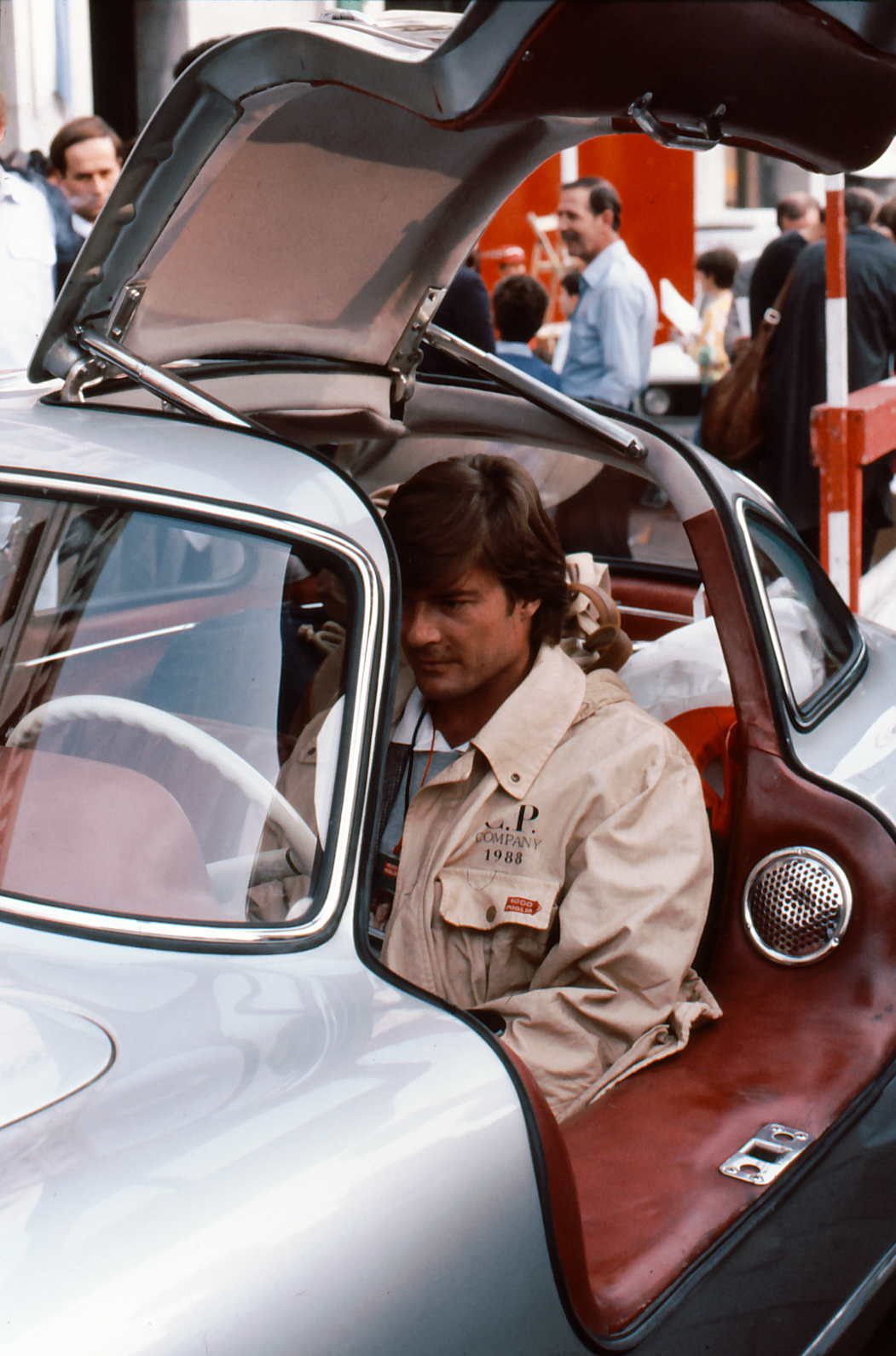


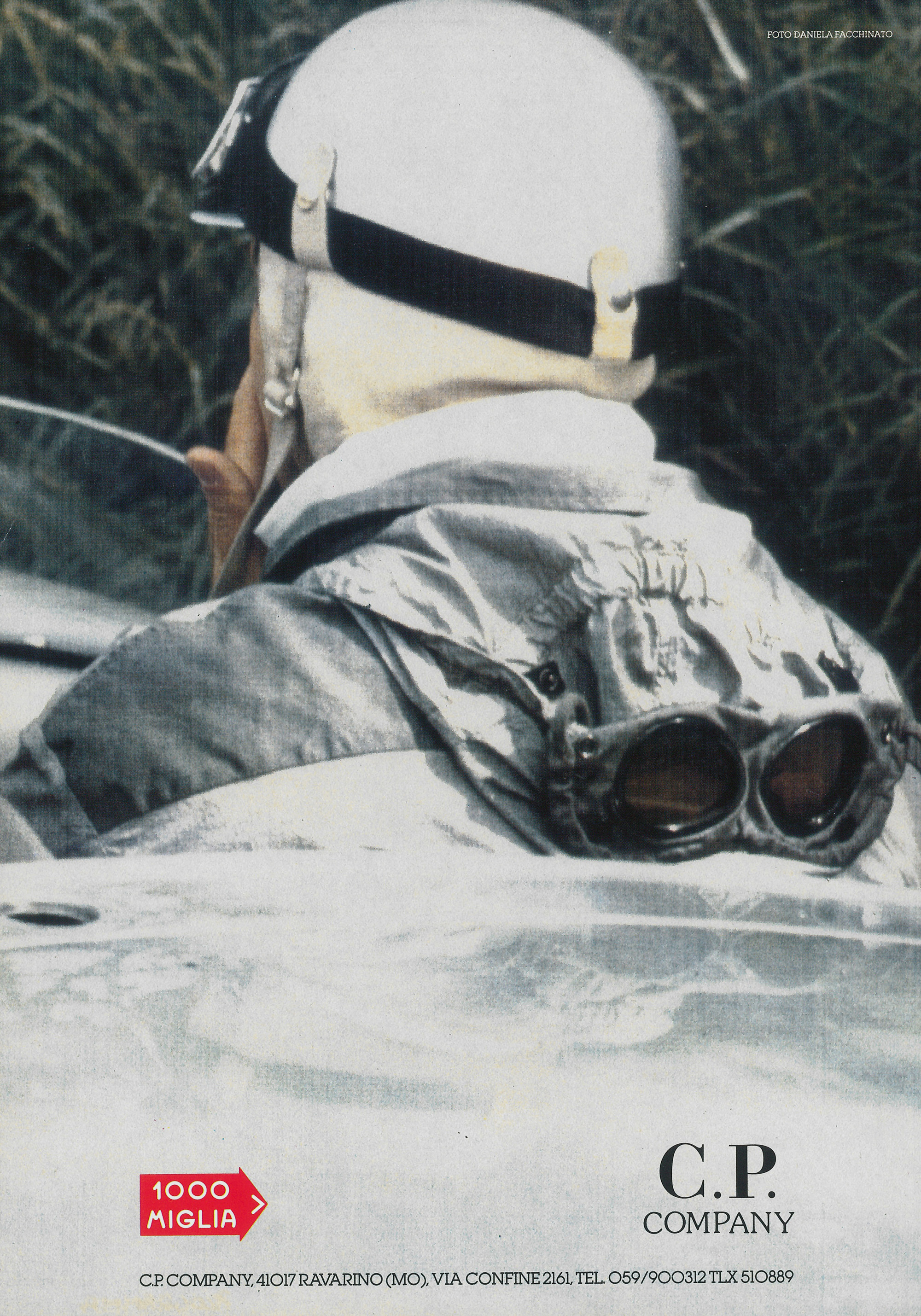







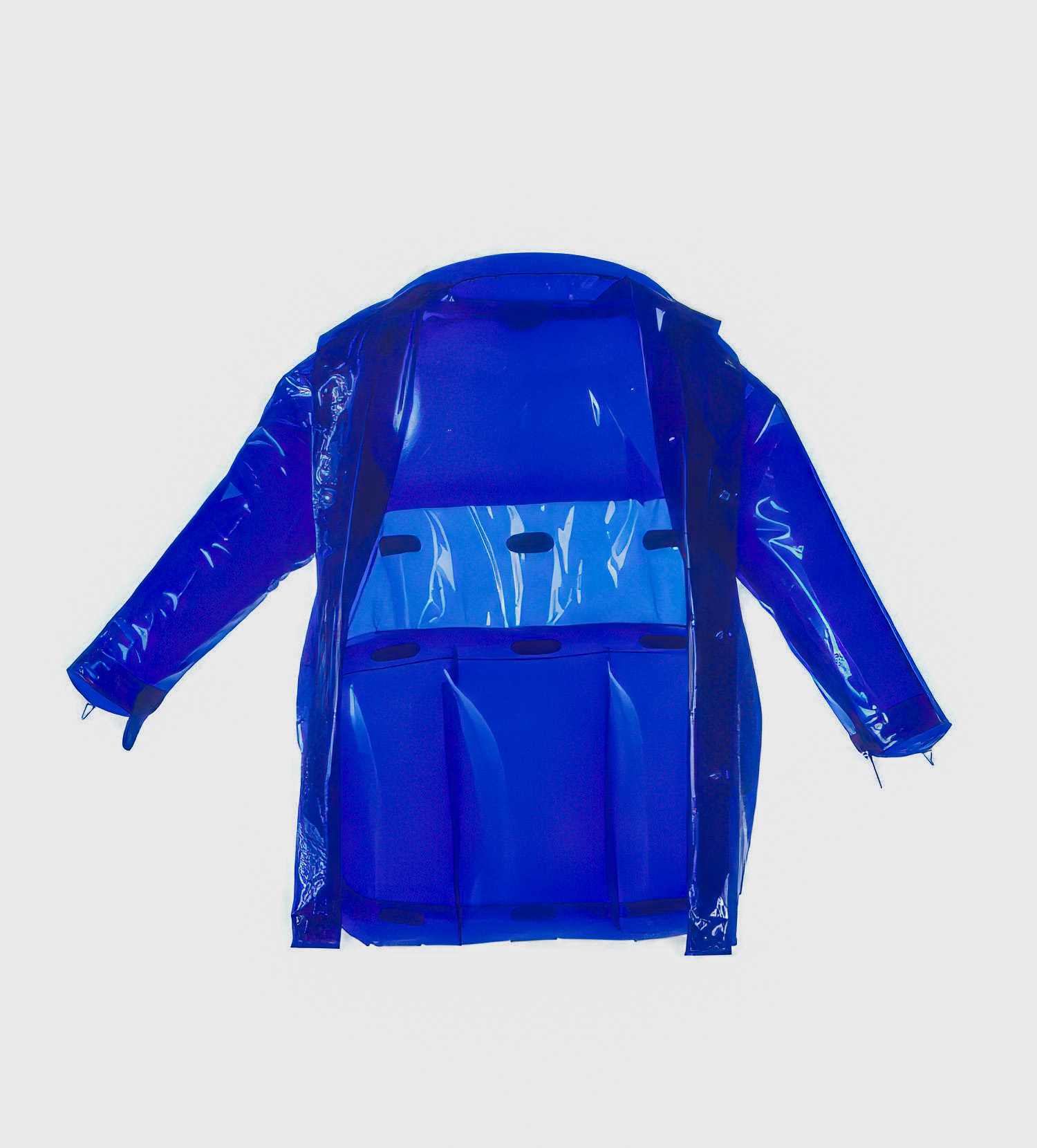


Cover Image: C.P. Company Mille Miglia, 1988. Photograph: Daniela Facchinato. Courtesy Massimo Osti Archive.
All images © their respective rights holders.
Image rights & attribution →