


A surface looks like something a room would ask the body to handle: a cupboard door, a knob, a pull, a fitting. Recognition comes quickly, ahead of any hesitation. The hesitation comes later, when the body has already pictured its next movement and finds no object there to meet it.
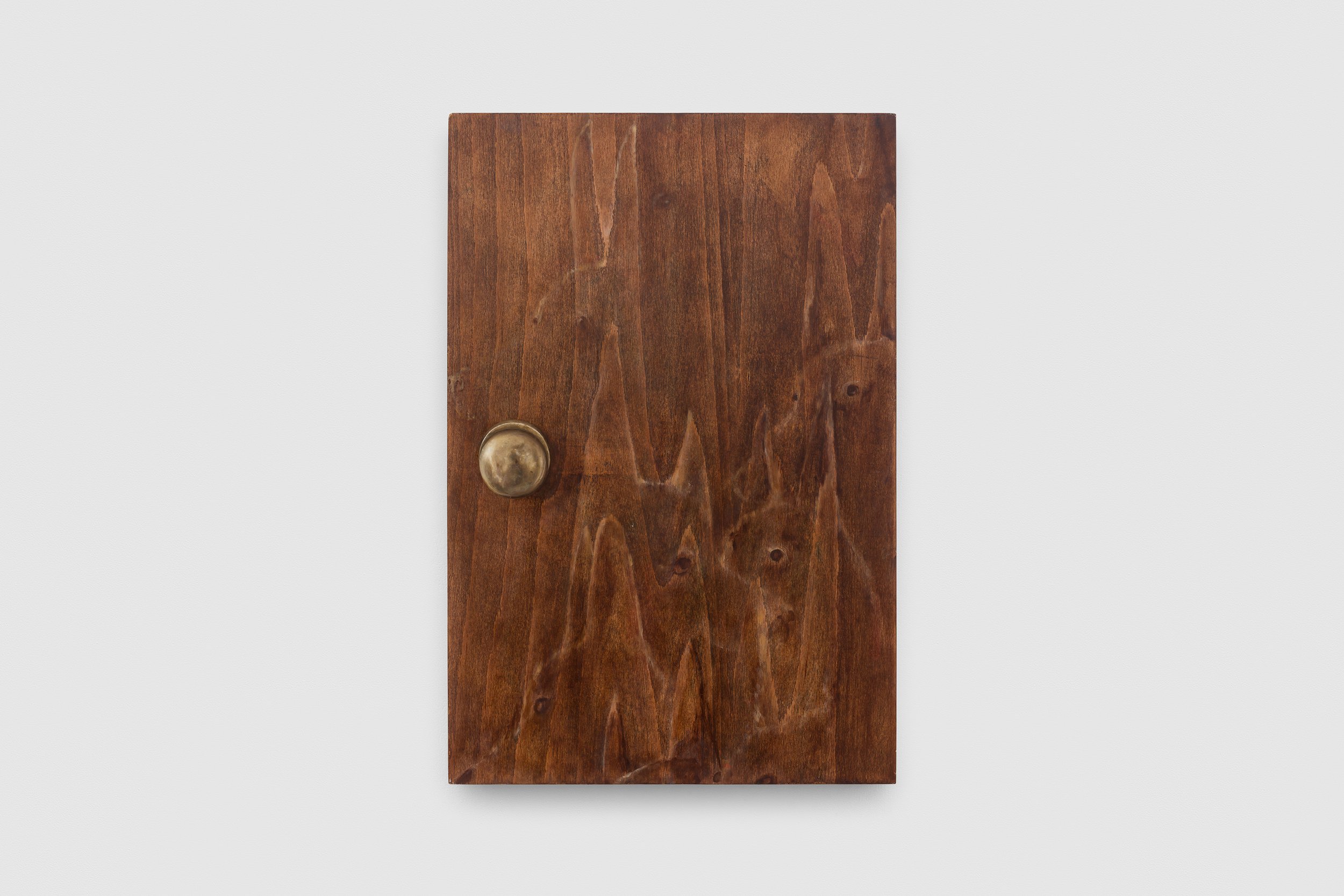
Cave Canem hangs like the front of a small cupboard. Varnished grain runs vertically around a brass knob set into the left side, and the title carries an old domestic warning: beware of the dog. The eye goes where the phrase sends it and looks for the animal.
The animals are there only as the grain allows them to be there: vertical seams thicken into alert bodies, knots settle where eyes might sit, and darker ridges begin to read as ears, muzzles, and the line of a back. A pack is drawn out of the wood’s own movement. Finding them is not the point. The task the title set has been completed, and nothing has changed. The warning was supposed to stand in front of something. It guards a panel with no other side. There is nothing past the threshold because there is no past the threshold, and the dog that should mark the boundary has been folded into it.
Then the knob. It sits where a hand expects permission, round and lit and placed for turning, and it is painted. A picture has always refused to be handled, but Polazzo’s emphasis is more exact than that. Of everything in the cupboard he could have rendered, he renders the one part a hand would reach for first, and renders it as paint. Sight is not denied an image. It is denied the small instrument by which sight would have become contact.
The older drama of trompe-l’œil often stays with a depicted thing whose use is suspended: a grape that cannot be picked, a fly one would brush away. Here the emphasis falls on the hardware. Knob, hinge, pull, latch: the signs of use are exactly what Polazzo paints, and exactly what will not work.
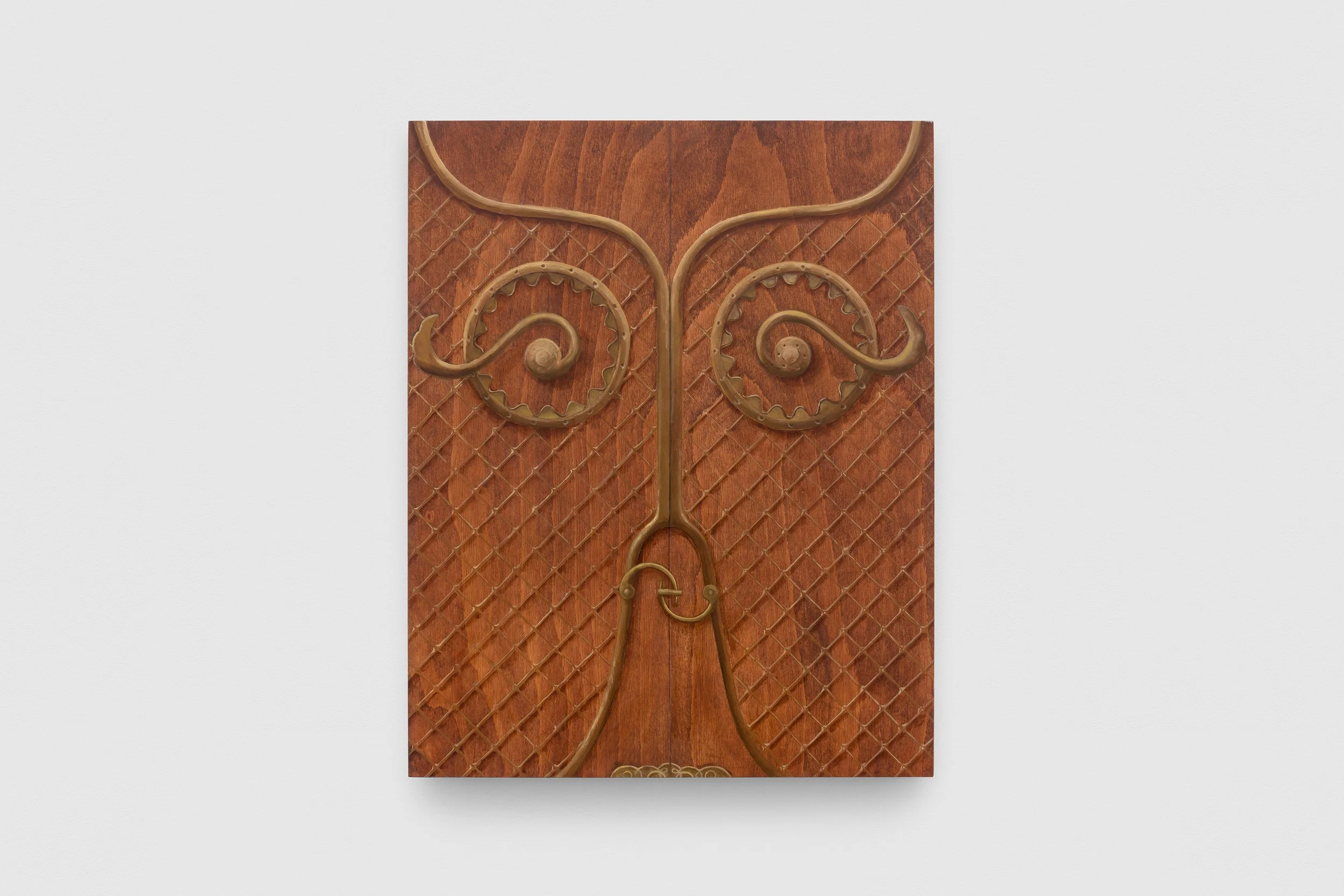
Taurusgate pushes the same move further. Brass-colored forms appear fixed to a wooden ground scored with a diamond pattern that reads as lattice, then fence, then cabinet face, settling into none of them. Spirals and bars and curled elements assemble upward into a face: two coils for eyes, a long stem for a nose, a brow across the top. The forms have the shine of use, the look of pieces cast for fastening and hinging and gripping. But they do not attach anything. The face is built from fittings that remain inside the image: signs of attachment, made from a surface that attaches nothing.
So the threshold is not where the matter ends. Polazzo’s surfaces do not delay passage from one side to another in the old way. They bring the body up to the point of ordinary use and stop it precisely there, at the seam where recognition would have turned into doing.
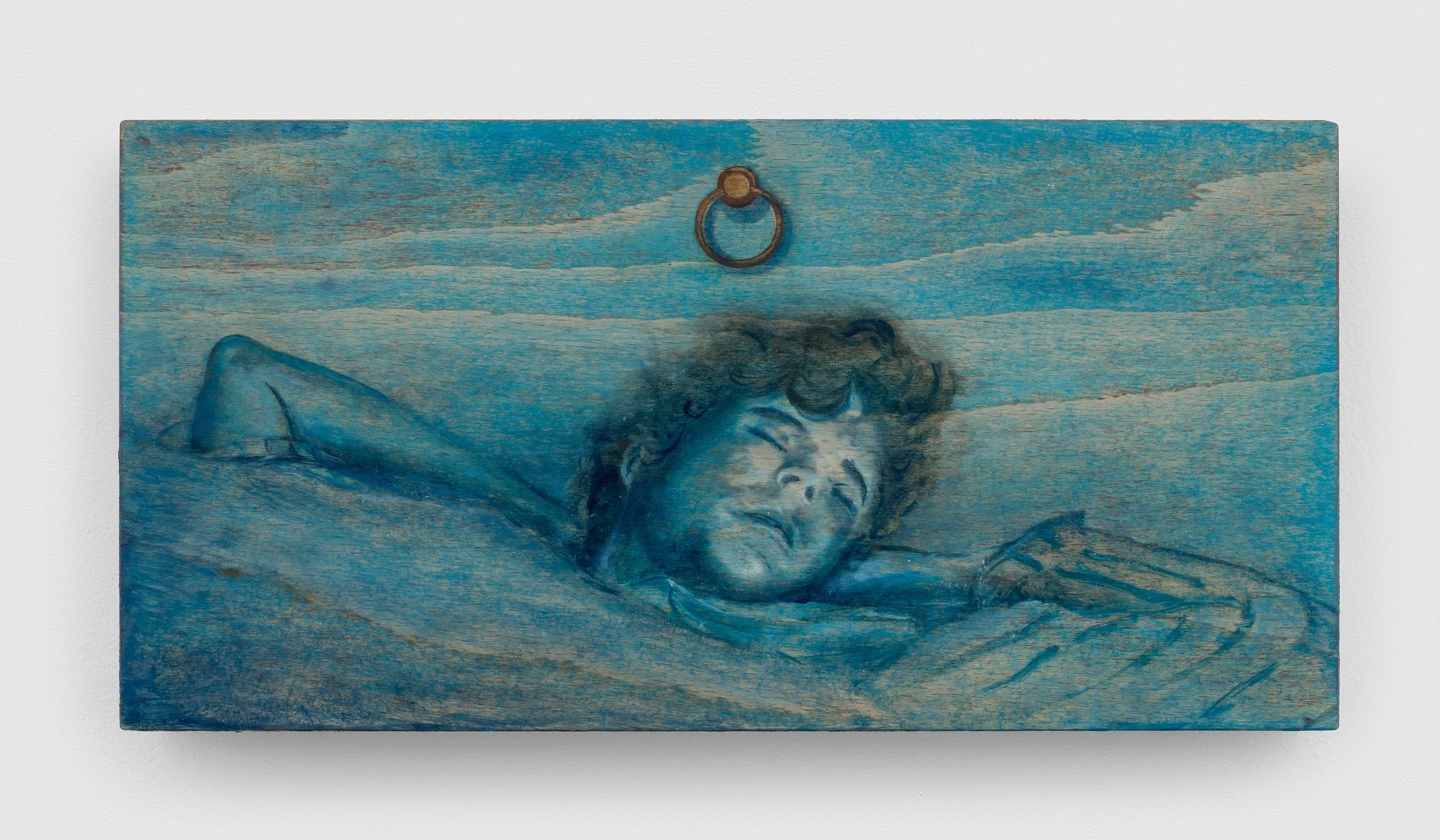
Sleeper II puts a body inside that stop. The blue panel lies horizontal, its grain running through the image rather than behind it; a figure rests across the surface, but does not rest on it. Hair, pillow, body, and field share one striation, as though the person had been kept inside the wood’s weather instead of laid against it. Above the head, a small brass ring, the pull of a drawer or a hatch, is painted flat to the board. Rest alone would make a body unavailable in the familiar way of sleep. The ring makes it something else: the body reads as stored, held where a pull should have offered it, and the pull is a mark. Storage is named. Opening is not provided.
Cupboard, knob, ring-pull, sleeper, fruit, garden: the vocabulary is domestic without ever warming into the homely. These are the furnishings of rooms where things are kept and handled and put away, and Polazzo takes the intimacy of that language while removing its practical clause. The cupboard stays shut. The pull stays a mark. The body stays in the grain. The room is built from the equipment of keeping, and keeping is the one thing it will not do.
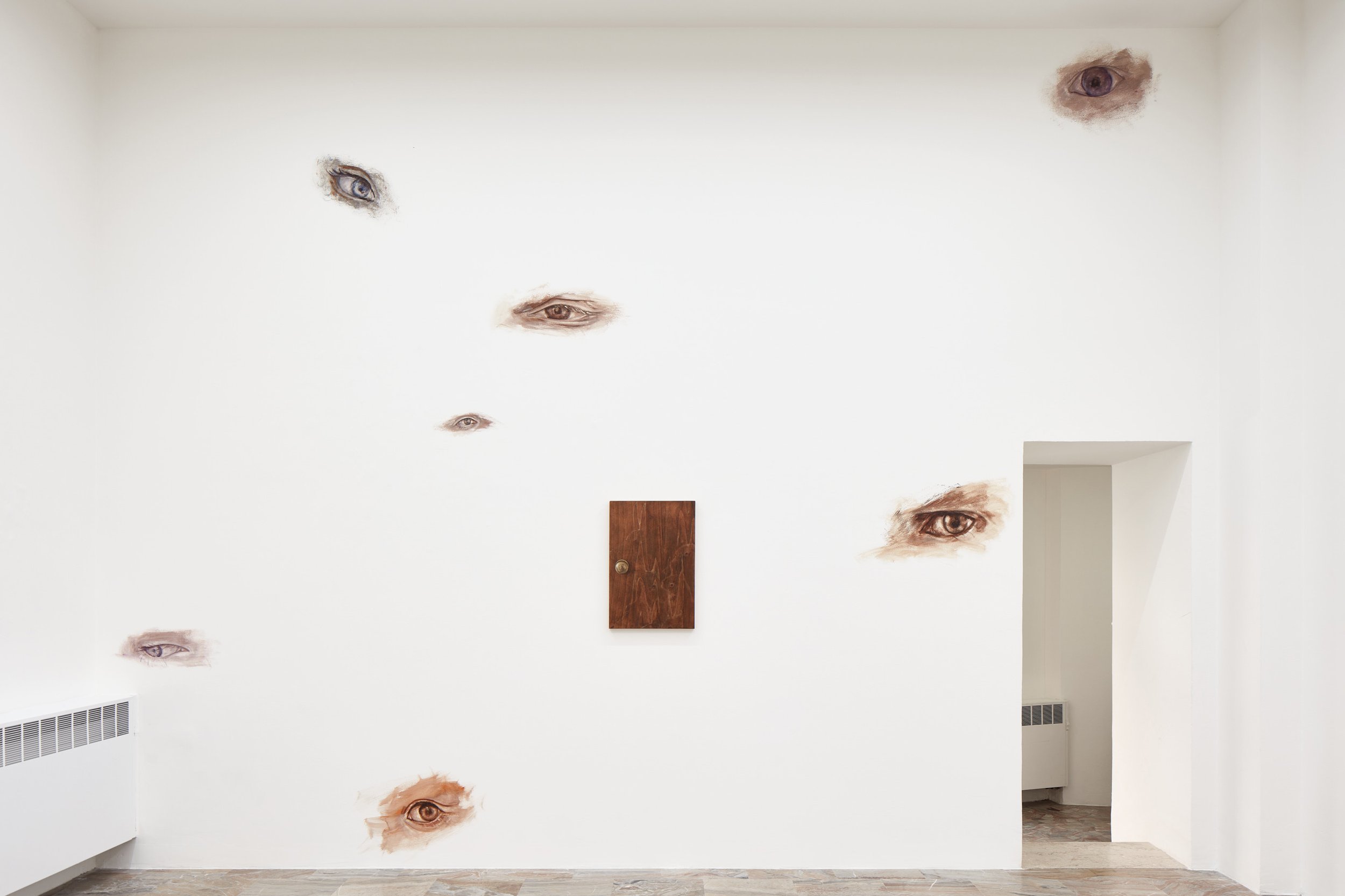
Then the work leaves the panel and takes the wall. Strawberries move across the plaster in a field of leaf, fruit, and blossom, continuing around the architecture rather than staying inside a frame. In one view, the painted field runs around an actual doorway; through it, an eye appears on the wall of the next room. Single eyes appear elsewhere directly on the plaster, frameless, each held in a smudged halo of brown and flesh-colored pigment. They are not hung. They belong to the surface of the room.
The panels and the walls withhold different things. On the panels, the hand is stopped at the mechanism: knob, fitting, ring. On the walls, the stoppage happens before handling. A panel can come off the wall and continue as an object. The strawberries and the eyes cannot detach from the room in that way. They are not portable works waiting to be removed; they are painted into the wall, and their force depends on that attachment. They can be stood within for the length of the exhibition, but they do not resolve into portable objects.
These are the most enveloping surfaces in the room. The garden one can stand within, the eyes that make the space feel occupied, the painted field that turns a white gallery into an interior. They are also the parts of the interior that cannot be separated from the place where they appear.
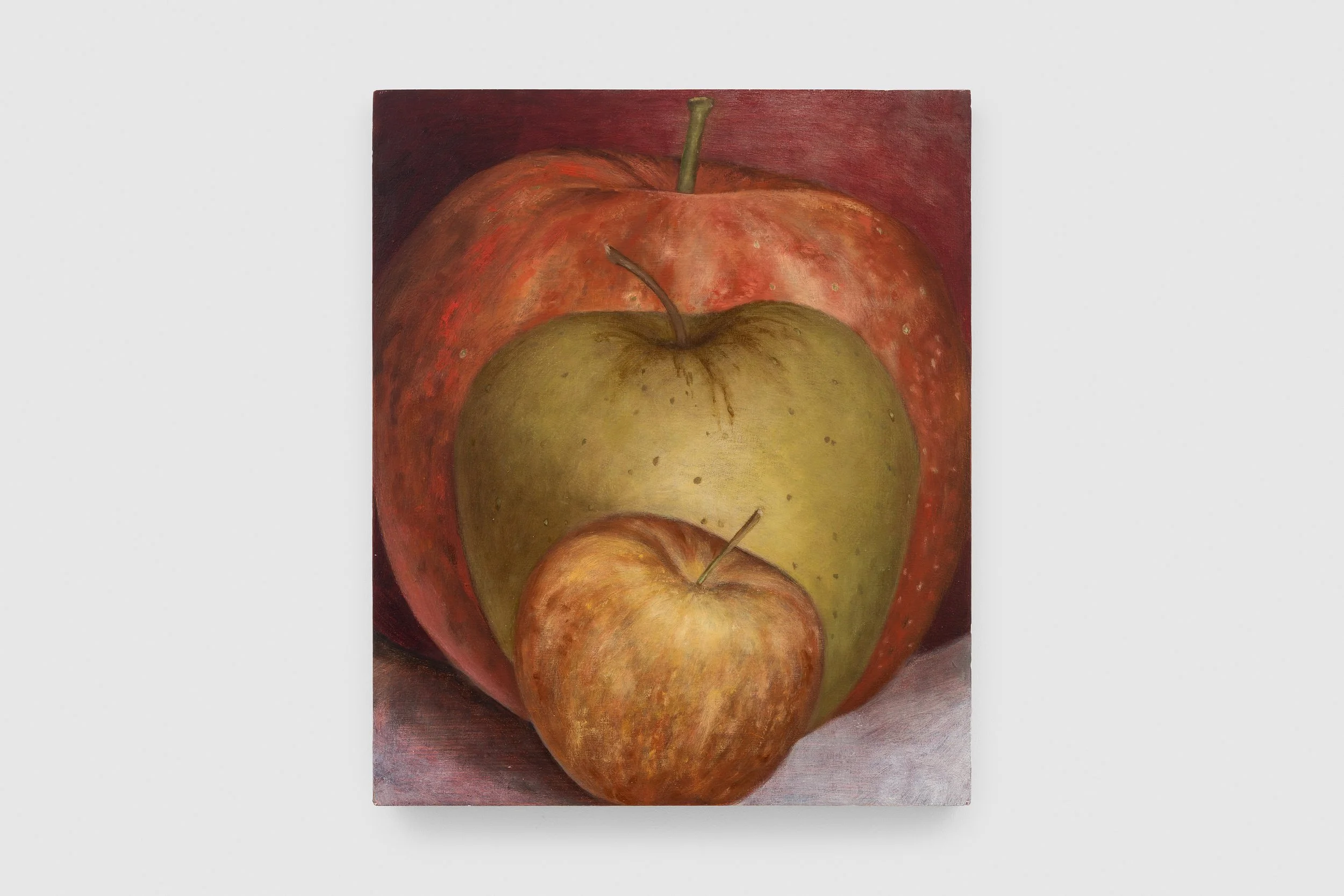
Succession compresses the question into fruit. Three apples sit nested front to back, descending in size: red, green, golden-russet, each distinct and still pressed into relation with the next. Stems mark sequence without making the bodies separable as portraits. Family is available as a reading, lineage too, but the painting does not turn the group into individuals. It keeps relation visible as arrangement, overlap, and scale.
The rest of the fruit passes more quickly: green apples crowded at the picture plane, cherries scattered on red, Passaparola lining apple varieties along a board like a chart. Their ease matters because it is so immediate. Recognition arrives before the objects have had to become singular.
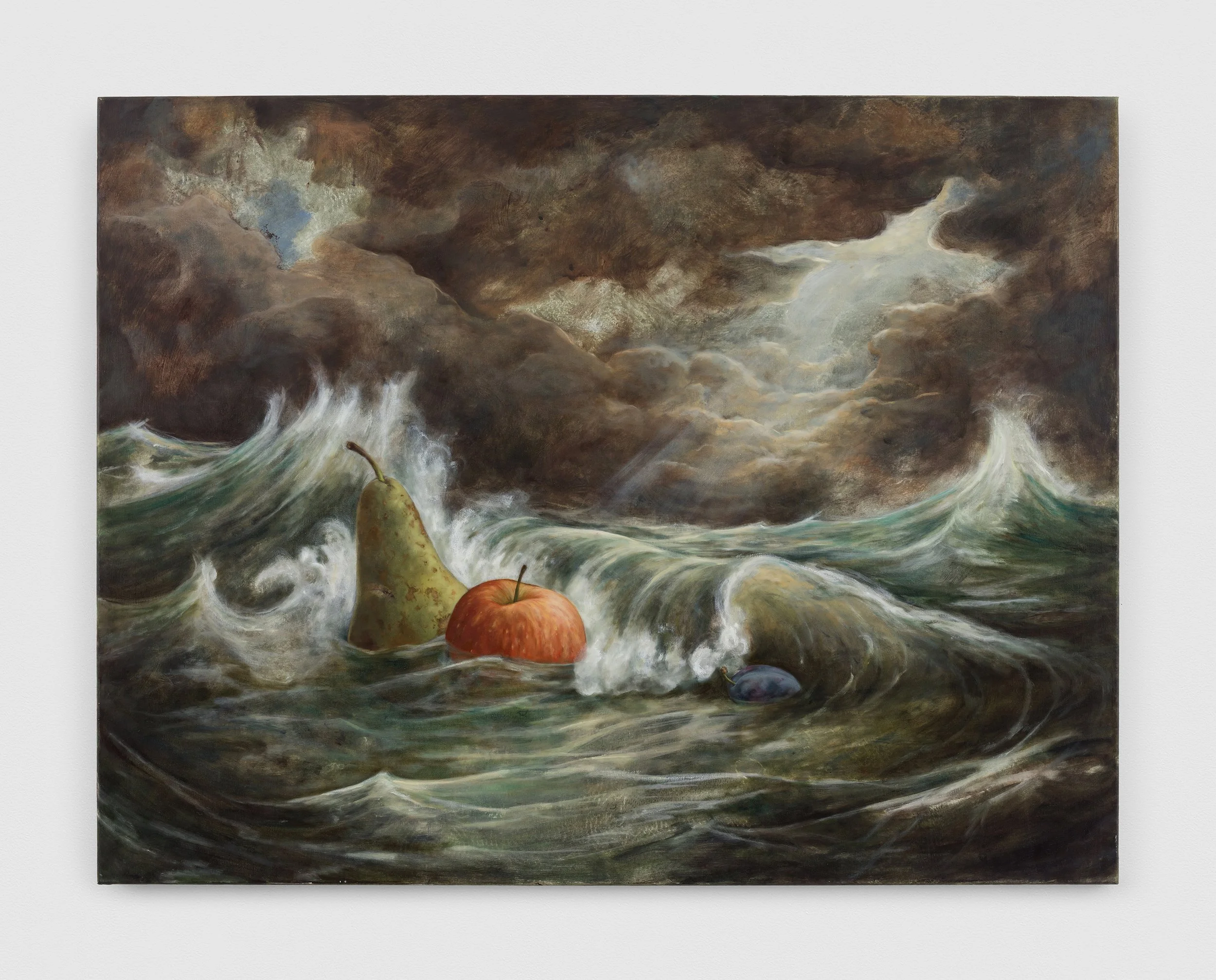
Il Richiamo opens the one deep distance in the show: dark water, broken sky, fruit carried on the swell. After the door, the board, and the wall, the invitation changes register: no longer to the hand but to the eye, to horizon and depth. The water is paint. Entry remains a surface effect.
The title need not turn the show into theatre. Commedia dell’arte names a stock of fixed parts that re-enter in new roles, and that is what these things do: door, dog, knob, ring, face, fruit, eye, sea, each returning with its old recognitions intact and its use suspended.
By the end, everything is recognizable, and almost everything carries an implied use. Turn the knob. Pull the ring. Lift the lid. Enter the garden. Each action reaches the surface. None is granted the object that would complete it.
Polazzo’s fruit does not remain symbolic or decorative. Apples, bananas, cherries, doors, and wood grain become actors inside a staged system where familiarity breaks down through scale, repetition, and perceptual unease.

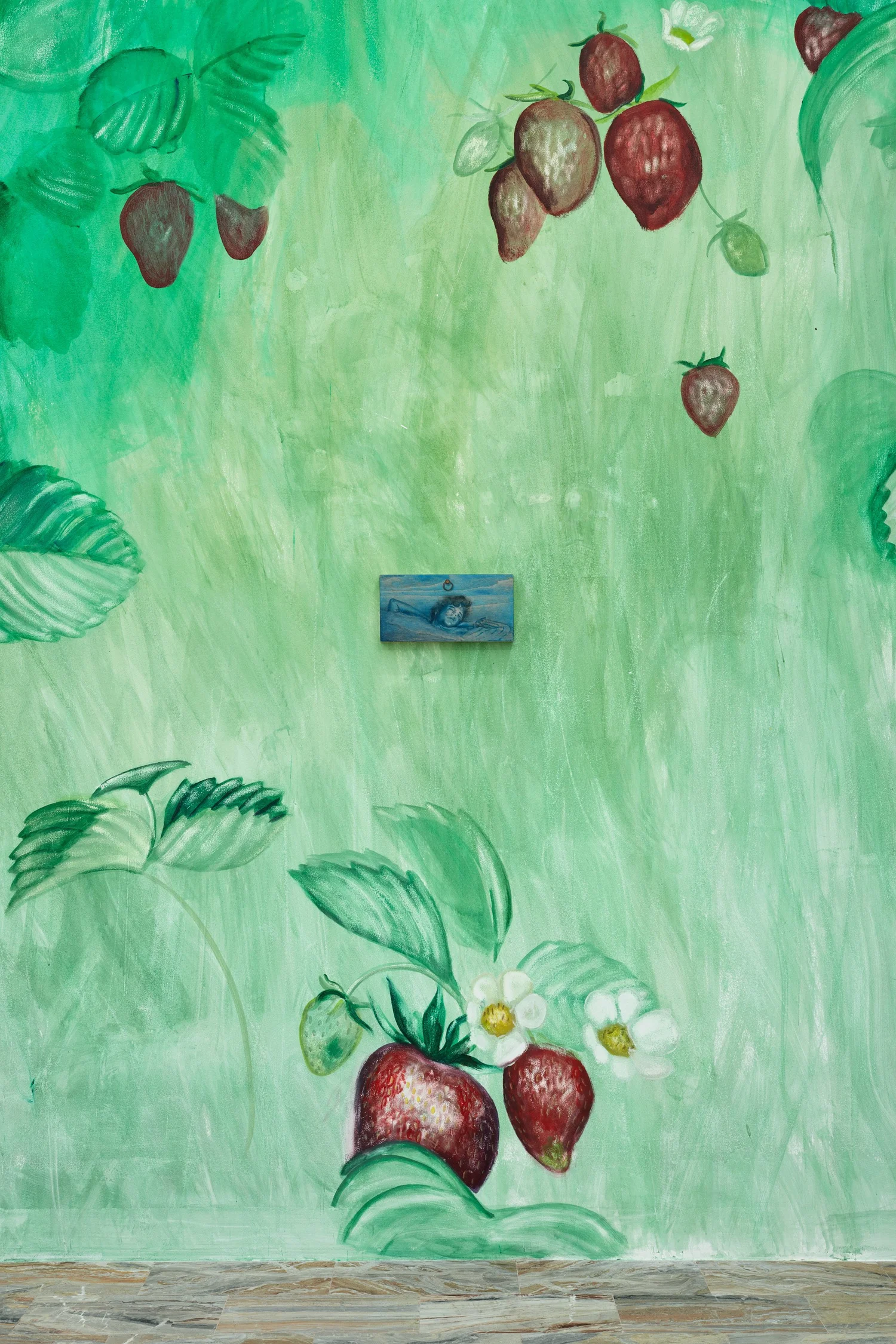



Cover Image: Amedeo Polazzo, Commedia dell’arte, installation view, Herald St, Bologna, 23 May – 1 August 2026. © Amedeo Polazzo. Photo: Carlo Favero. Courtesy of the artist and Herald St.
All images © their respective rights holders.
Image rights & attribution →