

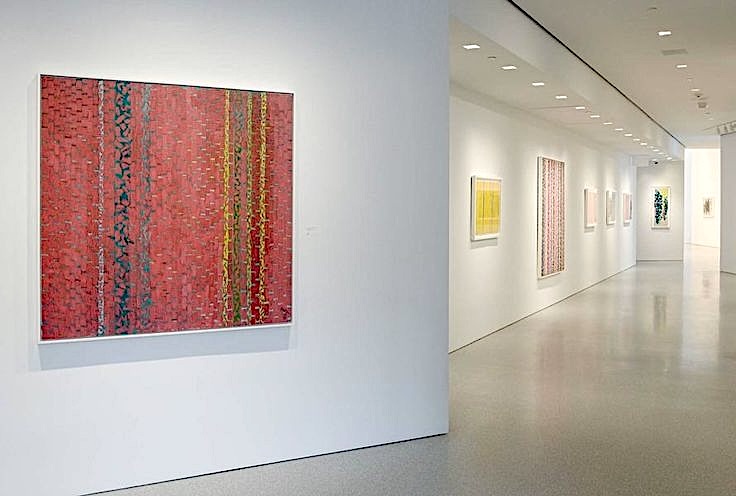
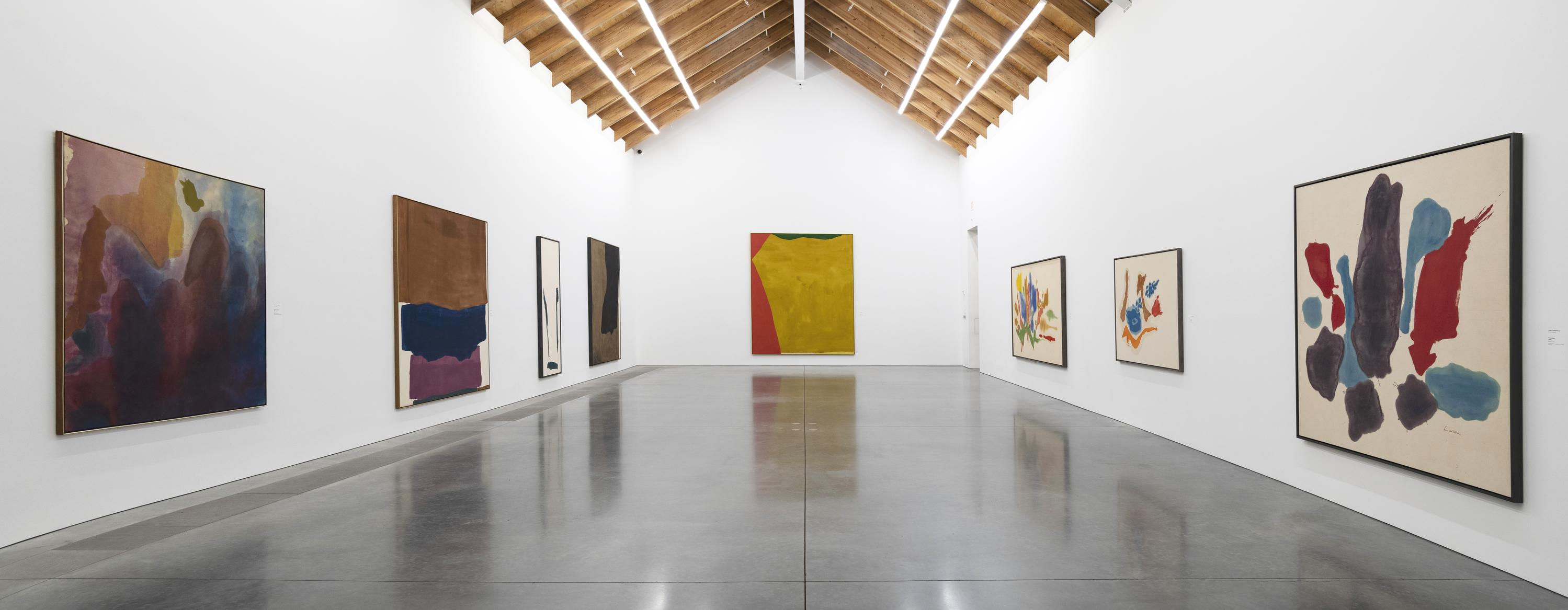


The words around Ann Purcell do not agree. In 1976, one account saw discipline and refinement. Another found gentleness. Later, related paintings could be called chaotic, brutal, sensual. At Berry Campbell, a survey of works from 1975 to 1979 returns to a familiar pairing: control and improvisation. The instability matters because Purcell is being recovered through some of the same language that failed to locate her the first time. The disagreement is not a question of taste. It is language reaching for a painting it can almost see.
The problem was not only Purcell’s. By the mid-1970s, gesture itself had become difficult to use. A drip brought history with it. The expressive mark, the open field, the residue of the body in pigment still carried force, but they also arrived already named by the generation before: drip, stain, field, action. For women painters in this period, those words were often already waiting: gentle, lyrical, decorative. They were not neutral descriptions. They were ways of deciding how much authority a mark by her could be allowed to carry.
Hooray Night, 1976, makes that failure visible slowly. A yellow-outlined trapezoid sits in the lower register of the canvas. Above it, a wide blue field. Drips fall from the blue toward the yellow, long thin verticals of pigment, some reaching the bottom edge of the canvas, some stopping where the trapezoid meets the floor of the frame. A white V opens inside the yellow, container-shaped. Red vertical lines cross the upper field, set at intervals, not measured but spaced. The runoff is admitted into a painting that has already made a place for it.
This is where the usual language starts to give way. The yellow trapezoid is not simply discipline holding back an unruly drip. The blue field is not looseness waiting to be corrected. The painting feels closer to a floor plan than a fight. The drip enters from above. The yellow opens to receive it. The white V holds what falls. What might be called freedom or chaos has been given somewhere to go.
By the mid-1970s, Purcell had built a vocabulary of edges, bands, masses, frames, and containers. These elements let gesture enter without letting it dominate. The limit allows the mark to appear without overrunning the surface. Structure was not restraint against expression. It was the condition that let expression survive. The drip arrives somewhere. The yellow band in Hooray Night is not a contour. It is a holding device. A painter using gesture in 1976 had to decide where the mark would arrive, or accept the categories that had already decided for her.
This separates Purcell from the inherited field. Against the stain-painting inheritance around her, where the mark could disappear into color as absorption, atmosphere, or spread, Purcell keeps the mark visible as an event. It does not dissolve into the field. It arrives against something built to receive it.
The show’s geography can make the decade look like a transition from Washington to New York. Skin Freeze, painted in 1975 before the move, makes that story harder to keep. A pale ground opens across the canvas while activity gathers against one side, where color, line, and mass compress near the edge. Whatever New York later changed in scale or opportunity, it did not invent the problem. The structural commitment was already there.
Dardanelle, 1978, is where the looseness has to be tested. Red sweeps move through the middle with more apparent freedom than in Hooray Night. The field is wider. The gesture has more room to look expressive, and this is exactly where the old categories could return: lyrical, decorative, chaotic. But the painting does not release the mark into atmosphere. A pink field holds above the movement. Gray-green and blue blocks gather below it. The lower color acts less like ground than resistance. What might be called looseness here is the architecture under pressure, not the architecture released.
That pressure changes the reception of softness. Cakewalk, 1978, is the kind of painting earlier critics could reach for when they wrote “gentleness.” A pale field. A dark mass sitting low. Marks held quiet. The temperature is soft, and the temperature is real. But gentleness, as a critical word, made that restraint sound like temperament. The dark mass is held. The pale field is not empty; it is the place the mass has been given.
What was called gentleness was force given somewhere to stop.
Marzipan, 1979, closes the decade and points toward what comes after. Line, mass, interruption. The painting is beginning to admit collage, paper with its own edges, surfaces with their own contour. If the inscription points toward Caravan, the painting still belongs to the seventies problem: edge, mass, line, and interruption. The materials begin to change. The architecture does not.
That is what the decade gives the show. Purcell found a way to keep gesture visible after gesture had become historically overburdened. The mark does not disappear into color, and it does not become performance. It arrives, is held, and remains visible because Purcell has built the limit that can carry it.
Purcell’s seventies paintings have often been approached through familiar oppositions: control and improvisation, discipline and freedom, softness and force. This review reads those terms as the problem rather than the answer. In works from 1975 to 1979, gesture does not simply enter the field. It meets edges, bands, masses, frames, and containers that give it authority without letting it dominate. What looked like gentleness becomes something more exact: force given somewhere to stop.


Cover Image: Dardanelle, 1978. Acrylic on canvas, 72 × 64 in. (182.9 × 162.6 cm). PUR-00188. Courtesy of the artist and Berry Campbell, New York.
All images © their respective rights holders.
Image rights & attribution →