



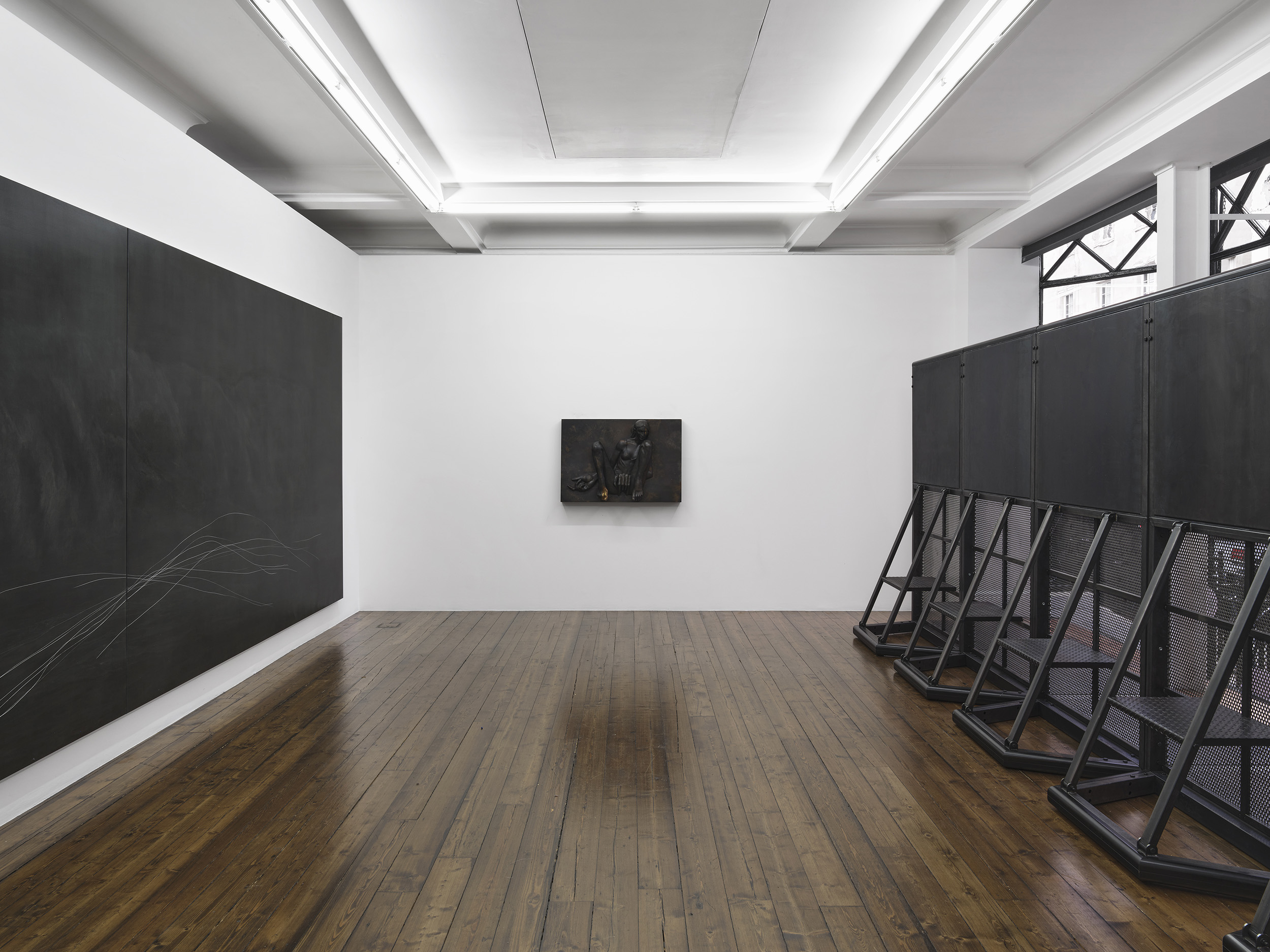
At Sprüth Magers, the first body is a barrier. It stands where a crowd might have been, where a performer might have crossed, where an audience might once have gathered: black, modular, repeated, cutting the white room into a route. Across from it, visible through the gallery’s shop window, The Lake of My Mother’s Tears stretches over two panels, glossy enough to hold the light and scratched enough to disturb it. The show begins before the room is entered. Street, window, barrier, wave: the viewer is already being addressed as part of a public that has not assembled.
There are no performers in the first room. There is no event to wait for. The familiar Imhof equipment is present, stripped of the live bodies, heat, and duration that once made it theatrical. That absence could read as retreat: performance converted into paintings, bronzes, barriers, film. Citizen asks a different question: what kind of public remains when performance no longer gathers one.
The body has always been the question in Imhof’s work: how it moves through space, how it is watched, what it can occupy, what it cannot. In Fun ist ein Stahlbad at Serralves, that question was placed under the sign of Adorno and Horkheimer’s diagnosis of fun as discipline disguised as pleasure, with the steel bath made literal as sculpture and control given material form. In DOOM: House of Hope at the Park Avenue Armory, bodies gathered at scale: performers moving, audience held behind concert barriers, watching made physical by duration, sound, fatigue, and proximity. London follows those conditions by removing the gathering and keeping the positions.
Inside Citizen, the title names a public condition after the public has been broken apart. The performer returns as footage. The viewer returns in the mirror. The image returns through the window, through painting, through recognition, through fashion’s circulation. These are no longer gathered in one event, but the room makes them visible together.
Fashion is where that condition had already begun to travel. The image of Imhof’s performances did not escape into fashion by accident, and fashion did not simply contaminate it from outside. Fashion became one of the publics through which the image travelled without the event that had produced it. The clothes, the gaze, the exhausted stance, the severe beauty of bodies held between display and withdrawal: these signs could circulate without requiring anyone to stand in the room, wait, be routed, or share pressure with others. What travelled was public visibility without public assembly. Citizen brings that visibility back into the room that first made it possible.
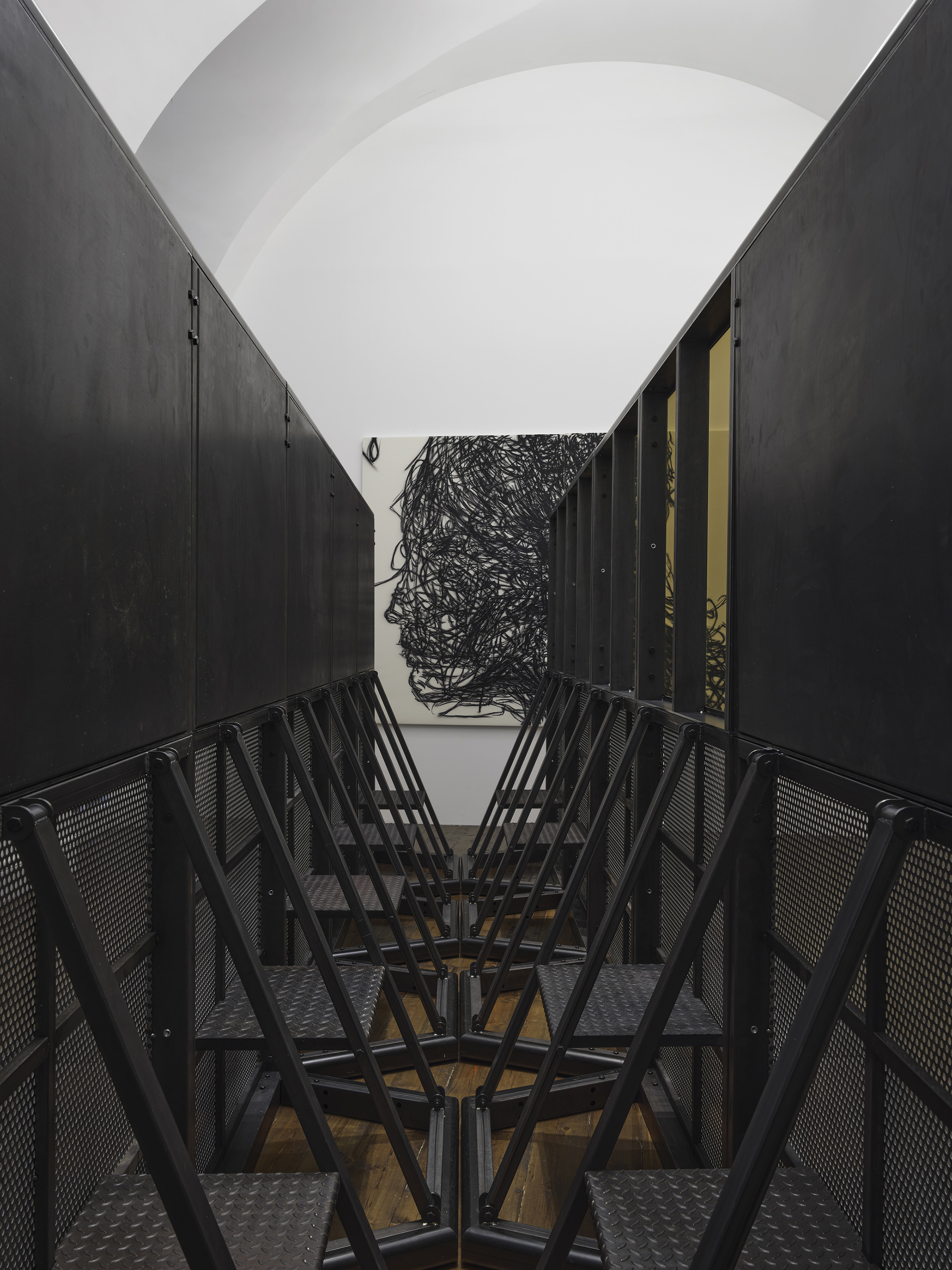
The barrier gives the title its first physical form. A citizen here begins as a body placed inside a public system: routed, narrowed, reflected, held back, moved along. The black modules belong to concerts, demonstrations, controlled crowds, bodies gathered and managed before they become a public. Here they stand without the crowd they were made to organize, and the absence sharpens their function. One barrier element replaces its black panel with a mirrored surface. The viewer appears where the crowd has been removed.
The barrier begins by changing the body’s route. It cuts the gallery into movement, pause, turn, reflection. It also blocks the view outside, turning the windowed threshold into a managed line of sight. The body that enters the room is placed inside a condition performance once made visible through other bodies. When the barrier returns as an inaccessible passage, it confirms that obstruction is not an entrance effect but the exhibition’s method of making movement conscious. The room has a tempo: approach, obstruction, deflection, return. The barrier makes the room behave.
Across the back wall, The Lake of My Mother’s Tears holds too still at first. More than six meters wide across two panels, the wave sits in glossy black and grey, with the finish of an image that wants to stay closed. Then the scratches interrupt it. White lines break through the oil, not as highlights laid on top but as injuries made into movement. What looked fixed starts to act again. The construction becomes part of the pressure: a digital image, painted into oil, then cut open by hand. From the street, the painting can still behave like a picture: dark, cinematic, immediate. Inside, the surface refuses that ease. The scratches keep the wave from becoming an image of force and make it behave as force again. The image that could circulate outside the room is brought back under surface pressure, made to answer to hand, damage, and scale.
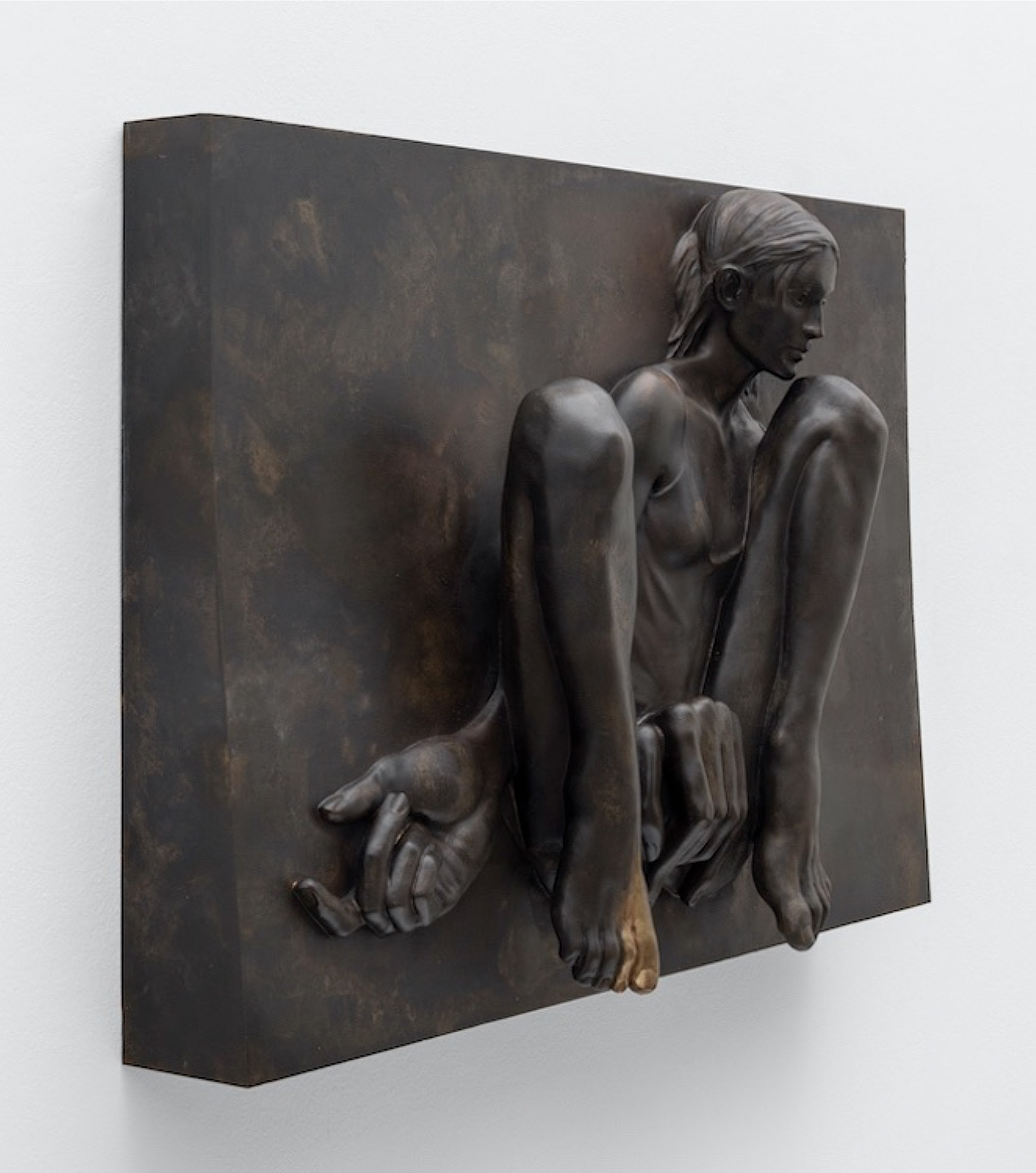
In Girl in Leotard, bronze holds the body close to the surface. The figure is folded into the plate: knees drawn up, one hand placed between the legs, face turned outward. It comes forward only in parts. The limbs and face rise into relief, but the edges sink back into patinated dark. Gold catches at the toes and one eye, less as ornament than exposure. The relief carries tenderness under pressure. Bronze, gold, patina, touch: the materials move close to object luxury, but the figure never becomes fully available to them. The medium gives it permanence, but not escape.
The film first offers the wrong reading. Citizen, shown on the floor above, also spills into public view through the window. Four channels are mounted on a modular black pedestal, using the same vocabulary as the barriers below. The footage comes from DOOM, shot on iPhone by one performer observing others across four nights of the Armory run. The channels first read as four camera angles on one solo. They are not. Each channel shows a different night. Xavier Days, a Flexn dancer, holds the same solo across four evenings without a score, the movement kept in muscle memory. What looked spatial is temporal. Recurrence becomes visible only after it has passed through Days’s body: through training, memory, endurance, and the capacity to repeat without becoming identical. The event’s public time survives inside one performer’s discipline. The room can repeat the structure, but Days carries the movement before the room can show it.
Days’s presence keeps the body from becoming abstract. This is not simply “the body” as a philosophical unit moving through space. It is a Flexn dancer’s body, a trained performer’s body, a body repeating across nights inside another artist’s frame. The work needs that specificity. Without it, recurrence becomes too easily credited to the room.
The absence is no longer neutral. The barriers route bodies, the paintings reopen images, and the bronzes hold figures close to the surface. Days’s solo carries something those objects can only continue after the fact. The performers are mostly missing, but the film makes that absence exact. The room learns from the body, then continues without it.
The wave returns. Grey Wave opens the palette: paler ground, finer white strokes spread across the field. You Are Queen so I Will Bow to You shifts to midnight blue, its crest dissolving into white horses tinged pink. Together, they change the first wave by making it part of a working method. One wave could be image. Three waves make recurrence visible as practice. Seen beside the earlier wave works at Serralves, the London paintings continue the test: whether an image of movement can keep moving once the body is no longer present to generate it.
The drawings bring death into this system as procession: a ballerina en pointe held by a personification of death, a woman carried on a horse’s back, bodies moved by a force larger than intention. The reference reaches toward the danse macabre, a tradition in which death does not arrive only as private ending but as movement shared across bodies, gestures, classes, and rooms. The danse macabre gives death a public movement. Imhof gives it route, screen, surface, and repetition.
Citizen can look like performance after the performers have gone: paintings, bronzes, barriers, film, each able to leave the event behind and become object. The exhibition stays inside that risk. The live body is absent, the crowd has dispersed, and the image has travelled too far to return unchanged. The objects have to take over work that once belonged to duration, proximity, fatigue, and the shared pressure of a room. Imhof has not left performance behind so much as exposed what performance had been doing. What remains is a room where performer, viewer, and image are made public again without the event that once held them together.
In Citizen, Anne Imhof does not simply translate performance into objects. The crowd has dispersed, the performers are mostly absent, and the image has travelled through fashion and recognition. What remains is a room that reassembles performer, viewer, and image through barrier, window, mirror, wave, film, and body.

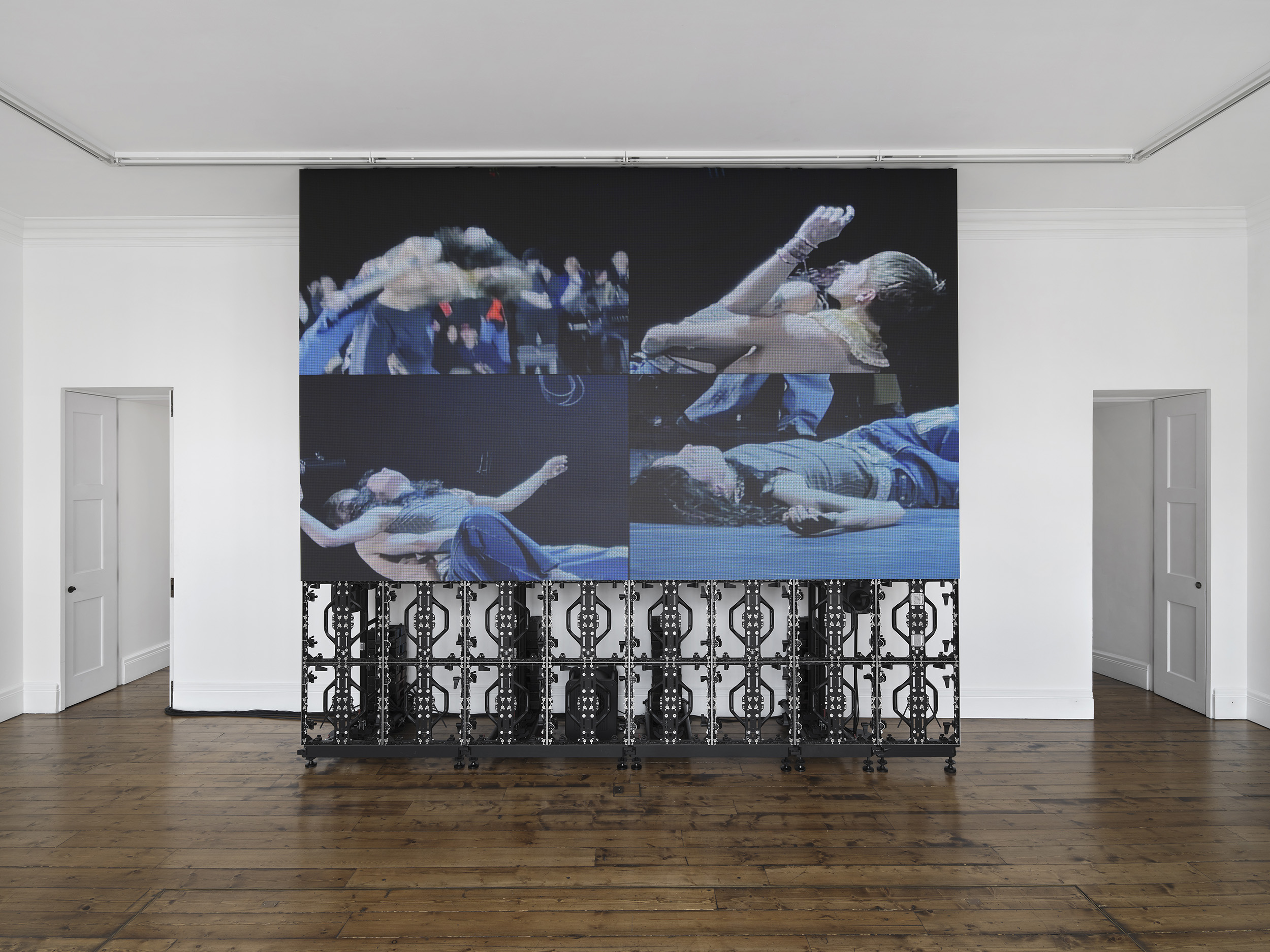

Cover Image: Anne Imhof, Citizen, Sprüth Magers, London, 5 June–1 August 2026. © Anne Imhof. Photo: Ben Westoby / Fine Art Documentation. Courtesy the artist and Sprüth Magers.