



Wall-sized in black and white, Saar belly-dances in metallic robes and a head covering she sewed for herself. Her arms open. Her body turns inside the garment. The artist made what she is wearing. She is wearing it before any actress ever did. The photograph was taken at the Renaissance Pleasure Faire, which the Saar family attended for years at Paramount Ranch in Agoura. The Faire was a left-wing pageant founded in 1963 as a fundraiser for Pacifica Radio’s KPFK, shaped in part by the climate of McCarthy-era Hollywood blacklisting. Saar’s daughters had taken theater class with its founder, Phyllis Patterson, in a children’s theater program she ran in her Laurel Canyon backyard. Saar wore her own garments there. Her daughters wore them. Before the exhibition has shown a costume design or a finished object, it has shown the work being worn by the family.
That changes the first terms of the show. The wearable work begins to look less like an earlier category and more like the place where the later objects learned what they could hold. The distinction between costume and assemblage starts to feel less secure. What first appears as costume history starts to press on the objects Saar is better known for making.
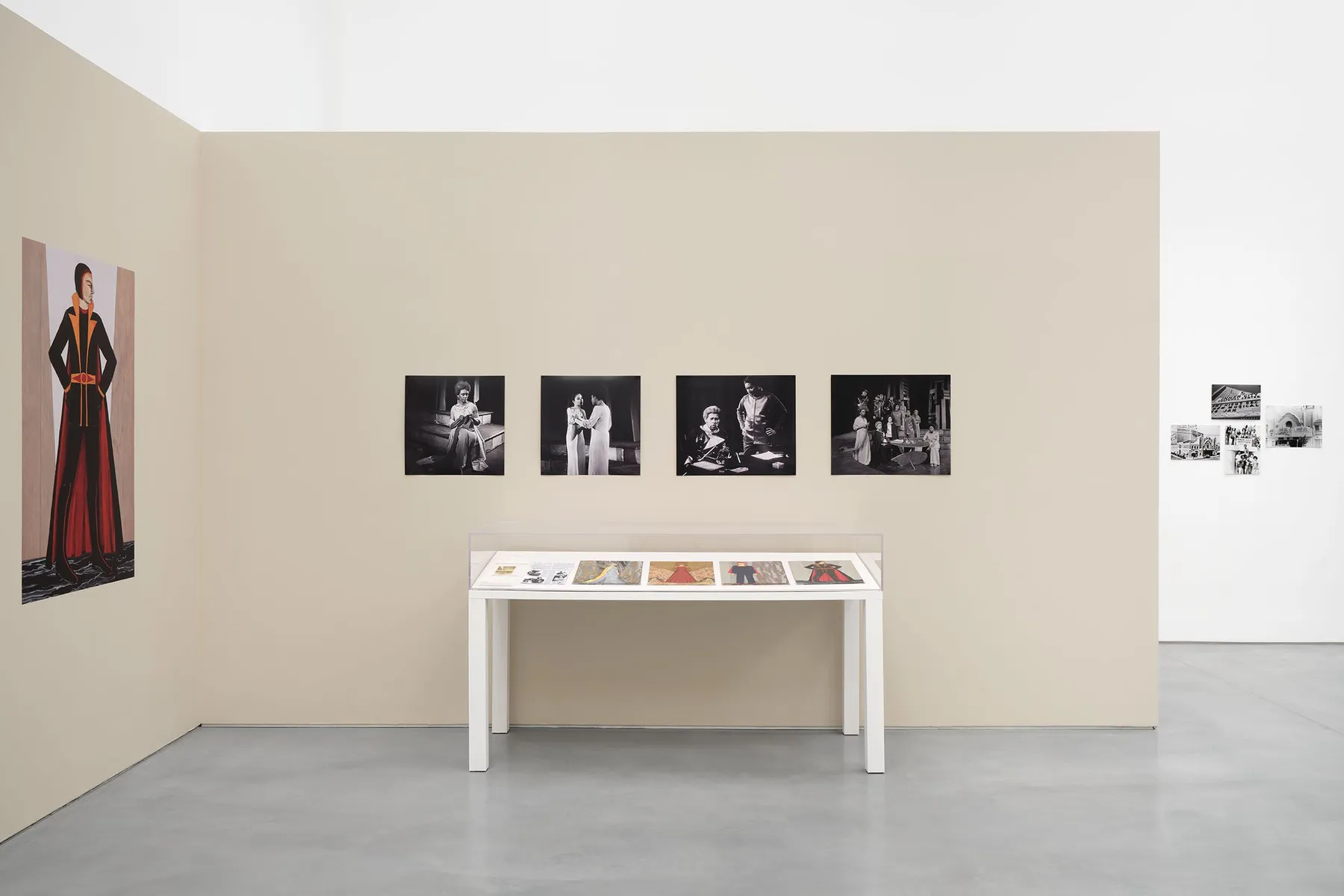
A red dress appears first as watercolor, but the drawing points back to use. It was made for Antigone, the woman in Sophocles’ play who buries the brother her city has forbidden to be buried and pays for the refusal with her own life. Saar drew the dress long and red, a black collar at the throat, a cape falling behind the standing figure. An actress had to wear it onstage. The refusal had to hold inside the cloth. The watercolor we see now is not only a design. It is what remains of a garment that had to act.
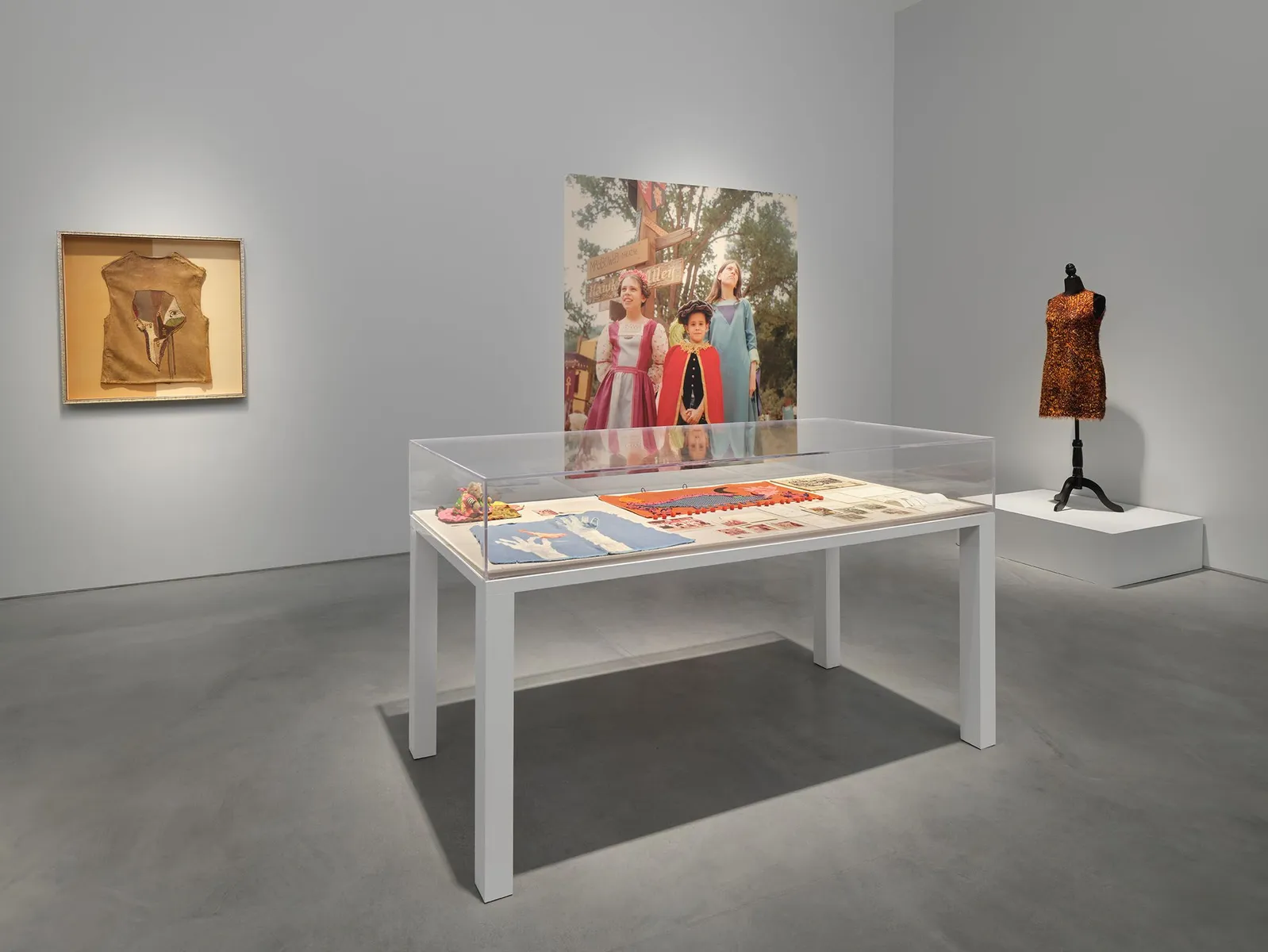
In a quieter room, a single dress form holds an A-line shag mini dress in cheetah print. Saar made it in 1969, the same year she made Black Girl’s Window. The dress passed from her to her daughters, then to her granddaughters. Each generation altered the hemline shorter. The garment was used, not stored. At first this reads as family history. Then it changes what the dress is. The object has been carried by bodies for longer than it has been held by the archive. A dress form usually removes the body so the garment can be studied. Here it does the opposite. It points to the bodies that kept changing the dress after Saar made it. The object is not complete at the moment of making. Its history continues through wear.
Watts gives the red dress another pressure. It was where the Inner City Cultural Center emerged. It was also where Saar’s grandmother lived, and where Saar spent summers throughout the Pasadena childhood that followed her father’s death in 1931, when she was five. By the time she costumed Antigone there, Watts was both the place of her childhood and the place of the 1965 uprising. A stage in Watts was not neutral ground. It was being asked to gather bodies the city had kept apart. The Inner City Cultural Center had been founded in 1965, in the wake of the Watts Rebellion, by C. Bernard Jackson, a Black musician and composer, and Dr. J. Alfred Cannon, a Black psychiatrist. By 1968 Saar had joined as an apprentice costume designer through a Ford Foundation training initiative run with UCLA. She was forty-two. She had three daughters. She was newly divorced.
A costume there had to do more than dress a role. It had to dress an actress who might be cast across the role’s assumed race. It had to read to an audience gathered across a segregated city. It had to function on limited means. Saar bought men’s suits at thrift stores and reconstructed them around a found fabric or a found pattern. What later becomes familiar in the assemblages is already here, but under pressure of use: discarded material and found pattern recomposed around a body.
A working ledger sits open in a vitrine, and it should be administrative. Instead it becomes one of the show’s most direct objects. It records the work that kept the household running: greeting cards, enamel plates, jewelry made with the artist Curtis Tann, costumes for the Tuskegee Choir, magazine commissions, teaching. The archive also holds the album cover she designed for the jazz woodwind player Bennie Maupin, whose playing moved through Miles Davis’s Bitches Brew and Herbie Hancock’s Head Hunters, and her illustrations for Ishmael Reed’s A Secretary to the Spirits, by the novelist whose Mumbo Jumbo was then redefining what a Black American novel could hold.
The ledger records the work that paid for the work. It refuses the separation between art practice and household survival. Images moved through jazz, literature, theater, commercial print, income, and childcare before museums had a category large enough for them. What has often been called versatility begins to look like infrastructure: not the gallery network around the practice, but the running system underneath it. The practice was not waiting for an art-world frame. It was already moving through the systems that kept life and work going.
Near the costume designs hangs a tooled leather vest. Saar made it for the folk singer Len Chandler, her boyfriend at the time, a civil-rights organizer she had also costumed. The hide came from Alonzo Davis, born in Tuskegee, who in 1967, two years after Watts, opened Brockman Gallery in Leimert Park with his brother Dale. Brockman became a crucial Black-owned gallery on the West Coast, showing Saar, David Hammons, John Outterbridge, Senga Nengudi, and Noah Purifoy. The vest contains that route. Chandler wore it. Saar made it. Brockman’s leather is inside it. What looks like clothing is also a body, a relationship, a performance circuit, and a gallery history carried at once.
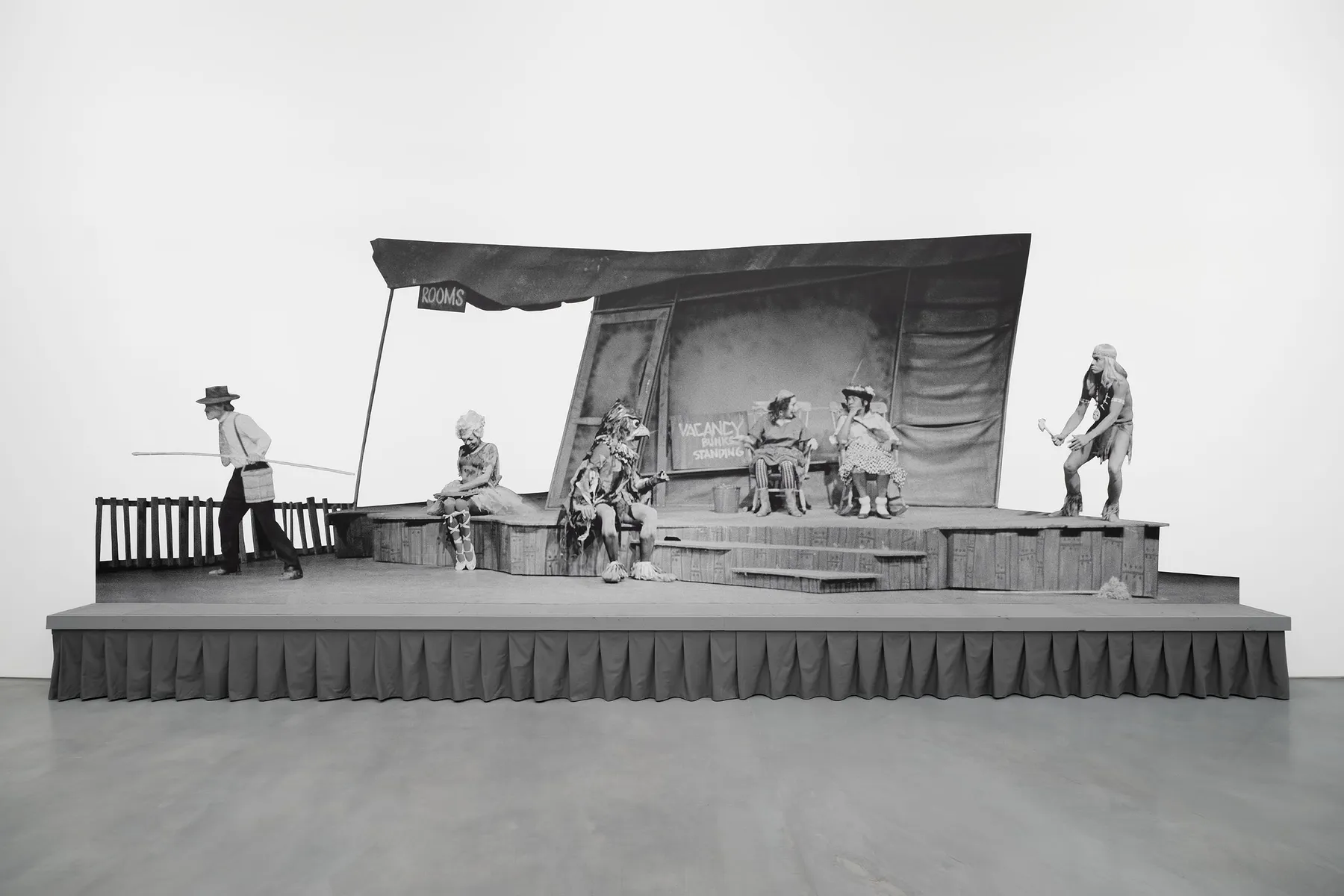
At the back of the central gallery, a photograph from the 1970 Inner City Cultural Center production of Tennessee Williams’s The Gnädiges Fräulein has been built up into a stage. The black-and-white blow-up is mounted to a real wooden platform with a grey pleated curtain skirt at floor level. The “ROOMS” sign and the “VACANCY BUNKS STANDING” placard are visible on the painted set in the background. The costumed figures stand mid-action. The viewer stands in front of a stage, not a hung image. The gallery has built the theater up rather than reduce it to documentation. The image has not been allowed to forget it was a stage.
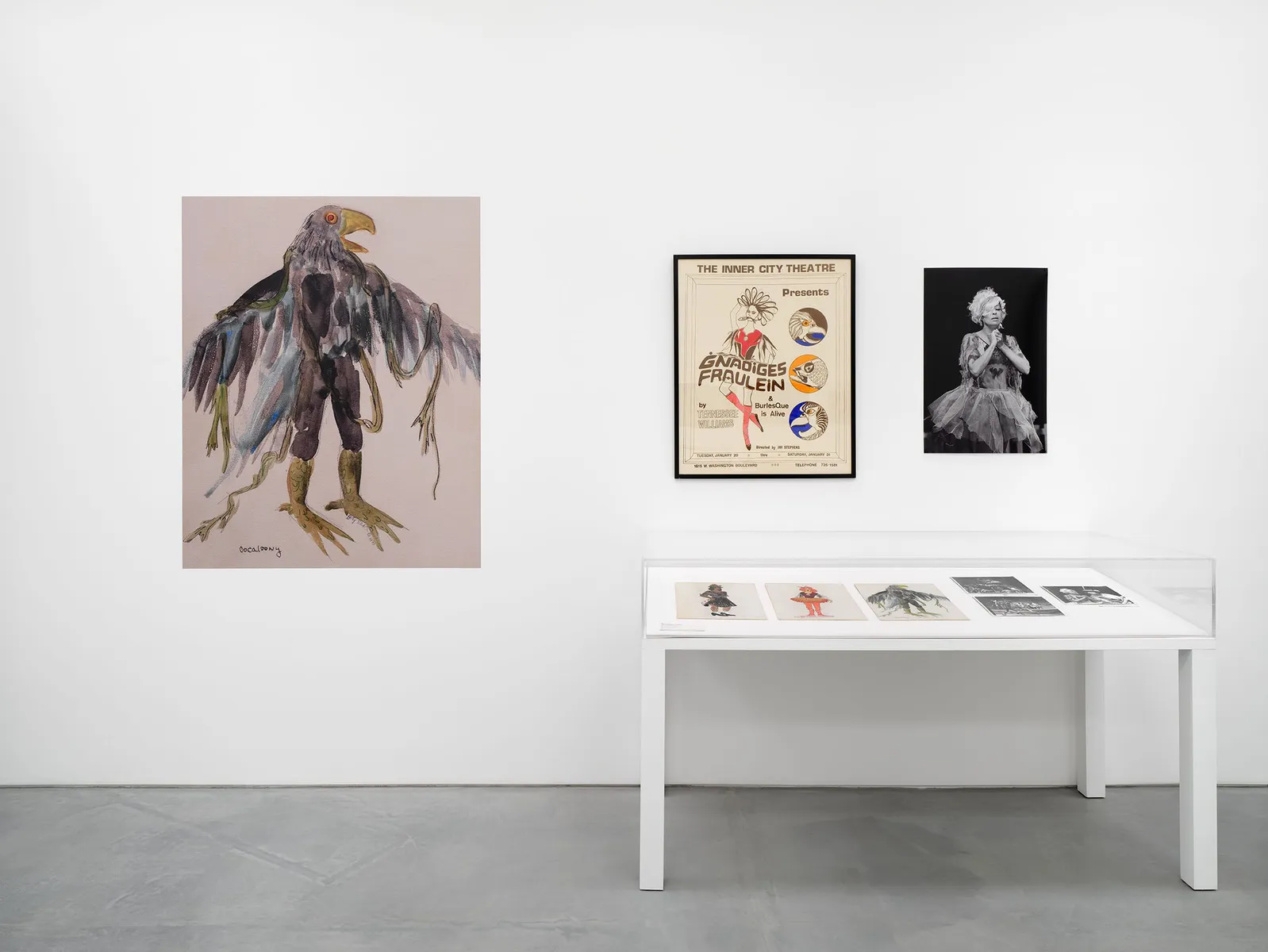
Nearby, a costume design signs itself Cocaloony, the predatory bird in Williams’s 1966 absurdist one-act, a giant pelican-like creature that competes with the female performer for fish and, over the course of the play, plucks out her eyes. The design hangs unframed on the same warm tan wall as the Antigone sketches. It is still working paper, not framed painting. The signature on the page is the character’s. The artist signed her assemblages later. Here she signed for the role.
After these objects, chronology is harder to keep. The costumes no longer look like material before the real work begins. They show Saar returning to a problem that would not stay inside costume: how an image could hold more than itself. Saar would later describe her assemblages as miniature environments and credit theater, design, lighting, and balance with shaping her sense of space. In this exhibition, the objects make that connection before the interviews need to explain it.
In 1969, the same year she made the cheetah-print dress and costumed the Inner City’s production of West Side Story, Saar made Black Girl’s Window: a wooden window-frame box with a Black girl’s face pressed against the glass, palms held up beside her, nine smaller boxed images arranged in a grid above her. Face at the window, hands raised, looking out from a structure that holds her there.
Saar had seen Joseph Cornell’s boxed assemblages at the Pasadena Art Museum in 1967, and the encounter mattered. Cornell’s boxes are chambers: a bird, a map, a wine glass, things gathered inside a frame the viewer is invited to look into. Saar’s box is not a chamber in that sense. It has a Black girl inside it, hands up, looking out. The viewer does not simply look in. The viewer is being looked back at. The window keeps the body in the image even when no one is wearing it.
The Liberation of Aunt Jemima, 1972, was made while Saar was still designing costumes at the Inner City. The work has often been read as the assemblage that turned racist iconography against its uses, and that reading remains necessary. After the costume practice, another pressure becomes visible. An image changes when the body inside it is given another role. Aunt Jemima remains recognizable, but the rifle in her hand changes what the recognition can be used for.
The washboards on which Saar would mount work for the next fifty years, most recently the 73-inch Tower of Destiny in 2023, keep labor inside the still object: washing, scrubbing, women’s work, often Black women’s work for households not their own. The shrines and windows and boxes start to look continuous with the wearable work because they keep asking the image to hold a body’s work after the body is no longer present.
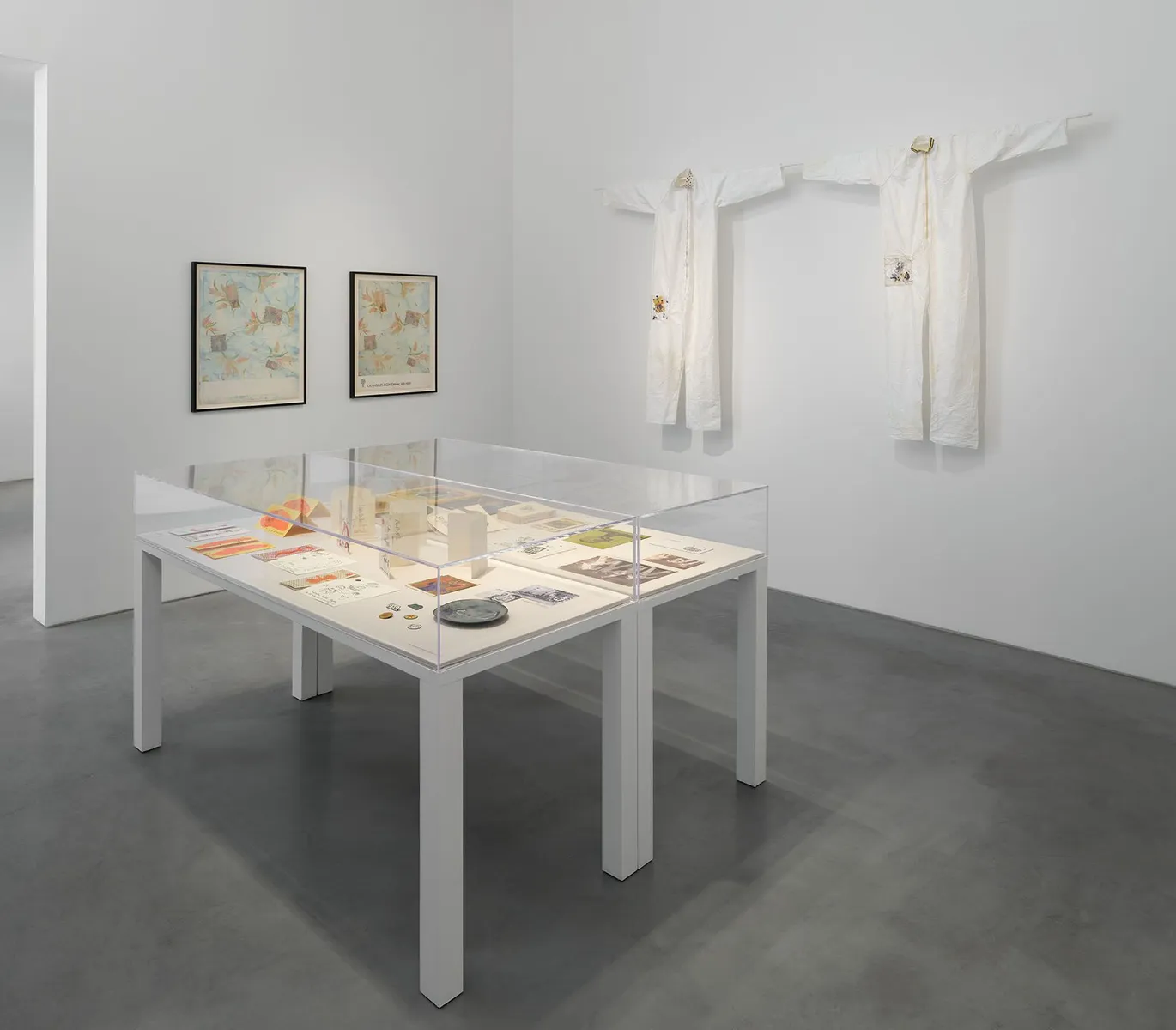
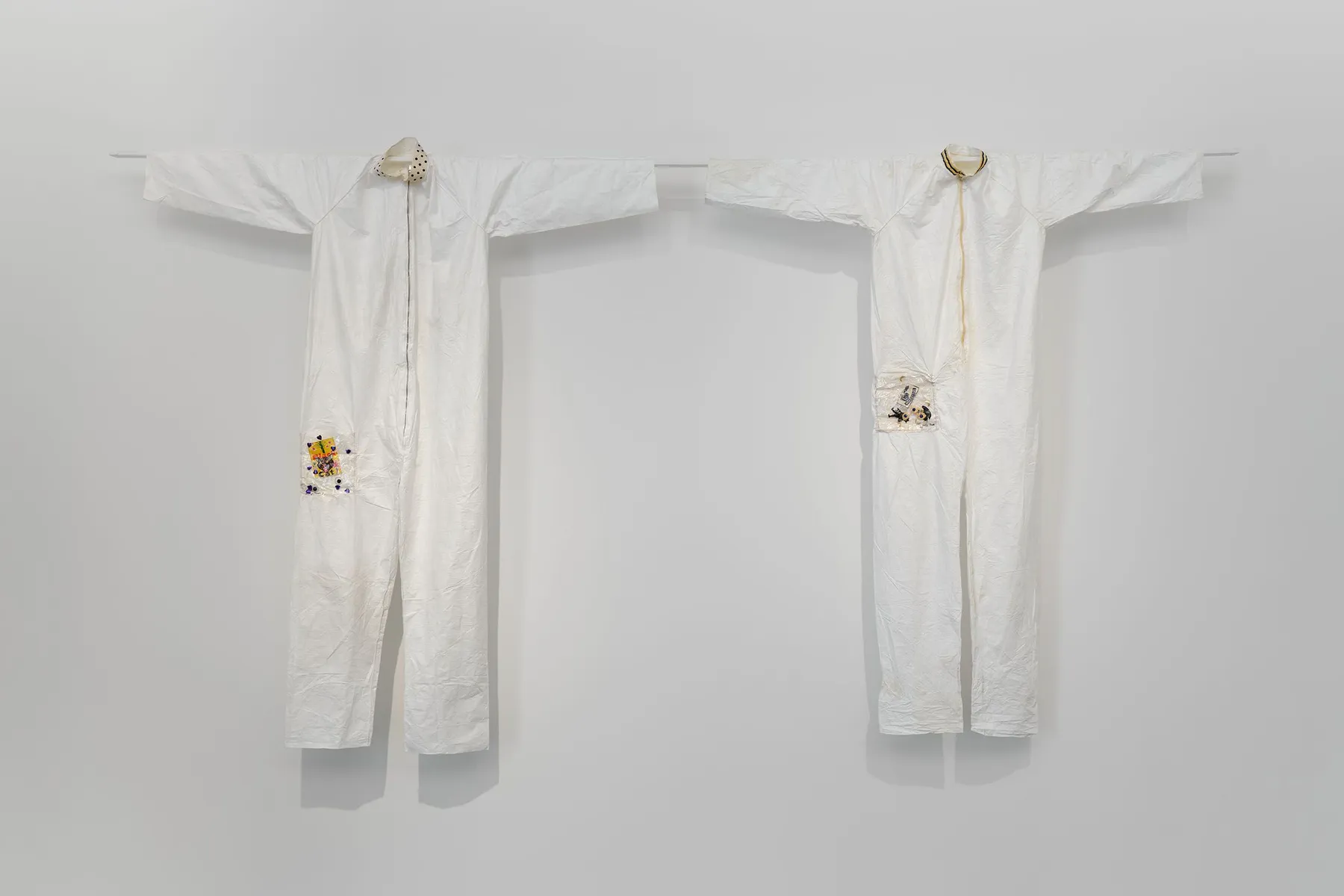
The show ends in a smaller back room with the material that ran alongside everything else: album covers, book covers, greeting cards, enamel plates, photographs from the Doo Dah Parade, things Saar made to keep her household going and her images circulating. In a photograph from 1979, Saar, her daughter Tracye, and the performance artist Rachel Rosenthal pose in matching white coveralls Saar made. The coveralls hang now in the show with embellished pockets sewn at the knee: ribbons, beads, small assembled trinkets behind transparent fabric. Saar called those little pockets little assemblages, each carrying something different. By the time she used that word, the garment and the assemblage start to look less separate. One needed a body to activate it. The other kept the body inside after use had stopped.
The body does not leave Saar’s objects when she stops making costumes. It stays inside them. The image is still being asked to hold something. It always was.
Saar’s assemblages have long been read through the force of their iconography, especially their transformation of racist, domestic, and found imagery. This review builds on that ground by starting with the wearable work Roberts Projects brings forward: garments, stages, ledgers, and coveralls where the image is already moving through bodies, labor, households, and use before it becomes still.

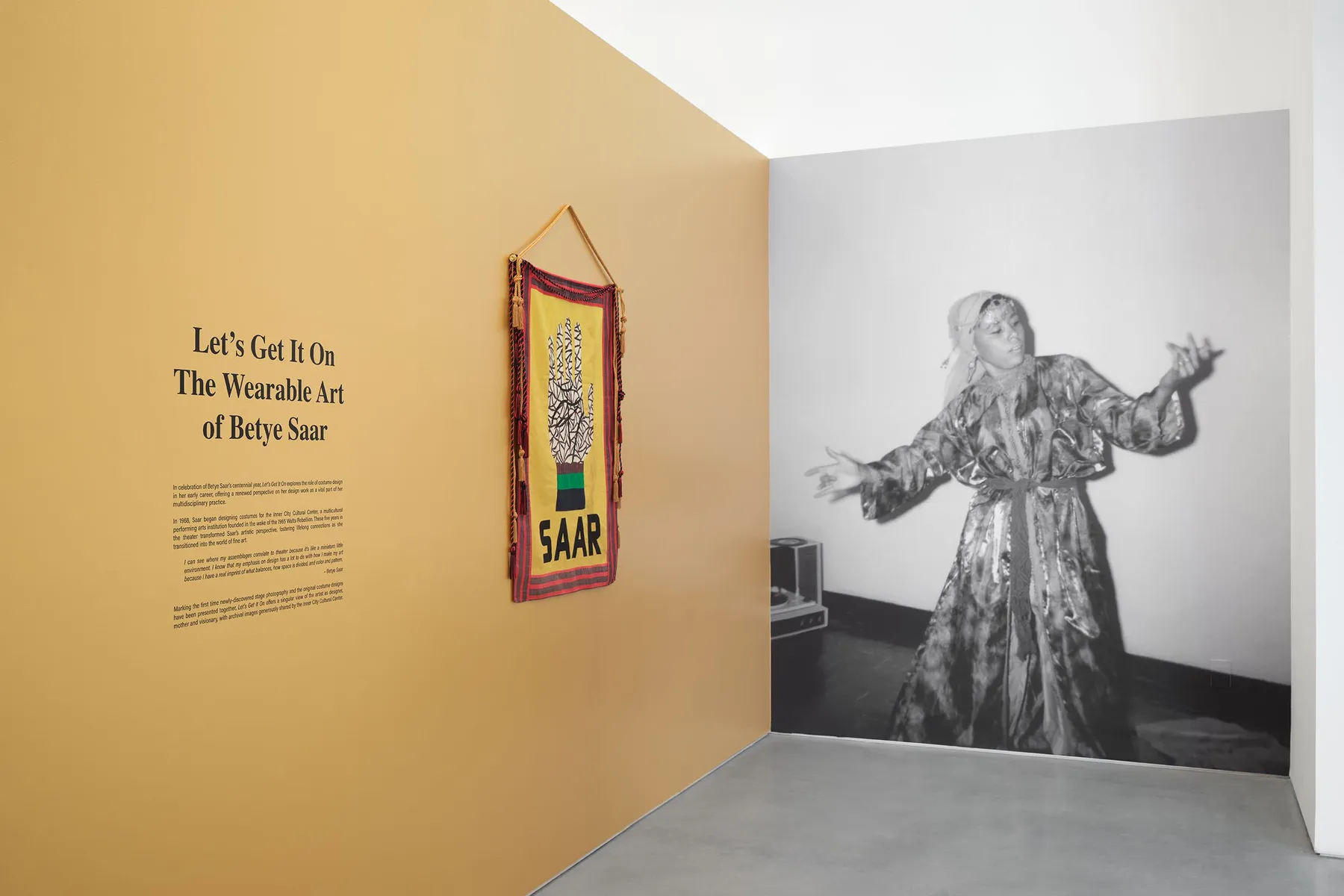

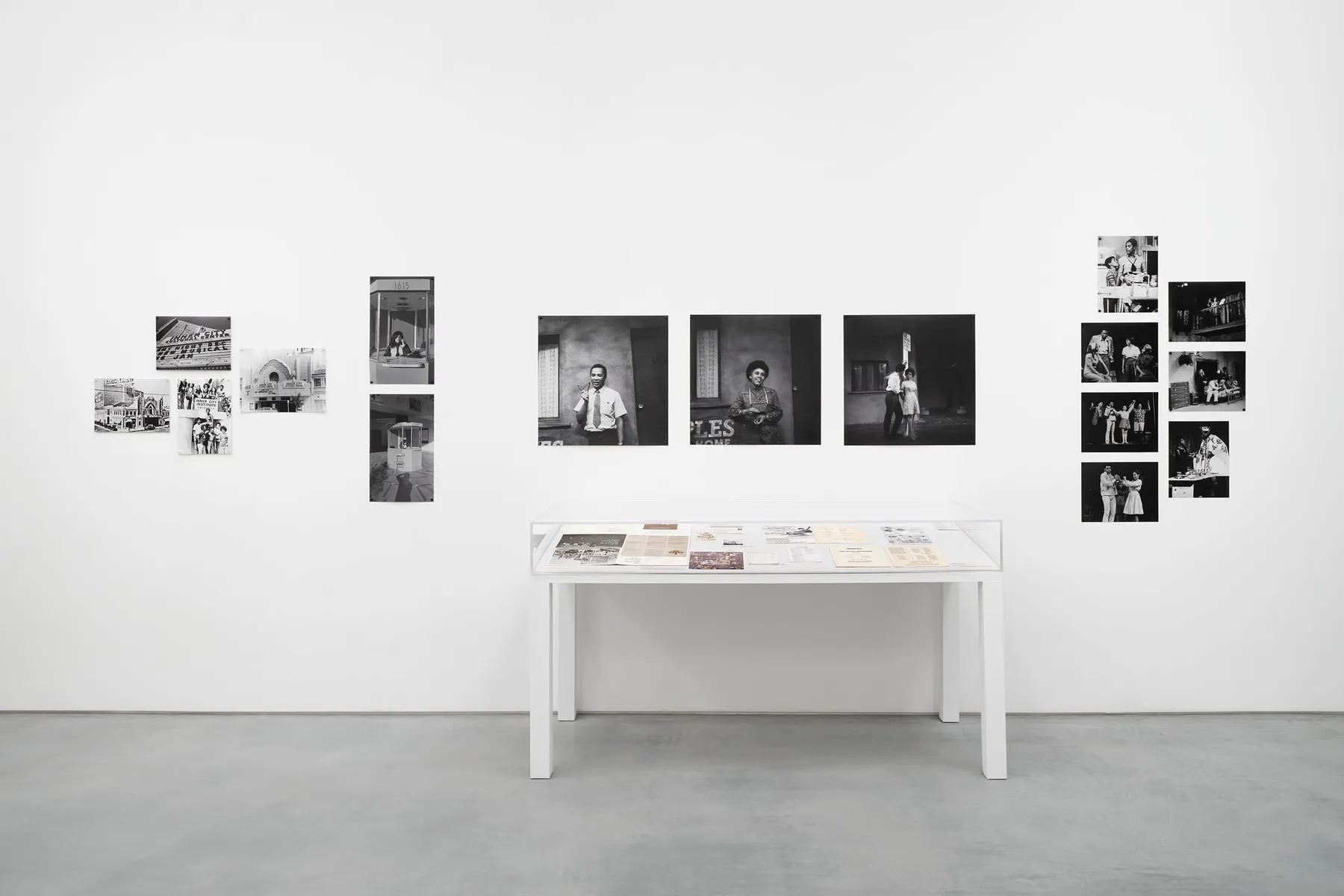
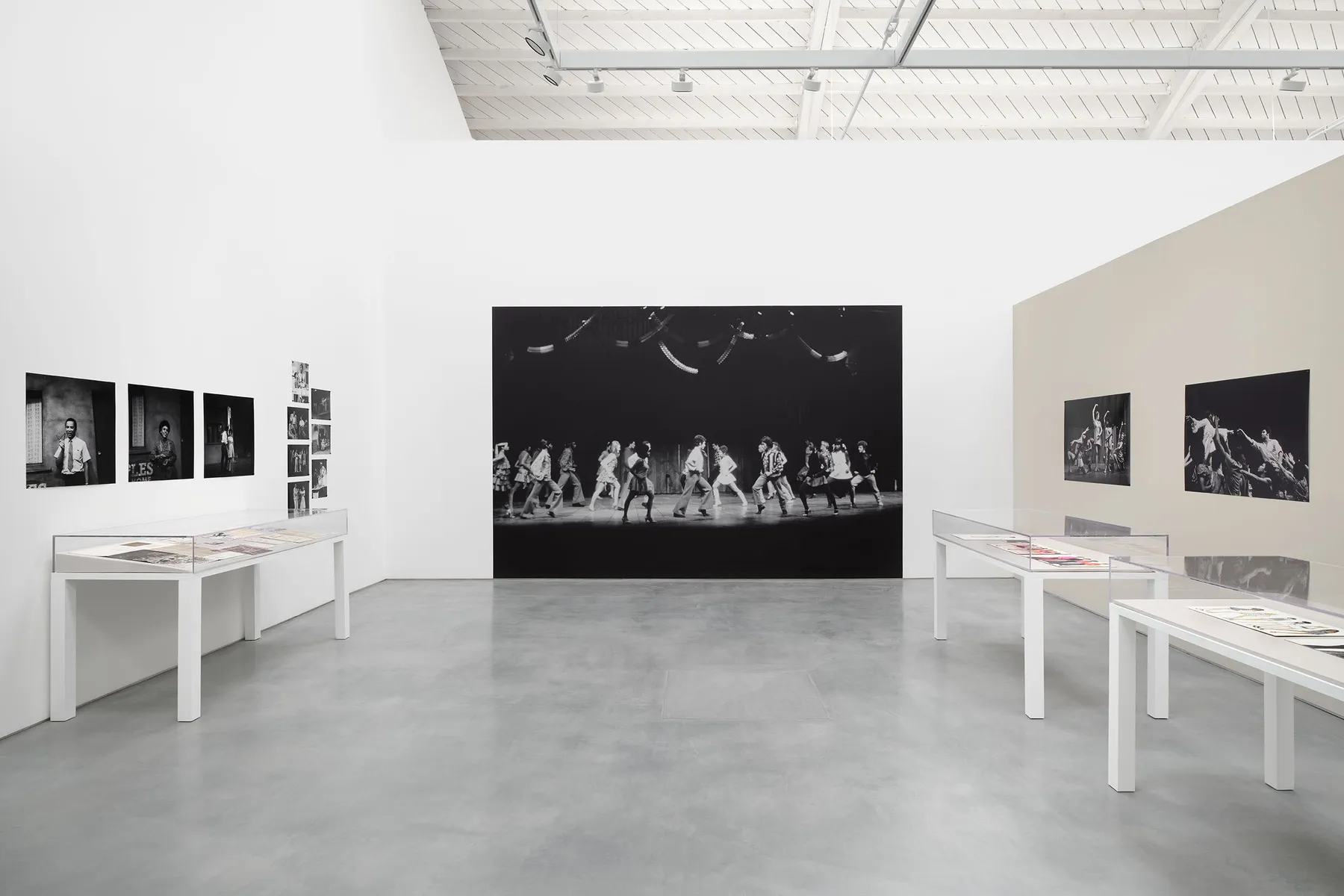
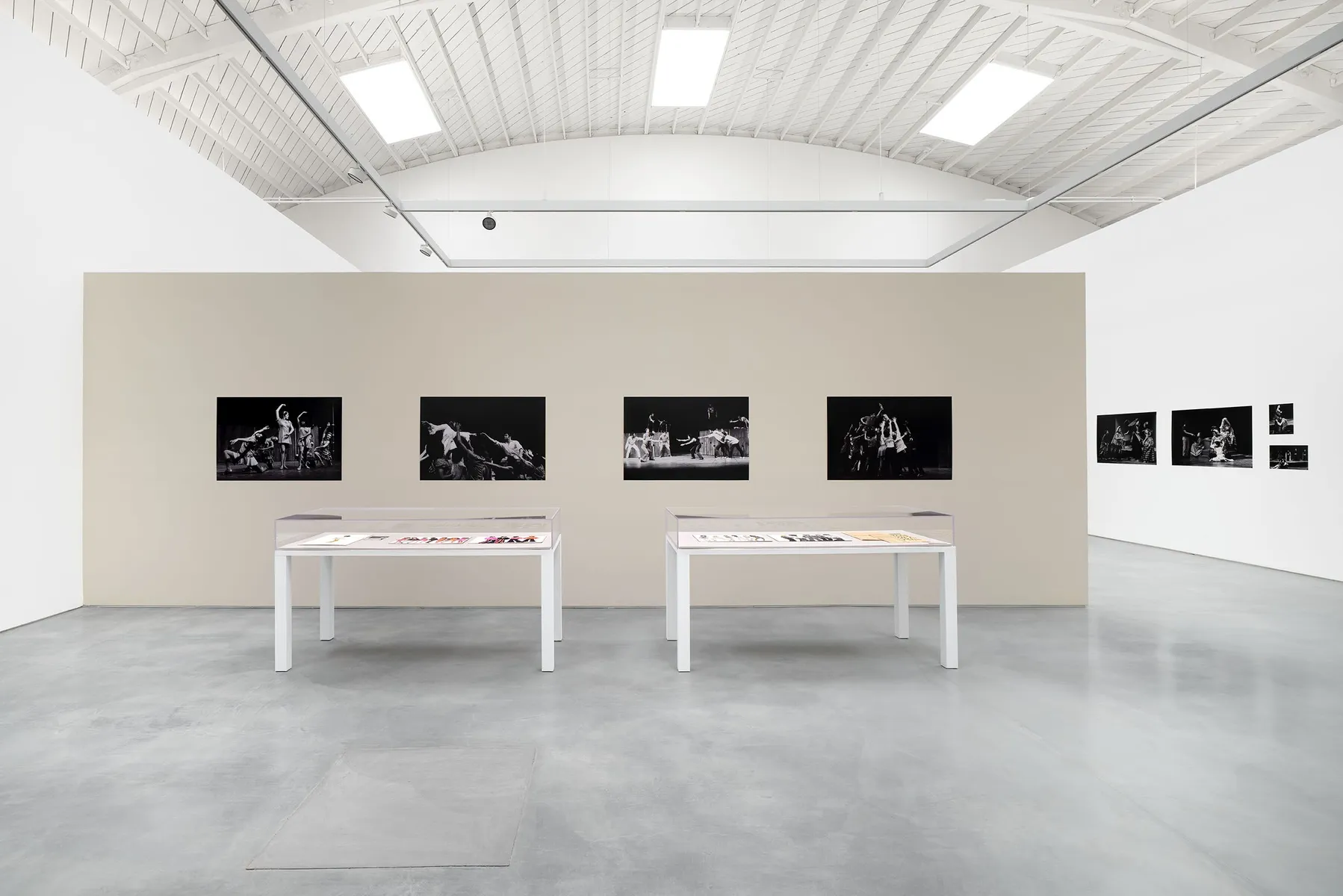
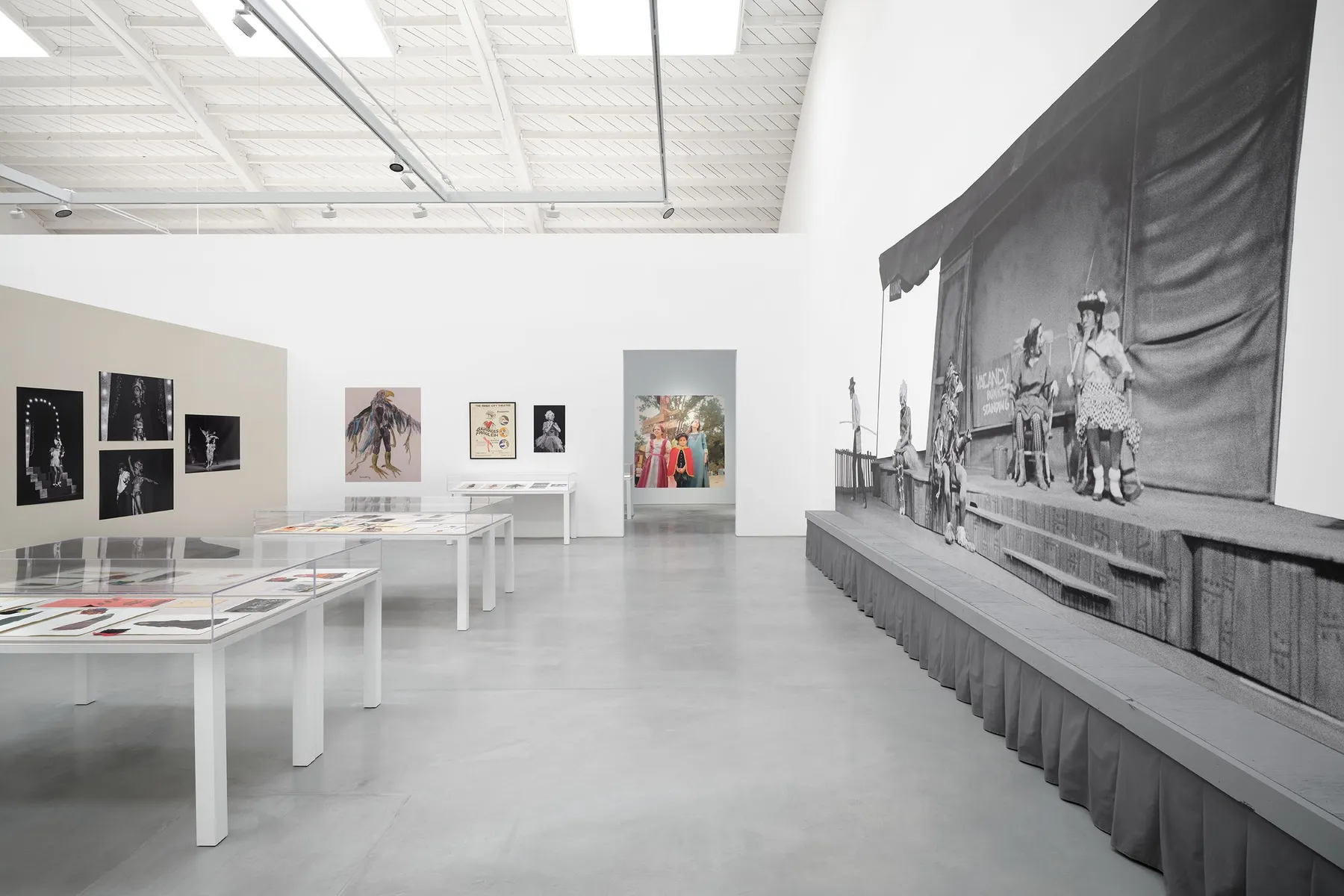
Cover Image: Costume designs installed beside the wall-sized photograph of Saar in motion. Exhibition view: Betye Saar, Let’s Get It On: The Wearable Art of Betye Saar, Roberts Projects, Los Angeles (30 May–22 August 2026). Courtesy of the artist and Roberts Projects, Los Angeles, California. Photo Paul Salveson.
All images © their respective rights holders.
Image rights & attribution →