



Watercolors confiscated before they could be shown. Women on hospital beds, tongues out, bodies exposed, prostheses where limbs should be. Doll eyes fixed into dark grounds. Bicycle inner tubes flattened against canvas like stripped skin. Taxidermy eyes held inside sprayed surfaces. A mail bag stretched on wood, worked in leather and rubber, titled La mucca pazza. Carol Rama’s work arrives as pressure before it arrives as category.
Carol Rama has long been read through transgression, censorship, and the exposed body. I See You You See Me follows another continuity: looking moves away from the intact figure and survives through substitute materials — doll eyes, taxidermy eyes, rubber, leather, animal matter, and surfaces already marked by use.
The familiar language follows quickly: transgression, obscenity, censorship, eroticism, outsider force, feminist recovery. The terms are not false. They stop too soon. They remain at the first shock — exposure, censorship, obscenity — before the work’s longer movement becomes visible. Rama’s first exhibition was closed by the police before it opened in 1945. Her early watercolors place the body under exposure, illness, desire, and the policing gaze that closed the show. The bicycle factory enters later through rubber, not as anecdote but as material inheritance. These facts are not background. They are the conditions each successive material takes up: watercolor, eye, rubber, leather, mail bag. Material does not remove the political pressure. It carries it differently. The problem becomes how to keep the body present after the intact figure can no longer hold looking, vulnerability, and exposure in one place.
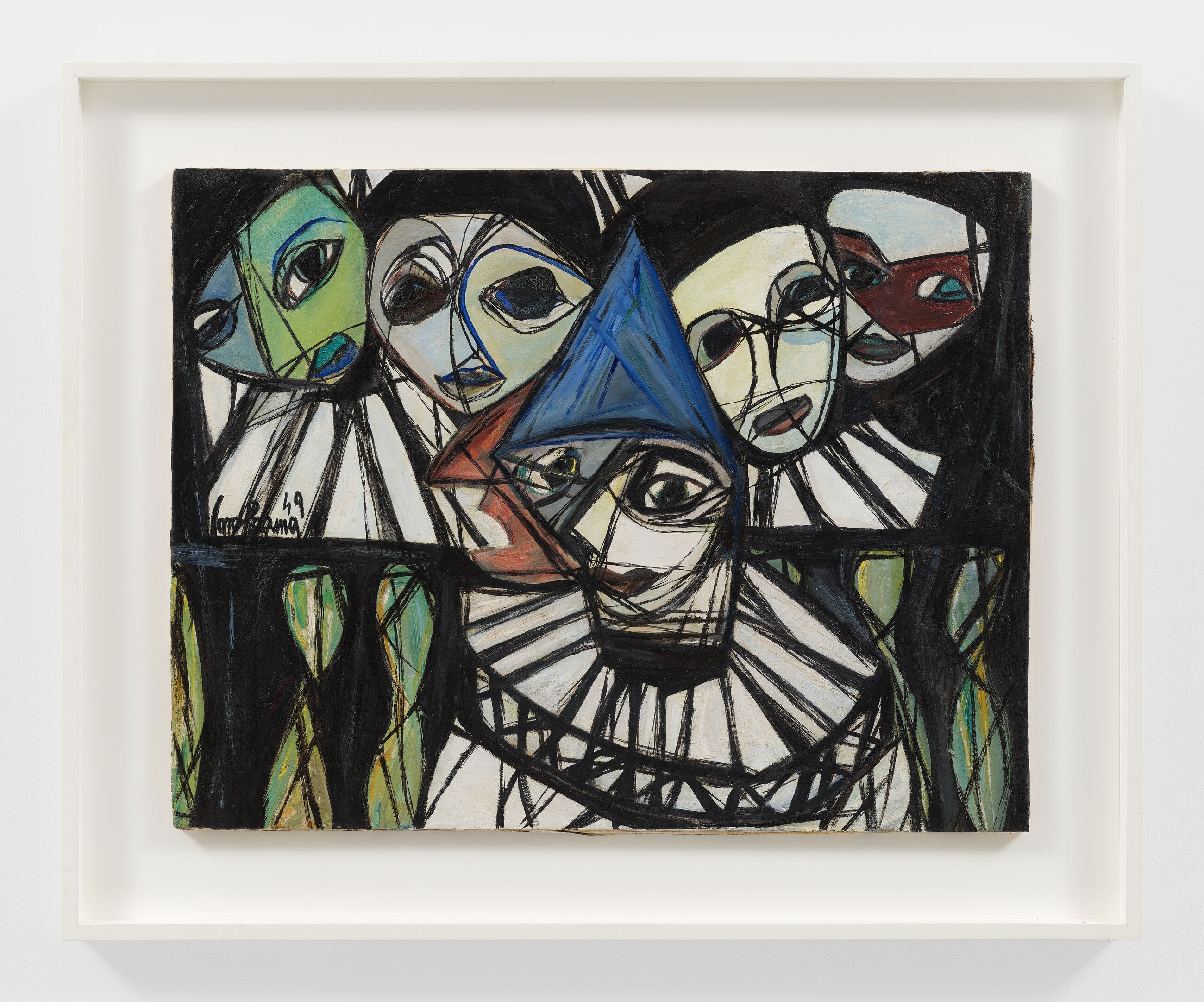
At the beginning, looking still has a figure to inhabit. In Dorina (Appassionata), 1943, watercolor, tempera, and coloured pencil gather body, face, and gaze into one exposed vertical form. The body is vulnerable, but it remains the place where looking is held. In Pagliacci (Clowns), 1949, that unity begins to strain. A grid runs through costume and face, organizing the figures from within while the eyes hold the viewer with an intensity the figure organizes rather than expresses. The gaze remains in the figure, but the figure no longer organizes it alone.
Transgression requires a boundary: a body intact enough to be exposed, censored, violated, returned. Rama does not keep that body available for long. The question is not why the work shocks. It is why the work keeps holding together after the body no longer does.
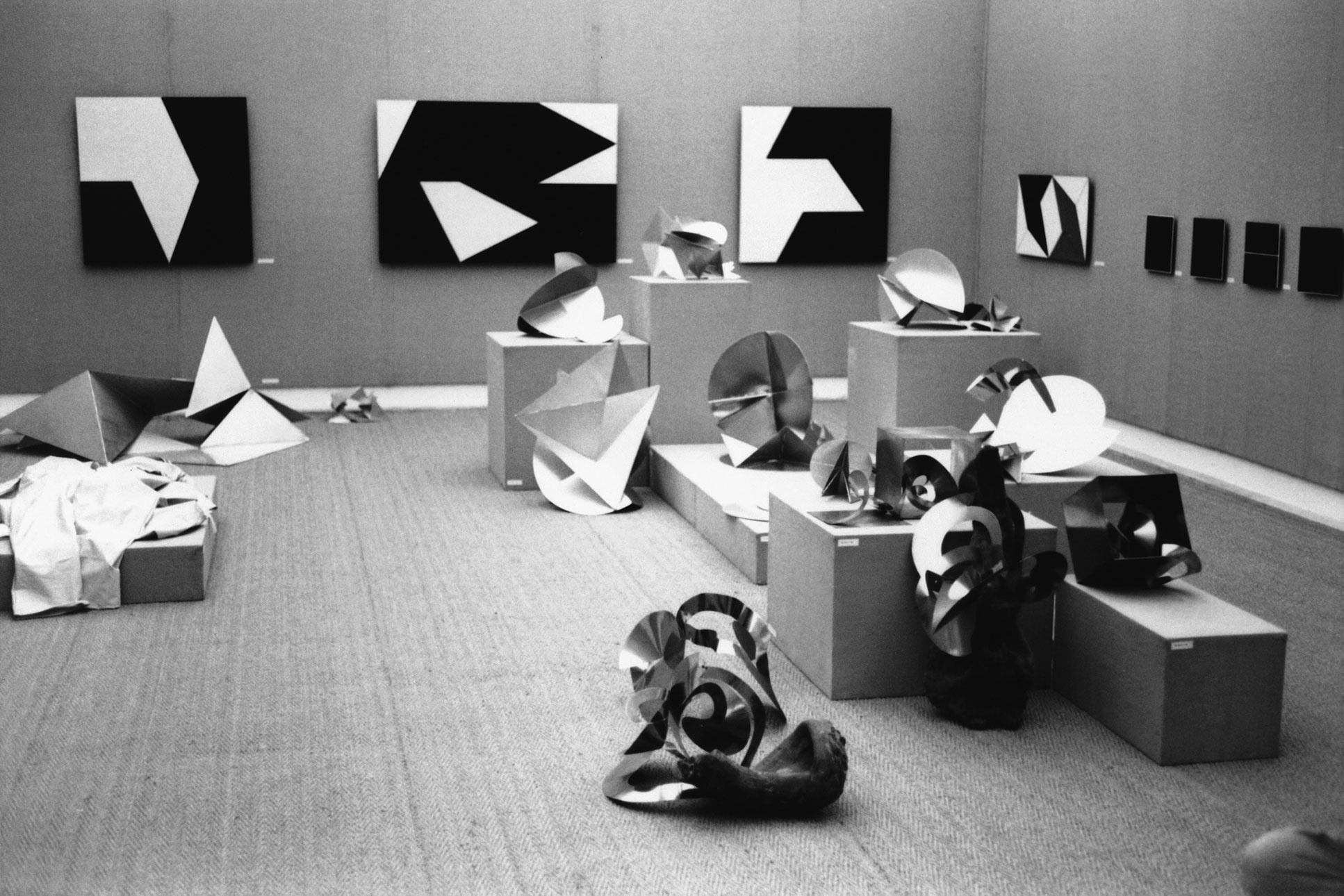
Movimento Arte Concreta gives that break a structure. Rama’s engagement with MAC does not simply interrupt the figurative work. It offers a system in which the body can come apart without disappearing into confession or scene. In postwar painting, the figure could still be asked to carry too much: moral pressure, social recovery, erotic charge, narrative legibility. Geometry gives Rama another structure. Grid, interval, and rational order briefly remove the exposed body from view, but the body does not vanish cleanly into abstraction. It returns through parts, substitutes, and attachments. The grid in Pagliacci had already begun that transition. The later eye works make it unavoidable.
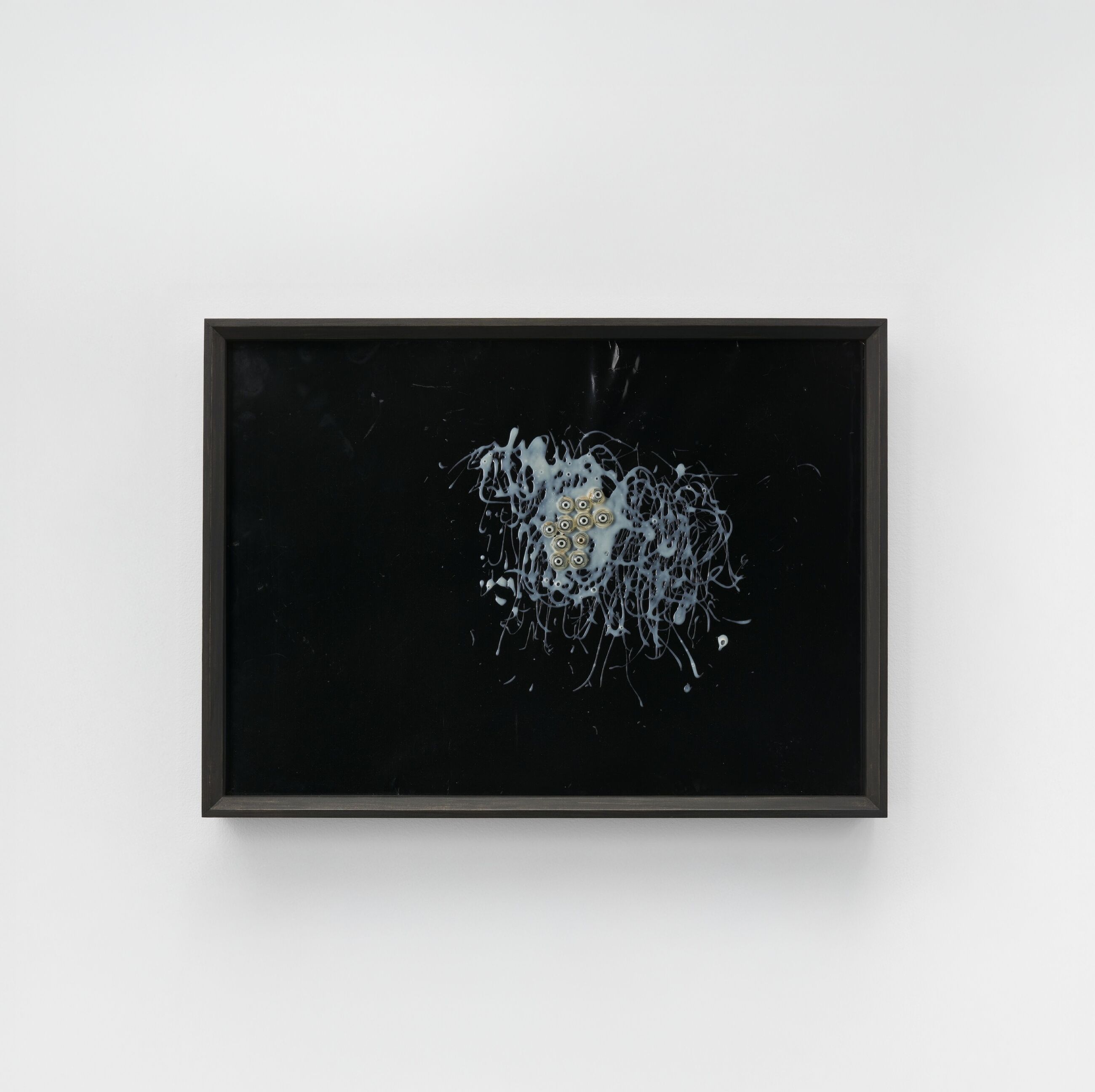
By 1968, looking has detached from the figure. Untitled, 1968, gathers doll eyes inside a loose field of dried glue against glossy black cardstock. No face arrives to organize them. No figure gives them a body to belong to. Looking remains, but it has been removed from the subject that once held it.
The eye was not always so detached. In Dorina, the eye belongs to a body. In Pagliacci, the eye begins to pull force from the figure that contains it. By Organismi ancora ben definiti e vulnerabili, 1969, taxidermy eyes are distributed across canvas as glass substitutes for organs whose seeing has stopped. The figural eye, the doll eye, and the taxidermy eye do not perform the same act. One belongs to a subject. One imitates a subject. One remains after a subject has been removed. Rama is dismantling the body’s claim to contain looking.
The bricolage works extend that dismantling into objects that have never belonged to the figure: syringes, claws, teeth, metal fragments, doll parts. They do not illustrate the body. They take over its work. Syringes have held injections. Claws have been torn from animals. Teeth have been pulled. The surface receives objects that already know contact, force, and removal before they enter the work. The body is no longer represented as a whole. Its operations have been redistributed.
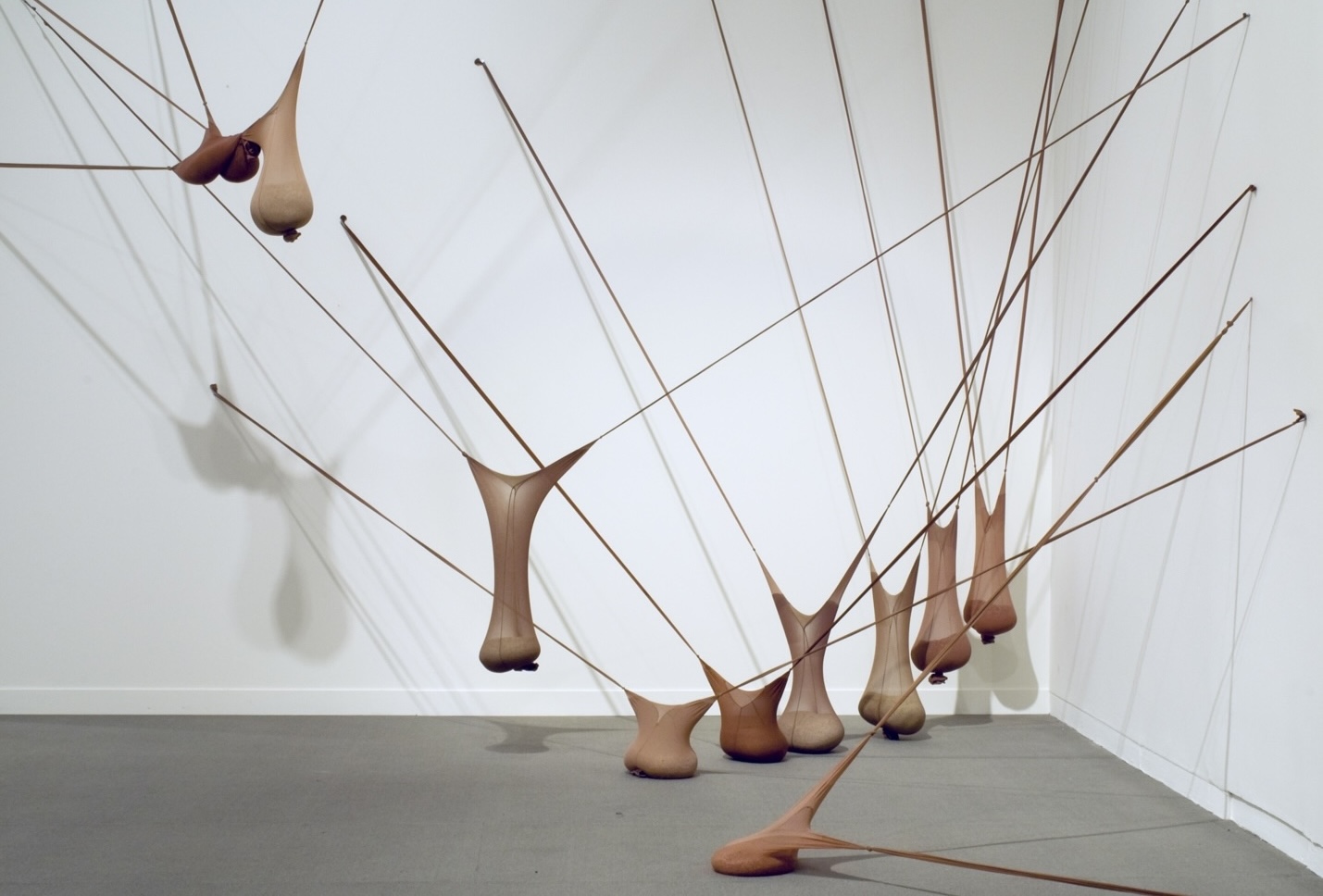
Rubber carries pressure before it carries image. In La guerra è astratta (War Is Abstract), 1970, used bicycle inner tubes flatten into wall relief, with valves and patches still visible. The material arrives already pumped, ridden, patched, and repaired before it becomes image. The factory was rubber before the work was. Rama inherits a material shaped by the road, the valve, and the patch, then lets it carry the body after the body can no longer appear whole.
Rubber begins to stand. In Presagi di Birnam (Omens of Birnam), 1986, inner tubes are held on a metal easel almost at human scale. The material leaves the wall and enters the room as height, support, and posture. No anatomy returns. The body is no longer shown. Its place is held.
Portraiture no longer requires a face. In La mucca pazza (The Mad Cow), 1997, inner tube and leather are mounted on a mail bag stretched across wood. Rama called the Mad Cow works self-portraits. The claim reorganizes the genre. A mail bag built to move things between bodies becomes the surface where a self-portrait is now mounted: leather, rubber, postal canvas, matter from the factory, the road, the postal system, the animal.
The sequence does not move from one phase to the next so much as return to the same problem through different materials. Early figuration, concrete structure, bricolage, rubber, and animal matter press against one another until continuity becomes more visible than chronology. The body is not abandoned once and replaced by material. It is displaced repeatedly. Sight goes to glass eyes, pressure to rubber, circulation to the mail bag, touch to leather.
I See You You See Me promises symmetry the works do not deliver. It appears to offer reciprocity: artist and viewer, body and world, one subject facing another. But looking keeps moving away from any body that could return the gaze whole. By the end, it has passed through watercolor figure, grid, doll eye, taxidermy eye, rubber tube, leather, mail bag, and animal matter.
The viewer may be the only intact body left to receive it.
What remains looking is not the body intact.
It is the portrait after the figure.
Identity no longer arrives through an intact figure. Material, residue, and looking inherit continuity after the body stops holding. The portrait survives the figure.





Cover. Installation view, Carol Rama: I See You You See Me, Hauser & Wirth, New York, 12 May–31 July 2026. Courtesy Hauser & Wirth.
All images © their respective rights holders.
Image rights & attribution →