




Industrial cedar does not begin as neutral material. It begins as infrastructure — beams cut for use, measured for replacement, designed to serve and then disappear. In Ursula von Rydingsvard’s hands, those beams return carrying the memory of utility. She does not disguise that origin. She presses it denser. Each ridge is carved. Each unit is handled. The repetition is visible, and the visibility matters. What accumulates is not pattern but duration.
Instability marked her earliest environment — temporary housing, wooden barracks, displacement before permanence. Structure was something provisional, something that could be dismantled. In her sculpture, repetition does not clarify a system; it stabilizes it. The beam, designed to be replaceable, is forced into endurance. Permanence is built from units designed to be replaceable.
That insistence first appears in early wall-based work from the 1990s. Rectangular cedar beams form disciplined lattices. The grid remains exposed; the module legible. But the surface refuses neutrality. The cuts fray the system from within. In works on paper, the grid remains, but the pressure shifts inward. Graphite accumulates as density rather than outline.
The grid eventually gives way in ALL THE CHILDREN I NEVER HAD (2018–23). Beams stack, hollow, and thicken into a circular form whose interior remains open, the industrial unit no longer legible as module but gathering into mass. What began as reinforcement condenses into density rooted in industrial origin. The work reads as body as mass — not figurative, but gravitational. The form does not project outward; it pulls perception inward. Scale gives way to pressure. Repetition no longer organizes space; it compacts it.
In the recent arched sculpture (2024–25), two carved masses rise toward one another, meeting in a narrow apex while holding a central void open. The beam reclaims verticality without returning to the legibility of the grid. What shifts is not the material but its role. Having passed through compression, density steadies into structure. Weight begins to bear. The industrial unit no longer reads as system or accumulation but as support, carrying an opening that holds space without smoothing it.
The opening remains. What once reinforced now bears.
Rydingsvard is often aligned with Minimalism because her work begins with repetition and a standardized unit. Minimalism used seriality to suppress expression and foreground structure. Rydingsvard keeps the module but alters its purpose. Repetition does not demonstrate logic; it reinforces structure. The industrial beam accumulates into density and eventually into span.


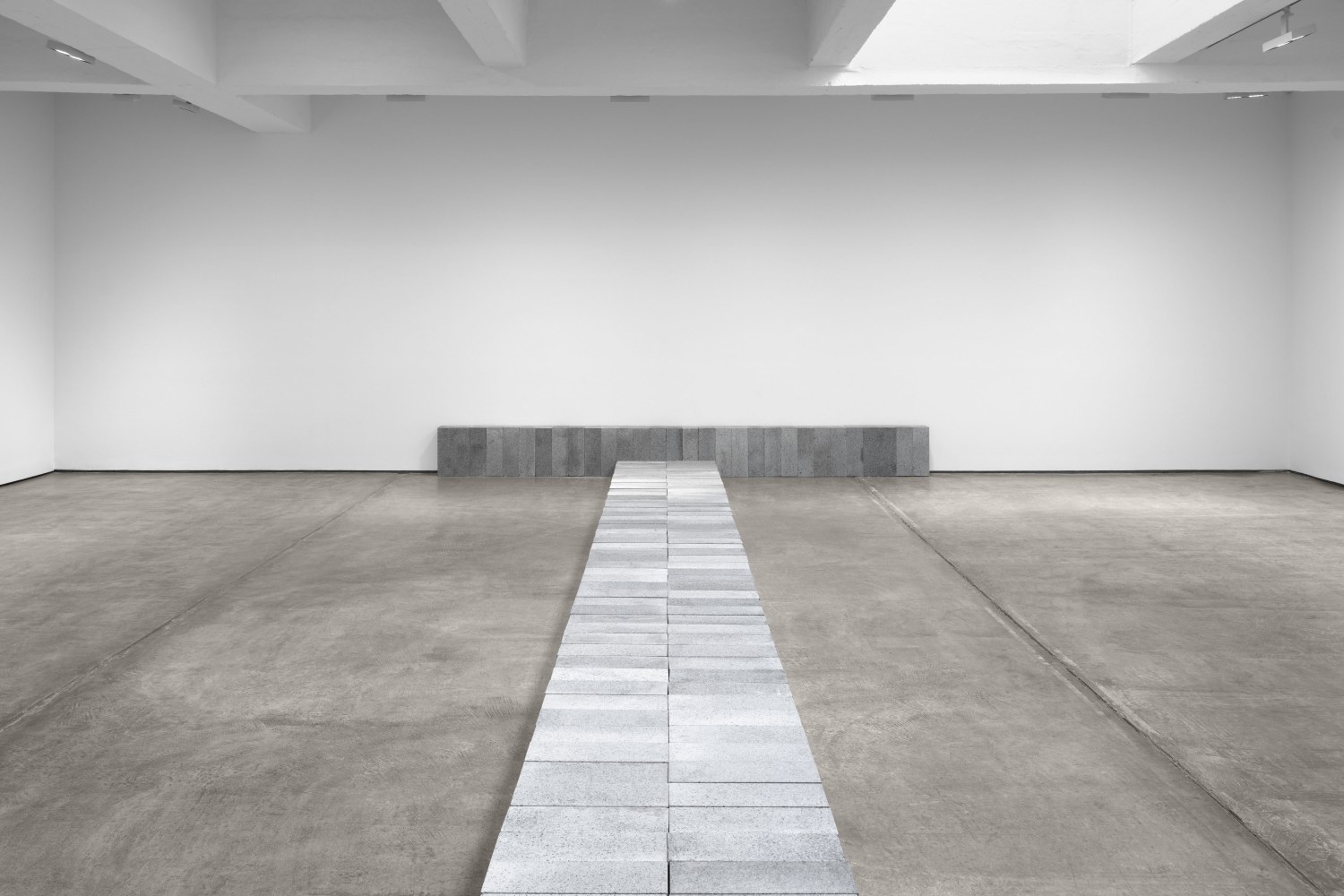
1. Exhibition view: Ursula von Rydingsvard, Galerie Lelong, New York, 19 February–28 March 2026. Artwork © Ursula von Rydingsvard. Courtesy Galerie Lelong.
2. Ursula von Rydingsvard, Untitled, 2022. Cedar, 95 × 32 × 32 in (241.3 × 81.3 × 81.3 cm). © Ursula von Rydingsvard. Courtesy Galerie Lelong.
3. Ursula von Rydingsvard, ALL THE CHILDREN I NEVER HAD, 2018–23. Cedar and graphite, 60 × 99 × 127 in (152.4 × 251.5 × 322.6 cm). © Ursula von Rydingsvard. Courtesy Galerie Lelong.
4. Ursula von Rydingsvard, Dziewczynka, 2023. Cedar and graphite, 82 × 45 × 37 in (208.3 × 114.3 × 94 cm). © Ursula von Rydingsvard. Courtesy Galerie Lelong.
5. Exhibition view: Ursula von Rydingsvard, Galerie Lelong, New York, 19 February–28 March 2026. Artwork © Ursula von Rydingsvard. Courtesy Galerie Lelong.
6. Ursula von Rydingsvard, Untitled, 2024. Graphite on paper, 20 1/8 × 26 1/4 in (51.1 × 66.7 cm). © Ursula von Rydingsvard. Courtesy Galerie Lelong.
7. Ursula von Rydingsvard, Untitled, 1995–2025. Cedar and pigment, 107 × 100 × 4 in (271.8 × 254 × 10.2 cm). © Ursula von Rydingsvard. Courtesy Galerie Lelong.
8. Exhibition view: Ursula von Rydingsvard, Galerie Lelong, New York, 19 February–28 March 2026. Artwork © Ursula von Rydingsvard. Courtesy Galerie Lelong.
9. Ursula von Rydingsvard, MIRACLE, 2024. Cedar and graphite, 99 × 74 × 24 in (251.5 × 188 × 61 cm). © Ursula von Rydingsvard. Courtesy Galerie Lelong.
10. Ursula von Rydingsvard, Untitled, 2024. Graphite and charcoal on paper, 22 1/2 × 29 7/8 in (57.1 × 75.9 cm). © Ursula von Rydingsvard. Courtesy Galerie Lelong.
11. Ursula von Rydingsvard, Untitled, 2024–25. Cedar, 123 × 109 × 90 in (312.4 × 276.9 × 228.6 cm). © Ursula von Rydingsvard. Courtesy Galerie Lelong.
12. Ursula von Rydingsvard, Untitled, 2024–25. Cedar, 42 × 77 × 97 1/2 in (106.7 × 195.6 × 247.7 cm). © Ursula von Rydingsvard. Courtesy Galerie Lelong.
13. Ursula von Rydingsvard, Untitled, 2024. Graphite on paper, 22 1/2 × 29 7/8 in (57.1 × 75.9 cm). © Ursula von Rydingsvard. Courtesy Galerie Lelong.
14. Ursula von Rydingsvard, Untitled, 2024. Cedar and graphite, 105 × 85 × 17 in (266.7 × 215.9 × 43.2 cm). © Ursula von Rydingsvard. Courtesy Galerie Lelong.
All images © their respective rights holders.
Image rights & attribution →