

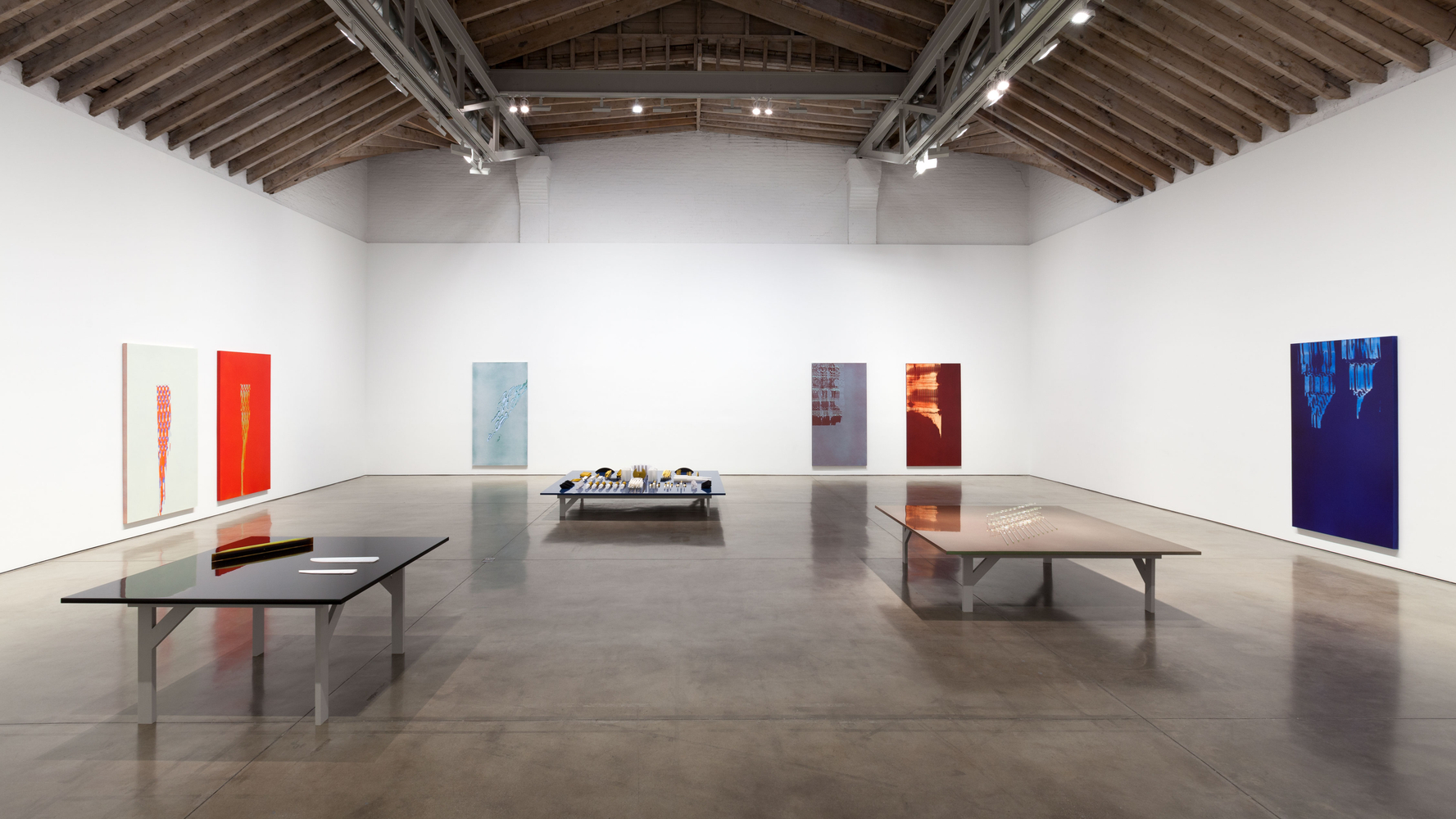


Before the face began in a tree, Dorothee von Windheim already knew how to take an image from a surface.
In Florence in the early 1970s, she trained as a fresco restorer. Strappo, the technique of lifting a painted surface from its wall by adhering cloth and pulling, became more than restoration. It became a way of making work. Anonymous walls, architectural skin, plaster, dirt, time were taken into cloth. The wall did not become an image because she depicted it. It became an image because something touched it and carried part of it away.
This is the older regime in von Windheim’s practice: contact. Cloth against wall. Gauze against face. Surface against surface. In Salve Sancta Facies, her face-cloth works from 1980, the link to the Holy Face became explicit. The Veronica, the Mandylion, the Shroud: images said to have appeared by contact rather than by painting. Images not made by hand.
Then the face appeared in a tree.
It was not painted there by von Windheim. It had been cut into the bark of a plane tree by someone else, anonymous and outside the work. She passed it more than once in Cologne’s green belt before she really saw it. The figure was almost life-sized. Its head sat near her eye level. The bark had already begun to take it back.
She tried to photograph it. The photographs did not hold what the encounter had held.
So she returned to the method the practice already knew. Damp gauze. Water. Bare hand. Pressure. She pressed fabric into bark until the face came away on the cloth. The image was not painted. It was taken.
The current exhibition is called non manufactum. Not made by hand. At first, the title seems to close the circle around that history of contact images. But the title does not stay stable. To get the image, von Windheim had to use her hands. The hand pressed the gauze. The hand carried water. The hand made the contact possible.
One of the tree faces was given to a weaver and translated into a Jacquard pattern. At that point the older logic changes its terms. The face no longer has to be taken from bark by direct pressure. It enters a loom.
In Strappo, the image is taken by contact. In Jacquard, it is executed by instruction. One depends on surface touching surface. The other depends on a pattern passing through a machine. Both displace painterly authorship, but they do not produce the same kind of image. Contact carries a trace away from its source. Jacquard carries the conditions for a face to appear somewhere else.
Jacquard is textile, but here its textile logic is also procedural. A loom does not touch the original face. It does not receive an imprint. It does not preserve residue from a surface. It reads a prepared sequence and raises threads according to instruction. The image appears because its conditions have been built elsewhere and then set in motion. The weaver’s role shifts from drawing the face to sustaining the conditions of its execution. The loom follows the pattern. The face appears through textile procedure.
The hand has not disappeared. It has changed position.
The small Angesicht works make that change visible without enlarging it into spectacle. The faces are frontal, anonymous, mask-like. They do not behave like portraits. There is no sitter to recover, no expressive hand to follow. Their scale keeps them close to icons, but the image does not arrive through icon painting. It resolves through the density of the weave, through threads crossing and withholding until a face appears.
The face is in the textile, not on it.
A printed image sits on a surface. A painted image is built on a surface. These faces are woven through the surface. Front and back belong to the same operation: positive and negative, face and reverse, image and structure. The textile does not support the image from behind. It is the condition through which the image appears.
The drawings and later interventions keep the title from becoming too simple. Three Entwurfsskizzen zu “Angesichte”, two dated 2005 and one circa 2004, show the hand before the loom. Angesicht 11 brings embroidery and an adhered appliqué onto the woven surface; Angesicht 12 brings an adhered appliqué. Both arrive after the loom has executed its pattern. The hand appears before execution and returns after it. It does not undo the machine. It marks the chain around it: encounter, imprint, drawing, translation, loom, embroidery, mounting, frame. The hand is present almost everywhere. It is absent from one decisive moment.
At more than three by nearly four meters, Angesichte (Wandbespannung) changes that moment’s scale. The Jacquard face becomes wall. The unit becomes field. What was icon-sized becomes architectural. One face becomes many faces, or the same face becomes a field of itself. The work recalls wall covering, tapestry, damask, interior fabric. Wall covering has always known how repetition changes a room. Here repetition also exposes the system that makes the face appear.
Ohne Titel (Baumgesicht) brings the tree back after the loom. Cotton on Jacquard, cut openings, silk gauze, Plexiglas, no back panel. The tree face returns, but not as origin alone. Gauze returns too, the material of the earlier contact works, placed behind the Jacquard. Light can pass through the open support. The work refuses the closed condition of a painting. Its apparatus remains partly available.
Contact returns as gauze. Programmed execution remains as Jacquard. The image is neither simply taken nor simply executed. It is held between the two systems that have organized von Windheim’s work: surface touching surface, and instruction passing through a loom.
The face at Caprii is not an image no one made. It is an image whose making has moved through the system. It began in bark. It passed through gauze, water, hand. It entered drawing. It entered instruction. It entered the loom. It returned as weave, then as embroidery, appliqué, wall, gauze, open support.
The title says non manufactum.
The truth is more exact: not made by hand at one stage, made by hand at every other.
The present makes this easier to see. The Angesicht works were made in 2009, before generated images became a cultural condition. They do not predict that condition. They do not need to. They already stage an older version of the same structural question: what happens when an image appears as output, without painterly hand?
There are three image regimes moving through the essay. The first is contact: a surface touches another surface and carries away a trace. The second is execution: a prepared instruction passes through a machine and produces an image elsewhere. The third is generation: an image appears as output from a system whose relation to source, hand, and surface has become harder to locate. Von Windheim’s work does not collapse these regimes into one. It lets the difference between them become visible.
The loom does not invent the face. It executes the conditions under which the face can appear. Generated-image culture did not make these works contemporary. It made their condition legible.
In non manufactum, Dorothee von Windheim does not remove the hand from the image. She moves it through stages: contact, drawing, instruction, loom, embroidery, mounting, and frame. The Angesicht works are where the image taken by contact becomes an image executed by instruction.


%2C%20o.J.%20(2006)%20%2C%20Sies%20%2B%20Ho%CC%88ke%20Galerie.jpeg)

%2C%202013%20%2C%20Sies%20%2B%20Ho%CC%88ke%20Galerie.jpg)

All images © their respective rights holders.
Image rights & attribution →