



Some forms are recognized before they are seen.
Black and white, repeated unit, interruption, pattern: the name has arrived before looking has become specific. Grid. Stocker’s new works begin inside that speed, at the point where recognition gets ahead of vision and has to answer for itself.
The grid has long been one of modernism’s most efficient emblems: order without image, repetition without incident, a structure that can appear to say nothing and still organize everything. It has also had its later histories: optical disturbance, programmed movement, painting tilting toward architecture. Stocker does not need to prove that grids can become unstable. That has been proved, and already supplied with language. What changes here is where the instability moves. It is no longer only in the field, the system, or the eye. It enters the recognition itself: the word that continues to attach after the structure has changed.
In the most architectural painting, a cube is rendered in white dashes on a black ground, three of its faces partially visible. Smaller geometry hovers above it, fragments that suggest secondary structures without closing into them. The dashes are not lines so much as broken lines. The grid here is made of intervals. The cube uses a projection closer to axonometric drawing than perspective: parallel lines stay parallel, and depth opens without submitting to a vanishing point. This is not failed perspective. It is a drawing system that refuses perspective by design. The cube does not close. Its supplementary structure floats above without resolving into anything stable. The name we arrived with — grid — is being stretched over a partial architecture that should belong to another language.
Other works thin, open, or loosen that name without discarding it. A black field reduces the structure almost to disappearance, leaving white squares like coordinates after most of the system has been withdrawn. A central void asks the grid to organize itself around absence. White lines cross and overlap until no orthogonal armature remains to secure the word. Closure, alignment, intact field, right angle: one condition after another is weakened, and the name continues to hold.
The canvas is not the stable origin the PVC works leave behind. By the time the grid reaches fold, weight, and shadow, the name has already been weakened from within.
The PVC works carry that unreliability into matter. Sheets printed with the same geometric language are folded, twisted, and hung. A line that was straight in print becomes a shadow on a bend. A square crosses an edge and changes with the next shift of surface. The fold has weight. The weight is part of the line now. What had been a flat field becomes a pattern tested by curl, edge, shadow, and drape.
From there, the problem enters the room. The works hang from ceilings, turn near thresholds, occupy corners, and run along the upper edges of passage. Recognition now has to survive material behavior and architectural placement. Across canvas, plastic sheet, ceiling, corner, and threshold, the category keeps attaching.
The installation keeps those pressures beside one another rather than absorbing them into a total field. A painting opens a void. A PVC piece folds nearby. A thinned field sits close to a gridded object overhead. The room lets the differences remain visible: two pressures alongside each other, not one environment enclosing them.
By the time the exhibition title returns, it has shifted. Secrets géométriques sounds at first like a promise of hidden structures inside geometric work: codes, ratios, propositions waiting to be decoded. The exhibition does not deliver that secret. What it gives instead is quieter and more difficult. The secret is not buried inside the grid. It is in the speed of naming, the readiness of the eye to supply the word grid before the work has finished showing what it is. The geometry is not the secret. The recognition is.
The grid has not been broken. It has been asked to travel farther than the name should comfortably allow: into partial architecture, thinning, absence, tangle, curl, corner, and threshold. The force of the exhibition lies in the widening gap between what is there and what the name still claims.
A grid is recognized quickly because the eye needs very little before the word arrives. Stocker stretches that recognition past its usual supports: partial architecture, thinning, absence, tangle, fold, corner, threshold. The grid is not simply broken. It is carried farther than its conditions should allow, until the name remains active after the structure has changed.


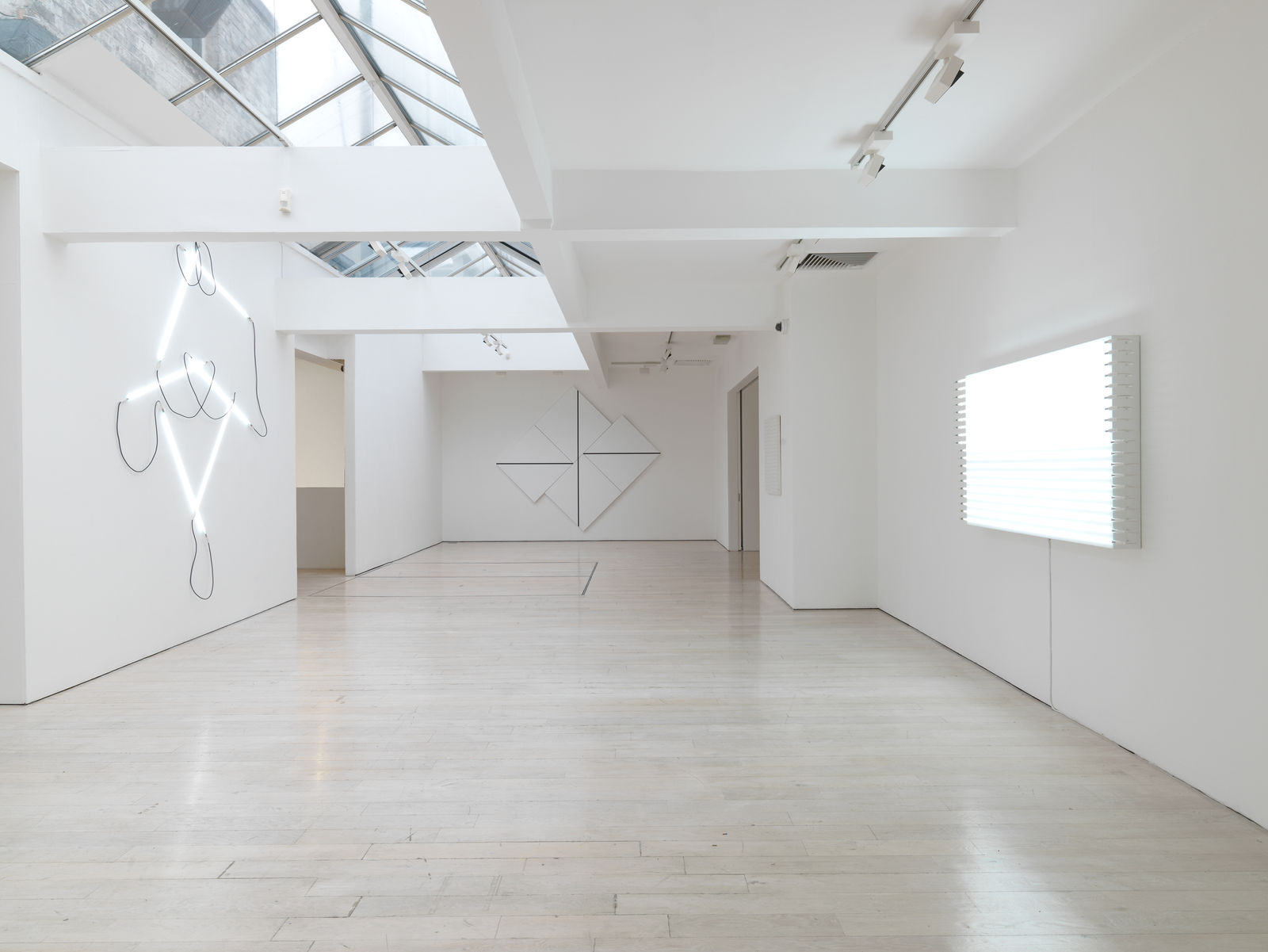
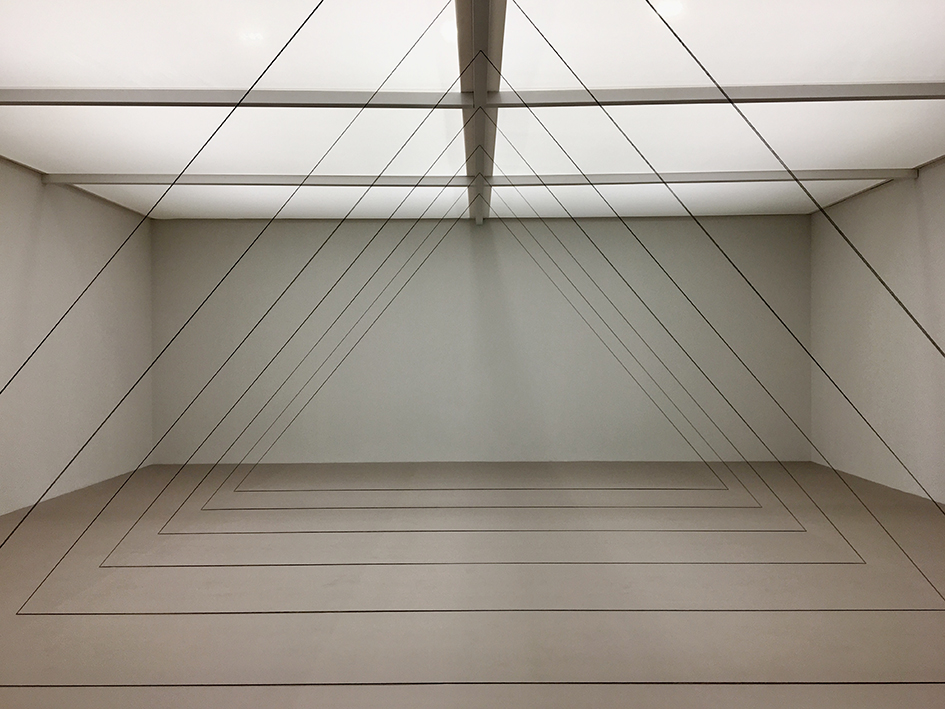
Cover image: Installation view, 'Secrets géométriques', Esther Stocker, Galerie Alberta Pane, Paris, 2026. © Esther Stocker. Photo: Vladimir Vatsev. Courtesy the artist and Galerie Alberta Pane.
All images © their respective rights holders.
Image rights & attribution →