



The garden arrives as a wall.
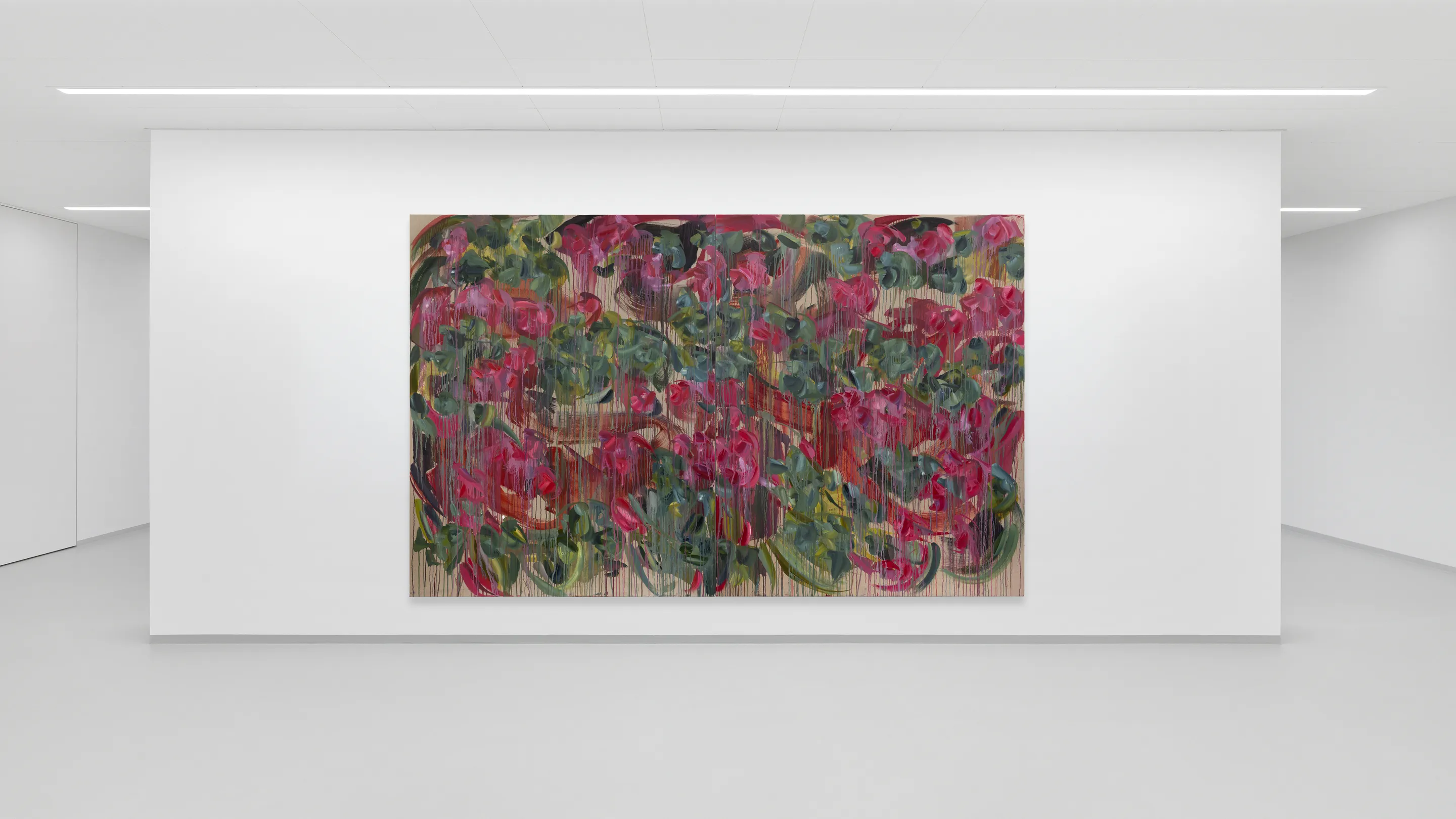
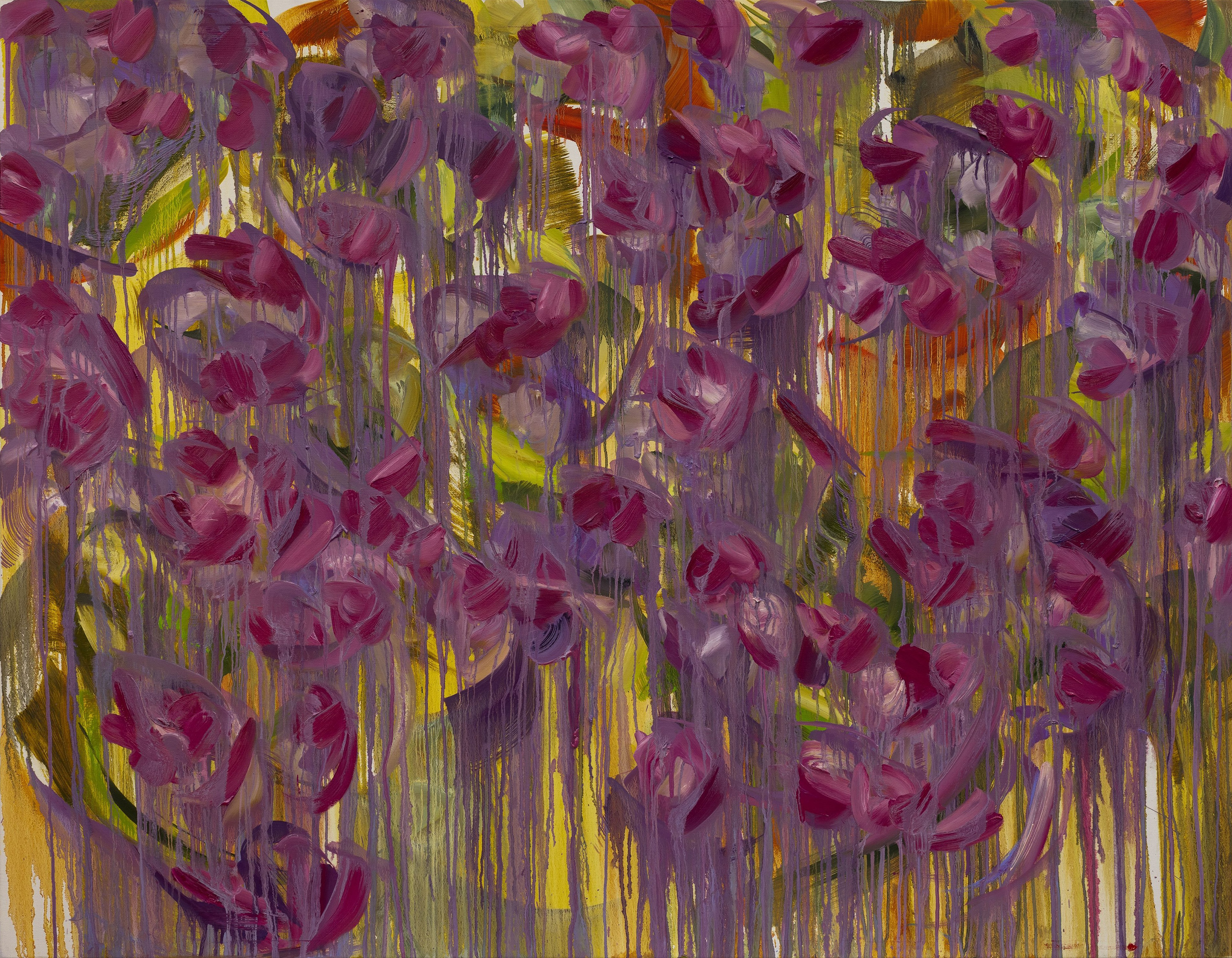
In Untamed Garden, rose and dark foliage press forward with the force of something seen too close, the way a hedge fills the whole window when you stand against it. Pinks knot and double back through greens that have gone almost black in places, and the surface is dense with the particular generosity of oil: every mark sitting up off the linen, catching light along its ridge. It is a beautiful painting in the least complicated sense. It offers bloom, weight, colour, and the pleasure of looking at a thing that has more in it than the eye can sort. There is no reason to look at it as anything other than what it appears to be.
This is where the paintings in Eden begin, with the garden allowed its full claim. Murphy works oil on linen at a scale that allows the flowers to stand without apology: seven canvases, several of them very large, all of them lush in the plain sense of the word. The flowers have their own claim, the pleasure is real, and to pass too quickly over it would be to describe another, drier group of paintings than the one on view.
From a distance, the garden remains intact. Colour resolves as bloom, density as abundance. With proximity, the same surface begins to disclose its material terms.
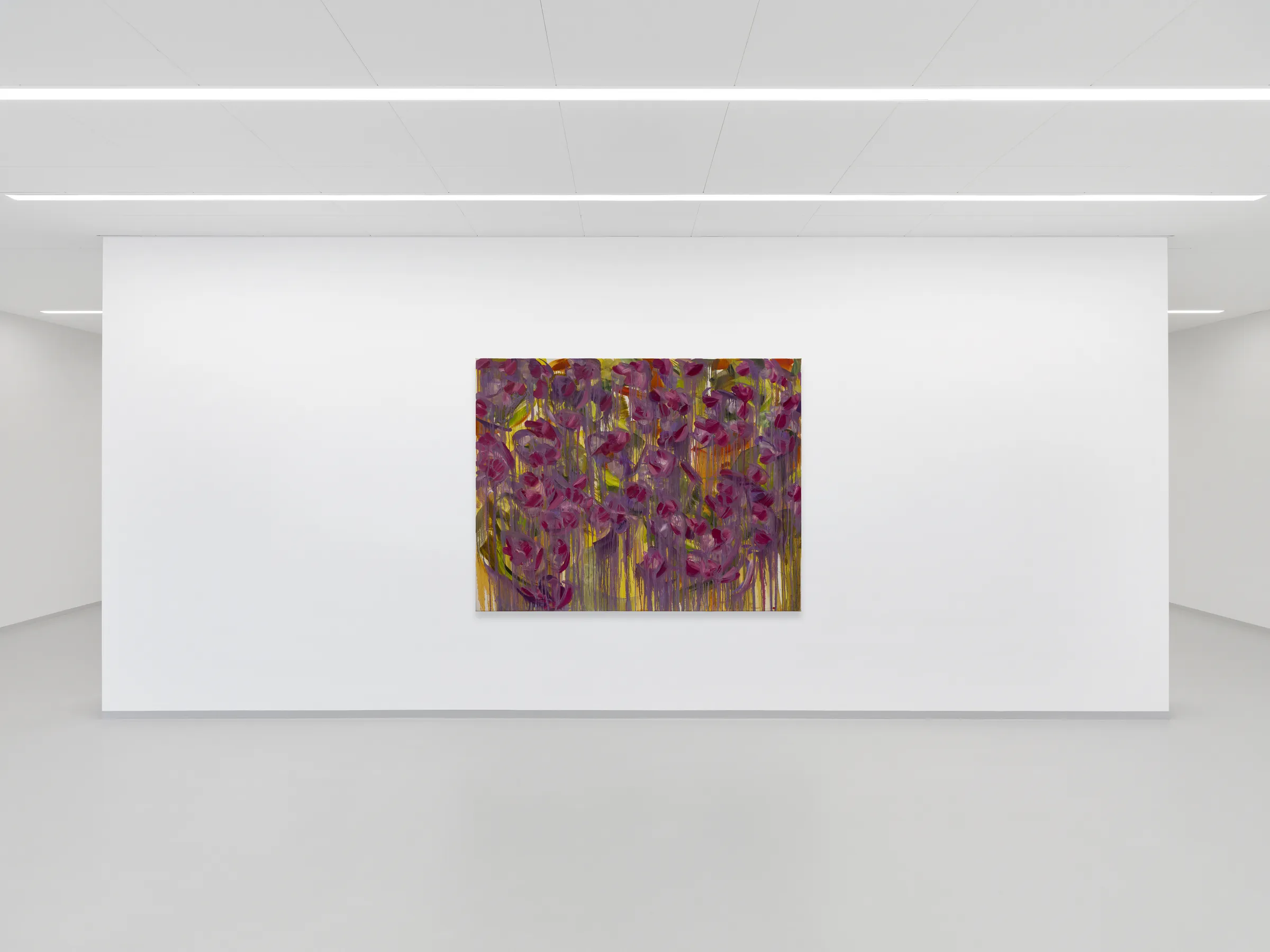
Close to the painting, growth starts to look like quantity. The marks press against one another with almost no air between them. Petal abuts petal, stroke laps over stroke, and the density that first appears as generosity begins to register as load: pigment accumulated past ease, a surface carrying more than it can comfortably maintain. The same colours that gather as flowers above reappear lower down in altered condition. In a blue upright such as New Blue, a knotted ultramarine stroke near the centre slackens, halfway down, into a single trailing line of the same blue. In a magenta-and-ochre horizontal such as Orange Veil, a rose-coloured petal-mark lengthens until it is no longer quite a petal but a thread of rose running toward the lower edge. The colour does not change as it descends. Only its hold does.
In the upright works, especially Green Perennial and New Blue, the field holds high and then lets go. Bloom gathers across the top and middle, full and crowded, and somewhere past the centre the marks begin to draw downward into long vertical threads. Colour thins as it travels. Knotted blues, greens, and magentas loosen into runs, and a petal-like mark becomes a trailing line in the same register of colour, so that by the bottom the linen shows through more openly, crossed by paint that reads as dragged, fallen, or thinned from the field above. At the foot of the canvas, the ground is not cleanly empty; it is streaked, touched, and interrupted by the same colour that crowded the upper field. The eye, having entered all that density, is led down the surface on threads. The fall belongs to the bloom, a consequence of its own weight.
In Untamed Garden, June Untamed, and Gold Perennial, the width is also a division: each is a diptych, two panels joined into a single field. The garden arrives across a seam before the paint begins to fall. In Orange Veil, a smaller horizontal work, the same condition tightens into a single panel. Here the fall is not confined to the lower edge. It passes through the whole field. Vertical runs come down from top to bottom, like rain seen against a far hedge: a scrim of descent laid over the garden rather than a drained register beneath it. The run passes through rose, ochre, blue, and green while those colours still read as bloom. A yellow ground can glow behind the flowers and still descend through them, so that the painting feels less like a field interrupted by rain than a field made out of rainfall.
The field is built first, as bloom, at density. The vertical runs belong to its later state. Again and again, a run carries the hue of a bloom just above it, lower and thinner, not as a poured line arriving from outside the image but as pigment continuing its own descent. The running paint appears when accumulation exceeds hold. The vertical thread is not an interruption of the flower. It is the flower lower down, the same matter after it has stopped being able to hold position.
At the base of these upright works, the exposed linen does not read as empty space or ground left bare for relief. The eye infers a direction of travel from a surface that is, in fact, still, and what it infers is a record: the height the field could no longer reach, or could no longer stay. What first appears as calm beneath the picture comes to look like the residue of the picture: what the surface could not keep.
That also changes the pleasure with which the paintings begin. The fall changes the beauty without cancelling it. The loveliness of the garden and the overload of the surface belong to the same condition. From across the room, density becomes bloom. Close to the linen, bloom reveals itself as density. Seen close, that pleasure unfolds in time: bloom, weight, loosening, fall.
Around the exhibition there is a language of transformation, devotion, motherhood, and unstable beauty. That language may belong to the origin of the works. On the linen, transformation is carried by the paint itself: oil thickens, holds, loosens, and descends.
Untamed Garden is the hardest painting to move past, because nothing in it asks to be rescued from beauty. It still hangs, rose and dark leaf, lovely from across the room. Stand closer and the garden becomes a surface testing how long growth can hold its place before it comes down. At its foot, the open linen keeps the trace of that descent.
Murphy’s paintings first offer the pleasure of a garden: bloom, colour, density, surface. Seen closer, that abundance becomes a question of load. The same paint that gathers as flower begins to loosen into thread, run, residue, and exposed linen.



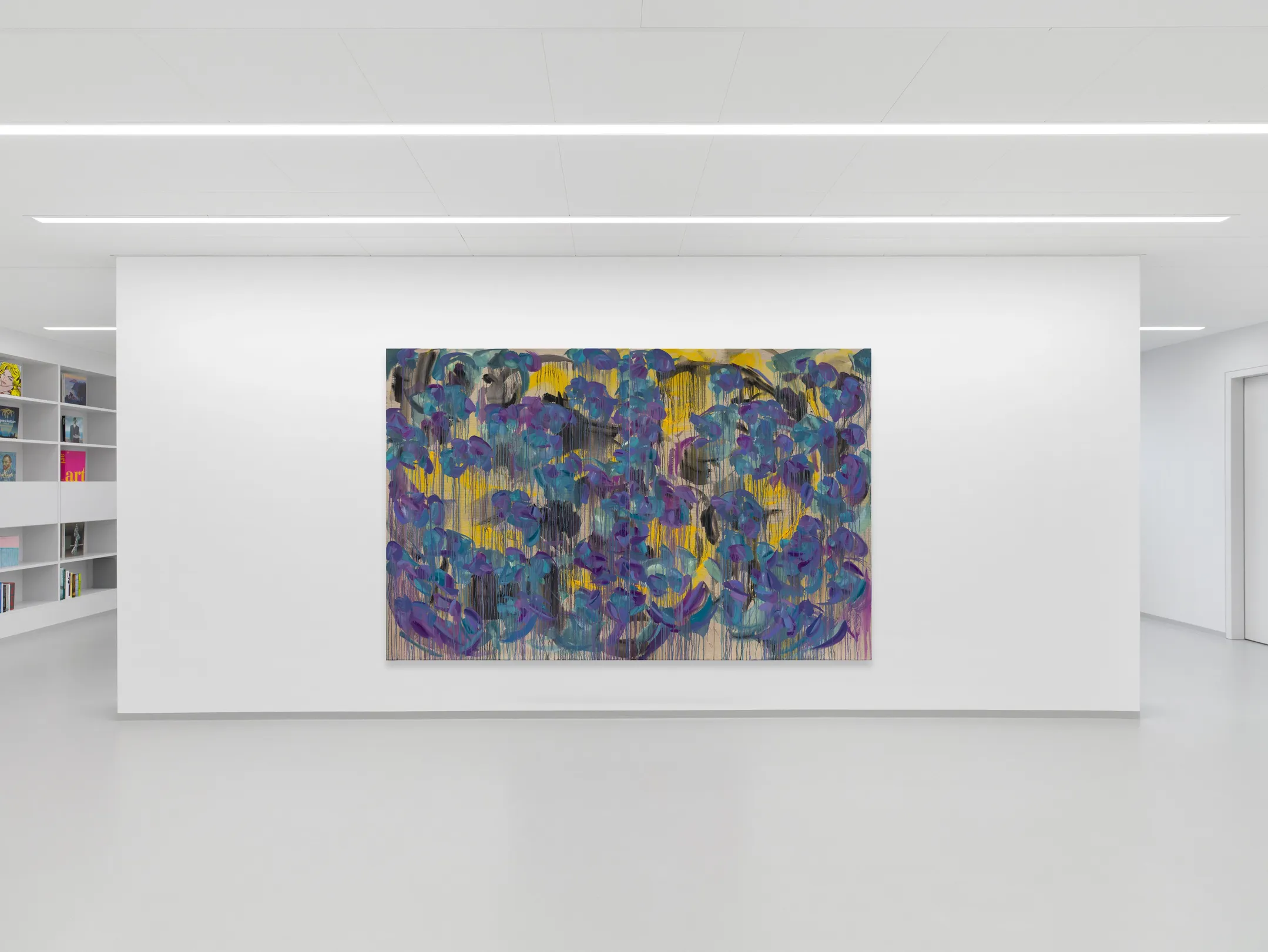


Cover Image: Installation view, Jemima Murphy, Eden, Kutlesa, Switzerland, June 12–August 7, 2026. Photo © Jemima Murphy. Courtesy the artist and Kutlesa.
All images © their respective rights holders.
Image rights & attribution →