




Josef Albers can seem unusually easy to know in advance. Even for people who would not call him a favorite artist, the square paintings are familiar: centered, disciplined, apparently complete. They reproduce well, which makes them feel even more settled. You can encounter one in a book, on a poster, in a classroom and think you have already understood the essential thing — an assumption Duets, now at David Zwirner in Los Angeles, begins by disturbing.
Two paintings from 1962, both titled Study for Homage to the Square: Rare Echo, hang side by side and appear, at first, almost the same. The same yellow structure holds them both: nested squares, the same golden ochre ground, no visible disturbance in the format itself. You look from one to the other expecting confirmation. Instead the second unsettles the first. A center that had seemed quietly absorbed begins to separate more distinctly in the next; a relation that had felt settled loosens under comparison. The difference is small, but once it appears the first painting is no longer exactly what it was a moment before.
That change does not announce itself all at once. It happens in the delay between one look and the next, in the brief interval when the first painting is still present in memory but no longer secure in sight. Nothing has been added. Nothing has been removed. Yet the first work begins to lose its claim to finality. Meaning does not accumulate here through addition. It shifts. The second painting does not deepen the first by giving more of the same. It sends you back under changed conditions.
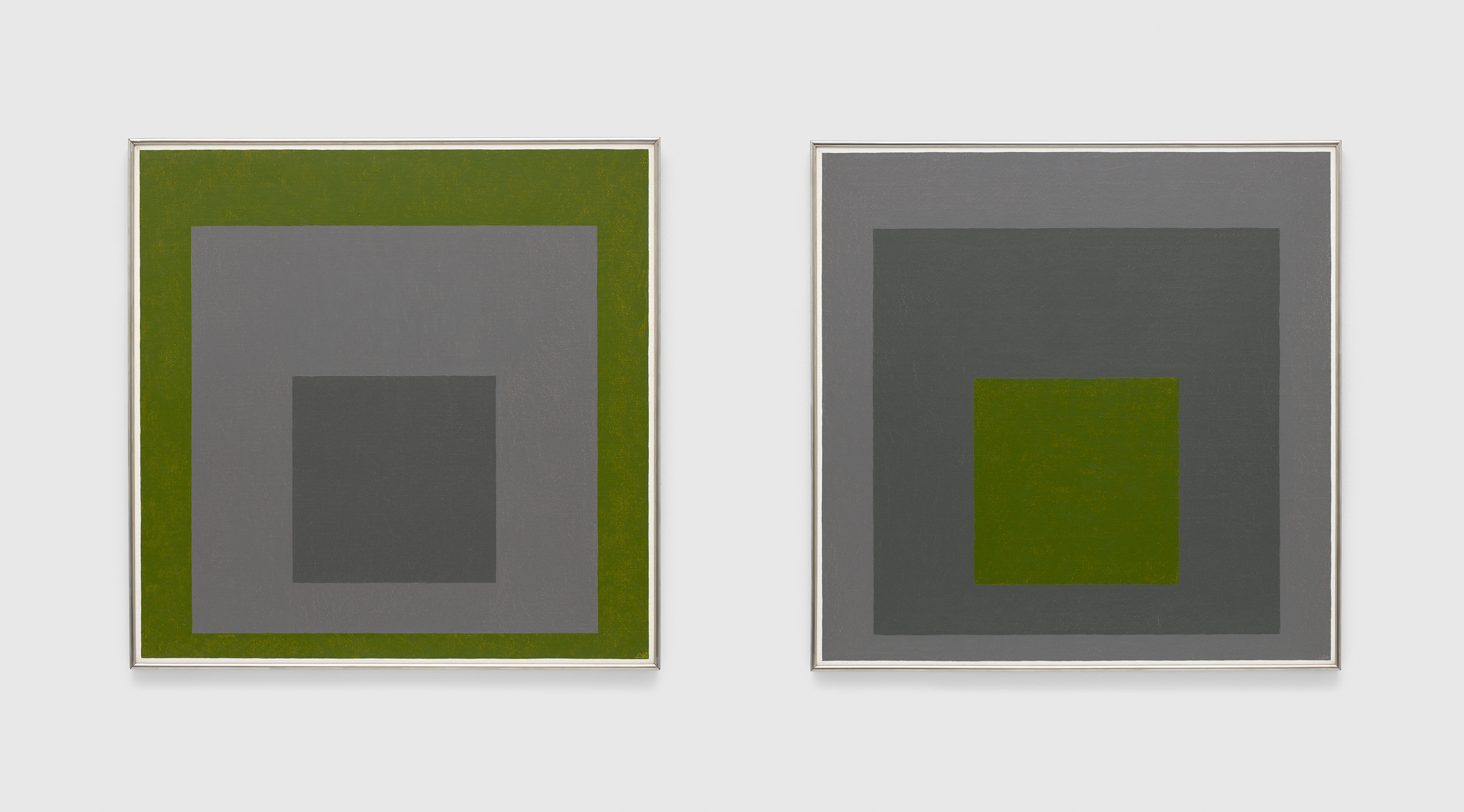
In one of the green-and-gray paintings, the green occupies the outer field and presses outward with a broad, almost assertive force, while the gray zones hold the center more quietly in place. In the other, those positions reverse. Gray now dominates the surround, and the same green is drawn inward, denser and more compressed, no longer expansive but held.
Nothing in the pigment itself has changed. What changes is only the relation into which it is placed. The green does not arrive with a fixed spatial identity. It becomes what the structure around it allows it to become.
Albers arrived at this not as a theory but as a repeated perceptual fact: the same color, placed differently, became a different color. There was no way to paint that fact in a single work. If color behaves not as a stable property but as an event produced by relation, then no isolated painting can fully state the condition on which it depends. It can present one version with perfect clarity. It cannot show that version as conditional without a second term.
The format is fixed not because the square is the subject, and not because repetition promises refinement toward a final version, but because the work needs a controlled structure in which the smallest change can remain visible. What looks, in reproduction, like formal repetition becomes in the gallery a way of stripping away every distraction except the one thing the paintings are built to test: what happens when a relation changes.
In one of the red-and-orange studies, the hotter value sits at the edge and the center cools into a darker hold; in the other, those thermal roles exchange places. What had framed now condenses. What had condensed now radiates outward. The structure itself has not changed, yet the painting’s hierarchy has.
Repetition does not stabilize identity here. It shows how unstable identity already is when it depends entirely on position.
Study for Memento I and Study for Memento II, both from 1943, show Albers working in numbered adjacency years before Homage to the Square begins. Their banded structure reads less like an iconic image than a passage built from intervals of color, each shift altering the next. The second already functions as a necessary alteration of the first. The duet is not a late refinement of the square. It precedes it.
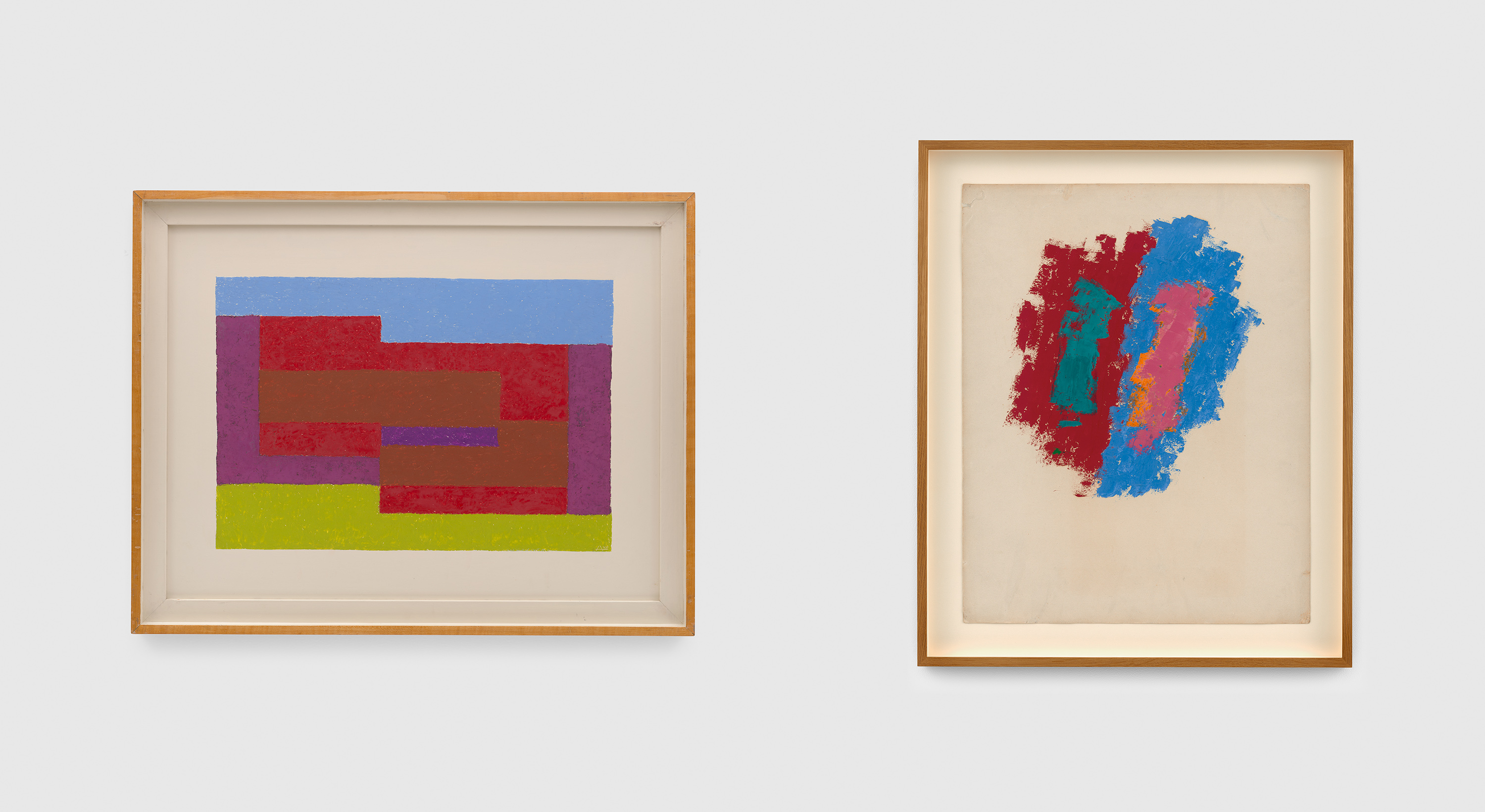
With To Mitla (1940) and Study for painting on a Victrola gramophone cover (c. 1940), even formal likeness falls away. One work is planar, banded, and architectural; the other is compressed, broken, and more unstable in touch, with color gathered into shorter, more agitated marks. Seen together, they do not offer variation within a shared armature so much as a relation across unlike structures. Each changes the terms under which the other can be read — the more measured painting becomes less self-sufficient beside the more volatile one, while the looser work no longer reads as free-standing but as one term in a larger comparative field.
A single Homage to the Square hung alone, reproduced alone, or circulated as an emblem of modernist clarity asks to be read as self-sufficient. Duets suggests otherwise. Isolation does not falsify the painting, but it does conceal the condition under which its argument becomes legible. Encountered alone, a Homage can still feel exact, complete, even quietly absolute. The book, the poster, the classroom slide — all deliver the image as though it were complete.
The second painting does not repeat the first, illustrate it, or confirm it. It exposes its dependence. In Albers, repetition is not the path to sameness but the condition under which no image remains singular. The square holds still so that relation can move, and the isolated painting, however complete it appears, conceals part of the argument it was made to carry.
Duets begins from a simple instability: two paintings that appear almost the same do not leave one another unchanged. Across the exhibition, repetition becomes a structure of revision. What looks fixed in Albers turns out to depend on relation.





1. Josef Albers, Study for Homage to the Square: Rare Echo, 1962. © The Josef and Anni Albers Foundation / Artists Rights Society (ARS), New York. Courtesy The Josef and Anni Albers Foundation and David Zwirner.
2. Josef Albers, Study for Homage to the Square, 1968. © The Josef and Anni Albers Foundation / Artists Rights Society (ARS), New York. Courtesy The Josef and Anni Albers Foundation and David Zwirner.
3. Josef Albers, Study for Homage to the Square: Starting Anew, 1964. © The Josef and Anni Albers Foundation / Artists Rights Society (ARS), New York. Courtesy The Josef and Anni Albers Foundation and David Zwirner.
4. Josef Albers, Three Color Studies for Homage to the Square, n.d. © The Josef and Anni Albers Foundation / Artists Rights Society (ARS), New York. Courtesy The Josef and Anni Albers Foundation and David Zwirner.
5. Josef Albers, Study for Homage to the Square, n.d. © The Josef and Anni Albers Foundation / Artists Rights Society (ARS), New York. Courtesy The Josef and Anni Albers Foundation and David Zwirner.
6. Josef Albers, Study for Homage to the Square, c. 1970–1973. © The Josef and Anni Albers Foundation / Artists Rights Society (ARS), New York. Courtesy The Josef and Anni Albers Foundation and David Zwirner.
7. Josef Albers, Study for Memento I, 1943. © The Josef and Anni Albers Foundation / Artists Rights Society (ARS), New York. Courtesy The Josef and Anni Albers Foundation and David Zwirner.
8. Josef Albers, Study for Memento II, 1943. © The Josef and Anni Albers Foundation / Artists Rights Society (ARS), New York. Courtesy The Josef and Anni Albers Foundation and David Zwirner.
9. Josef Albers, To Mitla, 1940, and Study for Painting on a Victrola Gramophone Cover, c. 1940. © The Josef and Anni Albers Foundation / Artists Rights Society (ARS), New York. Courtesy The Josef and Anni Albers Foundation and David Zwirner.
10. Josef Albers, Homage to the Square: Decided, 1951. © The Josef and Anni Albers Foundation / Artists Rights Society (ARS), New York. Courtesy The Josef and Anni Albers Foundation and David Zwirner.
All images © their respective rights holders.
Image rights & attribution →