


Generation now arrives with a digital shadow.
The word brings prompts, outputs, systems, images made from instructions before anyone touches them. For Keith Tyson, that seems convenient. The Artmachine makes him easy to place inside the present. His work can look newly available to the language of algorithms and generative production.
The fit is not superficial. Tyson originally trained as an engineer, and Hauser & Wirth’s press text is right to stress that he could both paint and code. The Artmachine makes the digital reading available from inside the work, not from a later fashion imposed on it.
The Generative Universe gives that language its widest field. The title is broad enough to gather the machine, the sensor, the puddle, the sod, the painting. But once gathered, the works begin to separate. What looks like generation becomes a problem of decision: where the determining act has already taken place, and what Tyson does after it. The first work does not give you a screen, a model, or an output. It gives you a hand.
The hand appears first.
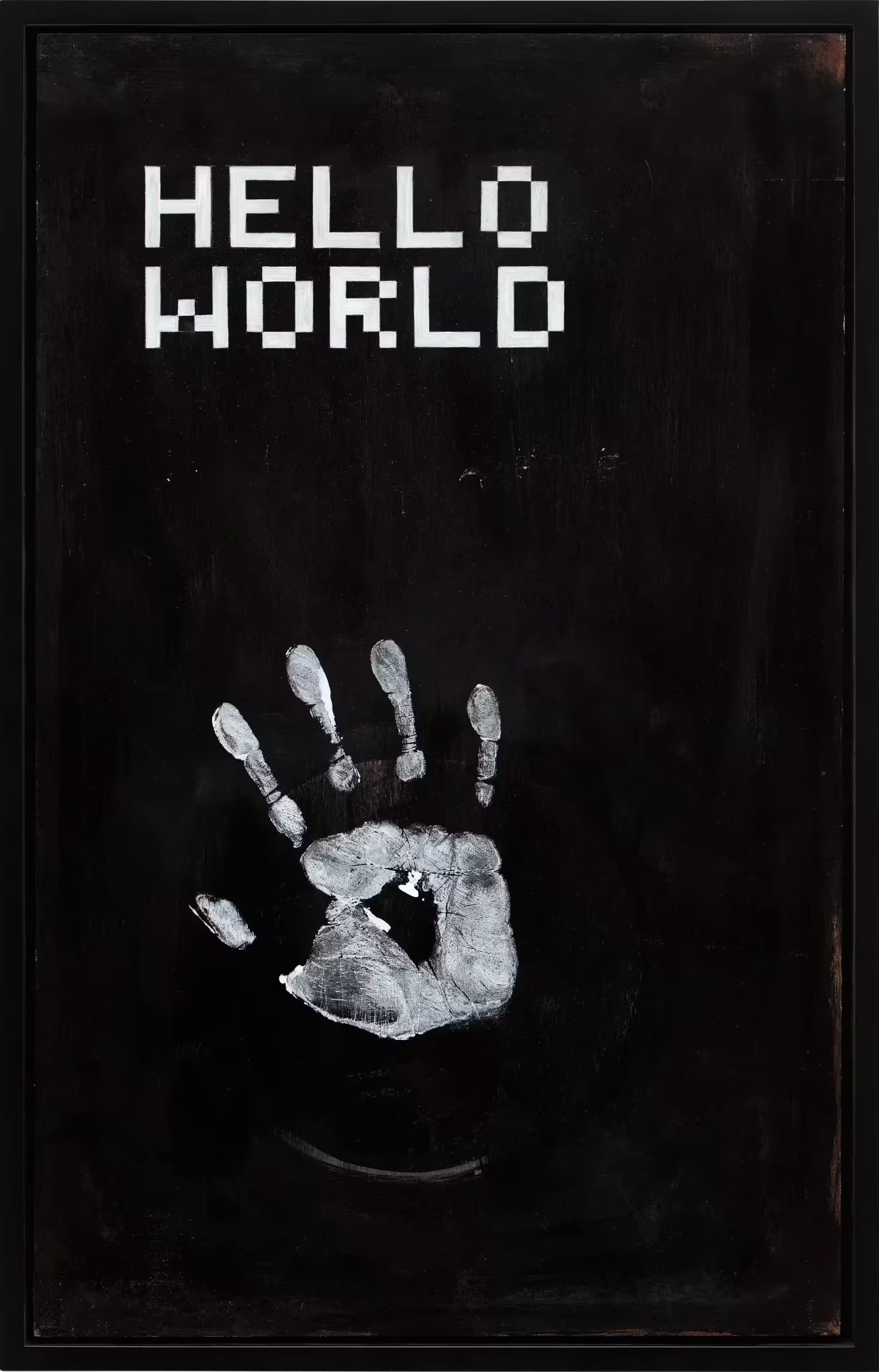
It is acrylic, pressed onto a metal plate, surrounded by typed text. The hand is Tyson’s. The placement of the hand, and of the text around it, is not.
Artmachine Iteration no. 1.1: Hello World (1991) begins with that split. The body is present before the system has even been explained. The handprint is the most immediate thing in the work. It keeps Tyson physically inside the image, while the image itself has already been organized by something else: the Artmachine, a system of algorithms, programs, flowcharts, and reference materials Tyson built and programmed in the early 1990s, which generated instructions for him to carry out by hand: subject, scale, material, and other parameters.
Tyson once described the Artmachine as “designed to filter any aesthetic or formal preferences I may have from the work.”
A filter does not erase. It stops some things and lets others through. Tyson’s systems are built to interrupt the preferences that would otherwise make the work too quickly his own. Preference is held back before placement happens. The hand still arrives, but it arrives after the system has already made a demand.
The decision has moved, but not outside Tyson’s responsibility. He is not absent. He is also not the artist whose expressive choice begins the form. He has built a structure that can ask something of him before he starts to make.
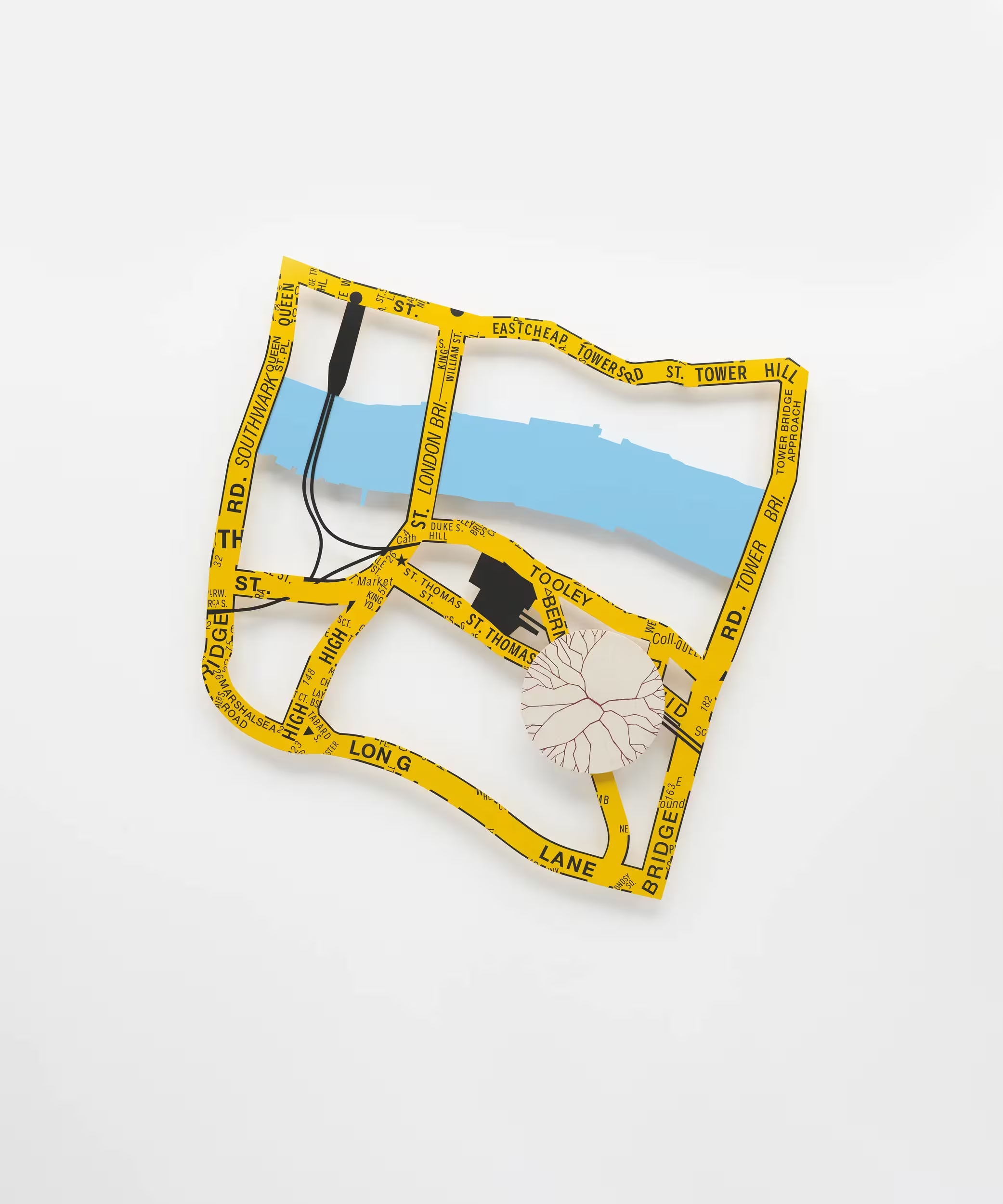
Artmachine Iteration no. 342: Unprimed Random Branching with Djikstra’s Heuristic frame (1997) keeps that condition active rather than historical. The number suggests duration. The Artmachine was not only an early experiment in algorithmic art-making. It became a way of continuing to place the artist after a structure he had built: rules, references, and branching instructions producing a task before the hand produces a mark.
Everything (2024), a sensor-driven sculpture, pushes that condition from prompt into feedback. The work continuously monitors its surroundings, including temperature, humidity, and pressure, and converts those conditions into ongoing response. Tyson’s hand no longer completes the instruction; he has built an apparatus that keeps receiving conditions after the work has begun.
For a while, this makes the exhibition’s language feel stable. Generation means the system that produces the prompt, the apparatus that measures, the protocol that runs. Tyson designs the conditions, receives or releases the demand, and remains responsible for what follows.
The obvious ancestor is Sol LeWitt’s conceptual instruction: the idea or rule set that organizes the work before execution begins. But Tyson’s Artmachine is stranger than an instruction waiting to be carried out. It is an apparatus built to produce instructions the artist does not choose in advance. The decision is not simply lodged in an idea. It is made to arrive through a system.
Then the puddle arrives.
Puddle in a Summer Shower (2025) is a bronze sculpture of a puddle surface caught during rain. The surface is small and exact. Ripples gather where water was struck. The instant has already passed, but its disturbance has been held in metal.
The first form was made before Tyson entered the situation.
Rain hit a surface. Water registered the impact. The puddle changed as it existed and began disappearing almost immediately. Tyson’s act comes after that: noticing the event, choosing the moment, casting the surface, and giving permanence to something that would otherwise have been temporary.
Here the word generation has to leave the digital register. The puddle did not begin as a prompt. Its first condition was weather, gravity, surface, and time. Tyson did not decide the ripple. He decided to keep it.
Bronze changes what “keep” means. A rain event becomes dense and permanent; a surface that should remain liquid and temporary takes on the weight of sculpture. The puddle is not only preserved. It is given a material authority its original condition could never have held.
That distinction changes the show. In Hello World, the determining structure is one Tyson built. In Puddle, the determining event happens before him. The work is not less authored because of that. It asks authorship to begin later: at the moment of recognition, arrest, and translation.
Pixel (2024) makes the digital pressure visible by naming it.
The work is a painted bronze sculpture shaped like a patch of earth with plants: grasses, soil, root mat, surface density. At first glance it still belongs to the world of natural form. The grass was not designed by Tyson. The contour of the sod was not composed by him. But the title pulls the object toward a different system. A sod becomes Pixel. Something grown, tangled, and continuous is given the name of a digital unit.
The object does not resolve that contradiction. It stays inside it.
The sod has passed through bronze, paint, title, and frame. Bronze gives a temporary surface a different substrate. Paint returns the cast to image. The title makes the ground readable through a language that belongs to screens and grids. Nature is not simply preserved in sculpture. It is translated into another condition of seeing.
Elsewhere is not the same place each time.
In the Artmachine, the decision sits in a system Tyson built. In Puddle, it sits in an event the world produced before him. In Pixel, it sits in material already carrying shape before the artist changes its register. The work is not moving from digital system to natural form as if one replaced the other. It is testing how many prior conditions can enter the work before Tyson does.
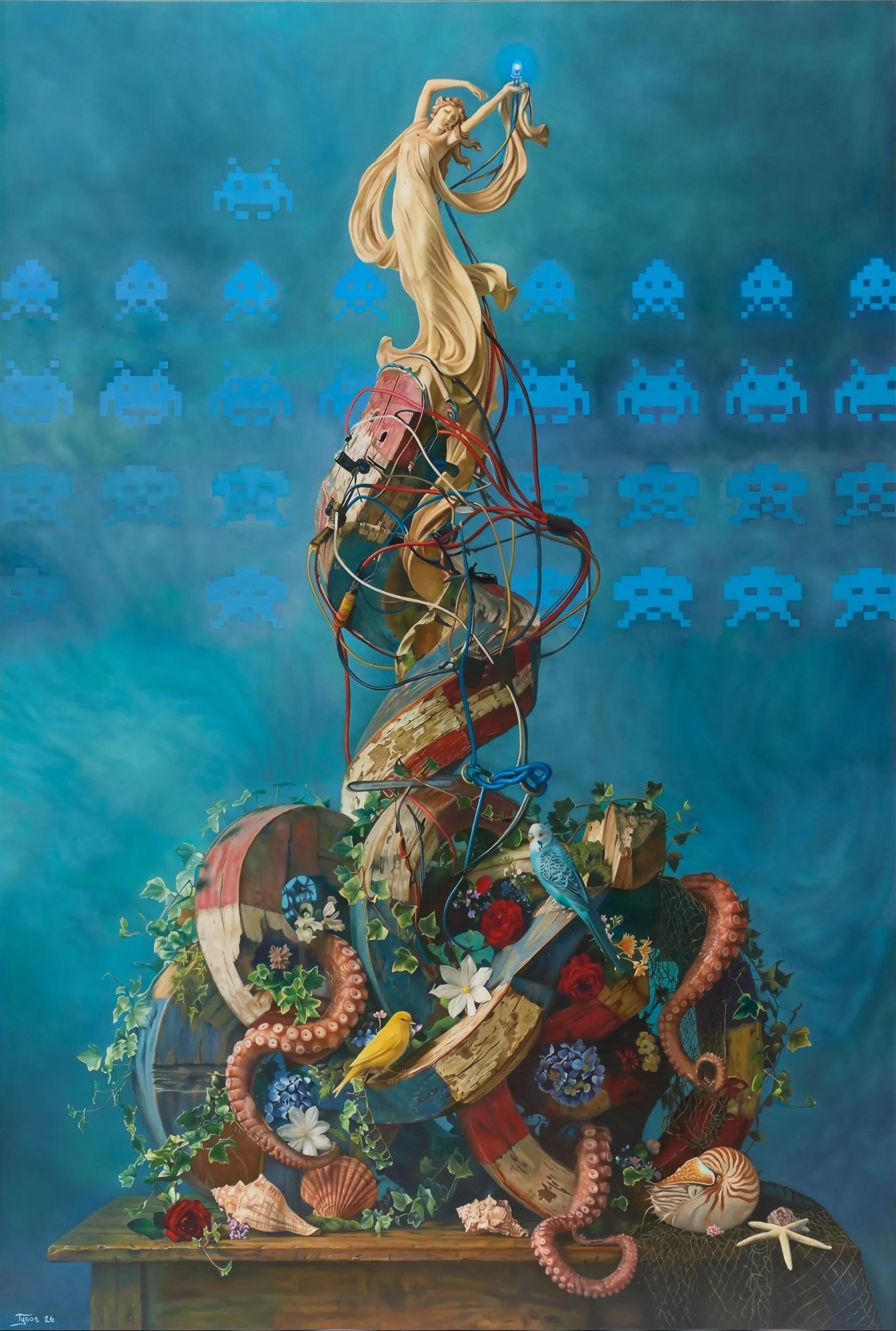
North Atlantic Still Life with Taito Overlords (2026) is oil on canvas. Here the hand seems fully returned. Every brushstroke is Tyson’s. The objects, color, modeling, and perspective belong to painting in its most recognizable form. After the Artmachine, the sensor, the puddle, and the sod, this looks like the place where the artist might return to the old position: hand, composition, image, decision.
But still life is not an empty room.
It is a genre with a long memory. Still life organizes looking from the front, turns the table edge into a ground, converts objects into inventory, and lets possession and decay enter as quiet subjects. It carries the world indoors by arranging it for attention.
Tyson adds another memory to that room. The title’s Taito reference pulls the arcade into the still life; pixelated invader-like forms hover behind shells, flowers, birds, rope, octopus, and carved figure. A game image enters a painted genre built around possession and display.
The digital is no longer the system issuing the prompt. It has become one object among others, one inherited image inside the room.
The still life moves decision into a different kind of prior condition. Nothing has been handed to a machine or caught from weather. The pressure is not external event now, but inherited grammar. Still life has already arranged the relation between object, table, display, possession, decay, and attention. Tyson paints directly, but he paints inside a room the genre has already built.
This is where the analog condition becomes most precise. Paint does not automatically restore expressive origin. A brushstroke can still happen after other decisions have organized the field. The hand returns, but it returns into genre, history, arcade memory, and inherited forms of attention.
10,000 Things (2026), a monumental painting, brings that pressure into language.
The work is structured like a comic page: panels, gutters, narration boxes, speech bubbles, figures, roles, fragments of city, weather, stock tickers, and profession labels. It is not only painting holding multiplicity. It is painting entering another inherited grammar, one built from sequence, caption, interruption, and named parts.
The title is not incidental. Inside the work, the language circles the same problem the exhibition has been building: what can be named, what cannot, and what happens when naming turns the unnamed into the ten thousand things. A caption speaks of a “probabilistic substrate” below the visible world, “irrigating and feeding the field of possibilities.” That is not outside the essay’s argument. It is the argument made visible in the work. The named world arrives after something prior has already moved beneath it.
The work also moves visually from monochrome comic structure into saturated color, as if the field it names cannot remain diagrammatic. Naming cuts the world into parts; image floods those parts with relation.
Here, the decision is elsewhere again, but not in machine, weather, material, or genre alone. It is in the structure that lets things become nameable at all. Comic panel, caption, role, market symbol, city, rain, figure, and speech bubble all become ways of cutting the field into readable parts. Tyson does not claim to originate that field. He paints the moment after it has begun to divide.
Tyson has said that “Art begins and ends, always with a human story.”
In this show, that line does not return the artist to the center in a simple way. It keeps the human story attached to what happens after the beginning has moved: after the system asks, after rain strikes, after earth arrives already shaped, after genre has arranged the room, after language has divided the field into things.
This range can easily look like sprawl: machine, sensor, puddle, sod, still life, comic, cosmology. Tyson’s practice has often invited that suspicion, as if its encyclopedic reach were a way of avoiding commitment. The exhibition argues otherwise. The forms change because the prior condition keeps changing. What stays consistent is the question of where the determining act has already happened.
Tyson matters now not because the Artmachine makes him prophetic of the current digital moment, but because his work keeps generation from becoming digital shorthand. He keeps the word attached to handprint, rain, bronze, earth, paint, genre, and naming — to the human responsibility that begins after control has been interrupted.
The decision was elsewhere, but that does not make the artist absent. Tyson’s work begins in the responsibility that follows.
Keith Tyson’s The Generative Universe appears newly available to the language of generative systems and artificial intelligence. The Artmachine makes that reading tempting. But the exhibition keeps separating what “generation” can mean: a system can issue a demand, a sensor can keep receiving conditions, rain can make a surface, earth can arrive already shaped, still life can organize the room before the painter enters, and language can divide the world into things. Tyson’s work does not ask whether systems replace the artist. It asks what the artist becomes responsible for after the determining act has moved elsewhere.





Cover Image:Keith Tyson. The Generative Universe, installation view, Hauser & Wirth Los Angeles, 28 May – 16 August 2026. © Keith Tyson. Courtesy the artist and Hauser & Wirth. Photo: Jeff McLane.
Image rights & attribution →