

Morphosis arrives already surrounded by coast. Fog, eroded rock, salt, shoreline, paper touched by seawater, wood marked by weather. The materials seem to invite a gentle reading: exposure, fragility, care, transience, the slow intelligence of things allowed to change. This is the reading the exhibition makes available first. It is not false. It is too soft.
In Burgess’s work, the coast is not a muse. It is closer to a laboratory. Materials are submerged, dried, burnished, salvaged, paired, stabilized, and mounted. The works do not ask what salt, weather, or color mean. They ask what changes when one condition is repeated with difference.
Before any mark reads, the way the works are held begins to speak. India Red 192 – Dissolution holds salt deposits under archival silica. Atlantic Series No. 1 sits inside a deep shadow-box frame, with the paper’s curl preserved rather than corrected. November Colour Chart No. 1: Terracotta, Sanguine names color through manufacturer pigment language before color can become atmosphere. These decisions do not arrive after the works are complete. They are part of the works’ final movement. Framing, naming, stabilizing, and classification decide which state of change will count.
Burgess’s own language gives the exhibition a serious philosophical frame. The practice has been shaped by long monastic training and by an interest in transience, mutability, and the absence of fixed identity in experience. That framework matters. It explains why paper, pigment, salt, water, light, and found support are allowed to change rather than being forced back into stable image. It also explains why the works accept irregularity, residue, outside pressure, and conditions Burgess did not fully control.
Yet Morphosis does not let change disappear into philosophy. Again and again, the works choose a state and hold it: salt arrested in paper fibre, curled paper preserved in a shadow box, pigments split into surface conditions, cardboard held in its industrial geometry. The language around the practice points toward transience. The objects ask for something more exact.
India Red 192 – Dissolution carries that shift most clearly. Seven vertical strips of brick-red paper are exposed to seawater and salt, then mounted side by side under archival silica. They begin from the same paper, pass through the same procedure, and are held in the same frame. They do not arrive at the same result.
The eye moves across them as a test would be read: left to right, difference by difference, each strip close enough to the next to make variation measurable. At first, the work offers itself as a record of coastal action on paper. Then the serial structure becomes harder to ignore. The point is not that seawater changes paper. The point is that the same condition, applied across related supports, produces difference.
Archival silica matters because that difference would otherwise continue changing. Paper exposed to seawater does not become stable by itself. Salt migrates. Fibre reacts. Pigment blooms, withdraws, shifts. The frame does not preserve the drawing from change. It decides which moment of change becomes the work. The final act is not only exposure, and not only mark-making. The final act is arrest.
Change becomes visible here because change has been stopped. Burgess does not present dissolution as flux. Burgess selects the moment when dissolution becomes legible. The work makes change observable by arresting it.
The title sharpens the same register. India Red 192 is not a poetic phrase. It is manufacturer language, a pigment designation, a number from a swatch system. The red is not allowed to drift into earth, memory, or mood. It is named as material. The title aligns the piece with catalogue before atmosphere can take over. India Red 192 reads less like a poem than a specimen label.
Atlantic Series No. 1 extends the register quietly. The object is small. The frame is deep. The paper is not flattened into a conventional image; its curl and dimensional irregularity remain visible inside the box. The frame contains the curl without correcting it. A standard display might treat that curl as damage or instability. Here it is the condition being preserved. The shadow box does not make the paper presentable. It makes the paper legible as a specimen. The intimacy of the object comes from that held condition: a small sheet, still slightly unsettled, given enough space to remain itself.
By the time the works have been read this way, the Albers context changes shape. The obvious Albers reading is color theory: hue altered by circumstance, perception trained by relation, the eye made attentive. Burgess developed this body of work through the Albers Foundation’s Irish residency, and the chart works make that inheritance visible. But color theory is the softened Albers. The deeper operation is comparison — the condition made explicit in Josef Albers: Duets, where a painting becomes fully legible only beside a second term. A single work cannot fully state the condition on which it depends; it needs another term beside it. Color is the vehicle Albers used for that argument, not the argument itself.
Burgess inherits that structure and compresses it. The comparison that Albers stages between adjacent works moves inside the object. November Colour Chart No. 1: Terracotta, Sanguine places two pigments into four states through the split between matte and burnished surface. India Red 192 – Dissolution holds seven strips under one procedure. Duet makes two reclaimed battens into a single work. Albers holds comparison open in perception. Burgess arrests comparison and mounts it as evidence.
In November Colour Chart No. 1, that shift is controlled almost to severity. Two pigments are halved: matte and burnished, uncompressed and compressed, surface left open and surface altered by pressure. Four states emerge from two materials. Burnish is not finish as refinement. It is a variable. One surface takes light more flatly; the other returns it differently. The pigment remains nominally the same, but the surface has changed the condition under which color can be read.
Albers asks what happens when one color is placed beside another. Burgess asks what happens when one color is subjected to different conditions and mounted as result. The chart is not preparatory. It is not a study toward a painting elsewhere. It is the work because the work is the comparison. Color is no longer only hue in relation to hue. Color becomes manufacture, surface, pressure, light, handling, and name.
Duet moves the same structure into space. Two reclaimed battens are mounted with a narrow gap between them. The gap is narrow enough for the eye to read them as one work, wide enough for the eye to understand them as two supports. The title names the relation before the viewer has to infer it. Pencil works against grain, weathering, darkness, length, and side light, and does so differently on each batten because the supports are already different. The duet is not between image and viewer. It is between two supports already changed by use and exposure.
Salvage – Prison Cove refuses the coastal romance most directly. The cardboard is still a carton before it is a drawing. Fold lines, tab cuts, scored panels, central panel and flaps remain legible; the geometry of packaging has not been dissolved into texture. The recognition matters. Someone designed it. Someone used it. Someone discarded it. The sea returned it. Graphite enters that structure rather than covering it.
The carton is not salvage as atmosphere — not beachcombing, not drift, not the romance of weathered things. It is a found template. Drawing begins after design, use, discard, weathering, and recovery have already marked the surface. The hand arrives late.
That lateness changes the meaning of drawing in the show. India Red 192 – Dissolution arrests an active process: paper still wanting to change, salt still moving through fibre. Salvage – Prison Cove preserves a state already completed. The carton was designed, used, discarded, weathered, and recovered before Burgess approached it. Both works are evidence, but they belong to different kinds of time: one mid-event, one after the event has ended.
This is not process art in the usual sense. The procedure is not left open as event. It is stopped, classified, and shown as result. Nor is this material poetics in the usual contemplative register. The materials may be humble, and the biography may invite a meditative reading, but the strongest works in Morphosis are not pure. They are contaminated, handled, folded, named, exposed, burnished, mounted, and stabilized. Their authority does not come from matter as sacred substance. It comes from matter submitted to procedure.
The works are intimate in scale, but not intimate in the usual sense. The smallness belongs less to delicacy than to study. The viewer is asked to compare conditions: seven strips, two pigments, two battens, one carton whose prior structure must be read before the graphite can be understood.
Drawing survives in Morphosis, but not as origin. The hand matters, but it is not first. A condition is applied. A change occurs. The change is held still. The result is mounted. Burgess does not begin with a blank support. Burgess begins after the world has already drawn on it.
The works in Morphosis are not images of transformation. They are mounted evidence of controlled difference. Drawing becomes the final readable event inside a chain of exposure, comparison, arrest, and mounting.
Burgess does not preserve materials from change. Burgess preserves change as evidence.
Lucinda Burgess’s Morphosis is not simply about erosion, preservation, or coastal atmosphere. The works arrange paper, cardboard, wood, pigment, salt, seawater, burnish, and side light into comparative procedures. Seven strips are exposed in parallel. Two pigments are split into surface states. Two battens become one duet. A flattened carton remains legible as a found template. Drawing survives, but not as origin. The works are mounted evidence of controlled difference.


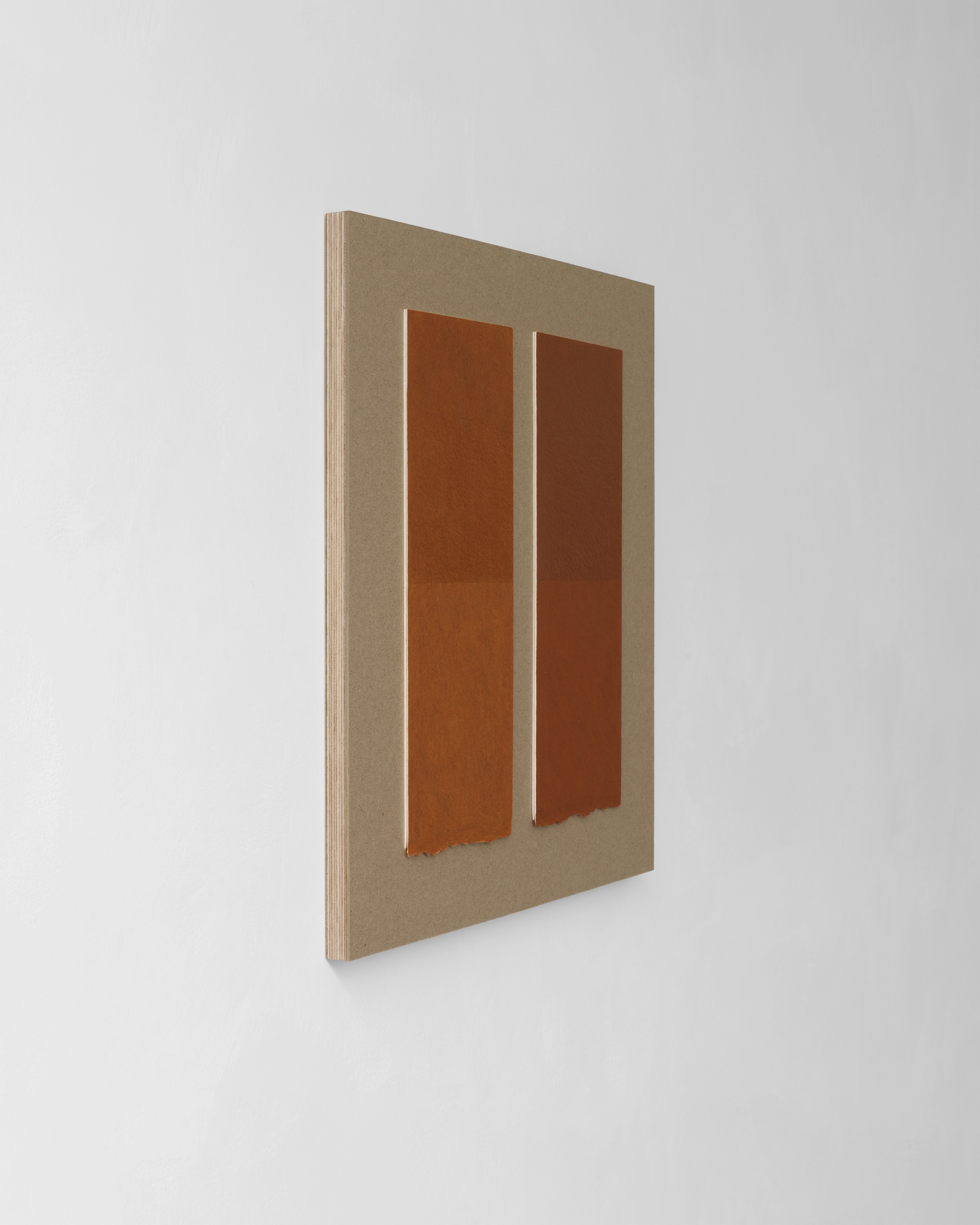
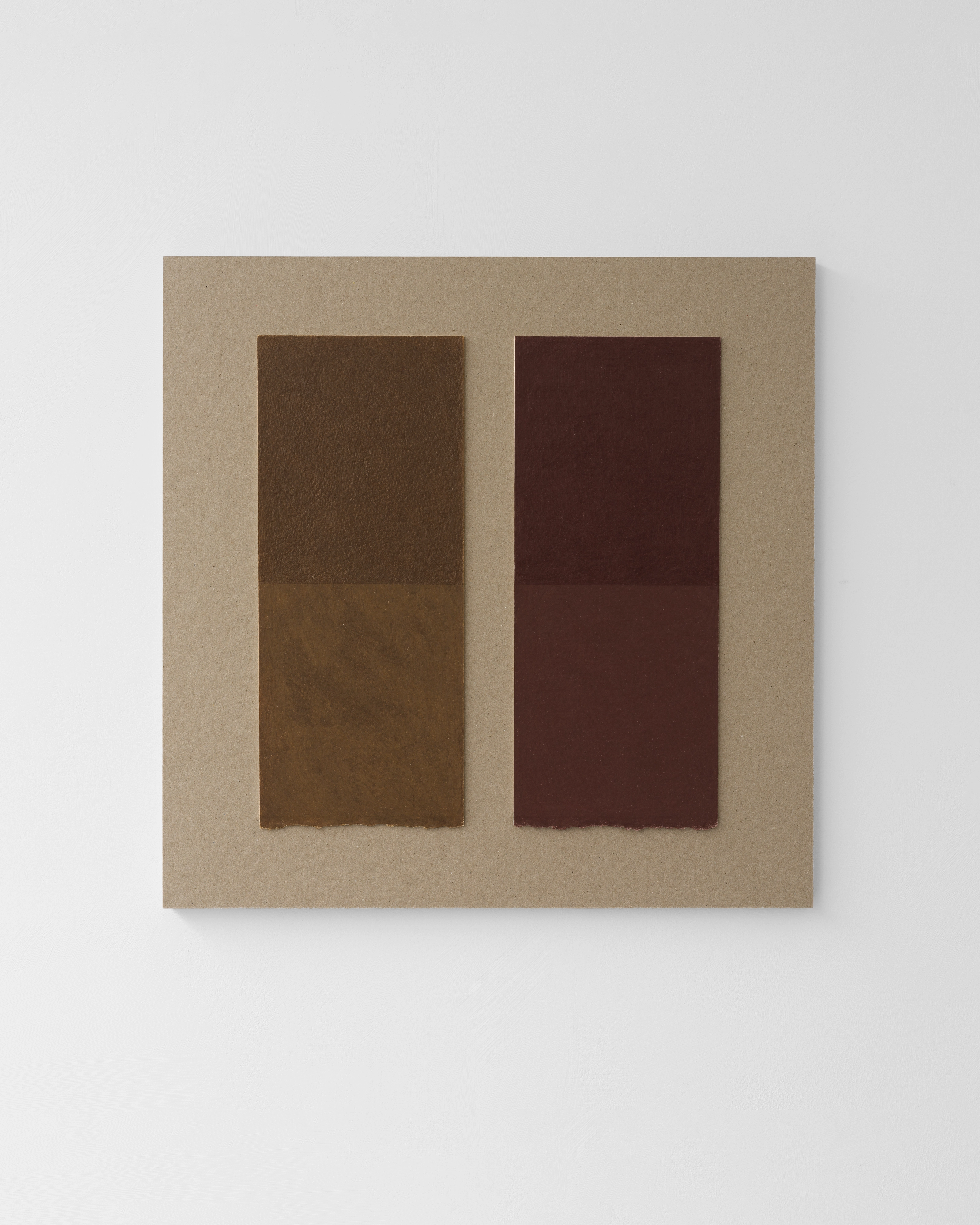
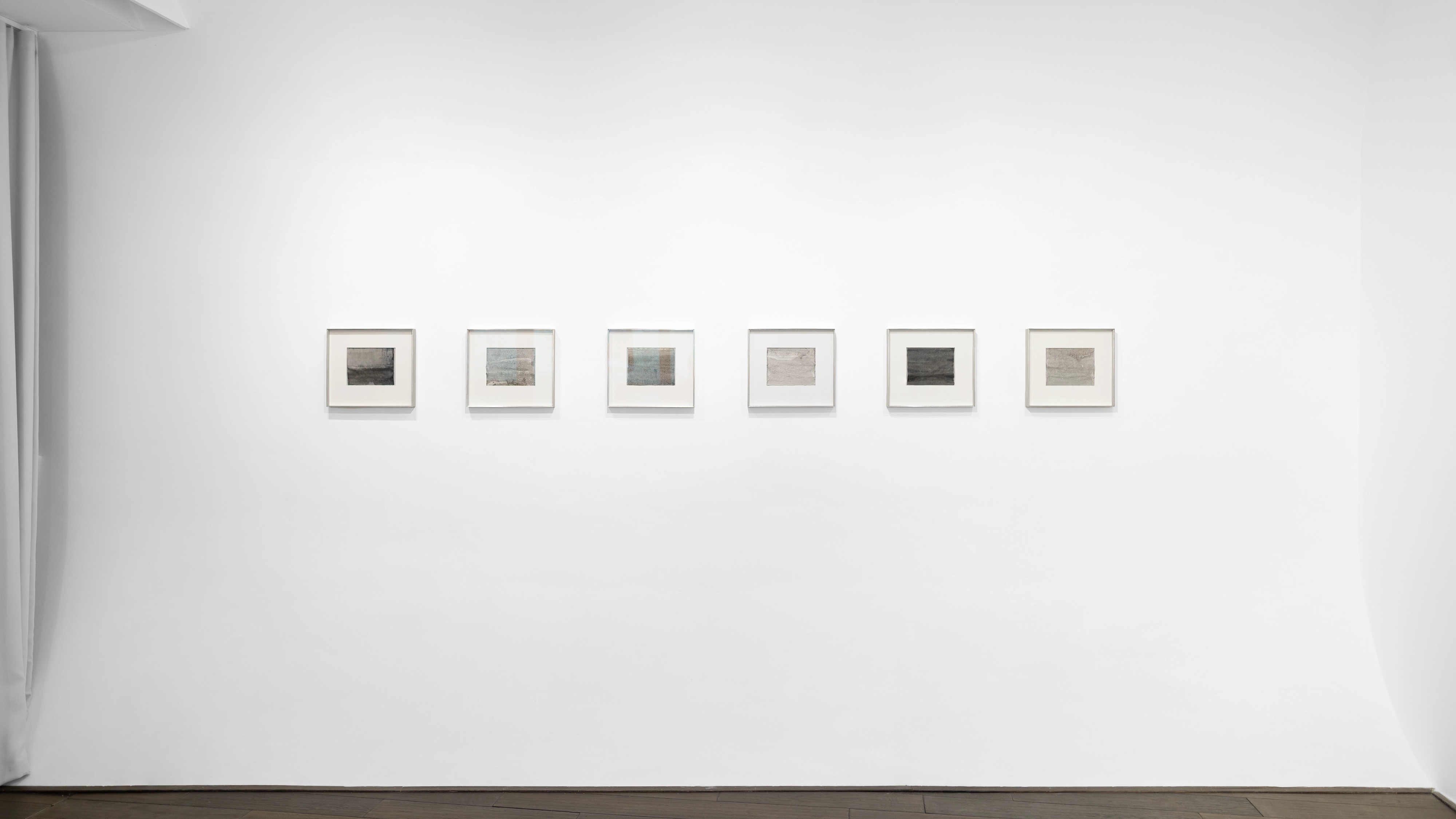


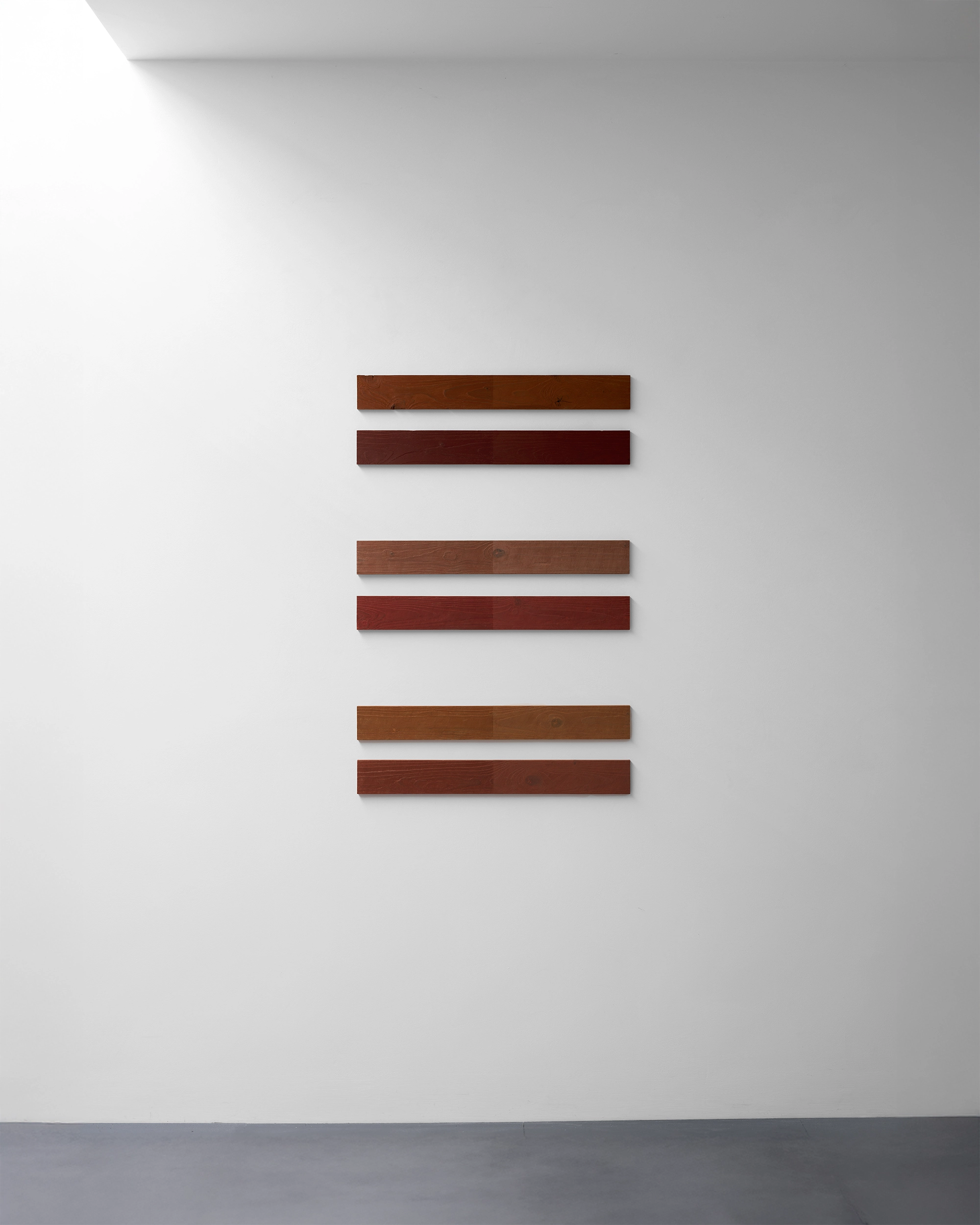
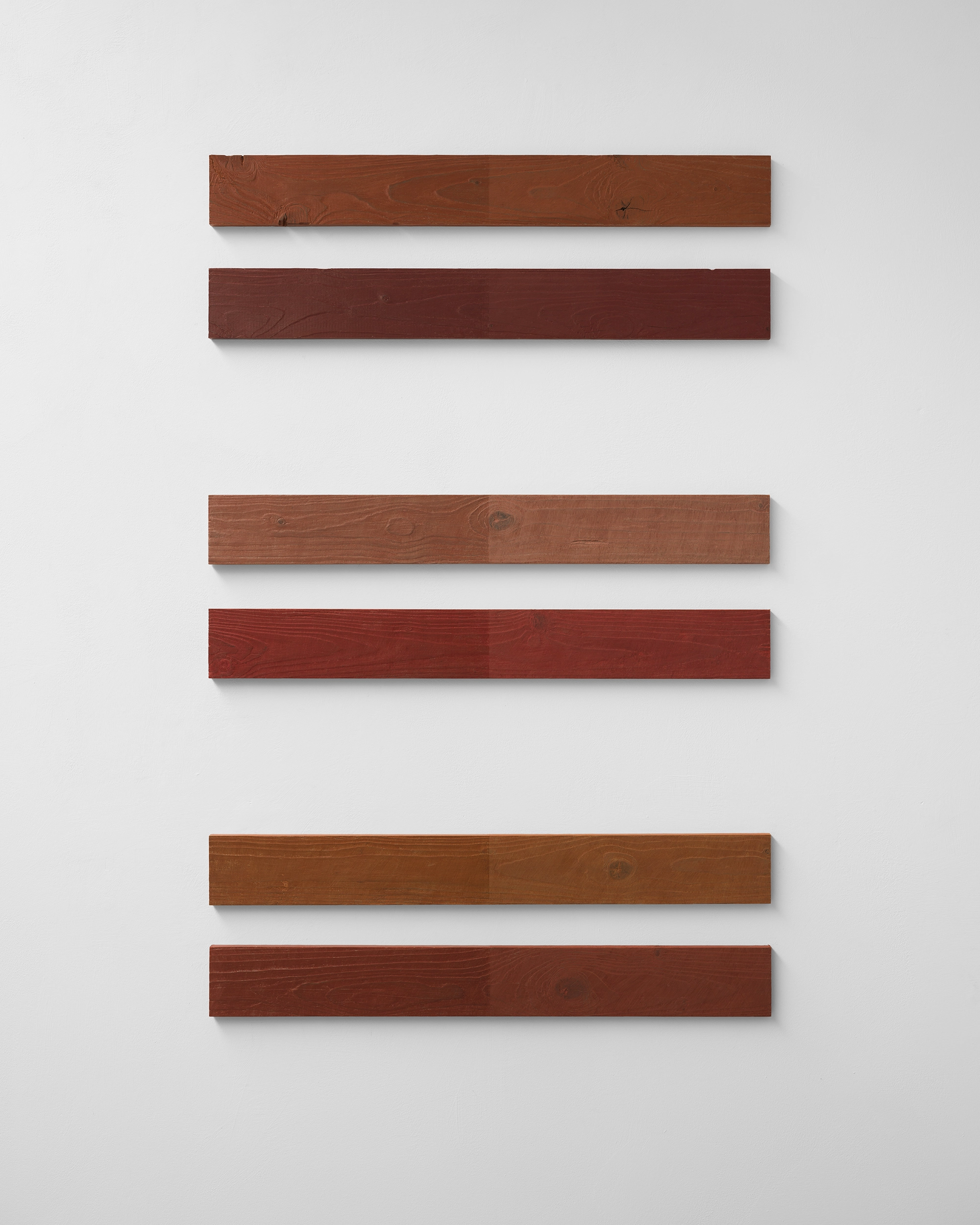


Cover: Installation view, Lucinda Burgess: Morphosis, Bartha Contemporary, London, 2026. Courtesy the artist and Bartha Contemporary, London.
All images © their respective rights holders.
Image rights & attribution →