



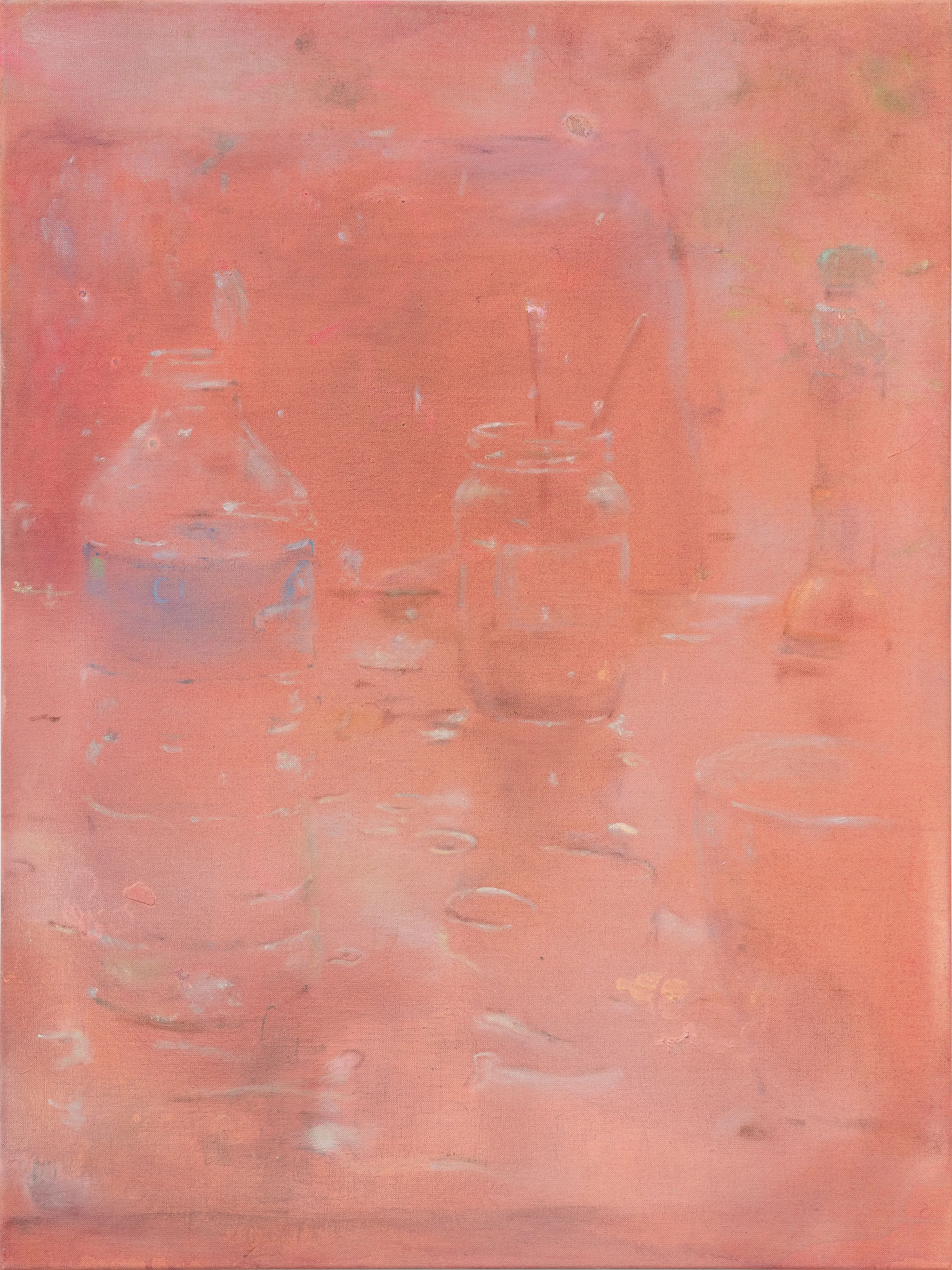
The brushes should be the proof.
They are the tools, the plain evidence of work, the things that come before the image. In Brushes on pink, they should be the easiest objects to verify. They are not. The jars and bottle are wiped rather than built. Glass is read through what has been removed, not through anything fully given. One upright brush leans out of the central jar, but it is among the least secure marks in the painting. The pink does not stay behind these objects. It moves through them, the same temperature as the table they stand on. The tool that should explain how an image is made has entered the same uncertainty as the surface around it.
Schoorel’s paintings often invite the language of delay: pale surfaces, late recognition, images sourced from photographs and arriving only after the eye adjusts. The familiar terms are mediation, archive, screen, memory, the worn image returning at a distance. That reading is tempting because it matches the first encounter. The image seems to sit somewhere behind the surface, almost present, almost returned, waiting for sight to catch up.
In DIANA, the surface keeps accepting more. Brush, table, name, lace, body, textile: evidence gathers on the paintings. The mould enters later as a counter-form, not as another surface proof.
The appliqué changes the terms of that gathering. It is not a painted suggestion or a photographic residue. It is material added to the surface, textile fastened where the image might otherwise seem to recede. A depicted thing briefly becomes actual. Not behind the painting, but on it. Weight, attachment, contact: the kinds of evidence mediation is supposed to lack. Yet the material does not stabilize the subject. It enters the same uncertainty it was brought in to interrupt.
Kitchen table sculpture with Adriaan, Pim gives more than the brush painting does. There are figures: a head near the upper left, a fuller head and shoulder near the upper right, one of the most resolved passages in the group. There is a table, a scene, the green and ochre marks of a room. The title adds names, and not general ones. Adriaan, Pim: first names, intimate names, names that imply relation before they explain it.
The names do not open the scene. They make its closedness more intimate. The painting has not withheld because there was too little to recognize. It gives figures, setting, relation, and names, and access still does not follow.
In Diana with lace, the demand becomes sharper. The figure is full-length, frontal, vertical, almost iconic. Head, torso, hips, feet: enough of the body is there for recognition to begin. The lace is the brightest and most worked event in the painting, a pink-white passage at the hips where pigment thickens into something close to an attribute. It should dress the body, mark it, bring it forward.
Instead, the place where the surface thickens is also the place where the body does not resolve. The painting offers what recognition usually asks for: frontal figure, bodily outline, attribute, material emphasis. The demand begins almost automatically. There is enough to ask for the body and not enough to receive it.
Diana becomes more than a title here. The myth’s pressure is the demand that a body become available to sight. The Ephesian Diana is read through accumulated signs rather than facial likeness, through attributes rather than portrait. Schoorel takes that model and turns it away from certainty. She gives the signs: body, lace, name, brush, table, material attachment. They do not gather into possession.
Schoorel made small clay figures from moulds, doubles or echoes of Cycladic forms. A mould belongs to another condition of form. It fixes an outline so that form can return. It makes posture repeatable. It lets a body come back without requiring the uncertain act of recognition each time.
Set against Diana with lace, that repeatability makes the paintings harder, not weaker. The moulded figure can return as contour, again and again. The painted figure arrives unevenly, once, and not as something that can be held. The contrast prevents the paintings from being read as failures of completion. Schoorel has made repeatable form and allowed painting to operate otherwise.
The brush dissolves into the surface that should prove it. The named scene remains closed after recognition has been helped along. The body appears with its attribute and still does not become available. The mould is the form that can return, making the painted body’s refusal to return feel exact.
Looking carries a quiet expectation: if enough evidence gathers, the thing will become clear. If the body is frontal enough, named enough, marked enough, it will eventually give itself over. Schoorel lets that expectation form inside the work, then leaves it unmet.
The present is there, close enough to name. It has not receded. It has not been given.
Appliqué changes the terms of Schoorel’s pale surface. Material is no longer only painted, remembered, or mediated through an image. It is attached. The surface receives something actual: textile, weight, contact.
That nearness does not make the painting easier to possess. In DIANA, the thing comes closer and still does not become evidence. The image has not disappeared. The present has arrived without being handed over.


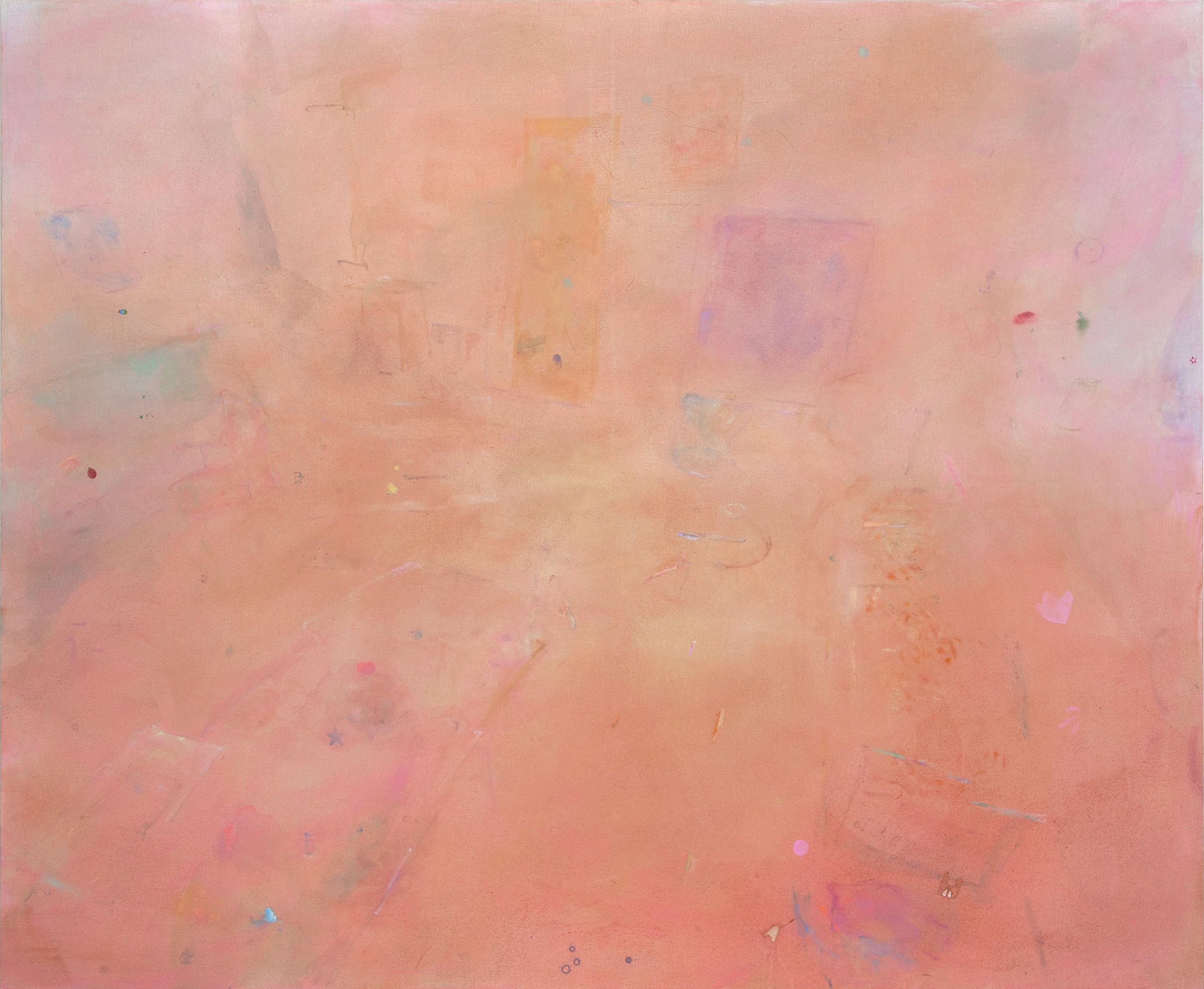


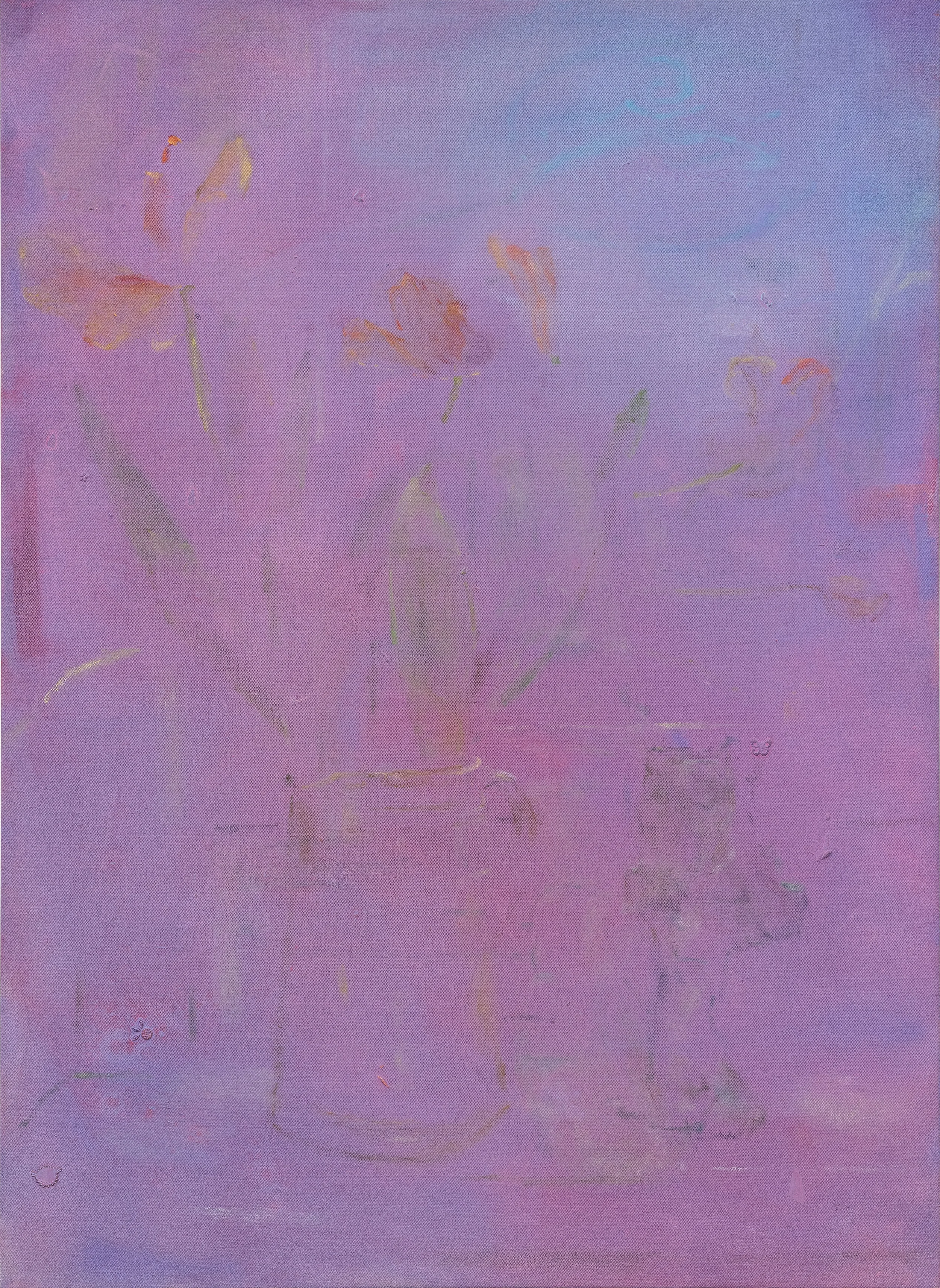
Cover Image: Maaike Schoorel, Studio in orange, 2026. Oil on linen with pigments, appliqué, 181 × 219 cm (71 1/4 × 86 1/4 in). Courtesy of the artist and Mendes Wood DM, São Paulo, Brussels, Paris, New York. Photo: Sander Tiedema.