



Raymond Saunders (1934–2025) did not come to painting as an outsider. He trained traditionally at the Carnegie Institute of Technology and the Pennsylvania Academy of the Fine Arts. Early photographs show him working from tonal cityscapes — disciplined, observational, compositionally grounded. He understood order long before he began to complicate it.
In 1967, Saunders published a short but decisive pamphlet titled Black Is a Color. In it, he rejected the idea that Black artists should be confined to a prescribed aesthetic or political role. Identity, he argued, should not dictate subject, style, or obligation. That position did not resolve into a manifesto of style. It became something he worked through on the surface of his paintings.
Across five decades, Saunders built canvases in which no single visual language dominates. Political text appears but does not take over. Still-life imagery surfaces but does not become central. Chalk diagrams, spray gestures, art-historical fragments, color tests, and collaged debris accumulate without hierarchy. He does not synthesize them into harmony. He keeps them active. Improvisation is not a stylistic flourish in this work; it is a working method.
What emerges is an equalized surface — a painting in which image, language, abstraction, and history share compositional weight. Nothing absorbs the rest. Nothing becomes the headline.
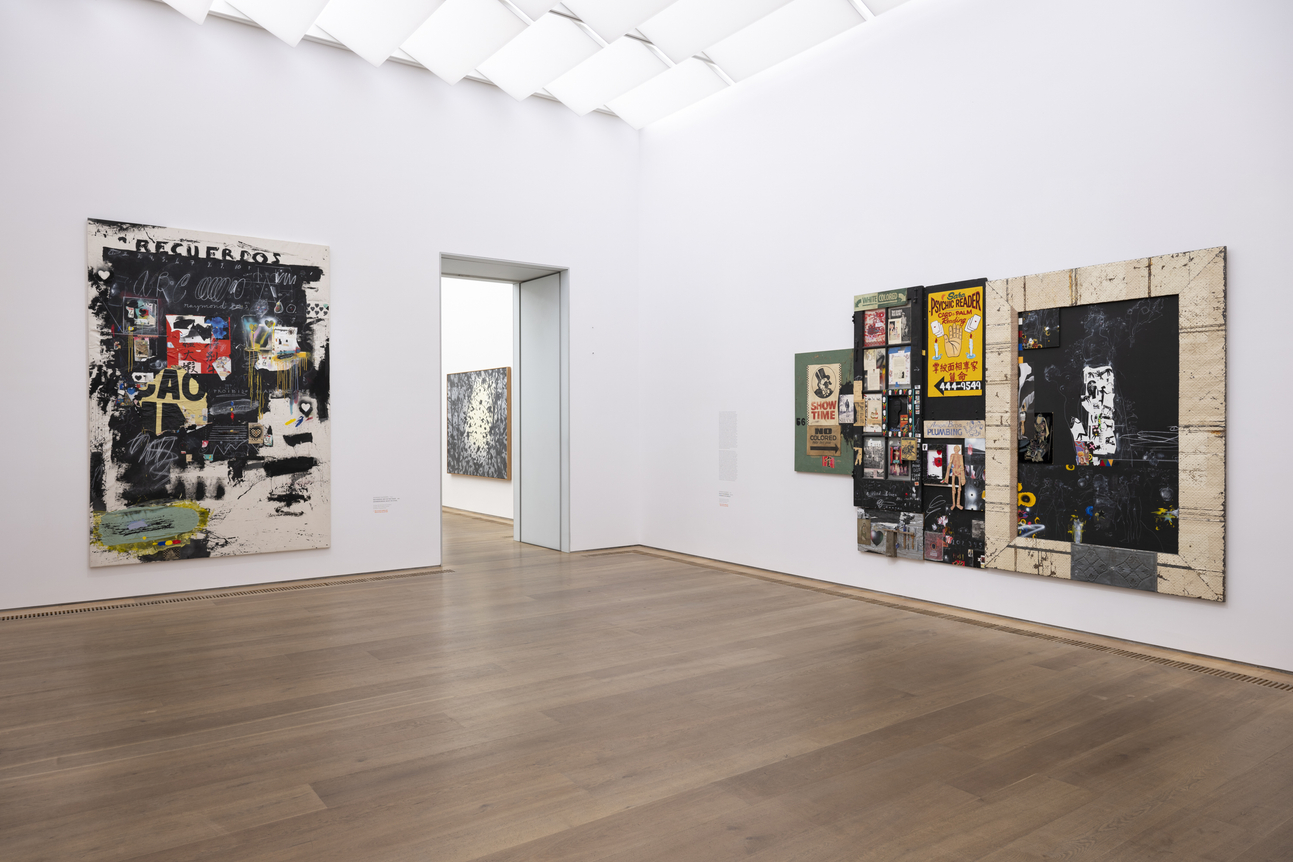
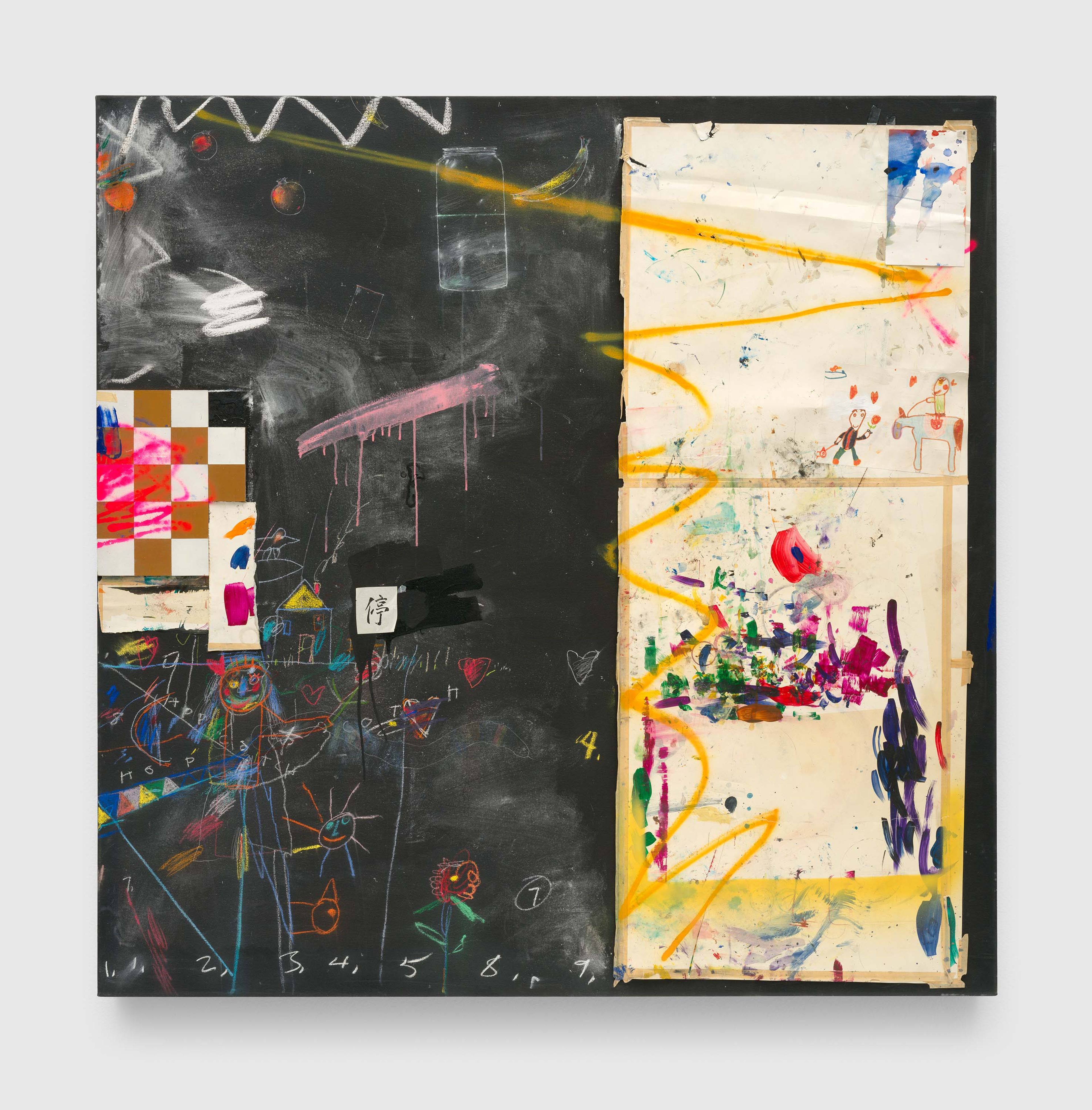
David Zwirner’s exhibition foregrounds the chalkboard surface that recurs throughout Saunders’ practice. It may evoke the classroom, the teacher, the student. But before it is symbolic, it is material. A chalkboard allows writing, erasure, revision, and return. Chalk leaves residue. Marks are partially removed but not erased completely. The black paint in Saunders’ work carries that history of touch — smears, revisions, layered pigment. The ground does not flatten the image; it holds it. A chalk triangle, a Renaissance fragment, a floral print, a political slogan — each sits against black as a separate presence. The ground absorbs without forcing resolution.
Across the works on view, a vase anchors the lower half of a canvas while a spray arc hovers above it. A classical reproduction appears beside calibration bars. In another painting, a phrase referencing apartheid sits between blocks of red, white, and black. Nothing resolves into narrative. The canvases operate as accumulative fields where instruction, improvisation, archive, art history, and politics remain visible at once. The surface behaves less like a finished composition and more like an ongoing notebook — a place where fragments are gathered, tested, and returned to.
The argument Saunders articulated in Black Is a Color extends into this compositional approach. If identity should not determine what an artist makes, then no single image should determine how a painting organizes itself. The paintings do not illustrate the pamphlet; they work through its implications.
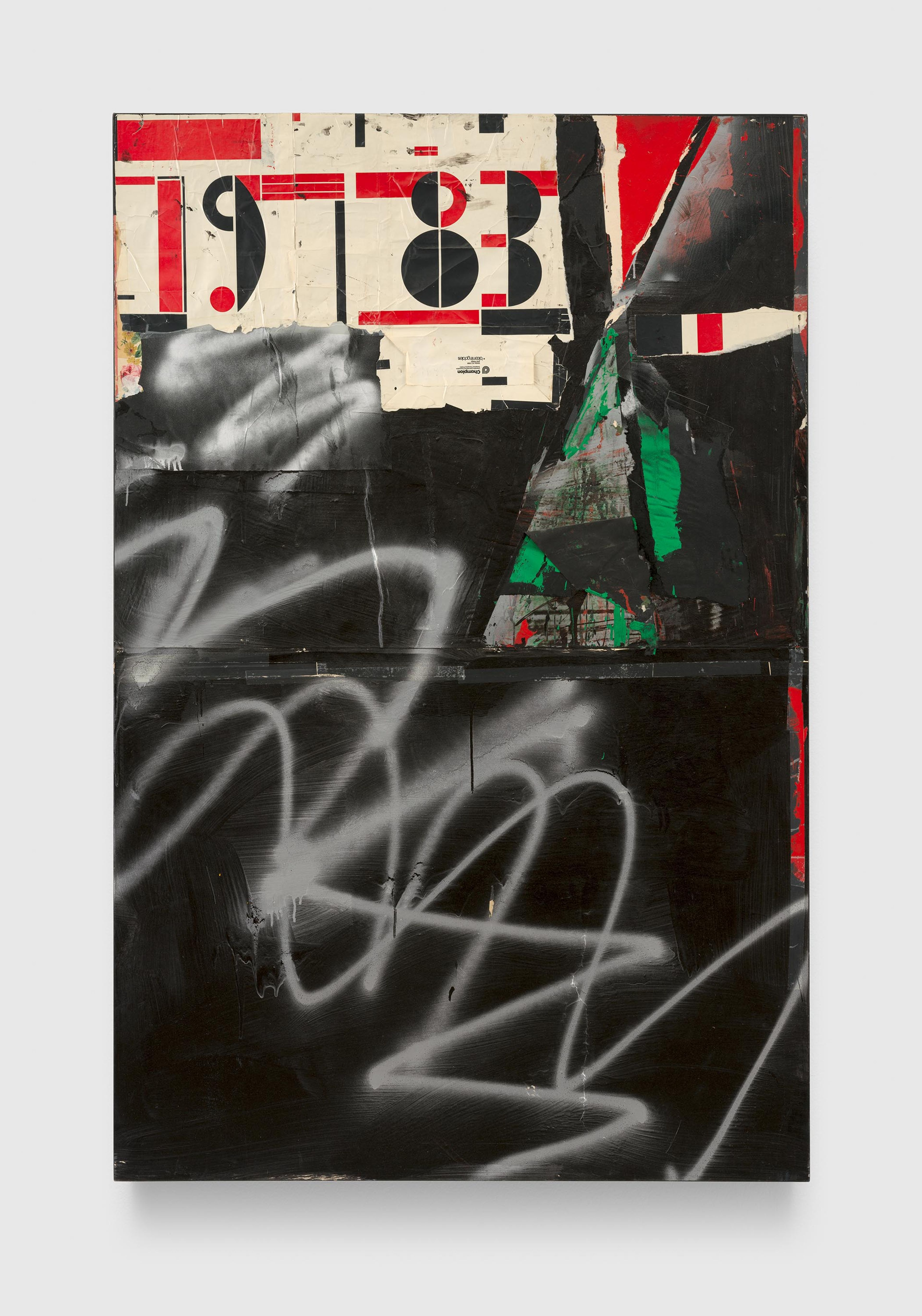
Some works introduce physical interruptions — wood slats nailed across the canvas, wire stretched over collage. Others stack fragments vertically, like notes pinned to a board. Meaning builds, but it does not consolidate into a single message. Saunders resists the compositional instinct toward dominance. He adds without collapsing. He revises without erasing entirely. The result is not system but practice — an ongoing negotiation across the surface.
Most paintings resolve by elevating one element above the rest. A figure dominates. A gesture clarifies the composition. A narrative organizes the field. Saunders avoids that consolidation. A political phrase does not overpower a still life. A Renaissance fragment does not outrank a spray arc. Abstraction does not neutralize reference. The surface remains plural.
This refusal is not indecision. It is the lived extension of his earlier position. If identity cannot be confined to a prescribed role, then the painting cannot be confined to a single organizing authority. The equalized surface is less a structure than a discipline — a way of keeping multiple presences active without allowing one to silence the others.
The exhibition spans works from the early 1980s through the 2000s, revealing not stylistic shifts but compositional consistency. In one painting, two black vases anchor the composition while color erupts from one form — containment and release held in balance. In another, chalk geometry, collage, text, and reproduction coexist across a dark ground. Density occurs within the surface rather than across the room. What emerges is not a closed argument but a sustained practice.
In 1967 Saunders argued for a wider reality of art in which color was means, not mandate. The paintings extend that argument beyond language. They do not illustrate freedom from hierarchy; they enact it through the way the surface is worked, revised, and taken up again.
In Raymond Saunders’ work, images do not resolve into hierarchy. Text, still life, abstraction, and archive remain active at once. The surface does not consolidate meaning; it holds it in suspension. The result is not chaos but discipline — a compositional practice built on keeping difference visible without allowing one element to silence the others.





1. Installation view: Raymond Saunders, Notes from LA, David Zwirner, Los Angeles, 2026. Artwork © 2026 Estate of Raymond Saunders. Courtesy David Zwirner.
2. Raymond Saunders, We Try, 1985. Acrylic, spray paint, chalk, collage, and mixed media on canvas, 73 × 73 1/8 in (185.4 × 185.7 cm). Artwork © 2026 Estate of Raymond Saunders. Courtesy David Zwirner.
3. Raymond Saunders, Untitled, c. 1996. Acrylic, spray paint, chalk, collage, and mixed media on canvas, 48 × 48 in (121.9 × 121.9 cm). Artwork © 2026 Estate of Raymond Saunders. Courtesy David Zwirner.
4. Installation view: Raymond Saunders, Notes from LA, David Zwirner, Los Angeles, 2026. Artwork © 2026 Estate of Raymond Saunders. Courtesy David Zwirner.
5. Raymond Saunders, It Wasn't Easy Being a First Grader, 1979/1984. Acrylic, spray paint, chalk, collage, and mixed media on canvas, 77 3/8 × 74 in (196.5 × 188 cm). Artwork © 2026 Estate of Raymond Saunders. Courtesy David Zwirner.
6. Raymond Saunders, Untitled (Apartheid), 1989. Acrylic, chalk, spray paint, graphite, and collage on canvas, 95 1/4 × 70 3/4 in (241.9 × 179.7 cm). Artwork © 2026 Estate of Raymond Saunders. Courtesy David Zwirner.
7. Raymond Saunders, Untitled, c. 1995. Mixed media on paper, 71 1/4 × 47 1/4 in (181 × 120 cm). Framed: 72 3/4 × 48 7/8 in (184.8 × 124.1 cm). Artwork © 2026 Estate of Raymond Saunders. Courtesy David Zwirner.
8. Raymond Saunders at work, n.d. © 2026 Estate of Raymond Saunders. All rights reserved.
9. Raymond Saunders, Malcolm, 1983. Acrylic, spray paint, chalk, collage, and mixed media on canvas, 76 3/4 × 50 in (194.9 × 127 cm). Artwork © 2026 Estate of Raymond Saunders. Courtesy David Zwirner.
10. Raymond Saunders, Untitled, 1982–1985. Acrylic, watercolor, colored pencil, graphite, collage, and mixed media on paper, 29 × 22 3/8 in (73.7 × 56.8 cm). Framed: 31 1/4 × 25 3/8 in (79.4 × 64.5 cm). Artwork © 2026 Estate of Raymond Saunders. Courtesy David Zwirner.
11. Raymond Saunders at work, n.d. © 2026 Estate of Raymond Saunders. All rights reserved.
12. Untitled drawing by Raymond Saunders, n.d. © 2026 Estate of Raymond Saunders. All rights reserved.
13. Raymond Saunders, Untitled, 2005–2015. Acrylic, spray paint, chalk, collage, and mixed media on wood panel, 98 1/2 × 48 1/8 in (250.2 × 122.2 cm). Artwork © 2026 Estate of Raymond Saunders. Courtesy David Zwirner.
Cover: Installation view: Raymond Saunders, Notes from LA, David Zwirner, Los Angeles, 2026. Artwork © 2026 Estate of Raymond Saunders. Courtesy David Zwirner.