



Two flowers are bound to an upright before they are a couple.
Seen through the tall windows on rue de Castiglione, they rise from a single bronze base, leaning apart at the top, heads turned a little toward each other. Between them runs a slender vertical post with one short crossbar. The room behind them is sealed, the door dark, the exhibition arranged to be read from the street side of the pane. But the first pressure is already inside the object. The two stems share the post the way two figures share a frame in a wedding portrait, and for a moment the work seems to accept the title’s promise: two things held together, a vow with its second clause still far away.
Inside, the arrangement continues the promise. The walls are papered, floor to ceiling and right up to the window plane, in a deep blue field of drawn and printed marks — flowers as weather rather than as any single bloom. Smaller Bound Flowers. Couple. bronzes sit on plinths close behind the glass, angled toward the arcade. The scale is generous, the staging composed. Everything is arranged like a portrait of two people who have decided to stay.
One of the heads has already fallen.
In Bound Flowers. Couple. (9195), the tall bronze that anchors the show, two sunflowers crown a structure more than two and a half metres high — and crown is already the wrong word, because the heads are not upright. They hang forward off the top, faces down, stems bent at the neck, the heavy seed-discs pulling everything toward the floor. Behind them the apparatus stands perfectly straight: two long verticals braced into a narrow tower, rungs across it like a ladder, splayed feet planted wide on a low base. The structure is plumb. The flowers pour off it. What had looked like a pair of figures standing together becomes a pair of collapses fixed in place by the scaffold they are bound to.
A sunflower head falling forward is natural; a mature disc is too heavy for its stem, and it bows. The droop is botany, not sculpture, and to read tragedy into it would be sentimental. That is true, and it is the thing the work is built on. A support in a garden arrives before collapse, to prevent it. Here the support arrives with the cast, inside the same operation that destroys the flower. It cannot prevent the fall. It can only fix the fall in place. The interest is not in the droop. It is in the standing thing beside it — plumb, level, and still binding what has already gone down.
The exhibition offers this as an everlasting pose. The objects make something colder of it. The casting is literal: these are live casts, the cut flower packed in silica and burned out of the mould as the bronze goes in, so the metal stands exactly where the body was. Silica stays in the crevices; the pouring channels are left attached rather than cleaned away. With banksia, the fire relation sharpens. Some banksias hold seed until fire opens what the plant has kept closed. Ruby’s casting fire reverses that release: the organic body disappears, and what remains is the structure that held it through the burn. The cremation is not the discovery. What matters is what the cast keeps bound. The bronze does not reverse the fall. It fixes the fall in place, with the structure still standing beside it.
The couple becomes colder. Whatever intimacy the title gives them is routed through one structure: they are fixed to it and fall in relation to it. The us of the title is shared dependence before it is anything warmer: two bodies bound to the same upright, not saved from falling but kept inside the same fall. The smaller Bound Flowers. Couple. works show it plainly. The post, crossbar, and footed base no longer read as stem alone. They are the binding apparatus the flower cannot leave.
The bronze does not hold itself apart from the room. The even darkness breaks where blue-green spreads across the seed-heads and down the stems — ordinary patina on cast bronze, but here a direction of travel. The metal is oxidising toward the blue on the walls. The sculptures do not stand against that field as solid against atmosphere; they begin, slowly, to corrode toward it.
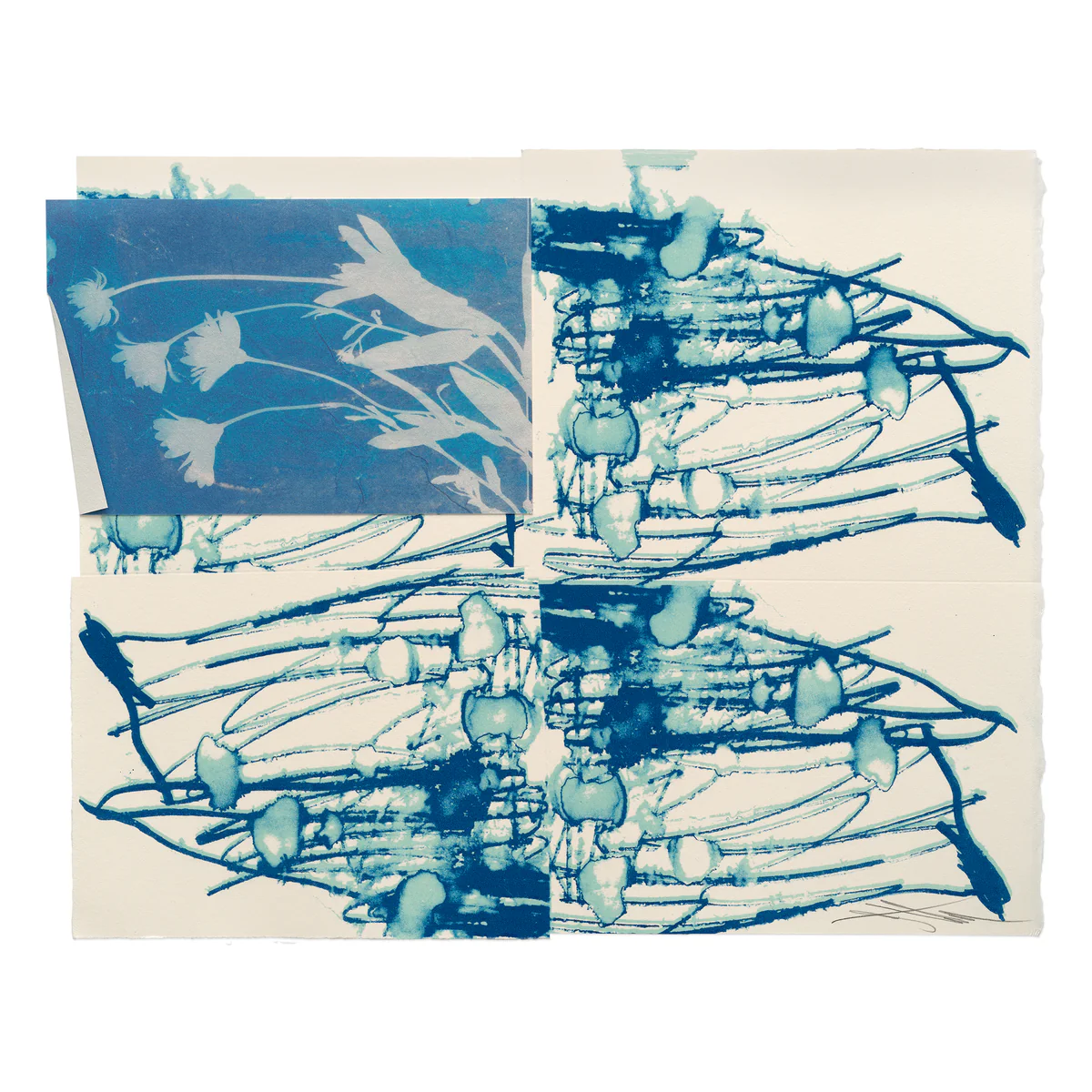
The blue is where the flower goes once it is gone, and the glass gives it to the viewer first. The field reaches the viewer at the window plane; the bronzes sit behind it, further into the case. So the disappearance arrives before the body can be approached. The blue comes from the GHOSTS works on paper: cyanotypes made by laying cut stems from the studio garden onto sensitised paper and exposing them to light, the plant printing itself as a pale absence while drawn lines run out from the captured stem into the field. The GHOSTS sheets are enlarged across the gallery and the framed originals hung back over their own enlargements. Presence is hung over its own ghost. If the bronze is the body fixed at the moment of collapse, the blue is what is left when there is no body to fix: contact, shadow, the flower laid flat and printed as the light that passed around it.
Behind glass, at the scale of a wall, the blue becomes display surface — a beautiful environment the eye can take as décor. That is not a hazard the show accidentally falls into. It is the mode the installation chooses. The cyanotype’s claim is indexical: this blue is where an actual stem lay. Enlarged and repeated against the window, that claim thins toward pattern, while the bronzes keep the flower’s bound, fallen pressure in front of the field. Surface, display, and afterimage are not failures here. Behind the glass, they are the conditions under which the work appears.
The binding finally reaches the viewer. The cut flower is already a display form — a bouquet is a stand of severed stems arranged to be looked at until they fail — and the window returns it to the condition it already knew: lit, presented, kept. A sealed case is built for display, preservation, and distance. What the post does to the flower, the glass does to the viewer. The same operation moves outward through the whole presentation: stem fixed to post, bronze oxidising toward blue, exhibition sealed into its case, viewer held to the street.
The vow does not resolve the way the threshold first suggests. Till death do us part reads first as duration; the objects set the second clause in the past and leave it there. The parting has happened. What remains is the apparatus built around the bond: the upright still plumb, the heads already down, the glass between the work and the viewer.
The structure stands. The flower does not.
The title invokes marriage, but the deeper question concerns relation itself. Once two things become structurally joined, the relation acquires a reality that exceeds either individual term.



Cover Image: Installation view, Sterling Ruby, TILL DEATH DO US PART, Gagosian, rue de Castiglione, Paris, 12 June – 3 October 2026. Artwork © Sterling Ruby. Photo: Thomas Lannes. Courtesy Gagosian.
All images © their respective rights holders.
Image rights & attribution →