


The morning was unusually cold for Florida. Ice had formed overnight on the launch pad at the Kennedy Space Center, and the flight had already been postponed three times and scrubbed once. Now, on 28 January 1986, seven people were preparing to leave Earth.
One of them was Christa McAuliffe, a social studies teacher from Concord, New Hampshire, chosen from more than eleven thousand teachers who had applied to go. She was to teach two lessons from orbit. The lessons would be broadcast to schools across the country, with as many as twenty-five million children expected to watch. A teacher was going into space, and the children she taught had been promised lessons from it. Another of the seven, Ronald McNair, a physicist on his second mission, was to record a saxophone part in orbit.
By then the shuttle had flown twenty-four times. NASA had declared it operational and spoke of a vehicle that would make going to space routine, and that, whatever the machine’s condition, was the promise the public had been given: that leaving Earth could become something people did on a schedule, and that a teacher could go and come back and tell her class about it. On the pad, in air fifteen degrees Fahrenheit colder than at any launch before it, Challenger waited.
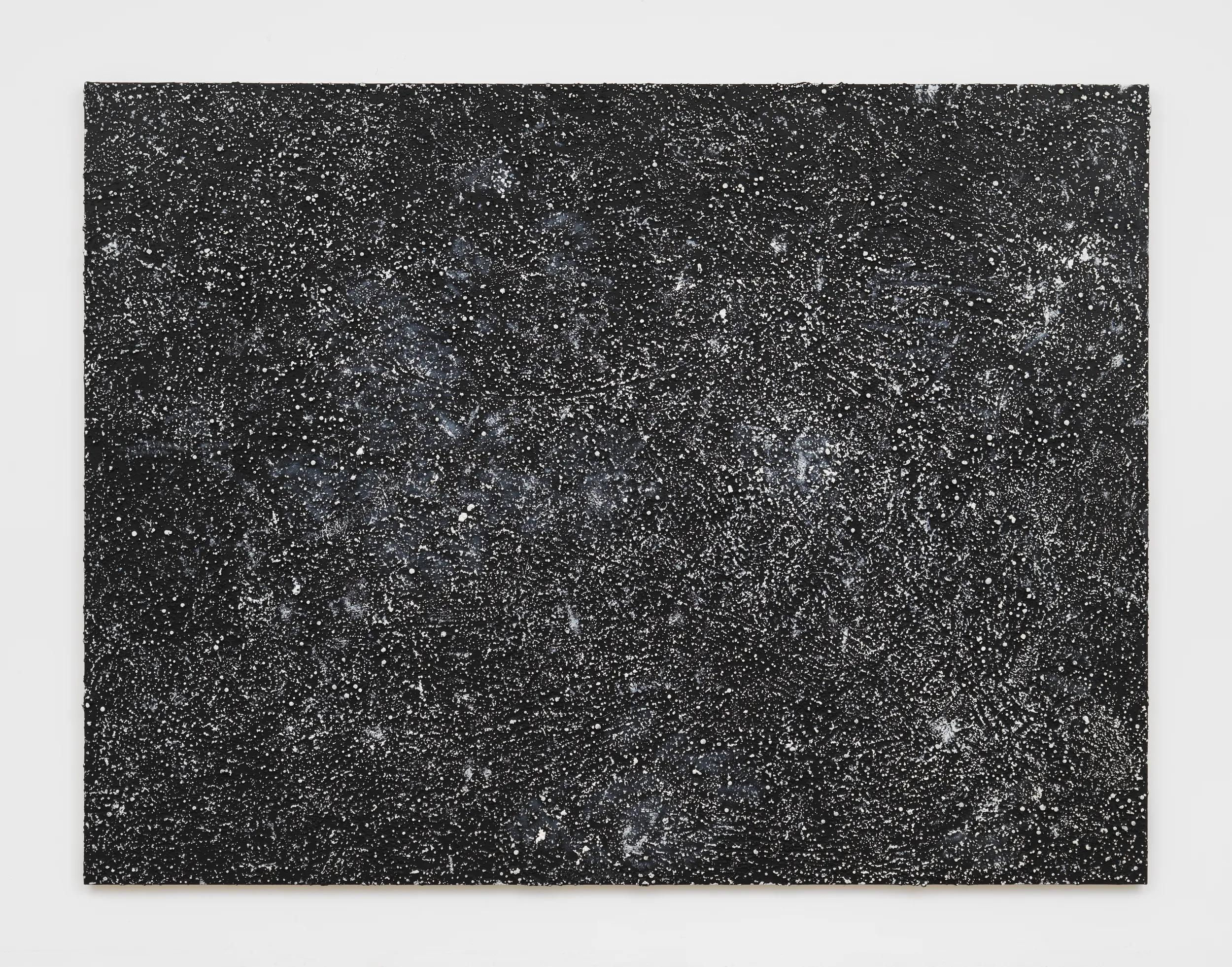
That same year, in New York, Jack Whitten made a painting called A Memorial to the Challenger Crew.
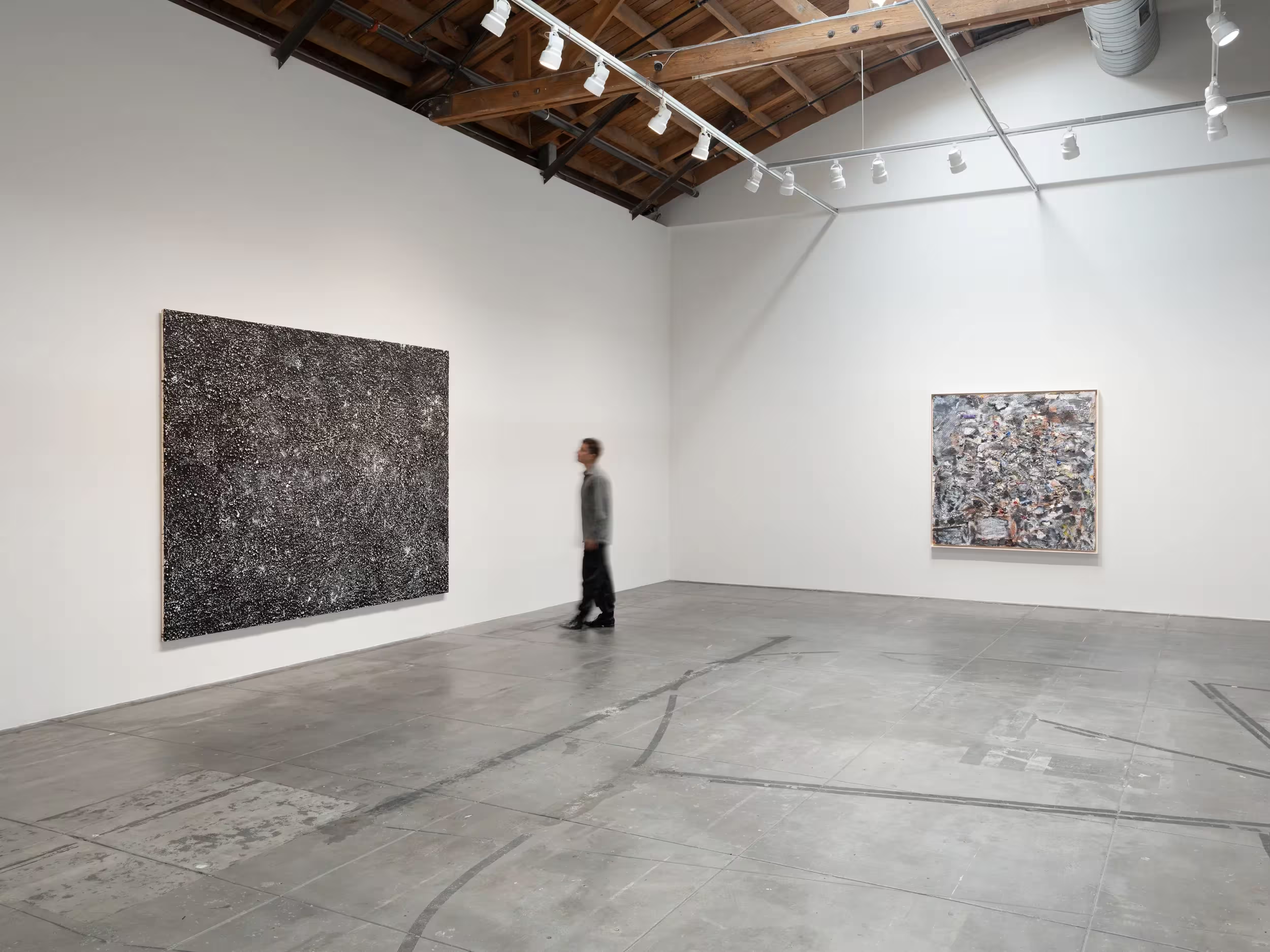
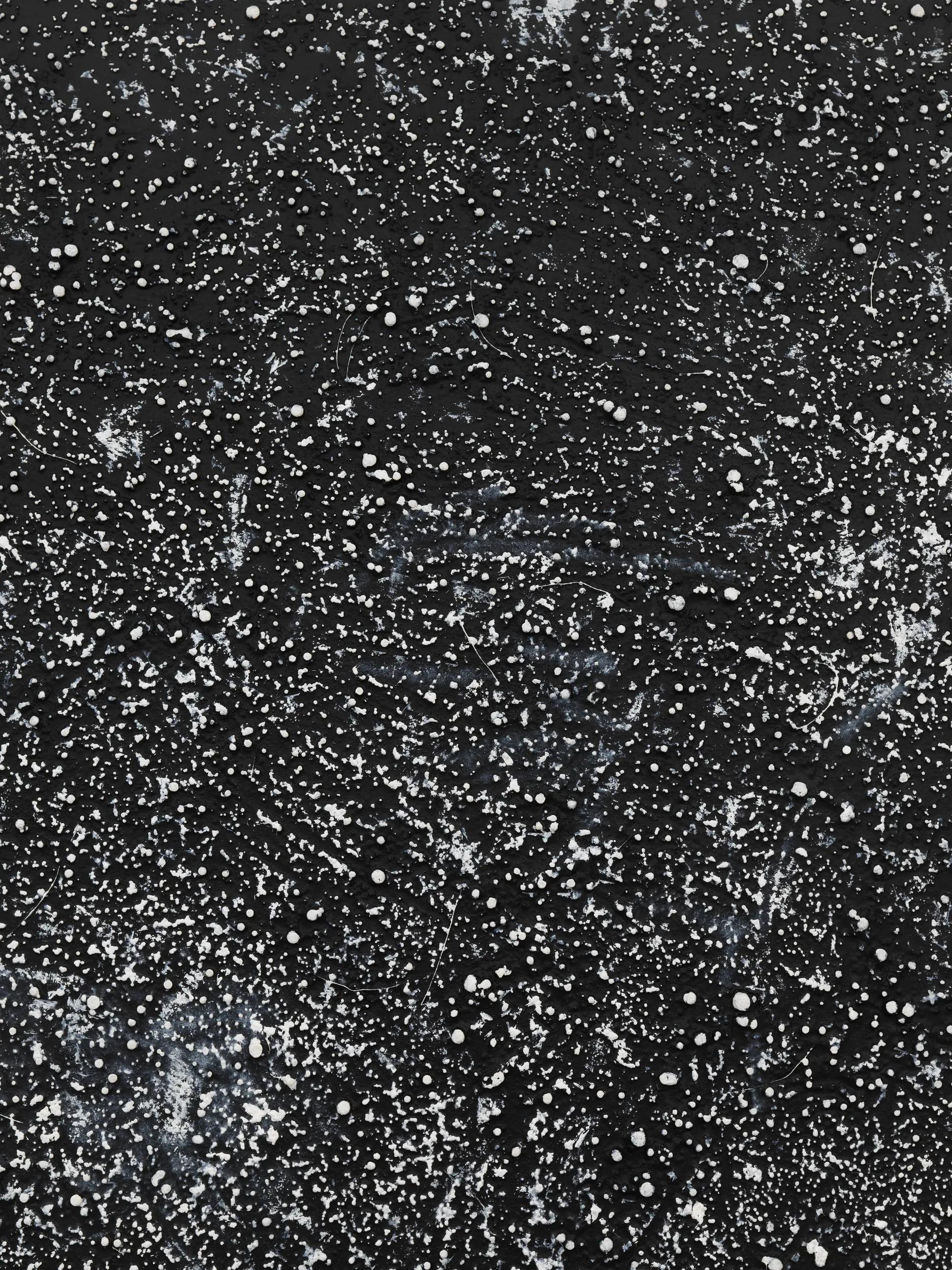
There is no spacecraft in it. No horizon, no figure, nothing that answers to a photograph of the morning. There is a black canvas nearly three metres wide, and across it, in their thousands, small white marks. A reader arriving from the launch pad looks for seven of something and finds no number that can be taken. What the eye does instead, and does at once, is make a sky of it: white points on black, uneven in size and brightness, a few larger than the rest. The painting allows this. It does not insist on it, because at the same time, and without any change of distance, the same white points are plainly things, a plastic and a paint, on a canvas. The sky and the material hold together, and the title settles nothing between them.
A memorial ordinarily keeps something: a name, a likeness, an object, a trace of a body or a place. This one gives seven people a title and nothing of their faces. What it gives instead is a surface that rewards being looked at more closely than a sky ever would. The round elements are of several sizes, most a few millimetres across, a few several times that. Among them, in great number, are white marks that are not round at all: flecks, short streaks, smears, and fine scratches that run in curves thin as hairs. In places the white gathers into a pale concentration, a loose cloud denser than the field around it. The black is not a backdrop. It is worked, swirled and disturbed beneath and among the white, so that in passages the ground itself seems to move. Some elements stand alone; others overlap and run together until it is no longer possible to say where a particle ends and the painted field begins. And some of this white is not paint. The caption lists polystyrene among the materials, a plastic more familiar as packing foam. Which of the marks are plastic and which are pigment, it does not say, and the surface does not tell. What it tells is that the painting contains things.
Whitten had a way of describing what a work like this is doing. Of a later painting, Black Monolith III, he said in an archival recording that MoMA uses on its audio guide: “The subject is built into the paint.” And, drawing the line that matters: “It’s not an illustration of something. It’s within the thing itself.” He was speaking of another painting, and he is not known to have said anything about the Challenger memorial. But the sentences name the problem this memorial sets more exactly than a viewer could, because in some of his dedicated works Whitten meant them with a literalness that is hard to credit. The Guardian I, For Mary, made for his wife in 1983, is a sculpture; the Metropolitan Museum lists its materials as black mulberry, Mary’s hair, window glass and mixed media. 9.11.01, a painting from 2006, is catalogued with ash, animal blood and hair in its medium.
The Challenger memorial is acrylic and polystyrene on canvas. Nothing in it is known to have come from the seven, or from the morning. That is the question the painting carries into the rest of the exhibition, and it is a harder one than the sky: how is a subject built into a painting whose materials, so far as is known, belong to no one?
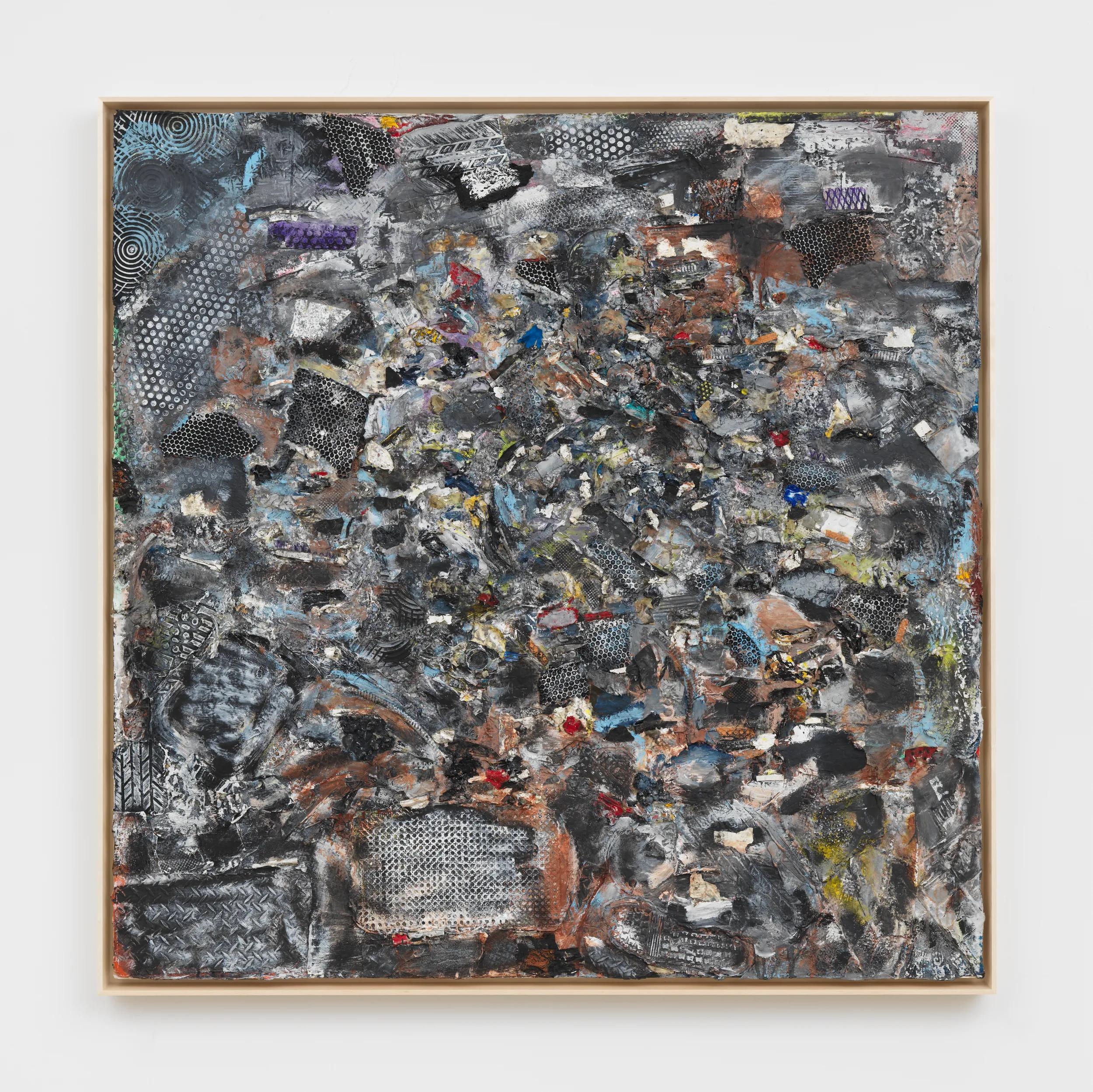
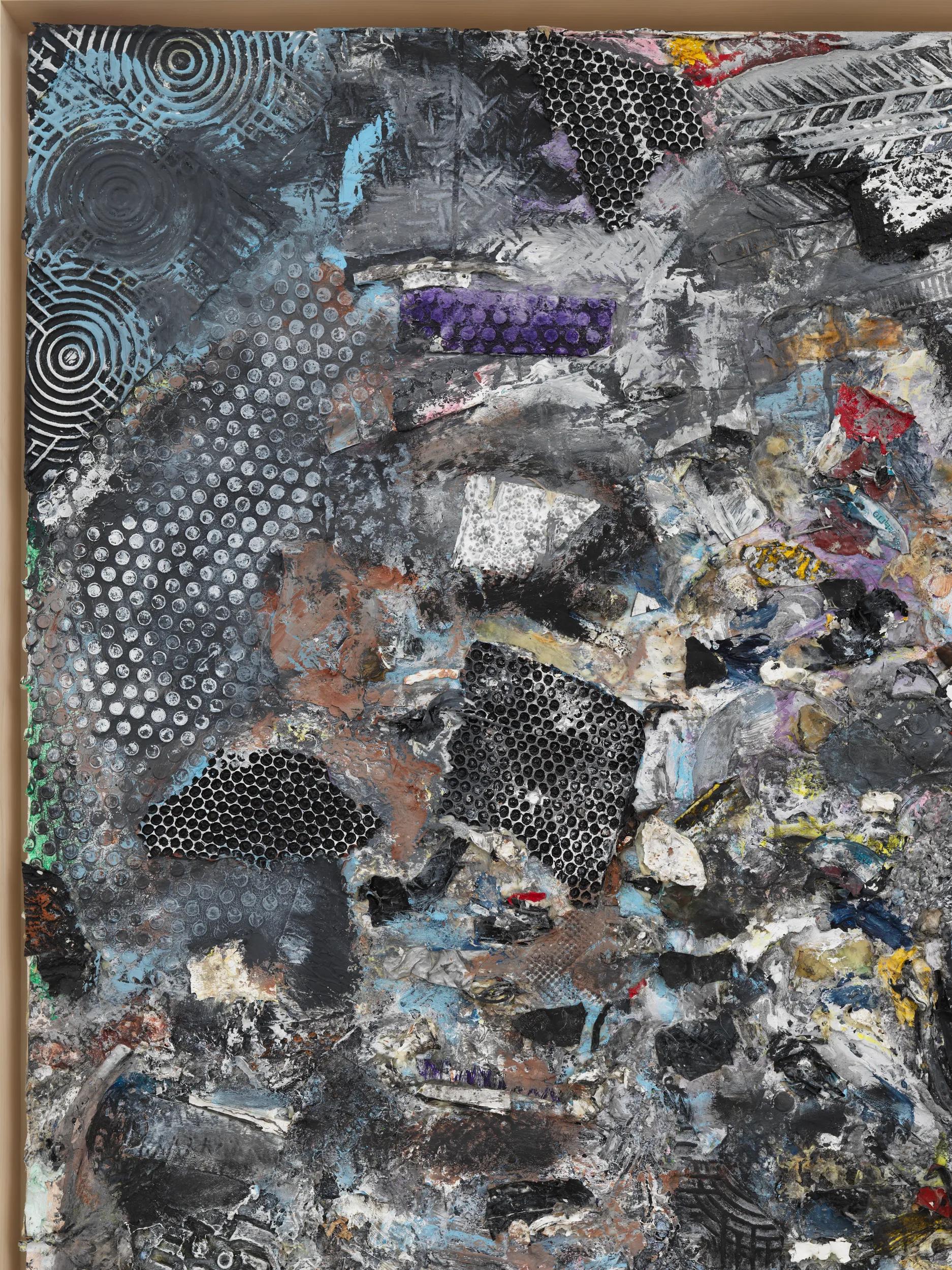
The memorial hangs in a corner, and the painting on the adjacent wall, at a right angle to it, is a dedication too. Spiral: A Dedication to R. Bearden (1988) is a large square relief packed to its frame with pieces of cast acrylic. Many of its larger pieces carry regular patterns that look pressed from the world: they resemble chair caning, tread plate, the sole of a shoe, wire mesh, and at the upper left a set of concentric rings. Between them, smaller chips and brushed passages carry nothing. During these years Whitten was casting acrylic from urban surfaces, including manhole covers and tyre treads. The relief has the look of that practice: a painting that appears to hold impressions, the texture of actual things taken by contact and set into paint. It depicts no street. The street seems to have been pressed into it.
Romare Bearden was a collagist. He had also, in 1963, co-founded a group of Black artists in New York called Spiral, and the title recalls both the collective and the concentric rings visible in the relief. What the surface itself offers is this: a dedication to a man who made pictures by cutting and pasting fragments of the printed world is an assembly of fragments, each carrying the print of something. None of them came from Bearden. If he is present in the painting, it is by way of how the painting was made. That is a different possibility from the hair in The Guardian, and the corner sets it at a right angle to a third: the memorial’s. Its white marks carry the pattern of nothing. They are not casts of a surface in the way the caning and the tread appear to be, and they are not assembled; they are dispersed. Its title does the dedicating; nothing in the surface records contact with the crew or resembles them. That leaves open what the surface contributes beyond the name, and an absence of relics is not an absence of subject.
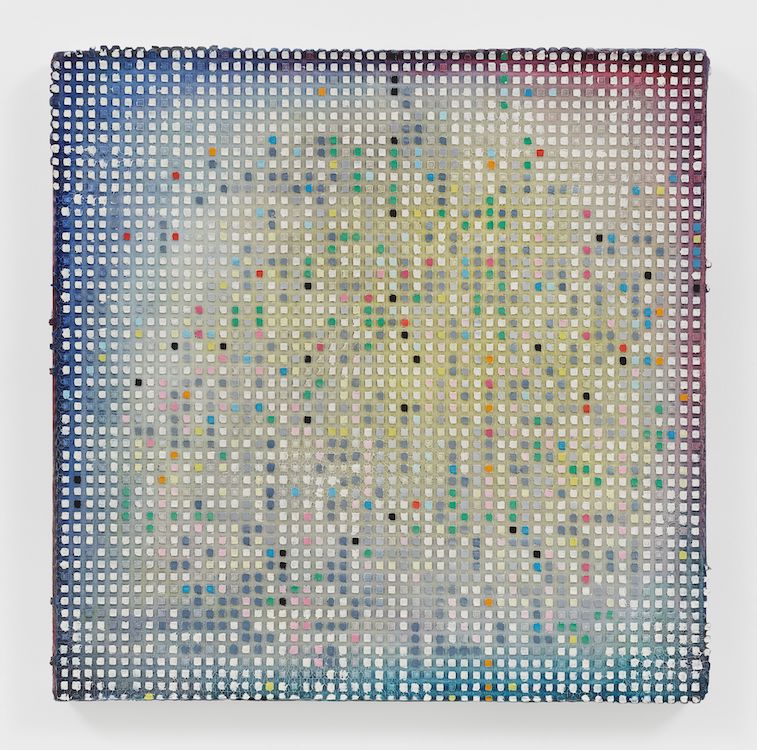
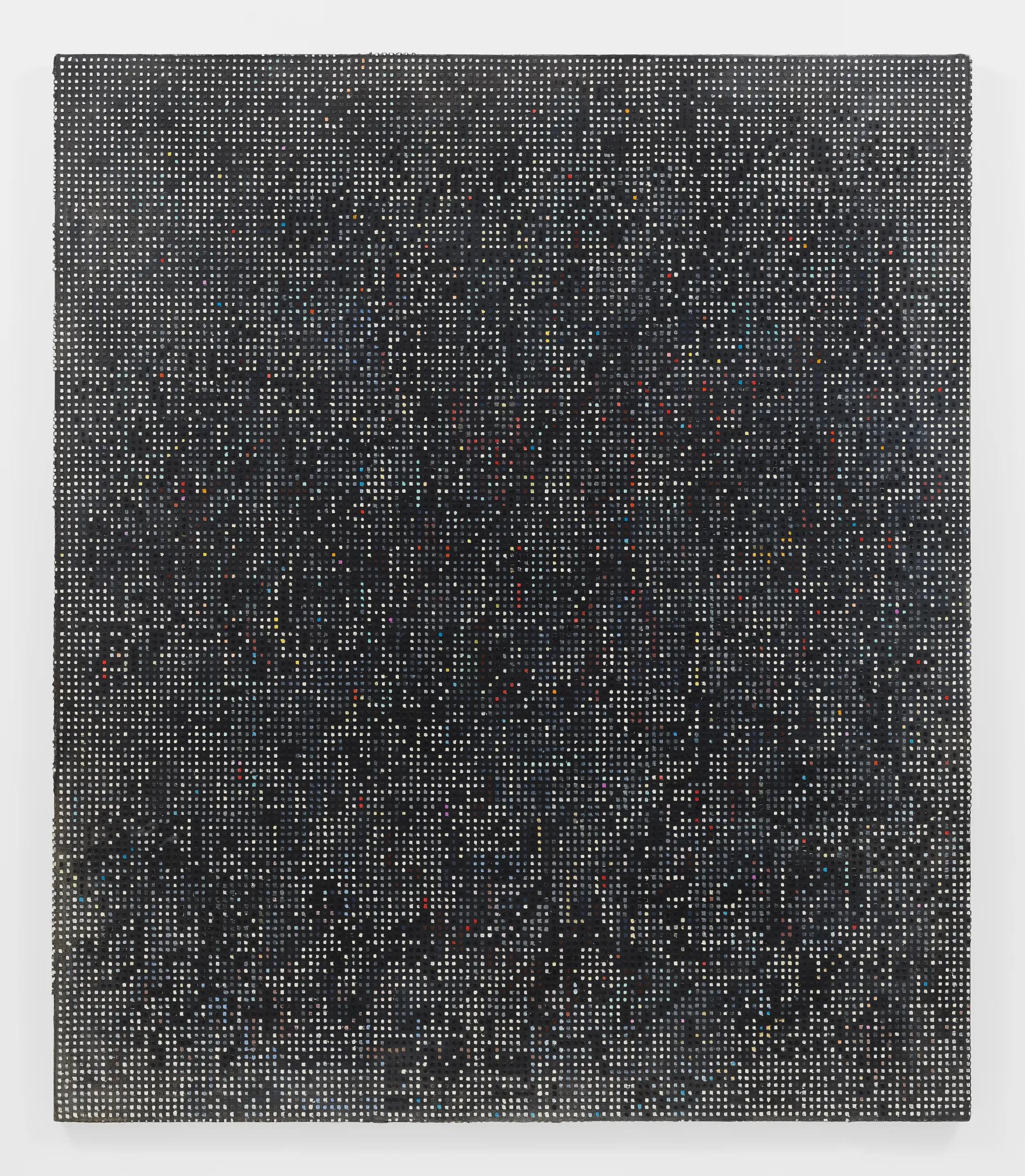
They say one more thing, which takes two paintings from the year before to hear. Dutch Treat II and Manhattan Odyssey, II are both from 1985, and both are grids. By 1985 Whitten was pressing wire mesh into wet acrylic. Both paintings have the resulting appearance: a complete lattice of small square cells, each cell one colour. In the smaller painting most cells are white or near-white, with single saturated cells scattered among them and a drift of blue, violet and yellow across the field. In the larger one, nearly two metres by more than two, the cells differ mainly in value, white to near-black, and the light ones gather into orthogonal runs and blocks, so that from a distance the painting is a dark grey shimmer with denser and sparser zones and no figure. Nothing is drawn in either.
Cathode-ray scanning, radar and electron microscopy offered Whitten ways of thinking about how information could be seen and transmitted. He came to imagine painting as a form of transmission, channelling a person, a spirit or a place through what the exhibition calls “coded, repeatable units.” The phrase fits the 1985 grids more exactly than anything else in the exhibition. A field of positions, each holding one value, is how a scanned image is organised, and these two paintings are organised that way and no other. That is a resemblance, not a working system; nothing in them can be read back out. But it is a resemblance a viewer can see, and the exhibition’s account rests on it.
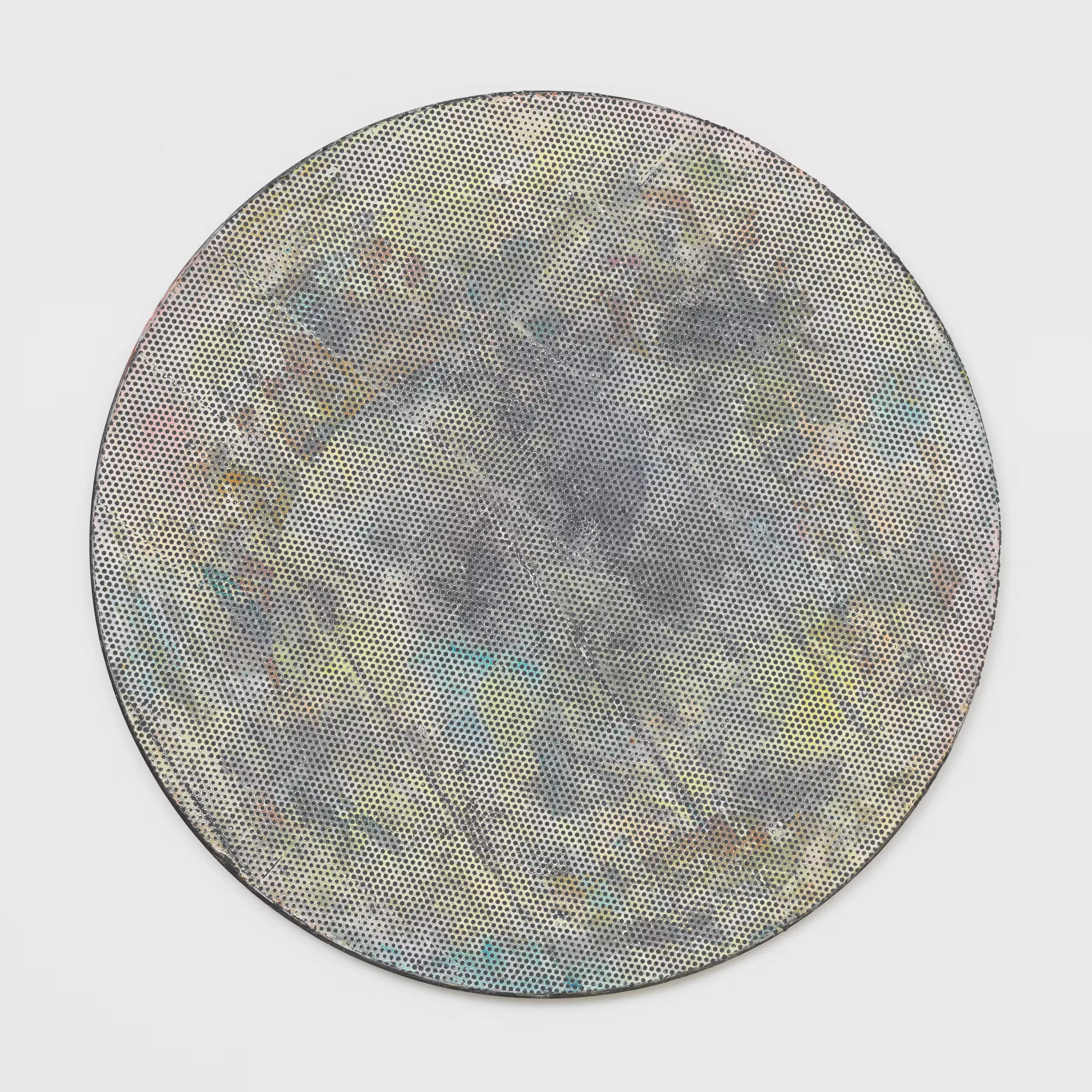
What, then, does the memorial share with them? Not the cell. Its elements are round, not square; they come in several sizes; many of its marks are not elements at all but smears and scratches. What is shared is seen at a distance before it is seen close to: a field built entirely from small, separately distinguishable marks, nothing drawn, in which the differences between marks, lighter and darker, denser and sparser, do all the work of the image, so that zones and drifts and bands appear without anything having been shaped. Sphere, begun in 1985 and reworked in 2008, so that its present surface cannot be dated, carries a staggered screen of round dots over a painted field, and it shows one thing whenever that screen was made: a round element can be held by a lattice as firmly as a square one. So the difference between the grids and the memorial is not the shape of the element. It is that in the grids every element has a place fixed before it has a value, and in the memorial nothing fixes the place. The elements repeat; their positions do not. In the one sense of the gallery’s word that is visible, the units of 1985 are coded, each given an address, and the units of 1986 are not.
Two years later the fragments of Spiral carry small lattices, like caning and mesh, inside many of them, with no order between the fragments. In 1990 Confirmation and Dexter! (For D.G.), alone together on a freestanding wall in the same hall, are held by a lattice of another kind, a cut one: square tiles of painted acrylic an inch to a side, laid in rows, each a scrap of a painted surface, a wash or a stroke or a splash with its tail, that stops at the tile’s edge. Set among these works, the memorial’s repeated elements have no visible lattice to hold them: no mesh impressed into the paint, no repeated pattern taken from another surface, no arrangement of cut squares. The absence of a visible order is not proof that no procedure governed the surface; a plastic can be distributed by a method that leaves no pattern. But the difference is there to be seen, and the grids are what make it visible.
McAuliffe’s lessons were one. The other was McNair’s music. A physicist with a doctorate from MIT, a jazz saxophonist and the second African American to fly in space, he had been working with Jean-Michel Jarre on a piece for Jarre’s album Rendez-Vous, and the plan was that he would record his saxophone part aboard Challenger. The recording was never made. The album was released that year, and its final track carries the subtitle Ron’s Piece. The painting commemorates all seven, but the unrealised lessons and music give its scattered elements another historical resonance. A crew whose planned lessons and music were never sent is remembered, in a painting addressed to seven people through the event that took their lives, by a surface that keeps what Whitten’s grids share with an image that is sent, the small repeated element, and lacks what makes such an image legible, a fixed place for each. A viewer who has seen the grids sees its white not as a sky, or not only, and not as foam, or not only, but as elements that elsewhere in Whitten’s work had a place, and here do not.
Whitten’s titles say what his works are for, to the living and to the dead alike: For Mary in 1983, an ode to Andy Warhol in 1986 while Warhol lived, the dedication to Bearden in the year he died, a tribute to James Baldwin the year after Baldwin died, For Amadou Diallo in 2000. By the end of the decade Whitten was making dedications to figures including Romare Bearden and James Baldwin, whose work had helped shape Black cultural and intellectual life. Whitten understood painting as more than technique: in his words, painting “elicits the presence of the soul,” and he gave the name “Soulspace” to the paintings he began in 1983. The memorial is where that claim meets its hardest case. It has no hair, no cast, no lattice and no likeness, and it is anything but empty: a black worked everywhere, thousands of elements of several kinds, bands and concentrations and scratches. If a presence is to be found in it, it is in that organisation and nowhere else, which is to say in the one respect in which it differs from the paintings around it.
In 2012 Whitten wrote in a studio note that his memorial paintings “are not mere dedications… they are gifts.” This one gives no likeness and keeps no relic, and it does not picture what was lost. The lessons were never taught; the piece was never recorded. The painting does not say so. What it gives is a surface on which the small repeated element that Whitten’s paintings of the year before held in rows is spread, in its thousands, across three metres of worked black, each where it lies. Whether the difference was meant, the surface cannot say. But a reader who began with seven people on a cold morning, two of them with something to send back, and who has since looked at the grids, sees in the memorial something that neither the morning nor the painting alone could show: a field of the elements Whitten elsewhere ordered, given to the seven without the order. The title says who it is for. The surface shows the terms of the gift.
In some of his dedications, Jack Whitten incorporated materials associated with the people or events he commemorated: his wife’s hair in one painting, ash and blood in another. His 1986 memorial to the Challenger crew is catalogued simply as acrylic and polystyrene. Nothing in its recorded materials connects it physically to the seven people it names. Yet its surface is anything but empty. Across nearly three metres, marks accumulate, overlap and disappear into black. The question is what this labour makes possible when resemblance and physical evidence are both absent.
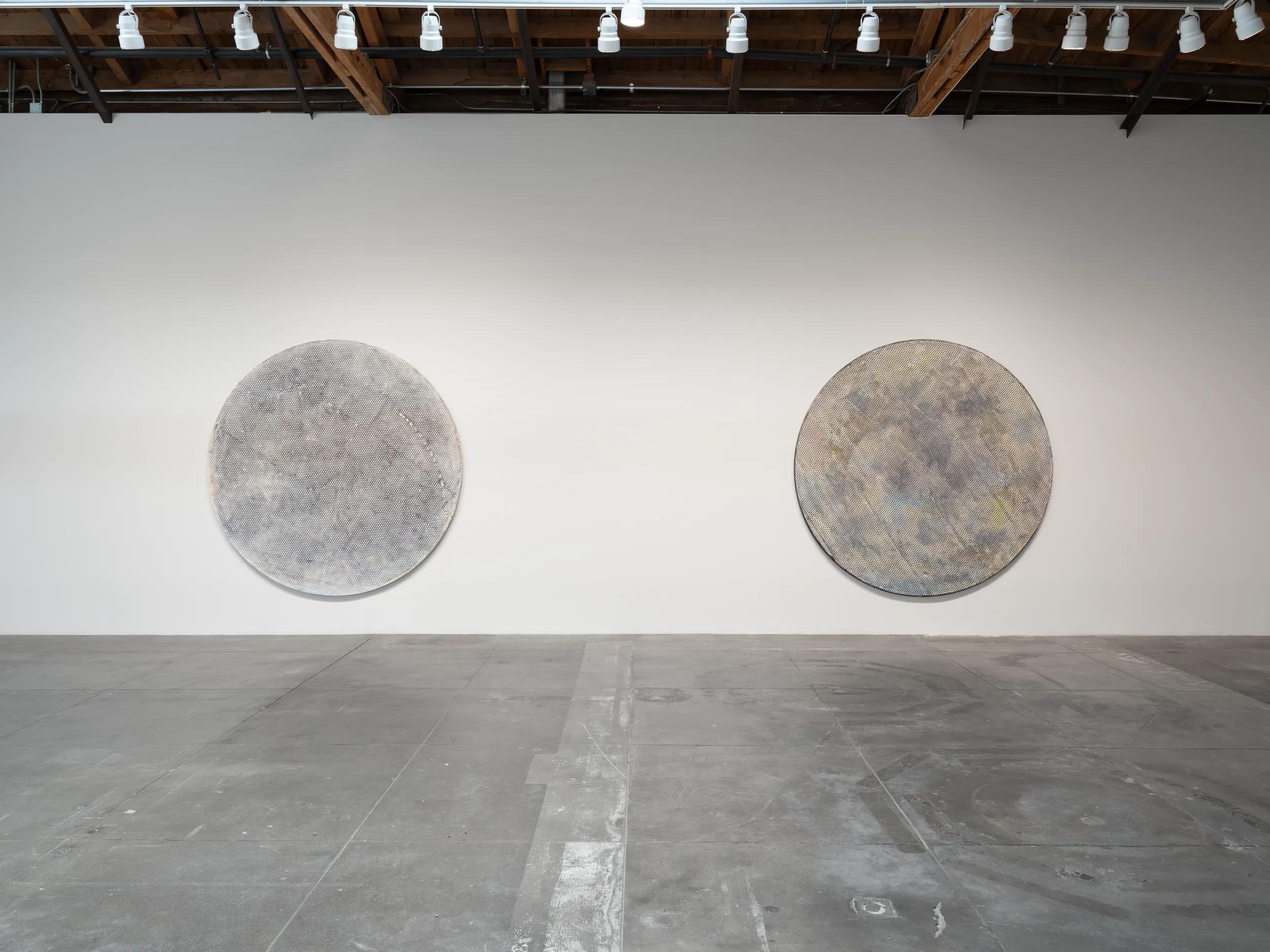


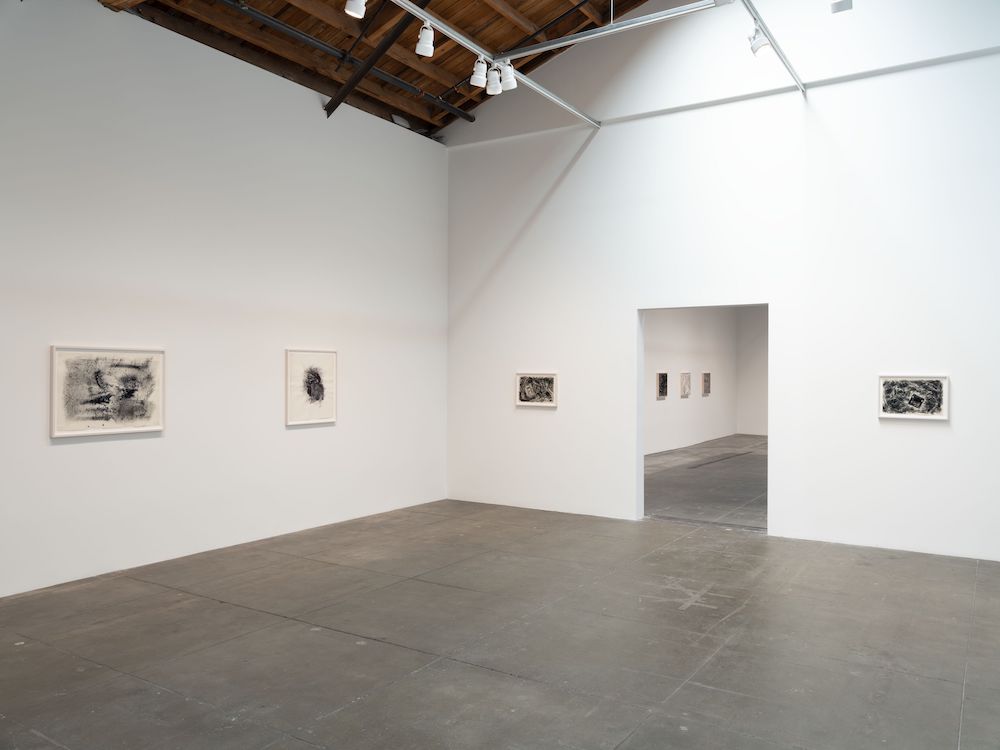
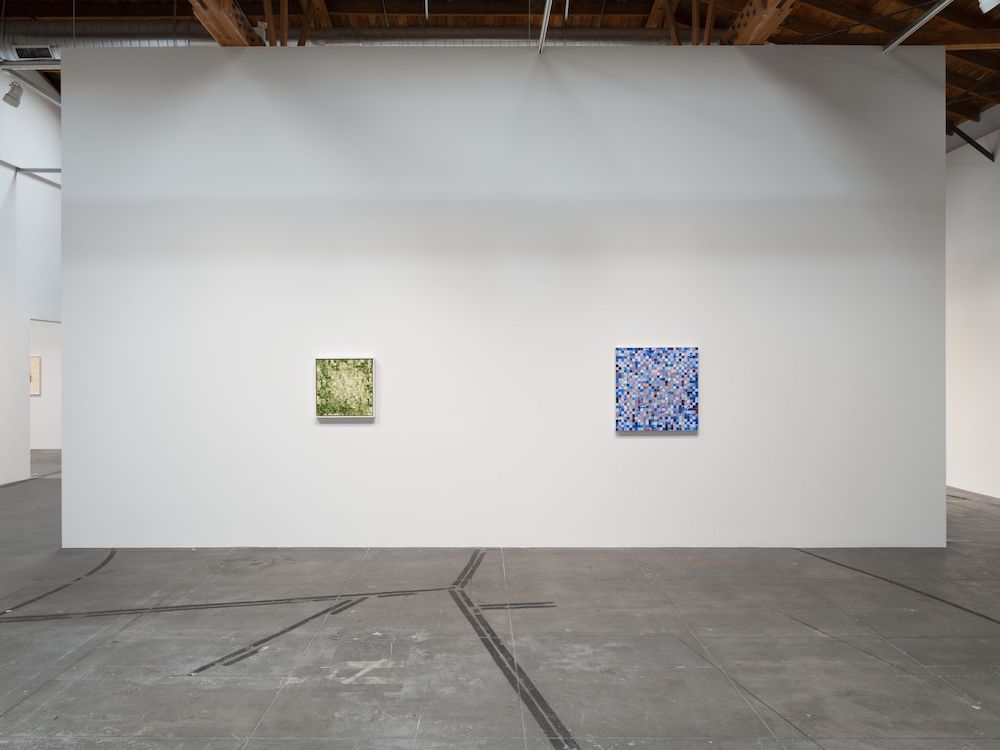
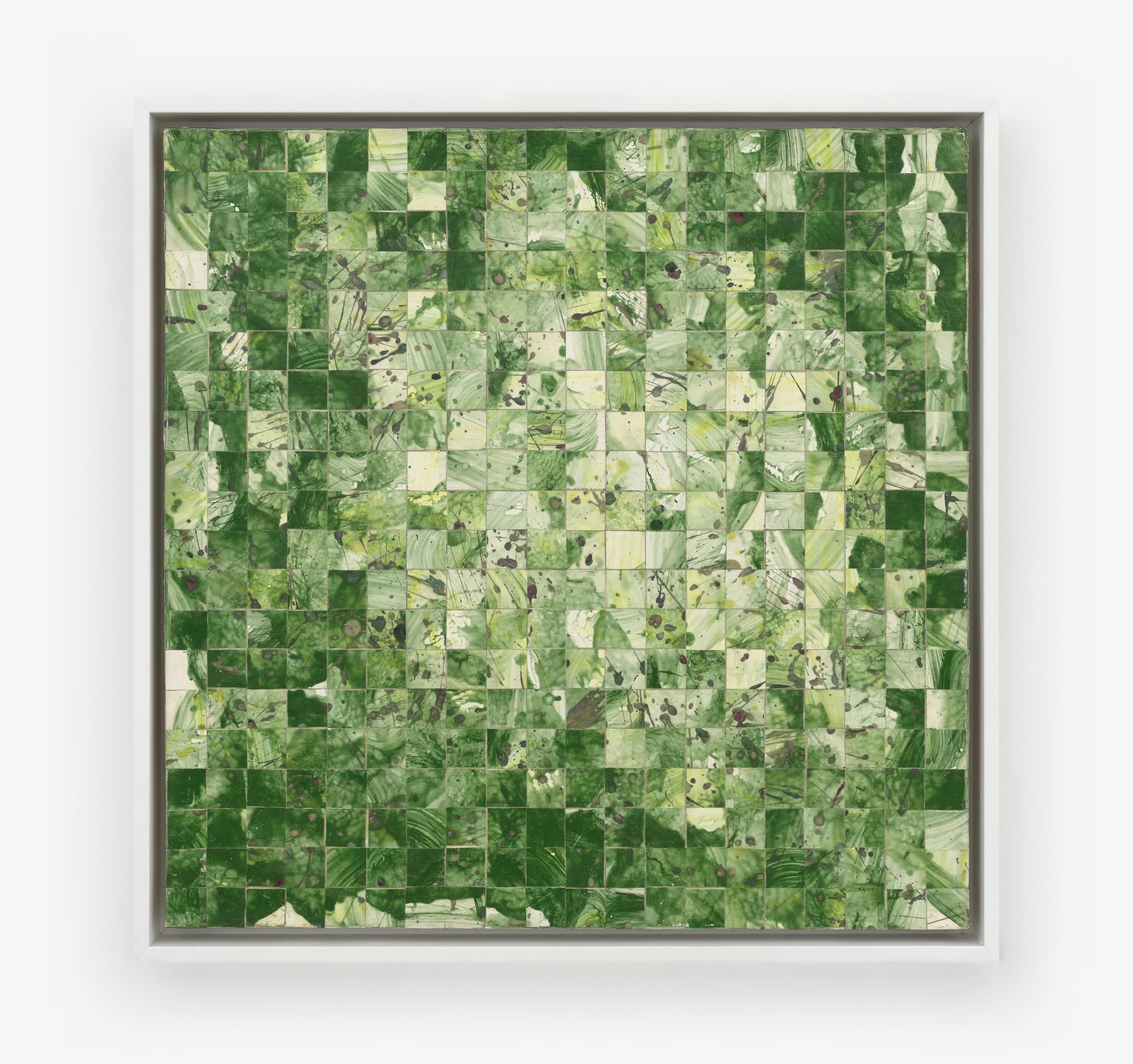

Cover image: Installation view, Jack Whitten: The Numinous, Hauser & Wirth Downtown Los Angeles, 30 September 2026 – 10 January 2027. © 2026 Jack Whitten Estate / Artists Rights Society (ARS), New York. Courtesy the Estate and Hauser & Wirth. Photo: Roger Edwards.