


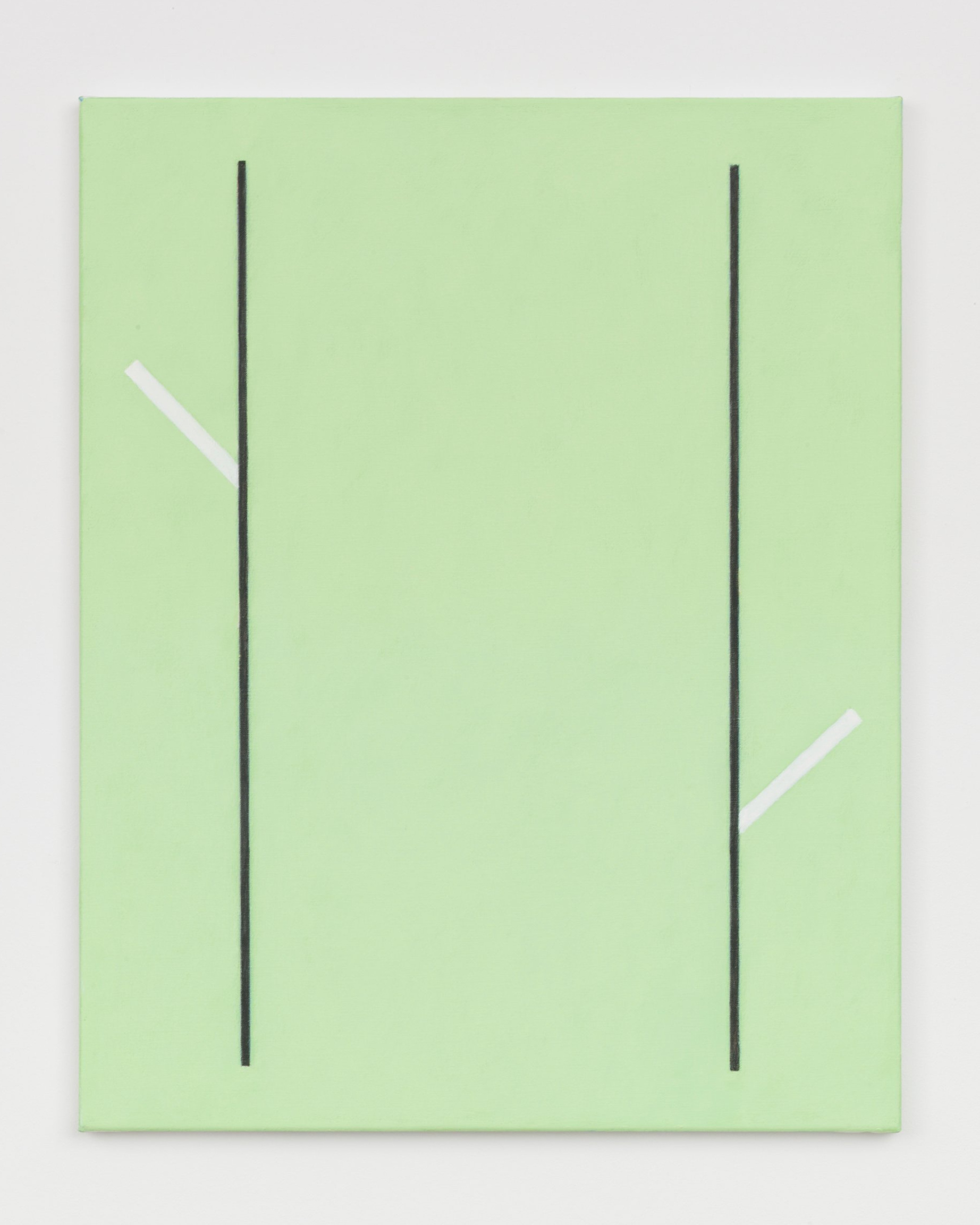
At first there are only two black lines. They stand apart on a field of pale green, well in from the sides and stopping short of the top and bottom. Each carries a short bar of off-white, angled outward and upward — one high on the left, the other low on the right. The label says Two Branches. It hardly needs to.
Roeland painted it late, in 2014, two years before his death, and by then his vocabulary had been narrowing for more than forty years. It is natural to read the picture as the end of that narrowing: a painter who began with envelopes and eggs, went on to tables and boxes, then to tools, then to plants, and arrived, near the end of a long working life, at two lines and two bars because everything else had been taken away. The reading has support from a direction one might not expect. Marianne Vermeer, reviewing the Kunsthal's memorial exhibition in 2017, wrote that in reproduction Roeland's pictures can recall Dick Bruna, and that only in front of the canvases, where colour and paint skin come forward, does the resemblance leave. Seen small, he is a maker of pictograms, and Two Branches is the pictogram at its sparest.
Three years earlier he had painted the same two lines with a difference. Composition with Flower and Branch is salmon across most of its width, with a narrower panel of cream down the left, and two black verticals stand in the salmon. The right one ends in a yellow tulip head. The left runs up to a bare end that stops level with the top of the flower, so that branch and flower reach the same height. Each line carries one off-white bar, the left one high and the right one low, both rising outward from their lines at the same angle; they are not repeats but reflections, the same mark turned over and set at a different height. The bar on the bare line is a twig. The bar below the tulip is a leaf. The two words arrive together, with the same confidence, and it is some time before it registers that nothing in either bar accounts for the difference between them.
Whatever makes the lower bar a leaf lies elsewhere, at the top of the other line, in the yellow head: the one part of either figure that has no counterpart. A road sign or a pictogram settles its meaning in advance; it offers one reading and no way back. This painting gives two readings of a single mark and keeps them side by side, close enough that the place the difference comes from stays in view.
With that in mind the green painting is no longer quite the end of a narrowing. It is this construction without the tulip: the mirrored bars, staggered in height, and nothing to tip either line into being a flower. The other Two Branches, from the following year and pale blue, is the same construction squared off, two bars on each line in mirrored pairs at matching heights, a symmetry with nothing withheld. The two late paintings are one picture made once symmetrical and once just not. Anneke Oele, writing in 1992, reported that when Roeland talked about painting he talked about symmetry and net geen symmetrie, just-not-symmetry, and about the tension between reality and image. The stagger in the green painting is that just-not, a decision rather than a looseness in the drawing. The two kinds of difference are not the same, though. In the green painting the break in the symmetry is a difference in height, and it names nothing; the lines are branches by the word on the label. In the salmon painting the break is a yellow head, and it says what the thing is.
The head is also the only colour the plant is given. In these flower paintings, with one exception, the ground carries the colour and the plant is drawn in black and off-white, except at the top, where it is yellow on salmon, yellow on mint, blue on yellow. The branches, which have no part that names them, have no colour at all.
His colours, the text accompanying Cherry Duyns's film portrait of him observes, are not always natural, plants mustard or white-yellow, trunks green or orange; in the salmon painting the tulip has a colour a tulip can have, and its stem is black.
Then there is the yellow painting, which will not be settled in this way. Composition with Flower and Square is a field of yellow with a black vertical standing a little in from the left edge and running nearly the full height. A short way above its lower end a second black line leaves it and climbs the canvas at a long angle to a blue head in the upper right; below the fork the vertical carries on as before. Low on the right sits a small off-white square. The title counts a flower and a square. After the branches, the vertical is a branch before anything has been decided, and then nothing agrees with it: no bar, no word on the label. It could be the stem the flower has grown from, a stake the flower leans away from, or a line. The painting does not choose. The tulip has been recognised in an instant, and the eye is left with the rest of the picture, which is most of it: the expanse of yellow, the fork, the long diagonal, a square that is counted though it names nothing, and a vertical that does more work than anything else in the composition and goes unnamed.
Composition with Flower and Squares is the exception among the flowers, and it shows what the withdrawal into black and off-white is doing elsewhere. Its black panel holds an orange square and a smaller yellow one; its cream panel holds a blue head on a green stem with a green leaf. Given its green, the tulip is simply a tulip, and the painting reads as a picture of a flower beside two squares, more nearly an illustration than anything else in the group. In the salmon and the yellow paintings the plant is kept from that. It stays a construction of lines and a bar that a coloured head turns into a flower, and the distance between the two kinds of picture is the colour of a stem.
Roeland saw the flowers hung beside the tools himself. In 2013, three years before his death, Slewe showed the new single-tulip paintings with tables, boxes and knives from the seventies and eighties under the title Works 1973–2013. In an interview filmed for that exhibition he speaks of each new series as another step and adds that a step need not be a step forward; he sees the work as horizontal, as themes that keep changing. The paintings of the seventies, he says, have a different emotional value for him from the ones he is making now: the later ones, the little flowers among them, are lighter on their feet, a bit playful, and not so closed, not so hermetic.
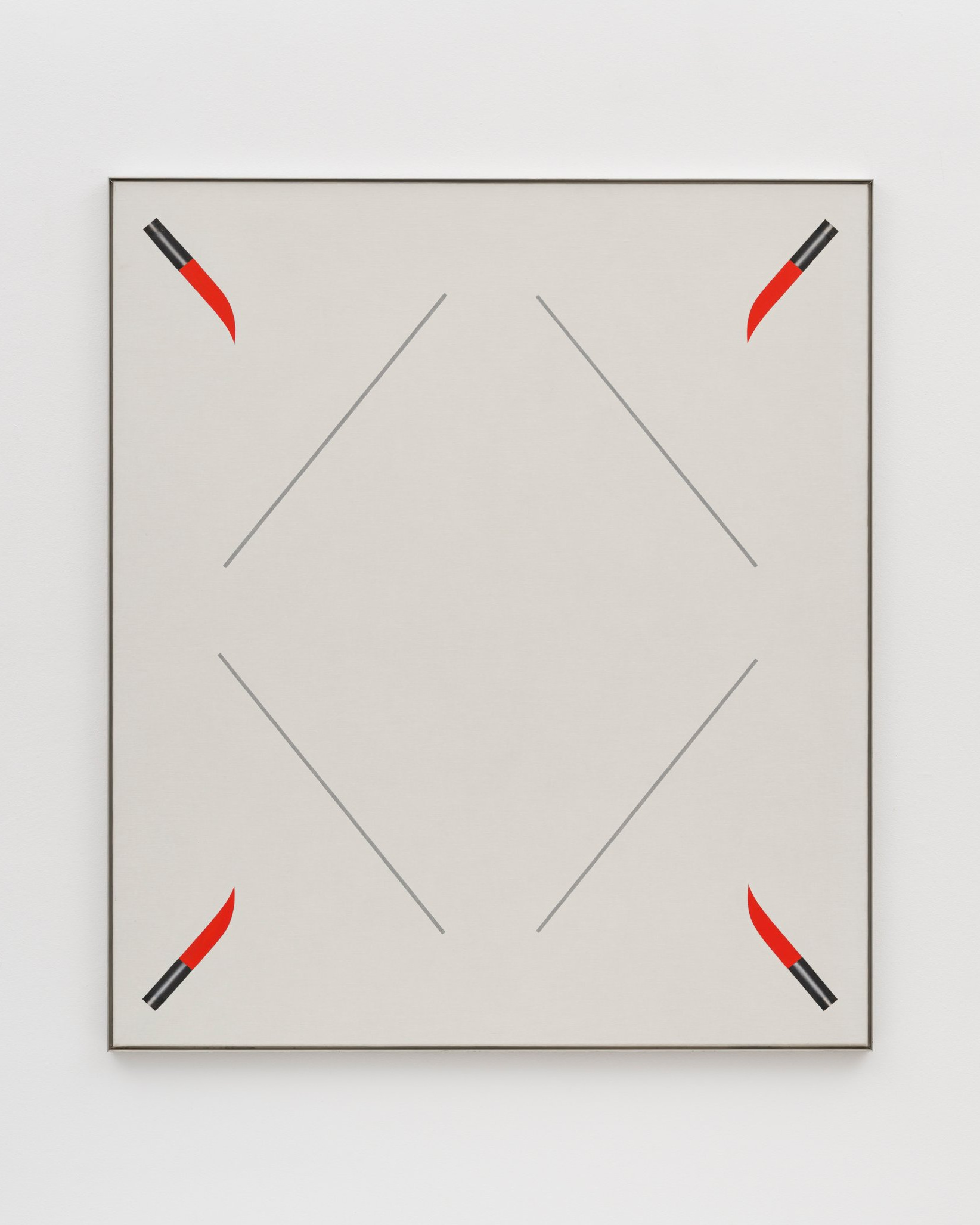
Composition with Four Sickles and Diamonds — the Dutch title says squares, vierkanten — is a square canvas on an off-white ground. Four black squares stand on their corners against the midpoints of the four sides. A red sickle blade with a black-and-white striped handle occupies each corner, the handle pointing outward and the blade curving in, and each sickle is the reflection of its neighbours across both axes, so that the painting mirrors itself whichever way it is read. The sickle is complete: a handle, the stripes along it, the curve and taper of a blade. Only the blade carries colour. Composition with Four Knives, slightly taller than it is wide, keeps the corners with a different tool: four red knife blades with striped handles, mirrored as before, on grey, each as whole as the sickles are. The centre has changed. Where the other painting has four solid squares, this one has a single large rhombus drawn in thin grey lines, open at its corners, and the gaps in the outline fall close to where the squares sit in its companion.
The two paintings are two states of one arrangement, and they are how he worked. He varies a theme, he says in the text accompanying Duyns's portrait, until he is sick to death of it; at the point of saturation a tension goes out of it, and then comes the tension towards something new, which begins with a drawing. The sickles and the knives belong to that practice: the object given and kept whole, the geometry around it — solid squares, an open rhombus, a mirror that runs both ways — tried and tried again.
After the sickles the salmon painting looks different. Its two bars are a reflection of each other, as the sickle in one corner is the reflection of the sickle in the next, and its two figures stand to one height. The bars are staggered and a cream panel runs down one side, and the construction is still the construction of 1978: a mark and its counterpart. In the sickles and the knives every blade is answered by a blade and every square by a square, and nothing in either painting is asked to be two things. The salmon painting keeps the counterparts and adds one thing without one, and the thing not reflected is where the twig and the leaf came from.
Composition with Four Hammers, from the following year, puts four red wedges on grey shafts against a grey ground. They are one hammer at four sizes, each a step larger than the last, growing clockwise from the top left. The shafts are shaded, a gradation from dark at the edges to a highlight running down each — the only shaded forms among these paintings, though Oele notes that his first plants, in the mid-1980s, were strongly modelled — and the heads are flat red. The two larger shafts descend almost to the bottom edge and stop a little short of it; the smaller pair end in the air. Vermeer reports that he painted to a plan made in advance, and the four heads stepping up in size around the square have the look of the plan. What the plan does not settle is where the hammers are. Nothing casts a shadow. There is no floor beneath the pair that nearly reach the edge and no wall behind the pair that stop above it, and four sizes on a blank ground will not say whether the difference between them is scale, or distance, or simply the order in which they were set down.
After the instant of recognition the hammers are four things of four sizes on grey, and where they are is the question the painting keeps open: a different question from the one the salmon painting asks, and no smaller.
Table Top, from 1976, is the earliest of these paintings and the largest, and it comes from the other end of the vocabulary. It belongs to the tables, benches and boxes Roeland made between 1971 and 1977, before the tools. The gallery's account of the tables is that what made them tables was the space beneath, which the top and the legs framed. In this painting there is no beneath. The canvas is a field of pale yellow, square, with a pale band running along its bottom edge, and that is all it is.
A bar and its reflection, a fork a little above a line's end, four squares against four edges, four sizes on grey: these can be read from an image. A field of yellow cannot, or not in the way that matters. Vermeer, who had warned about reproduction, reports that in the room the brightest fields are slightly transparent, and the Kunsthal's account of his paint skin has it showing the length of the process each canvas had been through. The image does not carry that.
The band it does carry. It is the only interruption in the field and the only thing that makes the field a table: a top seen from above, with its near edge catching the light. Without it the painting is a yellow square. With it, and with the word on the label, it is a piece of furniture filling the whole of one's view from a position just above it. The table is given in a moment, as the branches and the tulip were; and once it has been given, what remains is the yellow, which is nearly the whole painting and which the eye has no further use for as a table.
It asks for a different kind of attention from the salmon painting. There the eye goes back and forth between a bar and its reflection to find where a difference came from. Here there is nowhere to go but into the colour.
A band at the edge and a word, and then the rest, which is almost everything. In the green Two Branches, two bars are enough to make branches. The lines go on above them and below them, one bar is higher than the other, and the green is most of the picture. The branches were never difficult to find.
Jan Roeland painted tables, tools and plants plainly enough to be named at a glance. In Composition with Flower and Branch, one off-white mark appears twice, mirrored, and is read once as a twig and once as a leaf, though nothing in the mark tells them apart: the difference is decided by a yellow tulip head set well away from both. Across paintings from 1976 to 2015, recognition comes first and quickly, and what it leaves behind, the relations between lines, the near-symmetries, the fields of colour, is most of the picture.




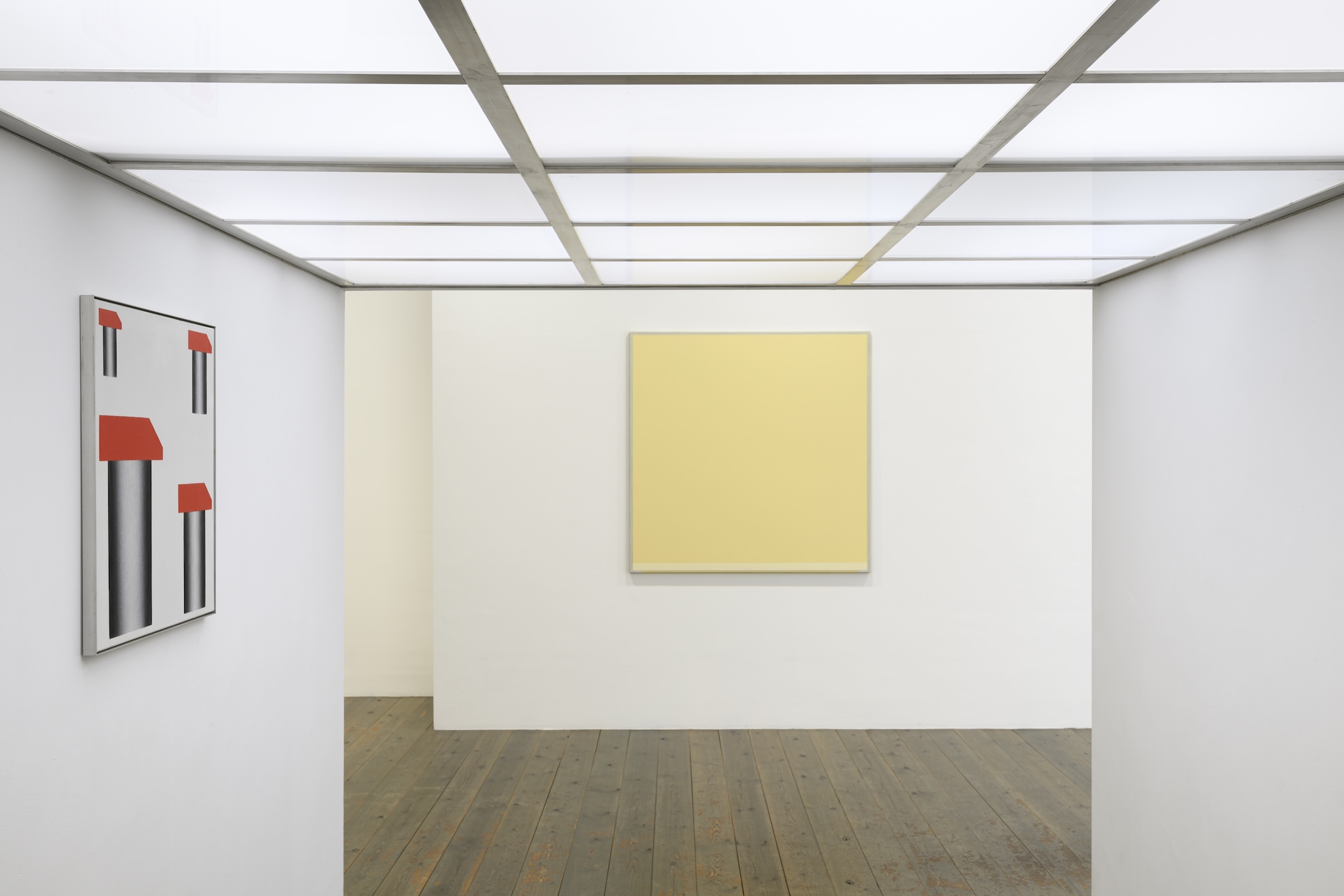

Cover image: Installation view, Jan Roeland: Handmade, Slewe Gallery, Amsterdam, 17 October – 14 November 2026. © Jan Roeland. Courtesy Slewe Gallery, Amsterdam. Photo: all rights reserved.