




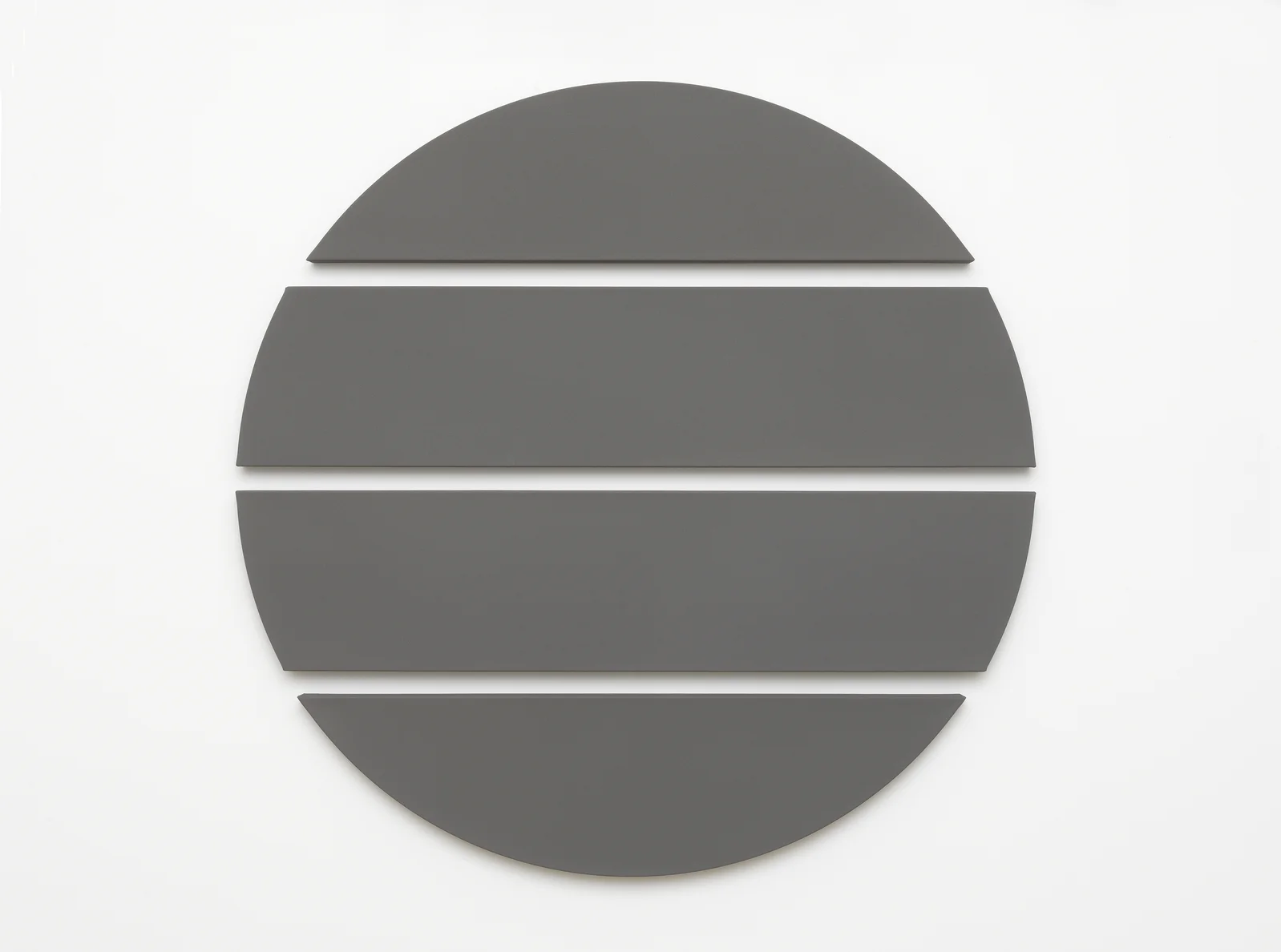
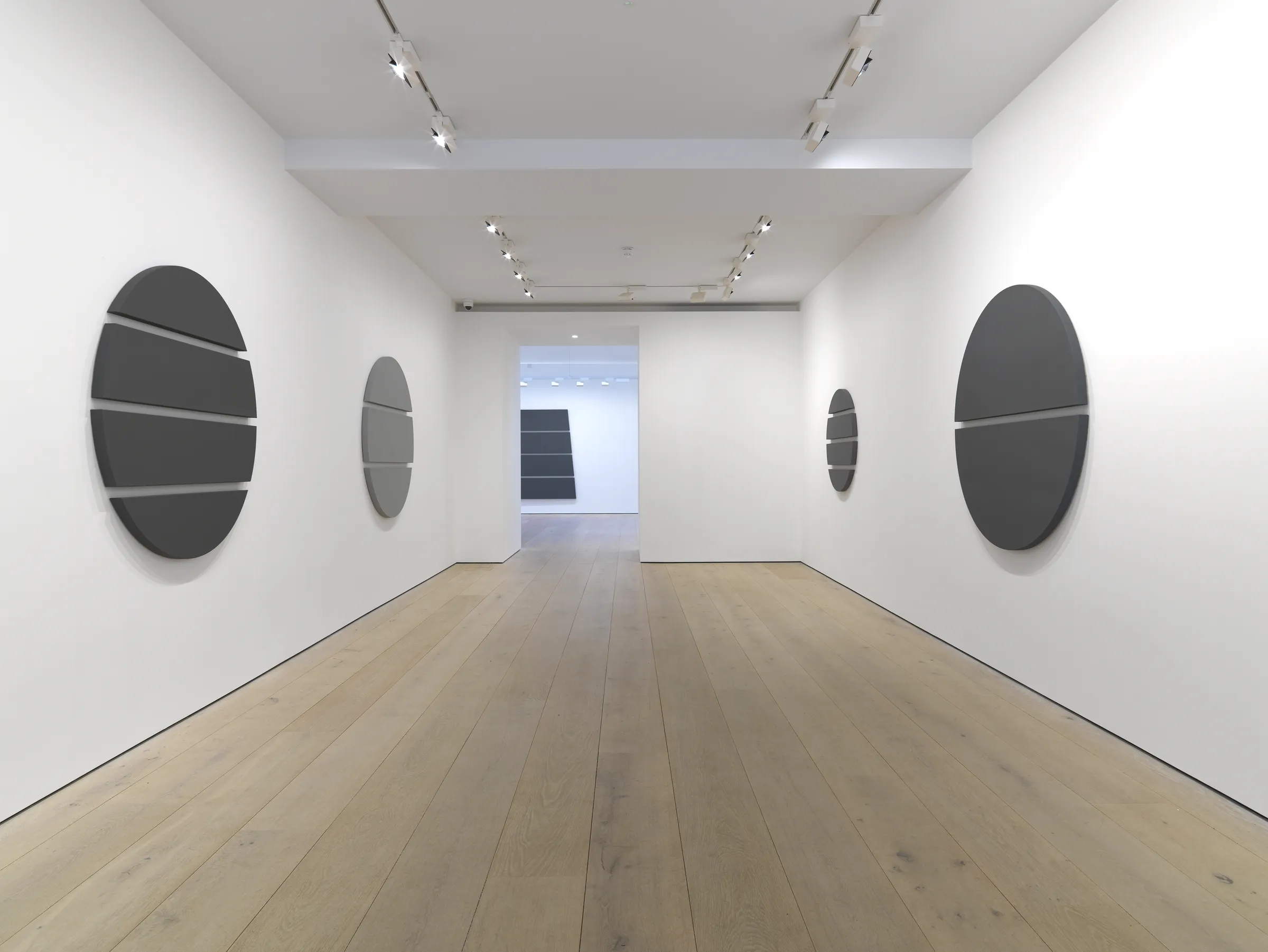
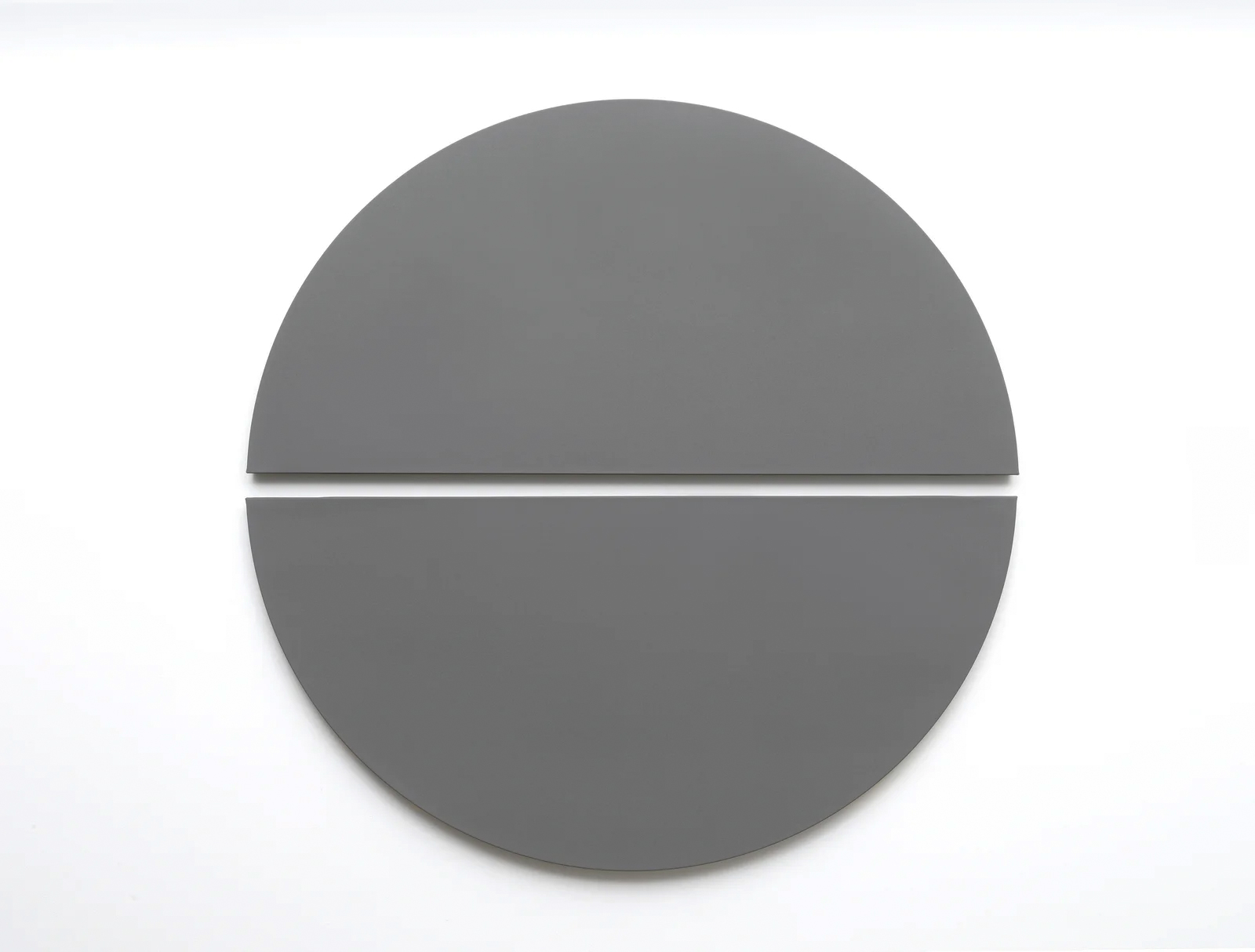
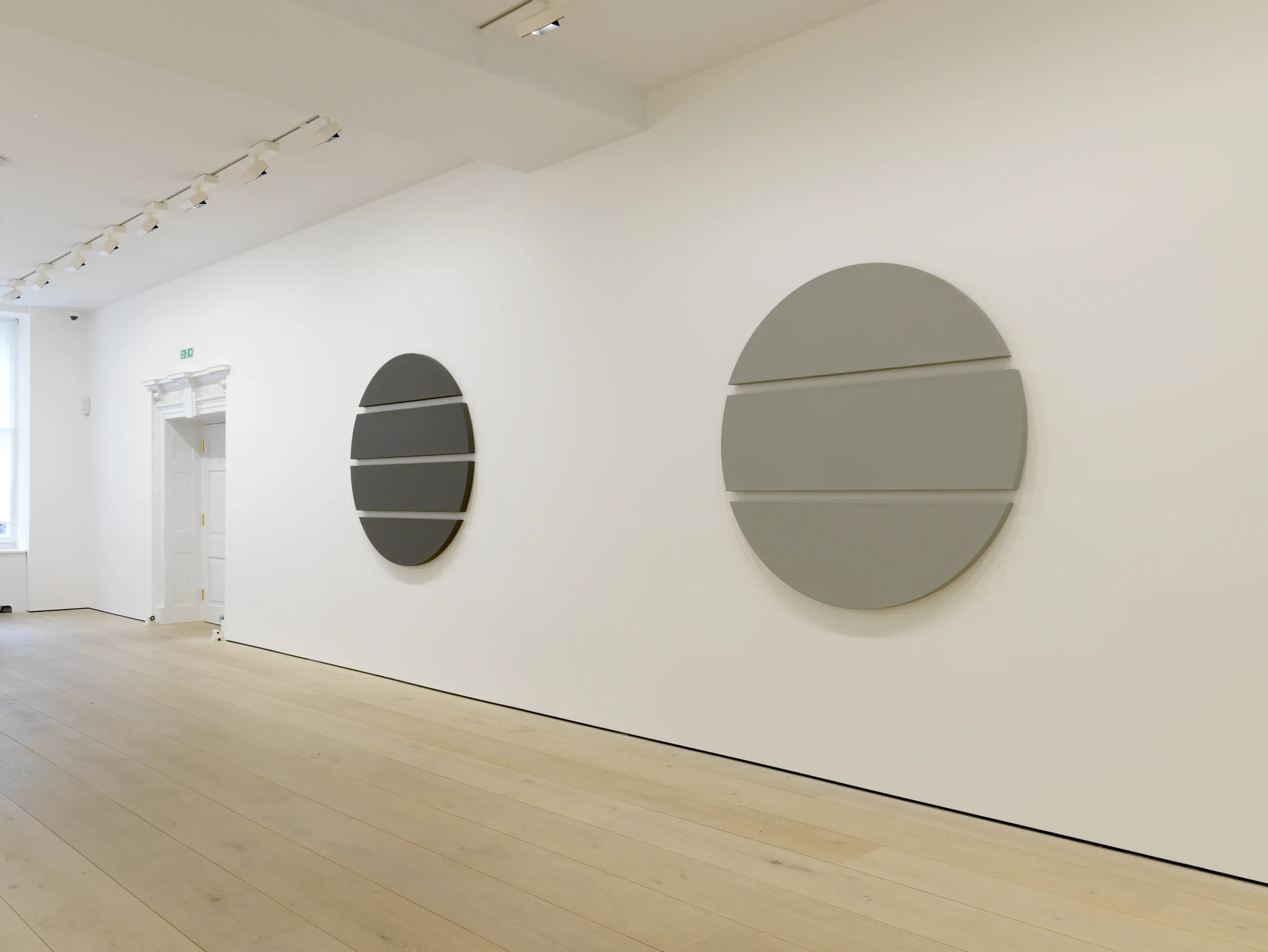
The eye accepts the circle too quickly. From across the room it appears whole, a grey form settled against the wall, calm enough to seem almost finished before looking has begun. Nearer, the circle loses that ease. A horizontal seam opens into a gap. The canvas parts separate, and the wall enters the shape as something more than background. What first appeared complete was real, but not self-contained. The room was already doing part of the work.
Grey has provided the most familiar vocabulary for Charlton’s work. Monochrome, Minimalism, silence, restraint, neutrality: the words have lasted because they are partly useful. The surfaces are cool. The palette is disciplined. Incident is kept out. But those terms keep attention close to finish, as if the work’s intelligence were held entirely by the painted face. Here, the eye is drawn elsewhere, toward the conditions that let the form hold at all.
For decades, the rectangle allowed those conditions to remain discreet. A rectangular painting can depend on the wall and still appear self-contained. It can be multipart and still read as a disciplined object. It can use interval and let the gap remain secondary. Charlton’s paintings have long extended beyond the surface that appears to contain them, but the rectangle allowed that extension to stay quiet. A form that no canvas can close changes the terms. The wall enters the painting’s order.
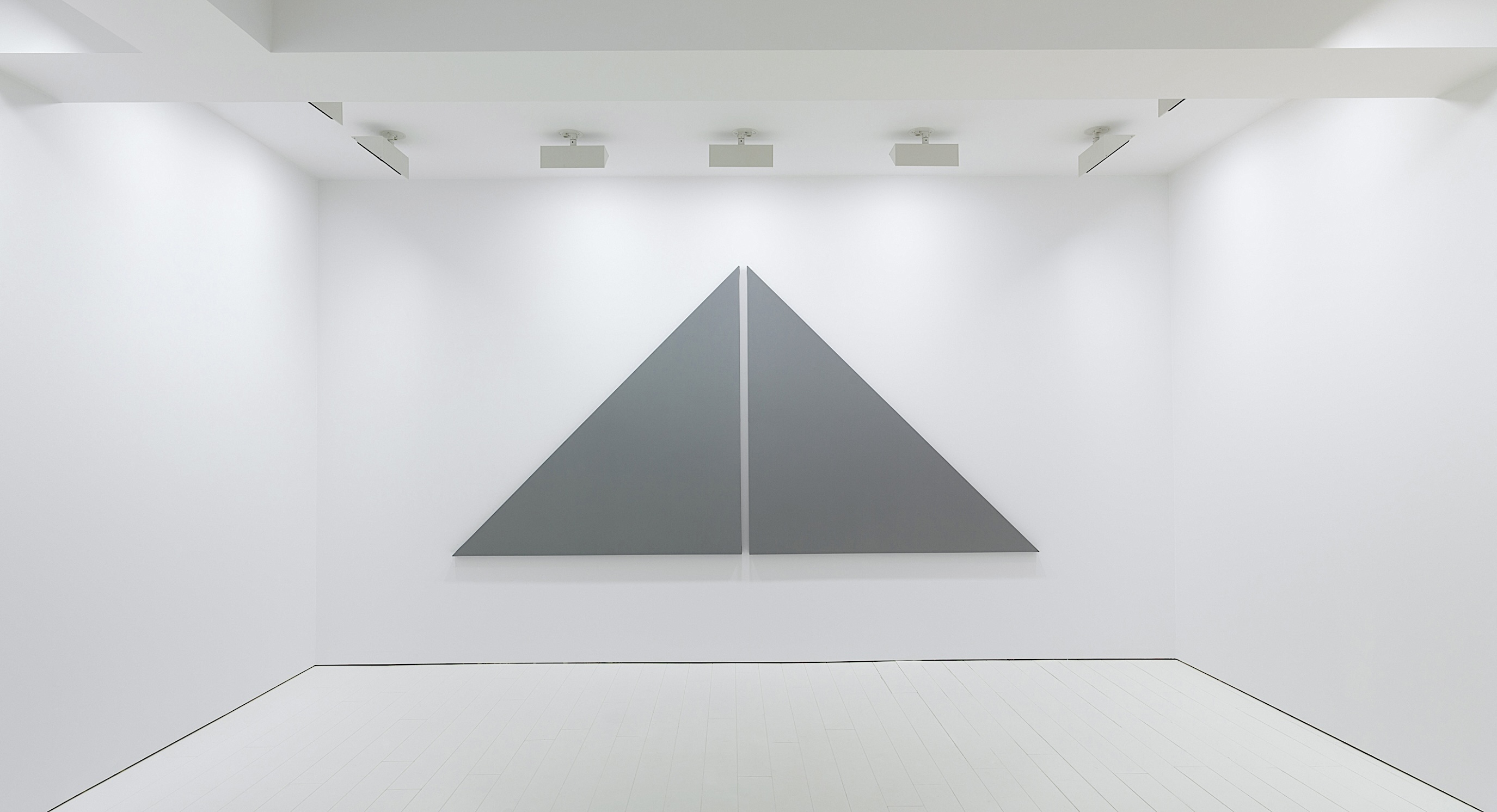
The simplest version does this almost without incident. Two grey canvases, each curved on the outside and straight along the inner edge, are hung with a narrow interval between them. The eye reads the whole before it registers the break. Upper canvas, lower canvas, wall between. The gap is not outside the painting. It is inside the painting.
The gap has a size. It is not empty space left over after hanging, but part of Charlton’s constructional system. His spacing follows rules drawn from the work itself: the depth of the stretcher, the 4.5 cm module, or the width of an adjacent panel. The module comes from prepared builder’s timber, not ideal proportion. The painting obeys carpentry before geometry. Its wholeness is built, not derived.
Charlton’s work has long refused the idea that painting is composed only inside the rectangle. The room is not a neutral setting. It is part of the work’s condition. In earlier rectangular paintings, that condition could remain a principle. The room mattered, but it could still be received as atmosphere, installation, or support. In the recent circles, the condition becomes visible. The room is needed for the painting to appear as itself.
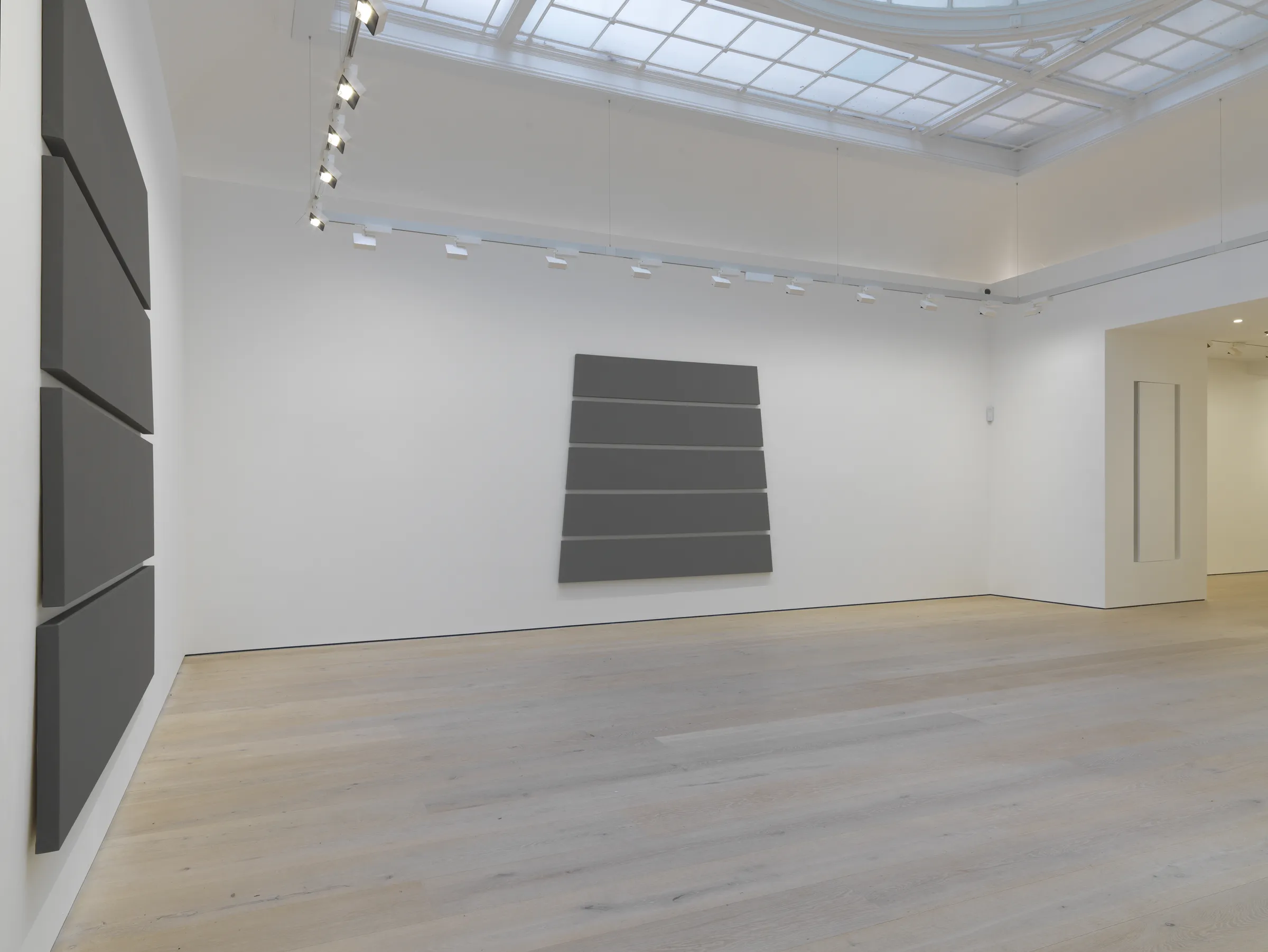
With three and four parts, the dependence becomes harder to miss. In Circle Painting in 3 Parts, the inner edges become chords, cutting the circle into relations the wall has to hold. Each canvas carries part of the curve, but none can produce the form alone. In Circle Painting in 4 Parts, the wall cuts through again and again. After the first interval, the next ones arrive less like separations than continuations. The eye still completes the shape, but it completes it across absence. The wall is where the circle continues without canvas.
The recentness of these works matters because the operation is not recent. Grey, module, multipart construction, measured interval, installation: these have structured Charlton’s paintings for decades. The new form behaves less like a departure than a disclosure. What changes is not what the painting does. What changes is what it can now make unmistakable: that its discipline does not end at the canvas edge.
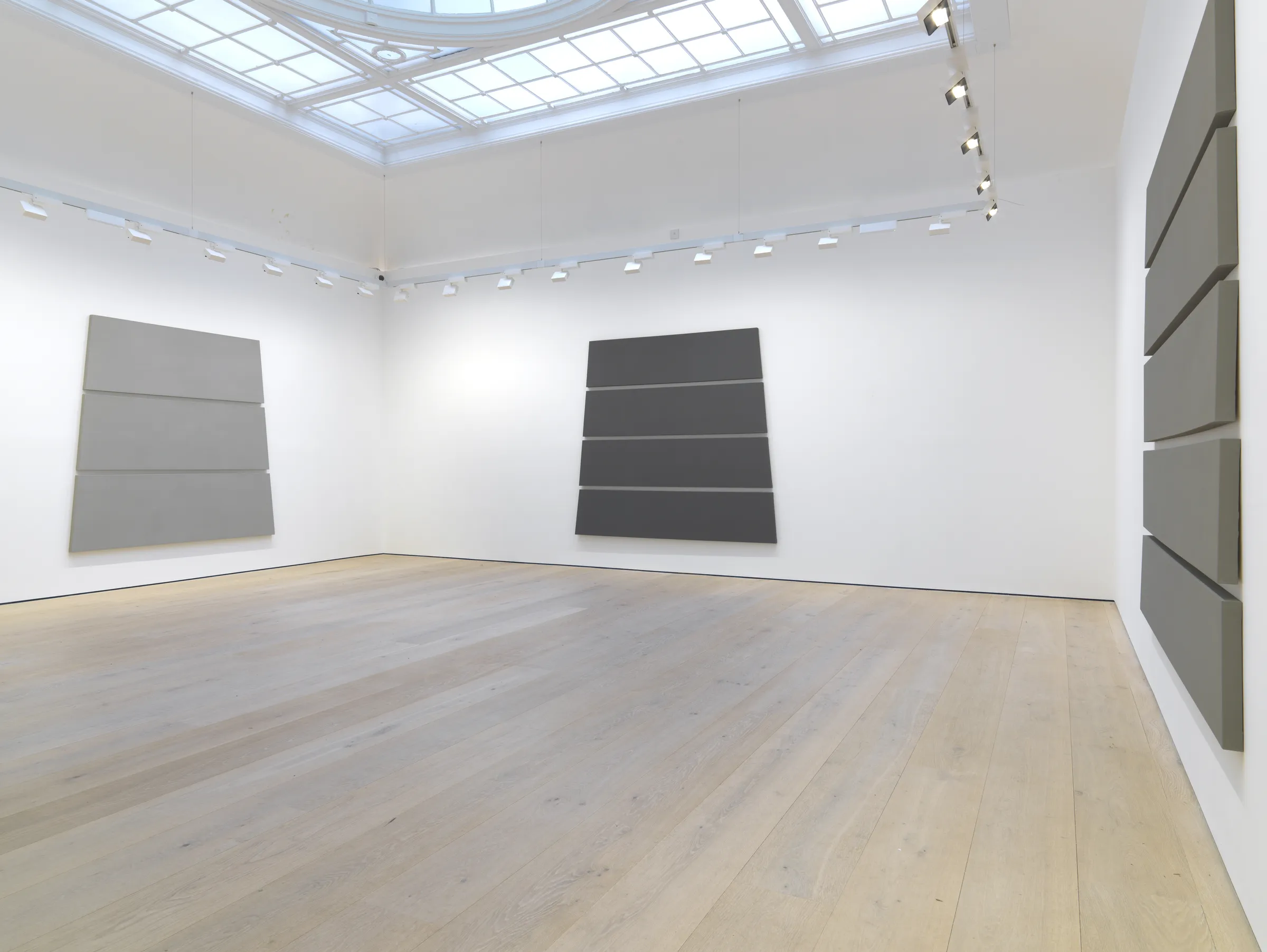
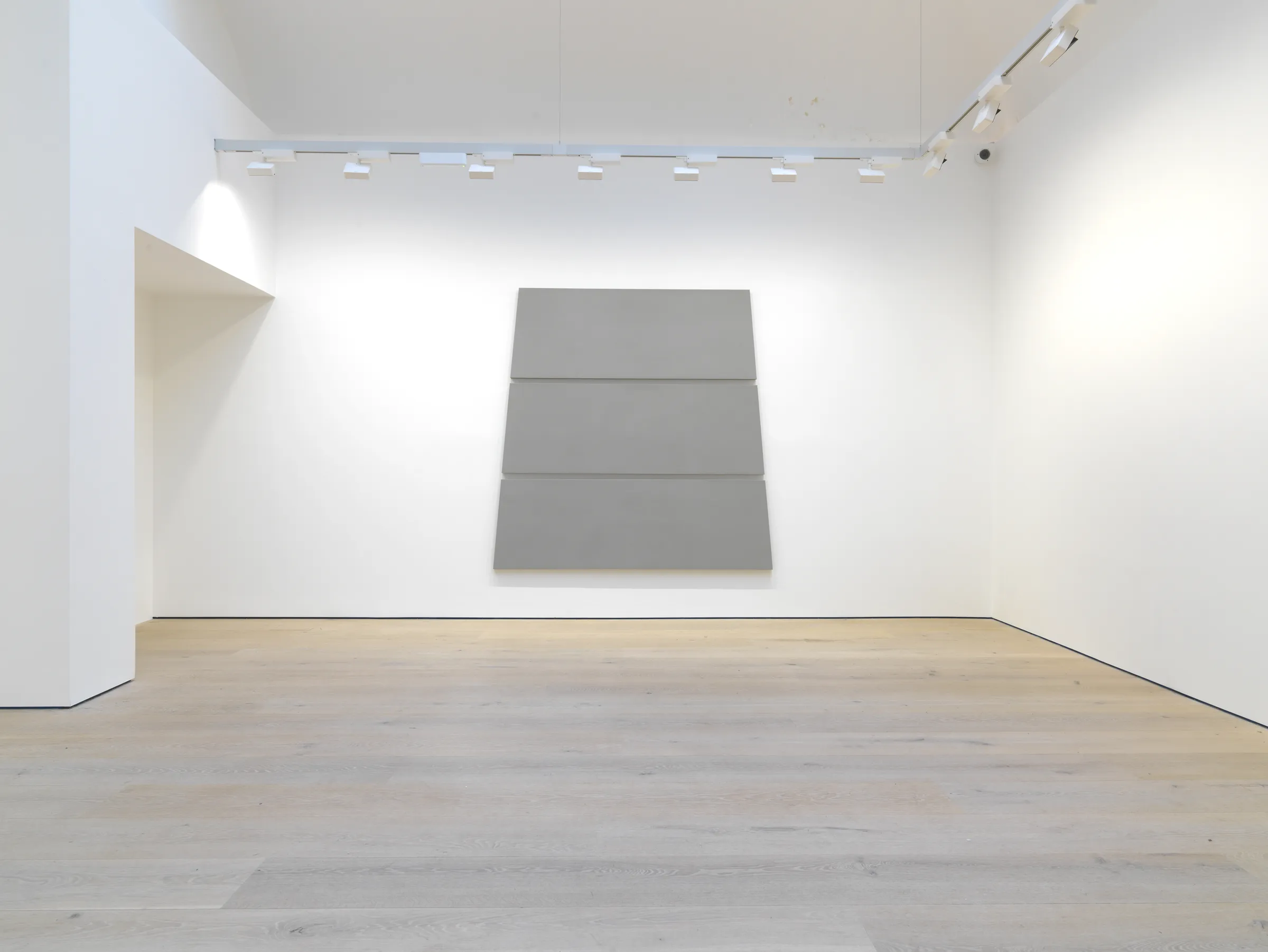
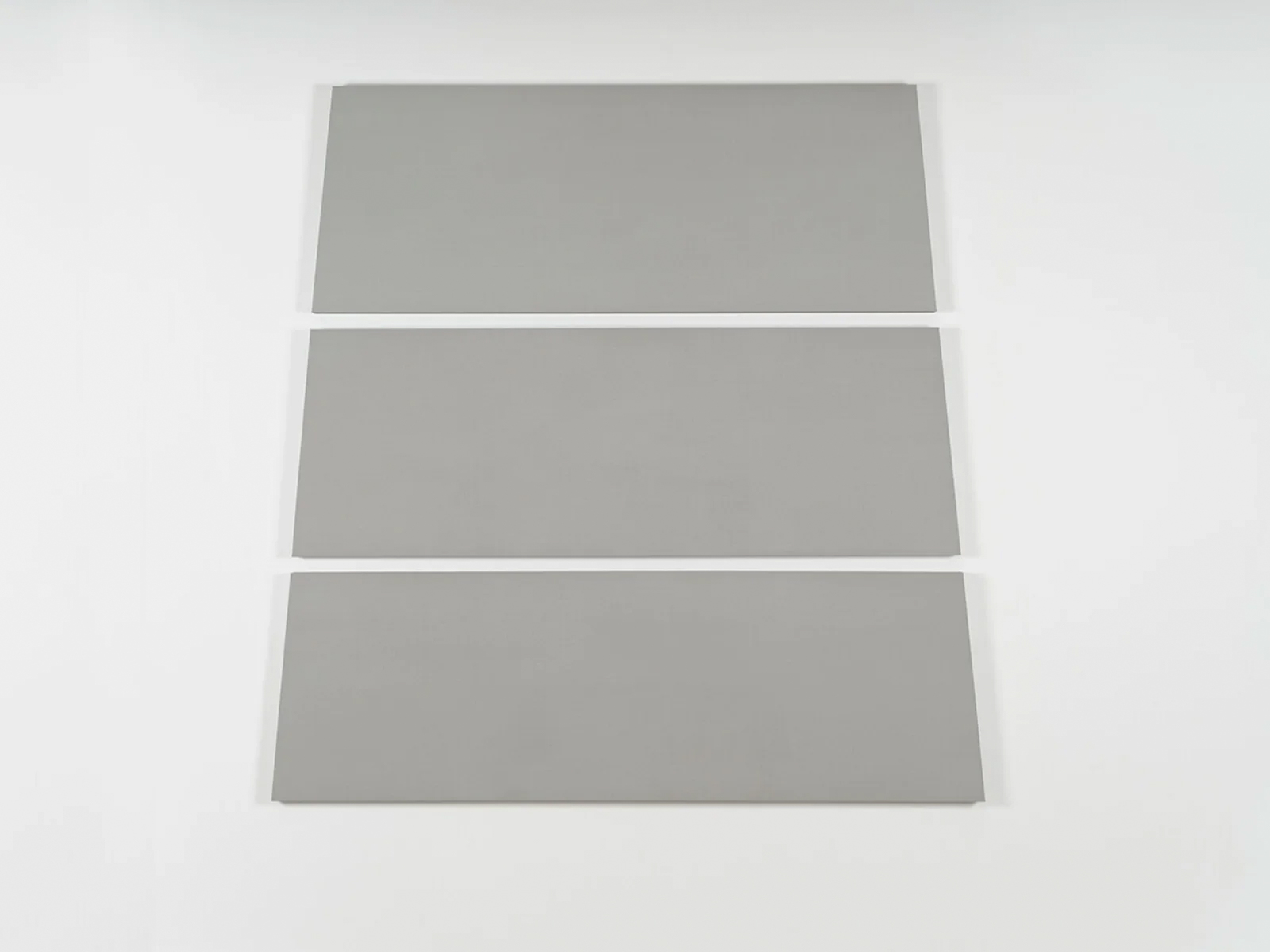
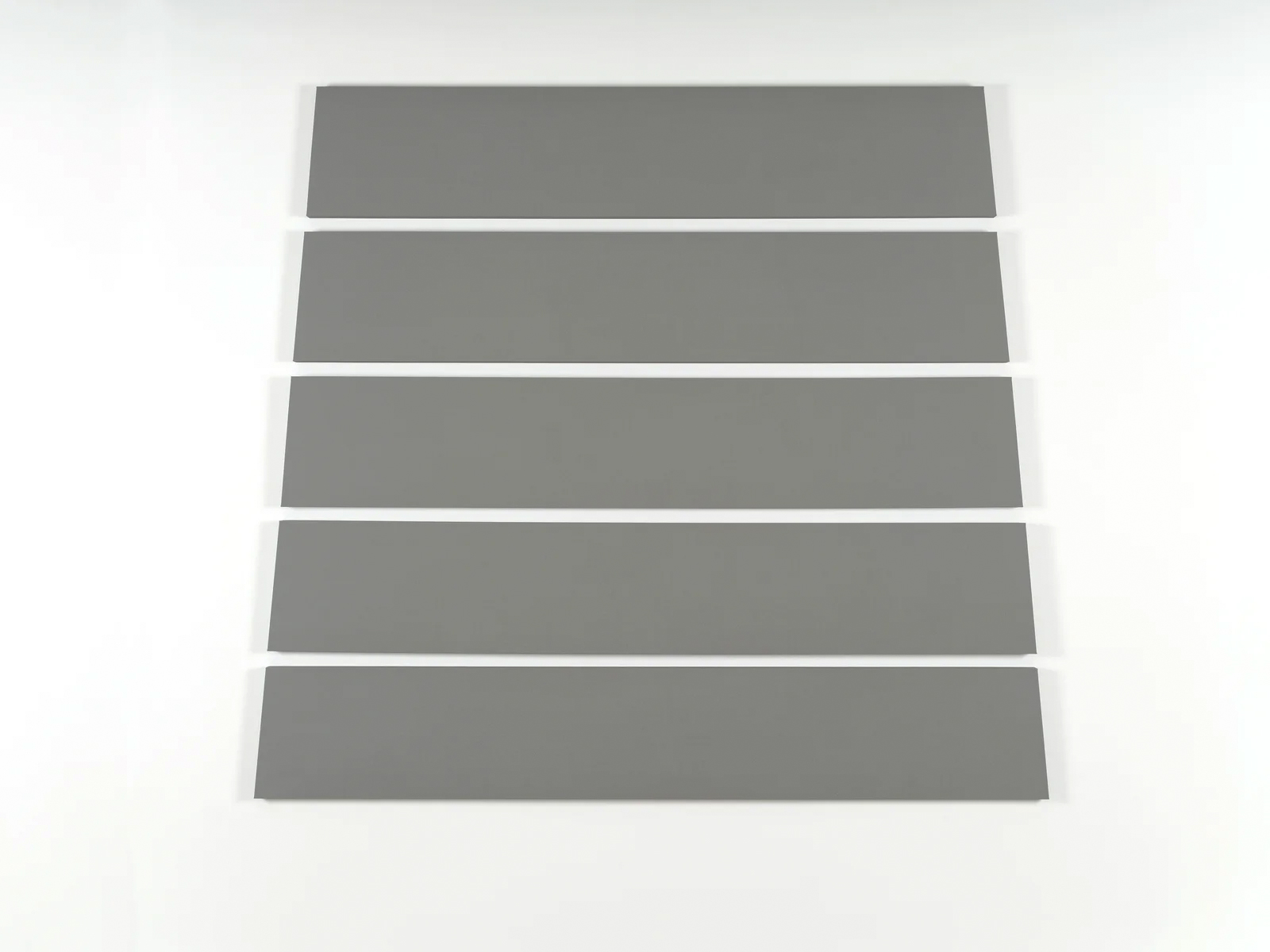
The trapeziums sharpen the distinction. Their edges tilt; their panels form constructed objects rather than framed images. They alter the rectangle without fully leaving the condition of the shaped object. A shaped canvas may engage the wall and remain complete at its edge. The circle asks more of the interval. Every horizontal part must answer to a curve that no single panel can complete.
Placement becomes closure. The canvases are not finished objects waiting for display; their spacing, height, and relation on the wall determine whether the form holds. The wall cannot be reduced to context because the work depends on it. Installation does not merely present the painting. It completes the conditions under which the painting can exist.
Seen again, the first circle no longer looks simply whole. It separates into bands held together across measured gaps. The wholeness is real, but it is not located in any one canvas, or even in the canvases collectively. It exists across canvas, interval, wall, and room. Charlton has not made a symbolic circle, or a pure geometric figure. He has made the clearest version of a question his painting has carried for over fifty years.
He has made a painting whose wholeness is no longer locatable inside the painted object. The circle cannot close itself.
Charlton’s recent circle paintings do not simply add a new shape to his grey vocabulary. They reveal that the work has long depended on more than canvas: measured interval, wall, and room complete the painting.


All images © their respective rights holders.
Image rights & attribution →