


A woman stands a little to the right of centre with her face turned down. She is in the first panel of Moritz’s four-part Fragment einer Idylle (1–4), 2026, and she is lighter than everything around her, cream and pale pink. Around her the paint is in motion: broad, curved, tapered strokes licking up in yellow and pale rose and bending back in blue and crimson. Galerie Max Hetzler’s release has a sentence for her: “In her new monumental quadriptych, female bodies emerge in a kind of alchemy from gestural swathes and strokes of paint.” Alchemy is a change of state, one substance becoming another, and the sentence means it. In front of the first panel, that is exactly how it looks.
Stay with her and the sentence remains true. Her eyes are lowered, nose and mouth drawn, a greenish shadow along the jaw. One hand rests at her hip with the fingers drawn. Knee and calf are contoured in dark teal, and her toes are set down in a dark line at the bottom. In places her torso goes flatter, paler and more blended than the paint on either side of it. The yellow next to her thigh continues on the thigh. A grey-blue that crosses the surroundings shades the back of her leg. Down her left side, the viewer’s left, a thin blue-teal line is drawn from the shoulder toward the hip, and on the far side of it, running the same course, lies a long curved salmon-pink stroke: a salmon that sweeps through the whole canvas has become, a finger’s width away, the pink of a flank. Crimson and red lie beside the salmon, with a touch of yellow near its top, and a blue stroke bends across line and salmon together near the shoulder. Across the four panels there are seven bodies, standing, reclining, seated, crouching, curled, and every one of them appears to have come about this way, out of the swathes and strokes.
The same strokes fill the twelve canvases that share the exhibition with it, and no object is painted in any of them. Their titles, Erde, Luft, Wasser and Feuer, each numbered I to III, name the four elements. In the canvases the elemental names hold at the level of colour. In the Feuer canvases the reds gather toward the centre and the blues keep to the borders. In Wasser the blues take the canvas and the strokes hang in long descending runs. Luft is rose-pink, flushed and scattered; Erde is ochre and yellow, its strokes shorter and more faceted. Across all twelve the strokes are broad, loaded, curved and tapered, the thin end of one taken up by the next. Colour tells the groups apart. Each canvas is full.
Low on the right of Feuer I a dark crescent holds a white fleck in a pale yellow mass, with the reds gathering round it and nothing of a face anywhere near, and it stays a dark crescent with a white fleck. In Luft III, right of centre, three heavy dark strokes close a triangle, and inside the triangle is the same rose and blue as outside it. Erde III keeps the eye longest. Upper centre, a pale cream mass stands vertically, the palest thing on the canvas. One loaded pink-red stroke runs down its right side and ends in a hook. Blue and green strokes cross its lower part, a small yellow touch sits at its top, and on its left side the cream simply stops among the strokes, with nothing drawn to say where.
In the second panel of Fragment a figure is seen from behind, and the back holds: broad squared shoulders, a groove down the spine, elbows out, both hands at the hips, the fingers of the left hand drawn dark. The skin is ochre and rose, with grey-blue strokes following the muscles of the back, and a blue-grey line draws the outline of the shoulders and upper arms and ends at the neck in a dark blue-black knot of strokes, possibly hair. Above the knot is the painting as it is everywhere else: a pale rose vertical, a yellow wedge to its right, the same colours and the same kind of stroke as on either side, with nothing drawn round them and no face. Below the figure two women recline with their faces painted, one of them asleep; an orange drape lies at the left, and a blue-grey mass sits at lower left. The back is entirely there, shoulders, spine, elbows, hands, and the strokes above the knot have not been asked to become anything on its account.
The seated woman in the third panel is more fully given: face, breasts, navel, knees drawn up, feet at lower left. Yet the panel’s own colours continue inside her. Olive green sits near the sternum, yellow at the waist, while the same green runs down the right side of the canvas and the same yellow flares beside her arm. A crouching figure sits at her feet with a hand at the face.
Moritz has said what she does. In 2023, asked why figures had come back into her painting, she recalled people telling her that her abstract paintings looked like flowers, and said: “When I want to represent the object in the painting, I paint the object.” The statement stops with the object. What happens to the painting around it is left open; the works on paper upstairs put the question differently.
A cargo ship in profile, low in the water, with a block of superstructure at one end and a row of cranes along the deck, appears on four sheets. On the first it is small and dark on nearly blank paper, with a little scribble for water. On the second, dense scribbled hatching fills the sheet, sky and sea alike, pressed up against the hull, and the ship is darker and larger. On the third a smudged black band lies across the top, the ship is solid black below it, and the water is a few horizontal strokes. Blank paper, scribbled hatching, a black band: the freighter is the same ship on all three sheets, in the same water, its cranes in their places, the hatching of the second sheet pressed up against its hull on every side.
In Flugzeug, an airliner is drawn in profile, outline, tail fin, a row of small windows, with horizontal hatching darkening the sheet above it. Vertical white erasure strokes run from the top of the sheet to the bottom, across the whole of it and straight through the fuselage, without narrowing where they meet the plane and without pausing there.
In Gelbes Kleid I a woman seen from behind stands in a yellow dress, a dark bag in her hand; beside her a small child in a wine-red pinafore looks out over a railing. The dress is hatched in yellow, orange and green, the air in blue, the two kinds of hatching closely related. She is there on the strength of a dark line at the shoulders and hem, the belt, the bag and the shoes. Her head is a smudge, and the blue hatching runs round it as the strokes of the second panel run above the knot.
On the fourth sheet the ship is built of broken blue verticals that stand and stop, with no continuous hull anywhere, and the verticals run down past where the hull would end, into the water. The cranes are in their places, the superstructure at its end, the deck runs its length. The dark hull of the other three is gone, and the hard waterline with it, and it is still that ship, low in the water, in profile. The cranes stand at their intervals along the deck in the same blue, and the block of superstructure at its end is the same block, broken into the same verticals.
(Kreuze) is made entirely of represented things. Small X signs in rows fill the sheet, each one two short strokes crossing, each one intact, and they stop at a blank margin.
Every case until now had something lying around the thing or across it: blank paper, scribble, a black band, an erasure, blue hatching. Whatever stayed unchanged while the thing was present lay outside it. Here nothing lies outside. At the size of the sheet the crosses become a grey mesh with the paper showing through, an even texture. Each X remains intact. In (Hammer und Sichel), the emblem is pulled apart instead, into curves and bars, a few pieces still close enough to read as the sign.
The bodies do emerge, as the release says, and that is how it looks. But the change of state implied by alchemy does not reach everything around them. Recognition happens, but it does not spread. The ship stays a ship without its hull; each cross stays a cross while the crosses together become a field. Once something is found it stays found, and nothing around it has to change on its account.
Seen whole again, Fragment is four canvases and seven bodies. The two reclining women lie below the back in the second canvas, the crouching figure sits at the seated woman’s feet in the third, and the standing woman in the first stands alone. In the fourth, the darker blue of a curled body is harder to separate from the blues around it. Across the four canvases, blue, crimson, yellow and rose occupy far more space than the bodies do.
The standing woman is the palest of the seven. The pale cream mass in Erde III is likewise the palest thing on its canvas, standing upper centre with the hooked pink-red stroke down its right side, the blue and green crossing its lower part, the yellow touch at its top, and the cream stopping on its left among the strokes. One is a body and the other is not. The dark crescent in Feuer I still holds its white fleck in the pale yellow with the reds gathering round. It is not a represented thing either.
Above the knot at the neck of the back in the second panel are pale rose and yellow; around the head of the woman in the yellow dress, blue hatching. In the fourth panel the body is harder than any of the other six to find. She lies curled across the middle of the panel, head to the left beneath an arm, the bent leg to the right. She is blue, in the painting’s own blues and darker than they are; her edges are mostly a change of tone, dark blue against lighter blue, though the hands are drawn. A grey-blue hand with fingers lies left of the panel’s middle, and to its right a large rounded blue form is hip and thigh. A shin carries short parallel hatching in dark blue. A bent arm, and beside it a head with the face turned down, half lost in green and pink; higher up another blue hand, its fingers open.
The blues she lies in are darker where she is and lighter around her. The lower third is salmon and rose masses bulging and folding, and a thin wavy orange-pink line drawn left to right that bounds nothing and stops.
In the first panel the standing woman has not moved. Down her left side the thin blue-teal line runs from the shoulder toward the hip, and on the far side of it, running the same course, lies the long curved salmon stroke, a finger’s width from her side and the colour of her lit skin, with crimson and red beside it and the touch of yellow near the top. Near the shoulder the blue stroke bends across both of them, line and salmon together, and goes on. Her face is turned down, the eyes lowered, the mouth drawn. The fingers of the hand at her hip are drawn one by one, and at the bottom of the panel her toes are set down in a dark line.
Recognition does not reorganize everything around it. In Fragment einer Idylle, Moritz’s bodies are unmistakably present, yet colour and gesture continue around them and within them without entirely taking their shape.
The works on paper push this further: a plane holds through erasure, a ship through the loss of its continuous hull, while in Kreuze individual signs remain intact even as they gather into something else at the scale of the sheet. What becomes recognizable can be precise without determining everything around it.
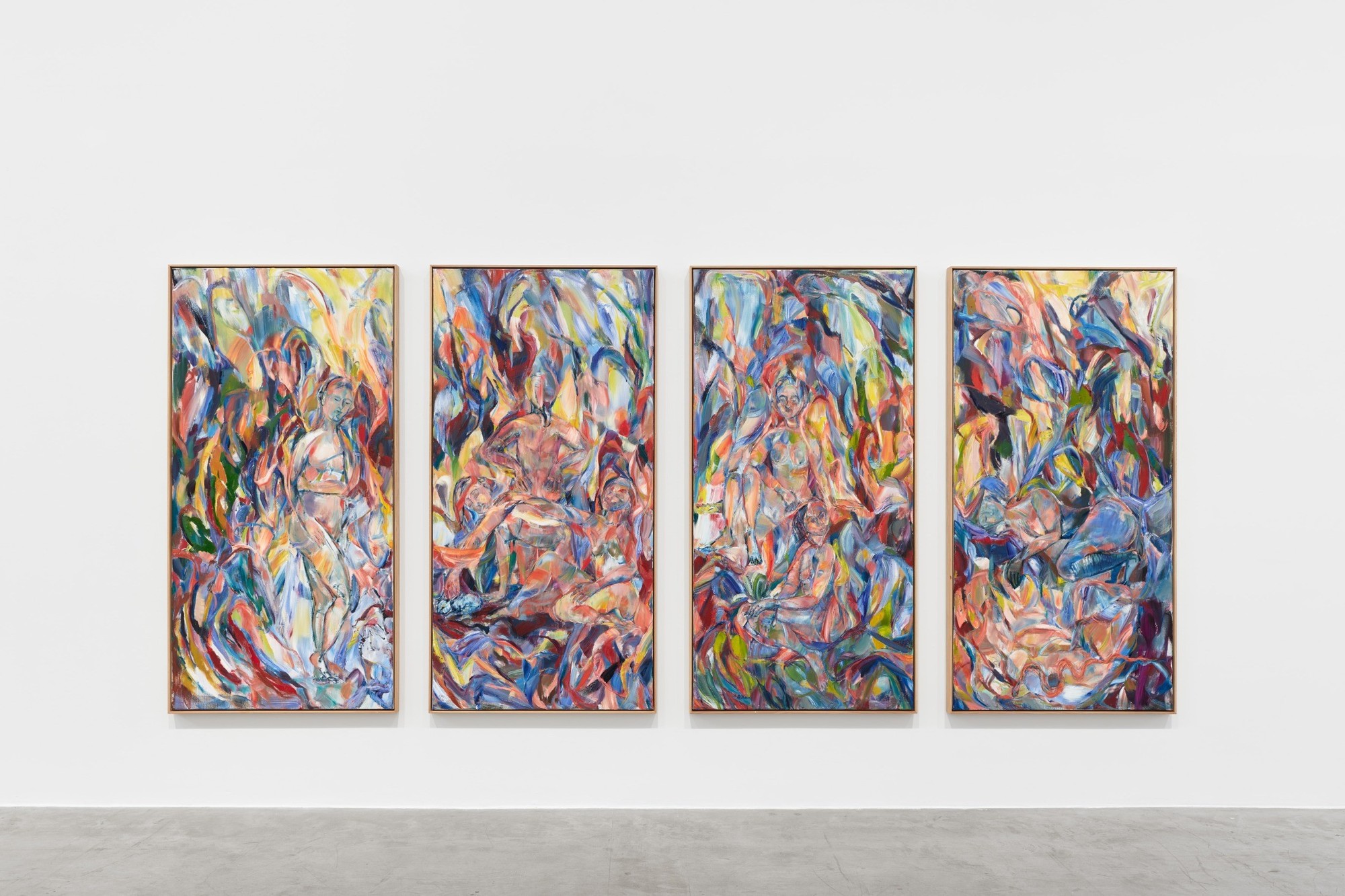


Cover Image: Installation view, Sabine Moritz, ROT GELB BLAU STAUB, Galerie Max Hetzler, Berlin, 11 September – 31 October 2026. © Sabine Moritz. Courtesy the artist and Galerie Max Hetzler, Berlin | Paris | London | Marfa. Photo: def image.