

Cécile gathers a seated woman, a fawn and a chaise into one grey. The figure sits with her legs crossed and the fawn curled on a cushion at her side, and the sculpture carries skin, knotted hair, long buttoned dress, heeled shoes, animal and upholstery through a single matte surface without generalising any of them: the dress keeps its buttons and folds, the shoe its heel, the chaise its tufting. It stands in the main room of Vanishing Point, Hans Op de Beeck’s exhibition at Almine Rech in Brussels, where the long benches set out for visitors repeat its buttoning and tufting in very nearly the same tone. The sculpture has its furniture; the room has ours. To sit down in front of the work is to take a place in the same suite.
The grey is thorough. It passes over things that ordinarily have nothing in common, the nap of upholstery and the back of a hand, a turned bench leg and the ear of the fawn, and takes from each its colour and shine while leaving everything else. A few steps away, in Pond (Roe Deer), it covers a deer, a scatter of flat pads and the moulded rim of a round basin whose interior is black and glossy enough to give the animal back its legs. In the middle of the room Smoldering Vanitas is the one warm thing: a black cake of four piped tiers on a round table under a black cloth that falls to the floor, with an orange glow showing from somewhere inside it and a pale vapour about the middle tiers. Across the room, a single substance seems to have agreed to be many things.
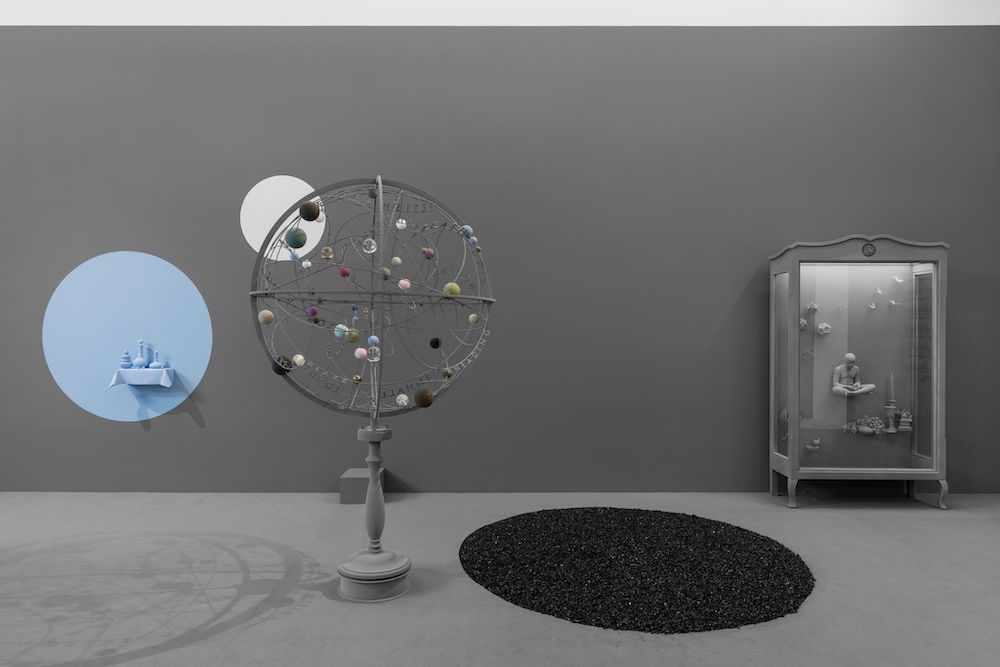
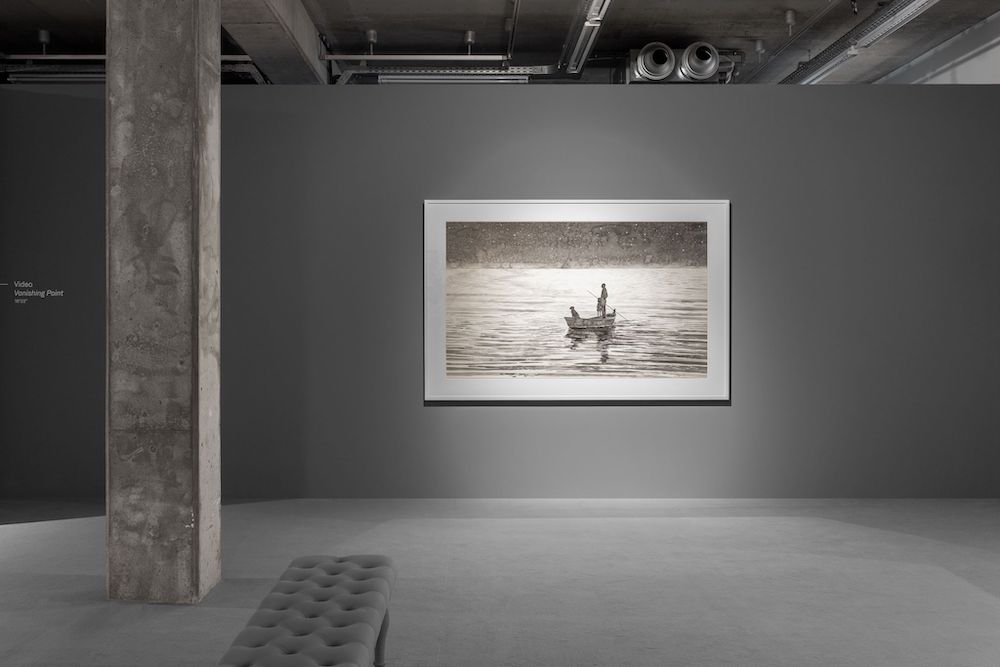
It comes up from the floor in one matte tone, takes the corners, passes over a door recess without a break, and ends at a hard horizontal line well short of the ceiling. Above it the building carries on as itself: white wall, silver ducting, rows of fluorescent tubes. The loudspeakers have been left black.
Wire spheres taller than a person stand about on turned stands, their rings strung with small coloured balls and words fixed along the wires. One has been placed in front of a white disc painted on the grey, so that its outer ring crosses the edge of the disc on its way round. Over the white the ring reads dark; over the grey the same ring reads light. Behind it the shadow lies large and soft across wall and floor, a second sphere drawn at nearly the scale of the first.
To its left a wider disc is painted pale blue, and low in the blue one of the two Small Blue Still Lifes, a shelf draped with a cloth, carries a gathering of bottles and vessels in the same pale blue. The match is close enough that the tops of the bottles nearly sink into the field. For a moment it is a picture of a shelf. Then the shadow gives it away, running down the blue, crossing the rim of the disc and continuing a little way over the grey wall.
Along another wall hang reliefs in grey frames, frame and image in the one tone, several small and one a large seascape. Nothing in them is painted. The cloud bank is cloud because it has been modelled deeper and rougher than the sky above it; the horizon is a step. In a lake scene the far trees repeat upside down below the shoreline, modelled shallower and so fainter, a reflection made by going less deep.
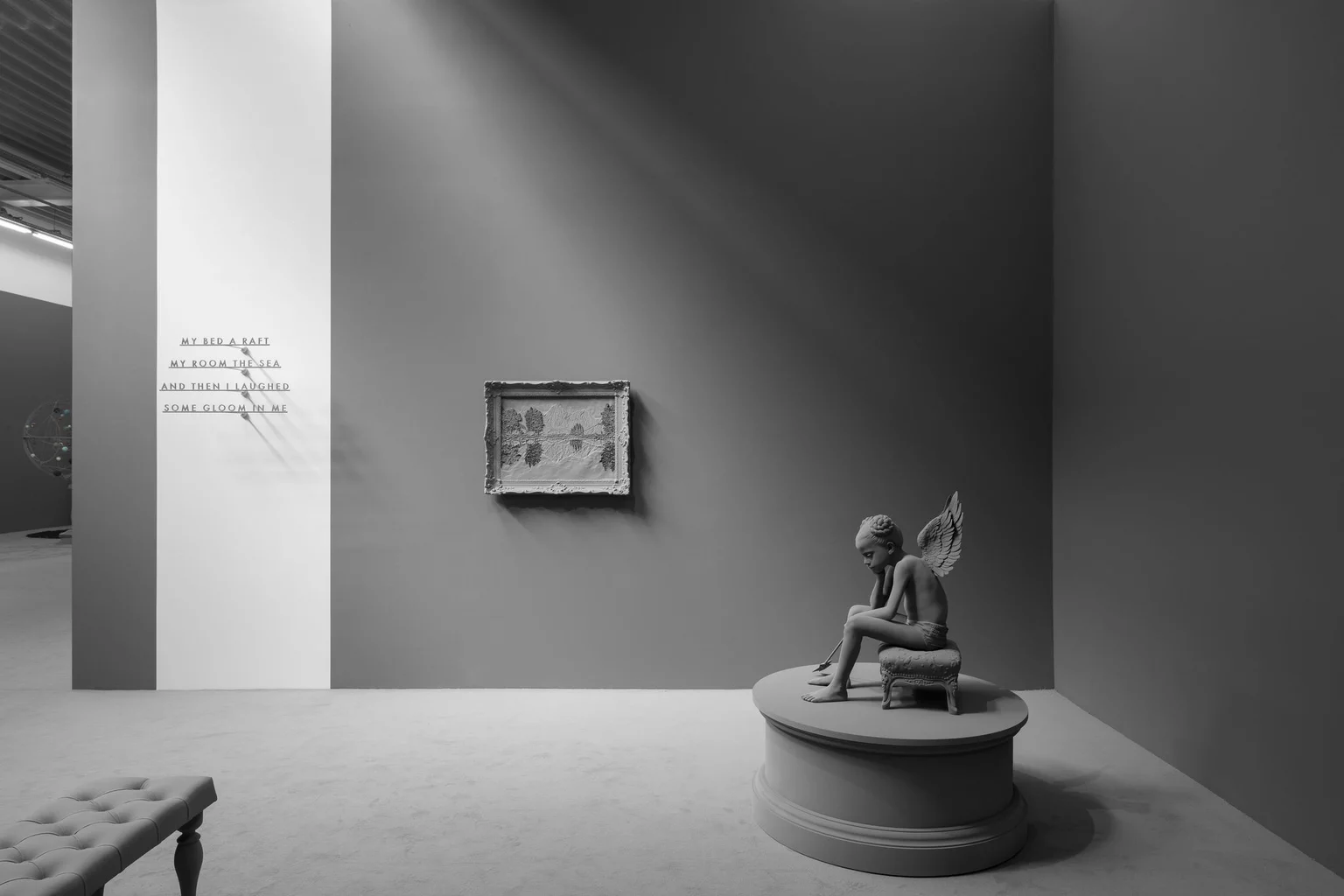
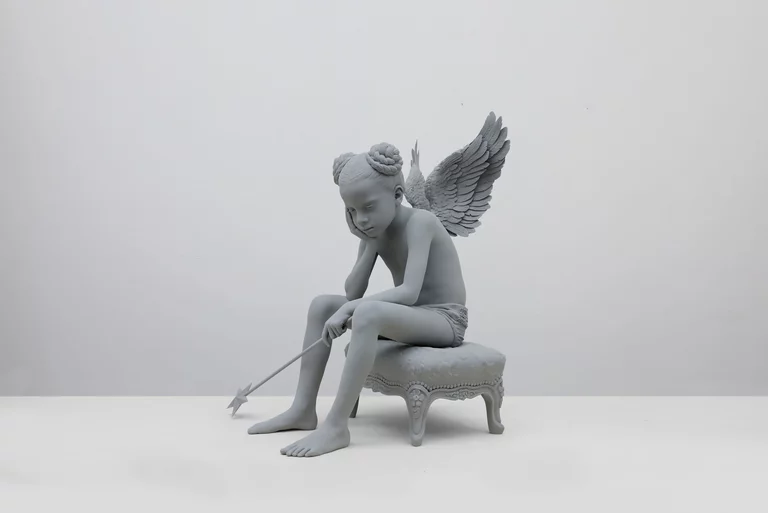
Zhai-Liza (angel), 2024, sits near one corner of the main room: polyester, polyamide and coating, eighty-one centimetres high, a winged child on an upholstered stool. The hair is parted and braided into two buns; one cheek rests in a hand, and the other hand, lying across the knee, holds a thin wand ending in a star that rests on the ground beside the bare feet. The same matte grey passes over skin, hair, feathers, cloth, upholstery and the carved legs of the stool, and each remains what it is, the feathers by their layering, the braid by its twist. From the front there is nothing behind the figure except uninterrupted grey, gently graded by the light toward the corner; from the side, the lake relief and a white strip of raised lettering come into the background. Of everything in the room, the arrangement seems most complete.
The ground on which the star rests is a circular plinth, about a metre across and knee-high: a thin projecting top, a plain drum, a stepped base, all in the matte grey of the figure. Nothing else is on it, and the star lies a little inside its edge. The benches stand on the gallery floor, and so do the chaise of Cécile and the rim of the pond. The angel sits a step above them, and the room makes nothing of it.
I saw it in New York in November 2024, at Templon, in an exhibition called Whispered Tales, and on the twentieth of that month posted ten frames from the visit with a paragraph of text beneath them.
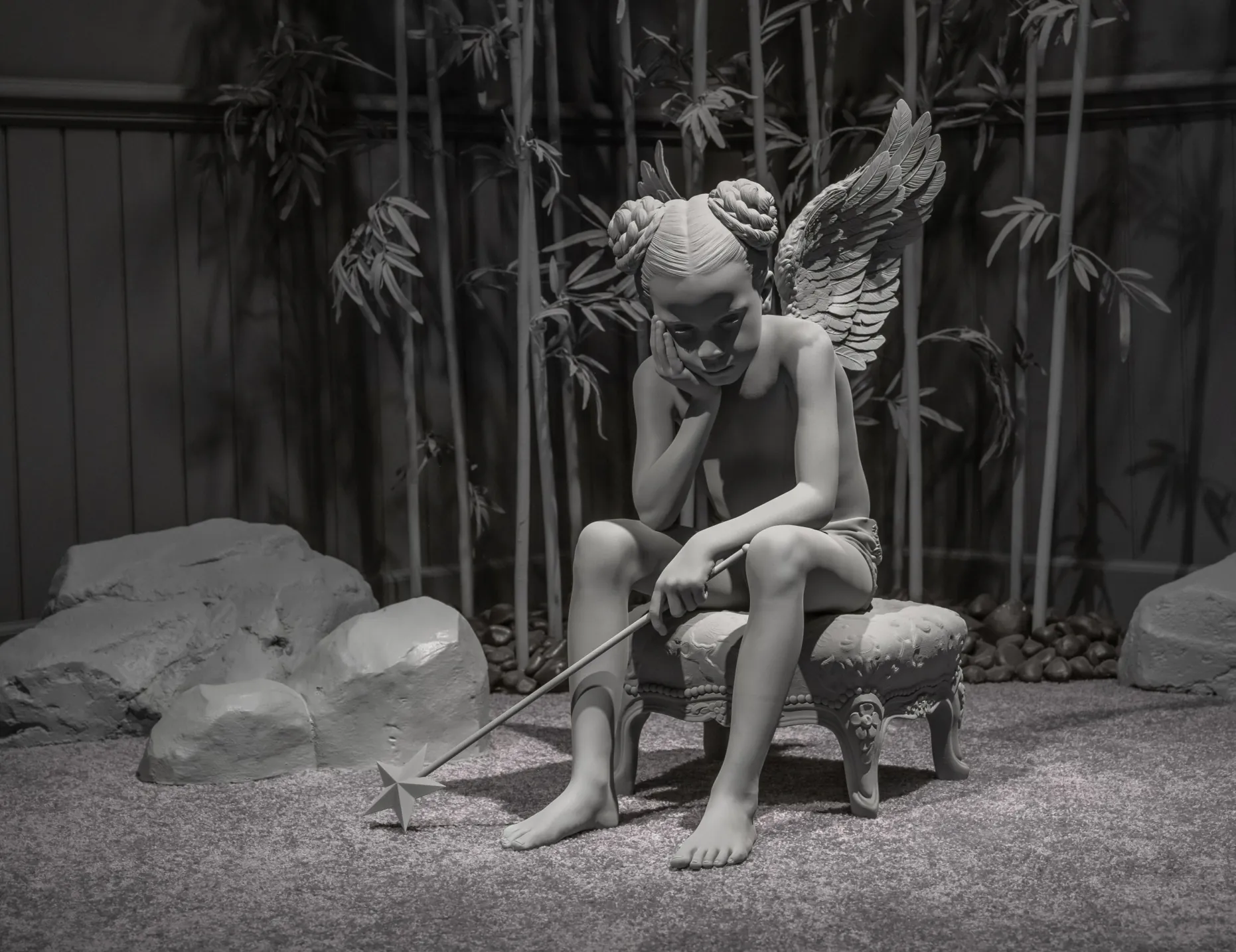
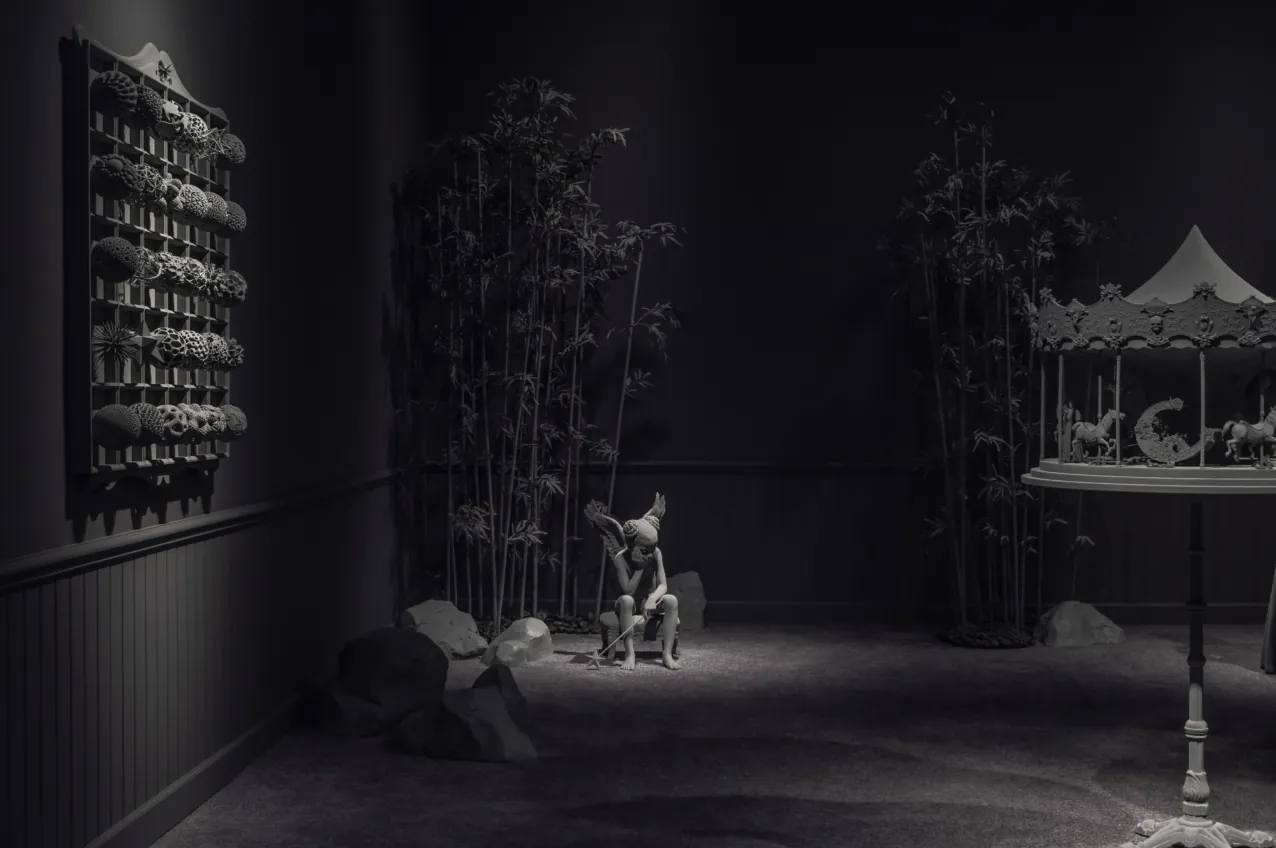
That room was dark. A boarded wainscot ran around it, with a chair rail above the level of the figure’s head; the ceiling was dark as well, and track spots let down separate pools of light onto a speckled carpet that ran from wall to wall. Stands of bamboo rose out of beds of pebbles, and rocks lay between them. The angel sat near a corner, as she does in Brussels, with a boulder about an arm’s length from her and stalks and leaves, close to her own grey, crossing and recrossing behind her outline. Three legs of the stool, both feet and the tip of the star met the carpet; the fourth leg was hidden. There was no plinth. The carpet went on under the rocks and the bamboo, under a carousel on its stem and base, and under the people moving through the room. The only edge around her was the edge of a pool of light, and it was a soft one, taking in the nearest rocks as easily as it took in her.
The frame I kept is close: the braid, the near wing, the face tipped into the hand with the eye in shadow. It ends at the hip. In another she sits at the far left, cut by the edge of the frame, while the carousel holds the centre.
In the frames where I appear, I am standing on the carpet she sits on. She is not beside me in those pictures. The ground is.
The paragraph underneath said that Op de Beeck’s “large-scale, monochromatic installations invite deep reflection”, that the work aims “to evoke a sense of universal melancholic anonymity”, that in it “simplicity conceals profound emotional depth”. It was the language the exhibition stood in, and I took it up; it was reasonable, and much of it could be said of Brussels. A dark room, one tone, a child with her eye in shadow: it read as a single continuous world, and melancholy is a fair name for how such a world reads.
The paragraph described an effect, and described it fairly. It also did something I did not notice it doing. Every verb in it belongs to the work: the installations invite, the work evokes, simplicity conceals. The whole of the effect is handed to the sculpture, and nothing asks what the effect was made of, or how much of it the sculpture could carry away. One room does not raise that question. I was standing in the only room I had.
The same form appears in Brussels under the same kind of coating, and very little around it is the same. In New York the figure and the person looking at her shared one continuous floor, the carpet passing under the stool and on under the visitor without a seam. In Brussels a bounded support comes between the sculpture and the floor a visitor stands on. In New York leaves crossed her outline and the light fell away softly into rocks; in Brussels the outline is clean against a plain field and the nearest edge is a hard grey rim a metre wide. Neither arrangement is the neutral one. The Brussels wall is graded by directional light, and the stool lays its shadow across the top of the drum. The New York room was a fabricated garden, and it was also a floor that anyone could cross.
What came through from one room to the other is quickly listed: the pose, the braids, the depth of the feathers, the carving of the stool, the scale, and the surface that lies over all of them. It is a shorter list than the 2024 frames hold. The bamboo is in those frames, and the pebbles, the pooled light and the carpet, and in them they are part of what Zhai-Liza looks like without being any part of what travelled.
Ground, light, shadow and the field behind the outline have all been given to the figure again in Brussels, differently. The plinth is there in one installation and not in the other, and beyond that it keeps its own counsel.
Brussels reads differently after New York, beginning with the orrery. Its ring is one grey, settled when it was coated; whether that grey reads dark or light is something the ring has no hold over. The wall behind it decides the matter twice along a single length of wire.
The blue shelf has given up more. Its own contour is the faintest edge in its vicinity, so that the eye takes the rim of the painted disc first and the shadow second. Where the work ends could be answered at the lip of a bottle, at the rim of the blue, or at the point on the grey where the shadow gives out.
Discs are painted, too, where nothing hangs, a pale pink one high on the wall of reliefs among them, and circles of pale blue chippings and black fragments lie on the floor beside works and never under them: grounds with nothing standing on them. The largest ground in the exhibition, the grey itself, has an upper edge that was there from the first, with the building going on above it. Nothing had concealed it.
The reliefs put it most quietly. Tone has not been taken out of them so much as laid down in them, as depth, and it becomes tone again each time light crosses the surface. From across the room the smaller motifs thin almost to nothing while the shadows of their frames stay sharp. The watercolours hung elsewhere in the exhibition keep their values wherever they go, and the video that shares the exhibition’s title gives off its own light. A relief keeps only its terrain. The lake scene hangs beside the angel, whose feathers and braid ask something similar of the light.
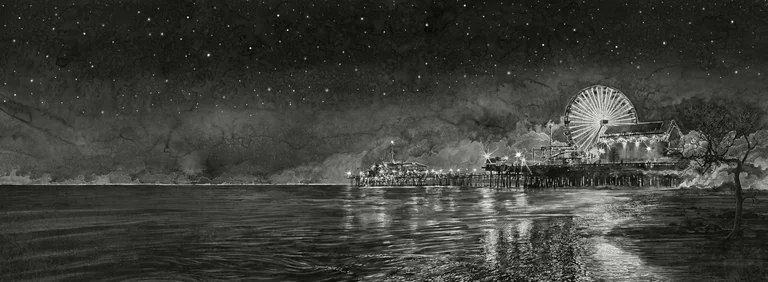
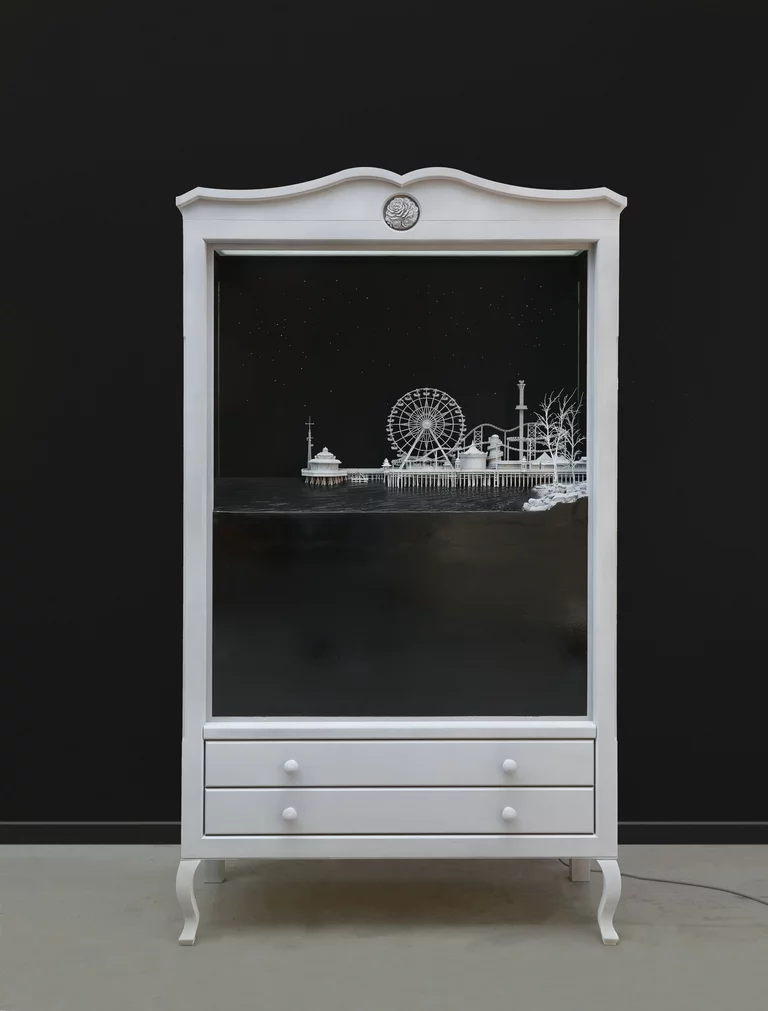
The room does not have equal purchase on everything. The cake glows from within and would hold its own elsewhere; the pond carries its gloss and its black with it. The Wunderkammer cabinets keep their grounds behind glass, a pier and a fairground held against a night of black in one of them. Danse Macabre (small version), the carousel from the New York frames, stands in Brussels as it stood there, horses under a scalloped canopy and a crescent moon, on its own slender stem and footed base; both times it brought its ground with it. The coated figure arrives with less. The angel would remain perfectly recognisable against another ground. Recognition is not what is at stake.
She is the harder case, and Op de Beeck has named the difficulty. Across interviews he has held that his constructions should remain visibly artificial while asking to be believed, and in 2009 he put the limit plainly: a constructed room remains factually a room, but “a three-dimensional representation of a human being is not a human being.” In the large environments of those years there were no sculpted people; the visitor completed the image as its protagonist.
When figures entered the built environments soon afterward, the distinction was not cancelled. Describing Sea of Tranquillity in 2010, he put its life-size captain and chambermaid in the language of the didactic museum, figures among showcases and exhibits. In The Collector’s House the sculpted bodies belong to a fictional art collection, and so does the pond. Years later he could still call the figure-filled interior depopulated, with the visitor “the only ephemeral, dynamic and colourful thing.” The fabricated person had not become a person. The work had found ways for the figure to remain an object inside a world.
His catalogue complicates the boundary from the other side. Zhai-Liza is an editioned sculpture, and the form has also appeared as a component of Nocturnal Journey, a separately titled installation at KMSKA. The sculpture can stand alone or be absorbed into a larger authored environment without ceasing to be the same work. What surrounds it is not always incidental. Nor is everything surrounding it part of it.
That history does not explain the difference between New York and Brussels. It makes the old asymmetry harder to ignore.
The two installations leave that asymmetry intact and put it somewhere else. A fabricated room can still be entered. The figure cannot cross the distance from her side. New York did not make her more real. It set her on one ground with the visitor, the bamboo and the rocks, and the line between figure and place went unusually soft.
The coating removes some of the means by which a person ordinarily appears — the colour of skin and hair and cloth, the wetness of an eye — while leaving pose, contour, texture and depth exact. What belongs indisputably to Zhai-Liza survives the move. What does not persist is the relation that made the figure appear as she did: the ground beneath her, the field behind her, the light across her surface and the edges that held her in place. Those have to be made again. The 2024 paragraph stays true on those terms. It described the result correctly and gave too much of it to the figure.
In New York the room gave her a garden to be alone in: bamboo, rock, carpet, darkness, a soft perimeter of light. In Brussels it gives her a bare field, a corner and a rim. She is no less herself in either.
In New York the difference almost disappeared into one carpet. In Brussels it appears as a circle.
She sits where she sat before, cheek in hand, near the corner, under the line where the grey stops and the ducts begin. Nothing needed to recognise her has gone. What has changed is the rim. It is a moulded circle in the figure’s own grey, related by its profile to the edge of the pond, and after New York it can be taken neither for nothing nor for hers. The star at the end of the wand rests on it, a little inside the edge. Below that edge the drum goes down to a stepped base, and the base stands on the gallery floor, where the benches are.
A coated figure carries certain things with it: pose, contour, scale, texture, the depth of a braid or feather. Other things are made again wherever it is installed. Light determines tone. A ground establishes its edge. A shadow extends it into the room.
Seen once, those conditions disappear into the work. Seen twice, they separate. Zhai-Liza (angel) carries enough with her to remain unmistakably herself, but recognition and presence are not the same thing. In New York, the world made around her extended beneath the visitor’s feet. In Brussels it stops at the edge of a plinth.
A note on method. This review draws on a November 2024 visit to Whispered Tales at Templon, New York, photographs and notes from that visit, gallery documentation of Vanishing Point at Almine Rech, Brussels, and published interviews with Hans Op de Beeck. The interpretation remains Quiet Modernism’s.
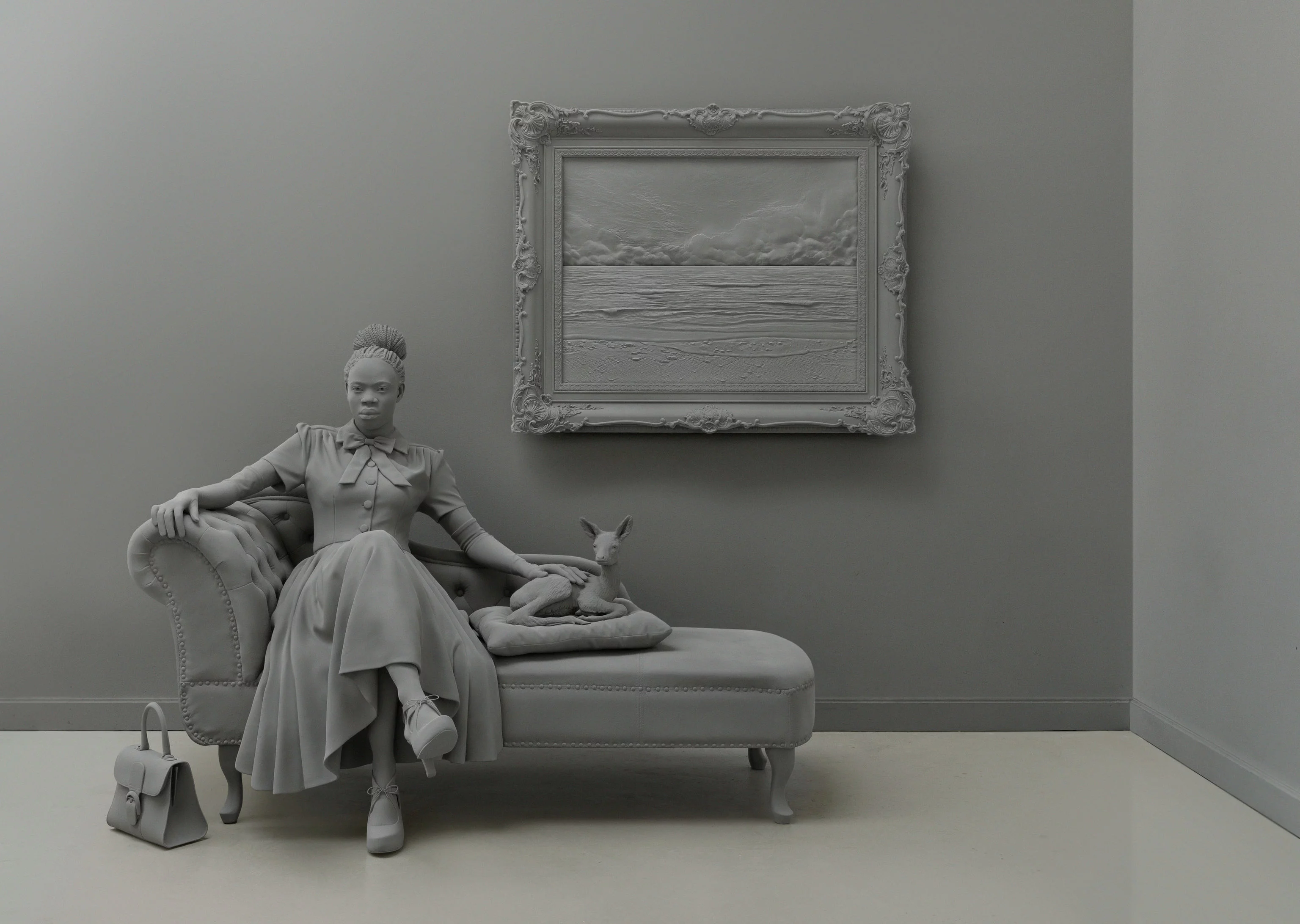





Cover: Hans Op de Beeck, Cécile, 2026. Polyester, polyamide and coating, 125 × 170 × 120 cm. Edition of 5 + 2 APs. © Hans Op de Beeck. Photograph: Hugard & Vanoverschelde. Courtesy of the artist and Almine Rech.