

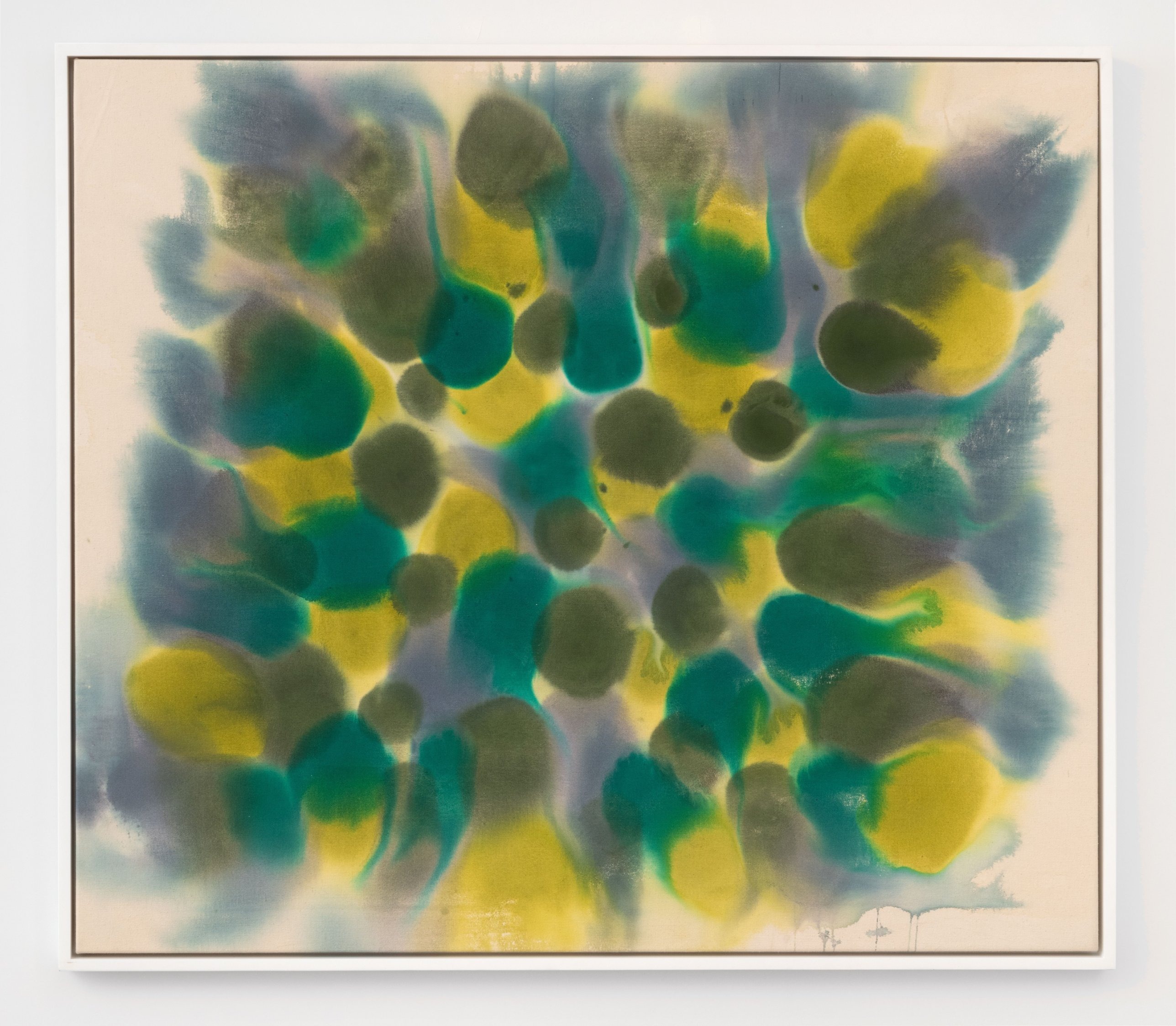
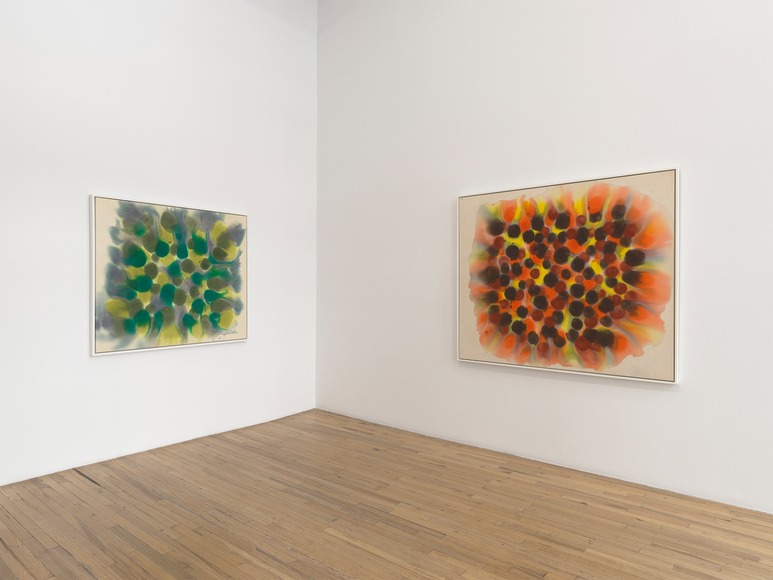
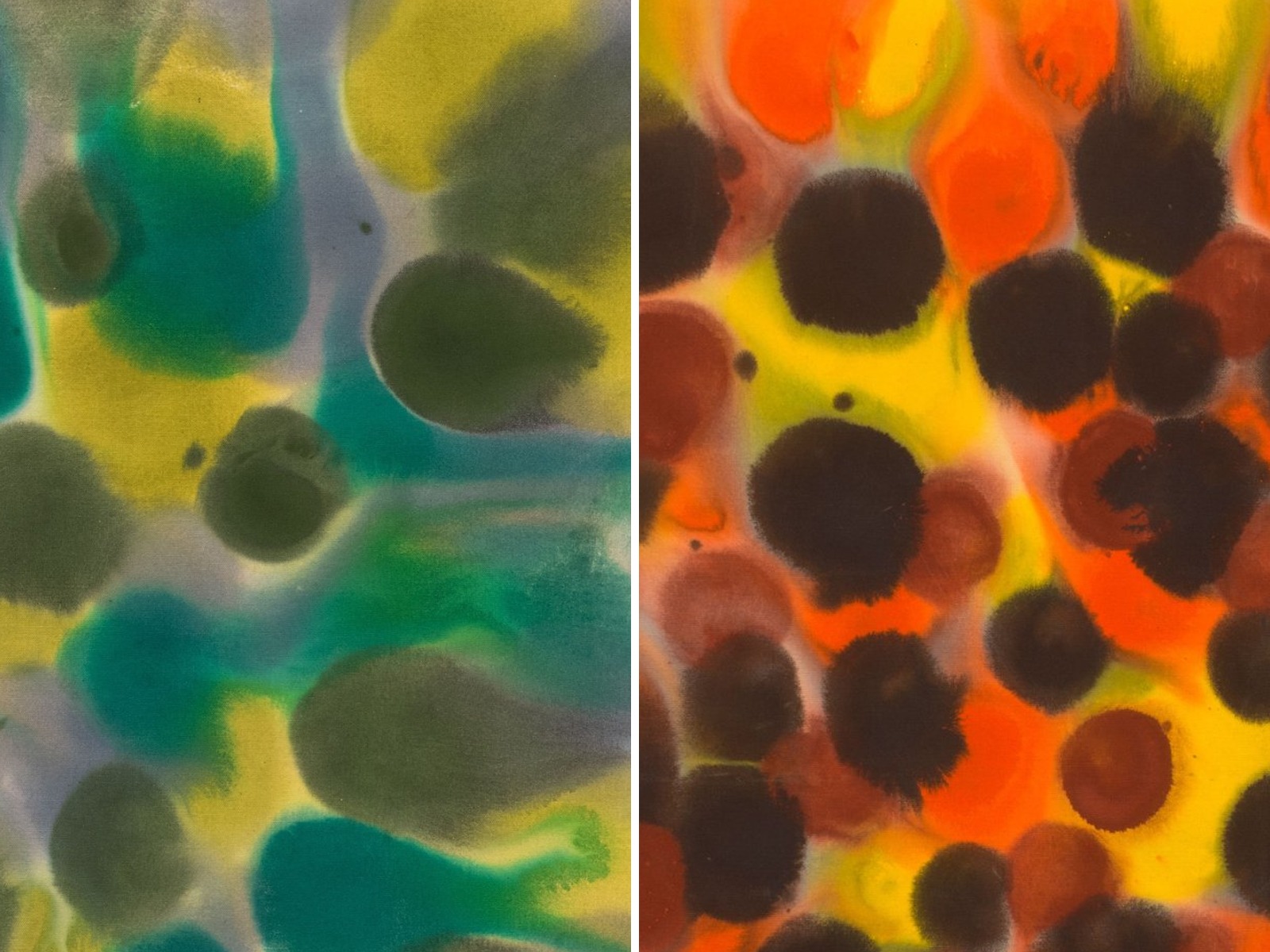
On the back wall the green painting is leaving its centre. Olive, teal and yellow on bare canvas. The teal blots in the upper half trail upward, those in the lower half trail down. Across the middle of the top a grey-violet fringe feathers out until it reaches the edge of the canvas, as though the mass had got that far and kept going. Where teal meets yellow the seam turns a bright, acid green. Pale rings sit around many of the blots. In the lower right, under the last of the wash, a few thin drips run straight down, the only straight marks in the painting.
The yellow is the softest thing in it. It is where the canvas is lit, and the blots sit in it or go through it. Where it thins, the bare canvas comes up through it, warm. The grey-violet is cooler and gathers at the outside of the mass, leaving by the top. Between the two the teal does the moving. Each teal blot has a tail, and the tails agree, so that the whole mass is going outward from somewhere near the middle, and the bare canvas is where it is going.
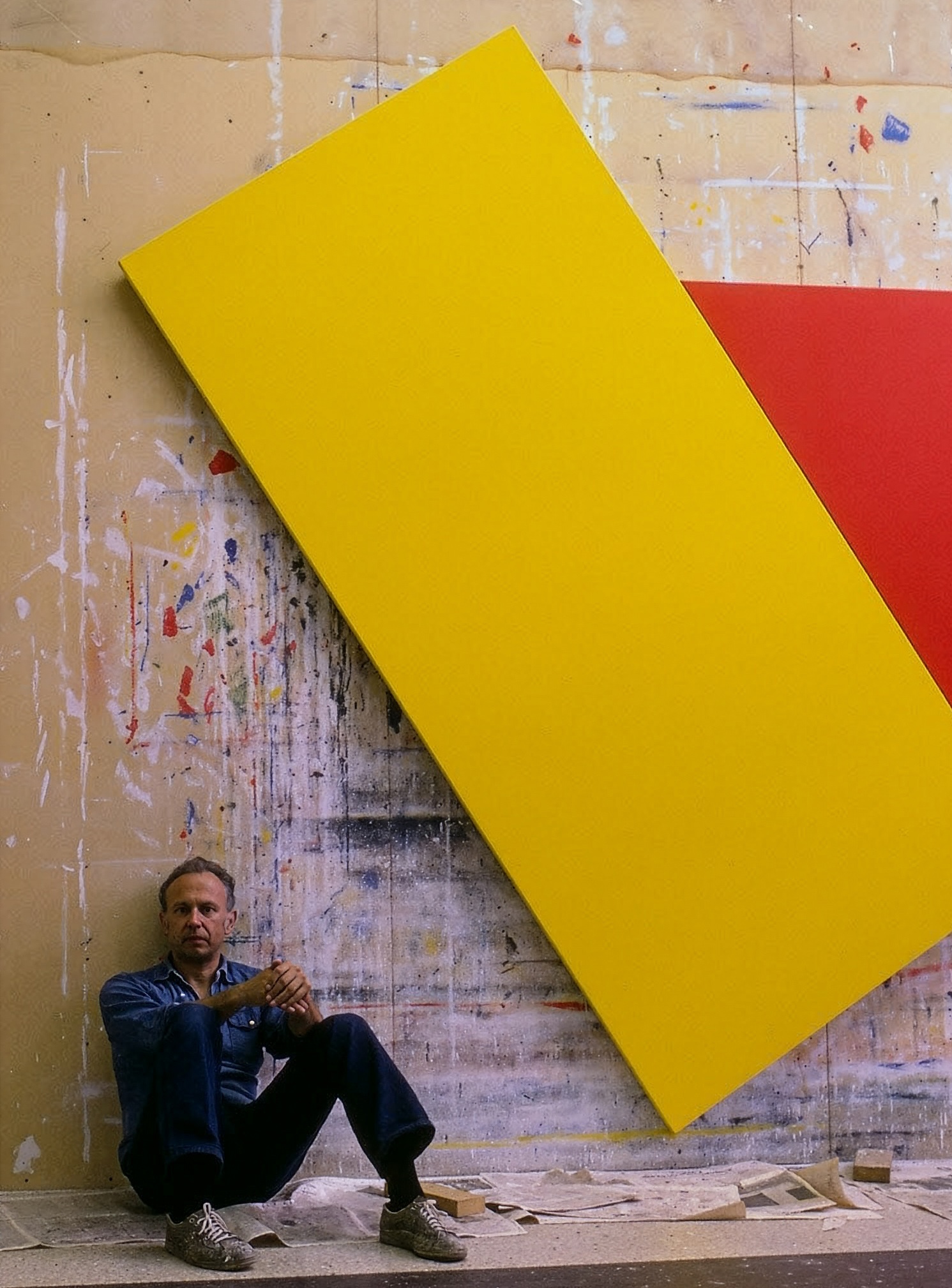
At what scale this is happening is hard to say, and the painting does not need to say. The blots are about the size of a hand, and a hand is not a scale. One way, they are cells: the pale ring a membrane, the teal tail the smear of something dividing or drifting under a lens. The other way, they are bodies at a great distance, each with its own weather, and the tails are what light does when a body moves through a medium. Kenneth Victor Young had both in one sentence. “Painting wet in wet produced haloes around these objects,” he said in 2017, “which looked like outer space, or inner space.”
The olive blots are the heavier bodies. Some are soft and go into the yellow the way the yellow goes into everything. Several have a firm rim inside a pale ring and no tail, and these sit still while the teal goes past them, in their own atmospheres, the way the heavier bodies of any sky do while the lighter things stream. A sky is bodies at rest and bodies in motion. So is a drop of pond water. The pale rings belong to both kinds of body, those that trail outward and those that remain where they are. Around one blot the yellow is almost indistinguishable from the bare canvas. Around another it gathers into a visible band of colour.
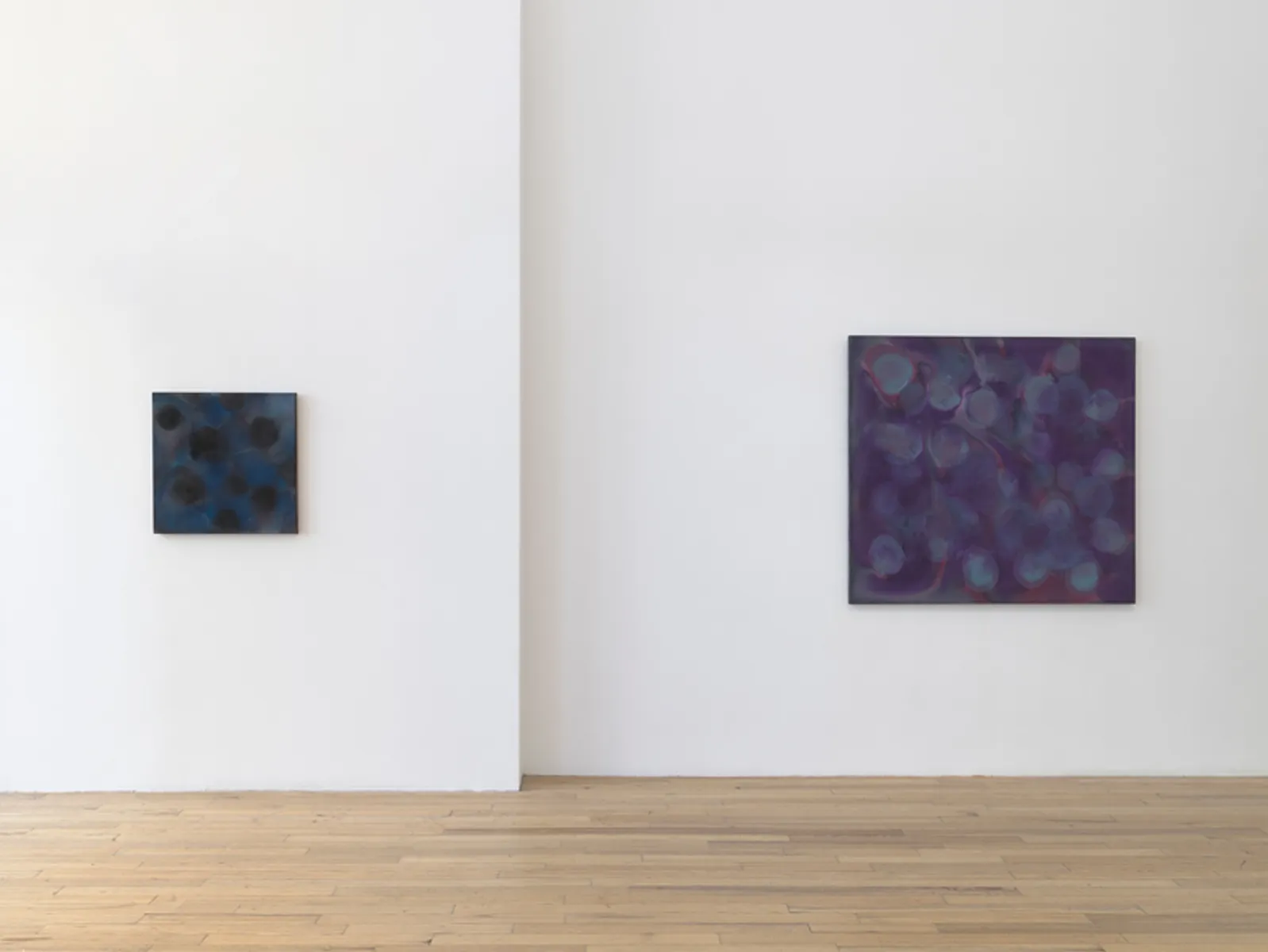
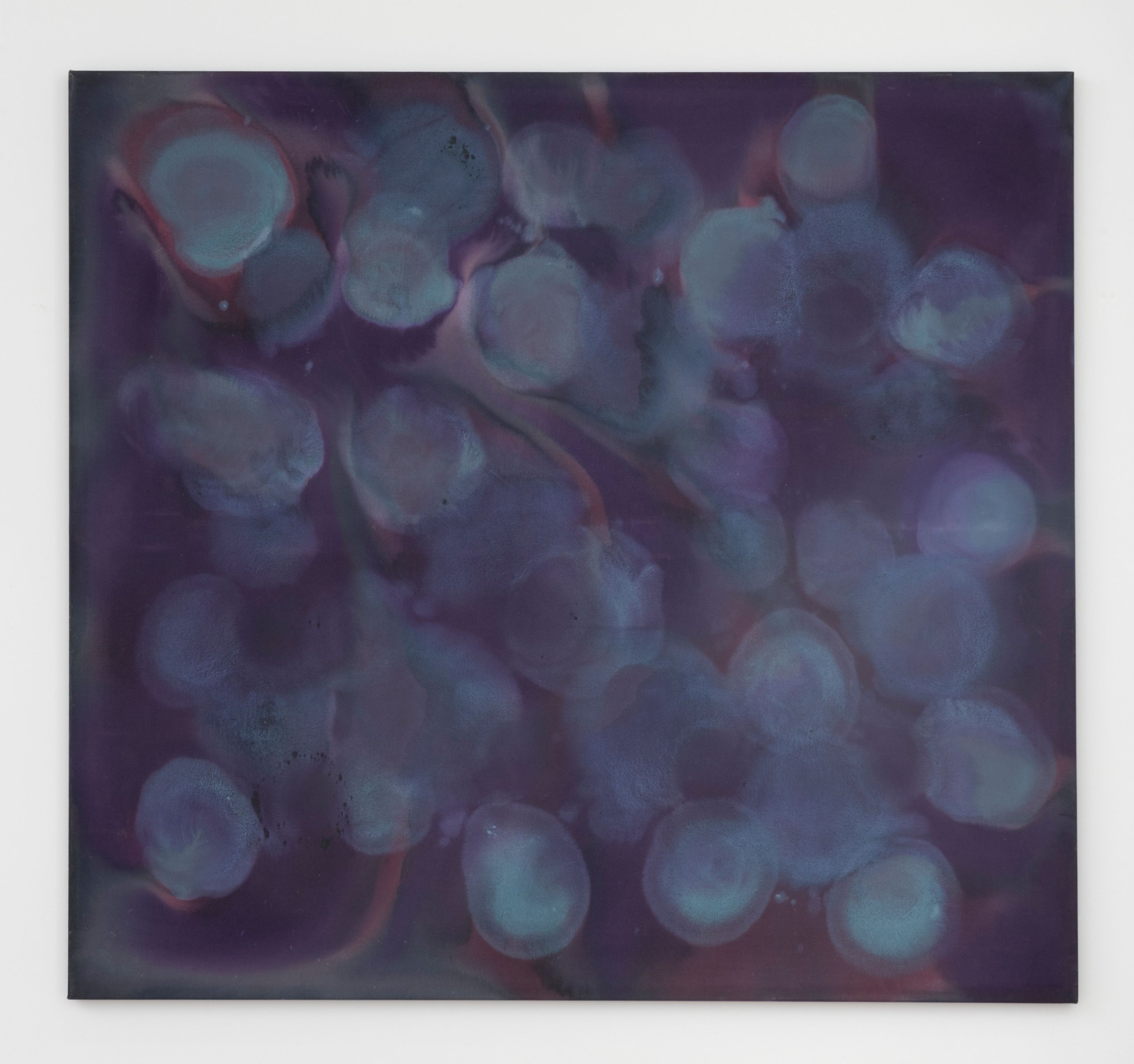
Violet offers a denser medium. It covers the whole canvas, out to its four edges, darker in a band down the left, and the discs in it are pale, concentrically ringed, and translucent where they overlap. These are bodies in something thicker than air, surfacing and sinking back. Rust-red lines run between them and around them. The brightest discs are in the bottom row; at the centre left they are barely there, the ghost of a ring in the violet. None has a tail. Where the discs overlap, neither entirely covers the other. The violet passes through both, and the eye can follow either contour across the place where they meet.
A blue-grey square offers the nearest view, or the farthest. About ten soft black discs fade outward at their rims, where the weave of the canvas shows through the thinning black like grain. Paler zones ring several of them. From the disc at the upper right a few fine streaks fan towards the corner. Nothing in it is sharp. The discs have dark centres, but no line separates them from the space around them. At this scale, whichever scale it is, a body is all centre and falling-off.
Yellow gathers at the centre of the largest canvas, and from it orange plumes run out in every direction to a scalloped contour where the orange stops, cleanly, in the bare canvas. Along the bottom the orange goes out in broad lobes; along the top and the right it goes out in streaks, and the streaks begin at the bodies. The bodies are black. Their edges are bristly and feathered, and where a black disc meets the yellow it carries a pale zone, a cooler rind of grey-blue or green. Along the top and down the right side the black discs are leaving. They stream outward into the plumes, so that at the rim a disc is half body and half tail, and the plume is the colour the body left behind it. Small dark spatter dots sit at the left and the lower left.
Among the black discs, and smaller, are bodies of another colour, a rust red a shade or two darker than the orange around them, so that they are the quietest things in the painting. They sit in the gaps between the black discs, in the core and out at the rim, often close enough to touch, and the orange meets them in a way it does not meet the black disc a hand’s width away. At the black disc the orange is an atmosphere. It thins into the grey rind, it takes the feathered edge into itself, and at the rim it takes the whole body out into a plume. At the rust disc the orange is orange. It comes up to a rim a shade darker than the disc and stops there, and the disc is simply visible against it, the way a thing is visible against a coloured wall. Several of the rust discs carry a faint ring inside the rim, a ring on the inside where the black discs have their rind on the outside. Nothing from around them crosses in.
Near the centre a black disc with its pale rind against the yellow and a rust disc with its dark rim against the same yellow sit a finger’s width apart, and the yellow is not the same yellow at the two rims. At one it is the medium the body is in. At the other it is coloured matter the body sits against. There is nothing between the two rims to mark where the one yellow stops being the other. It is one wash.
The distinction loosens along the lower edge. A rust disc sits at the head of an orange plume, its lower edge softer than its upper, the colour beginning to take it the way it takes the black. One or two others near it do the same. Above and to the sides the rust discs keep their rims. The difference is not fixed by colour alone. It depends on what happens at the edge, whether the wash stops against the body or passes into it. Across the same canvas, the orange is sometimes the space a body occupies and sometimes the colour against which it appears. At a few rims it is difficult to tell which.
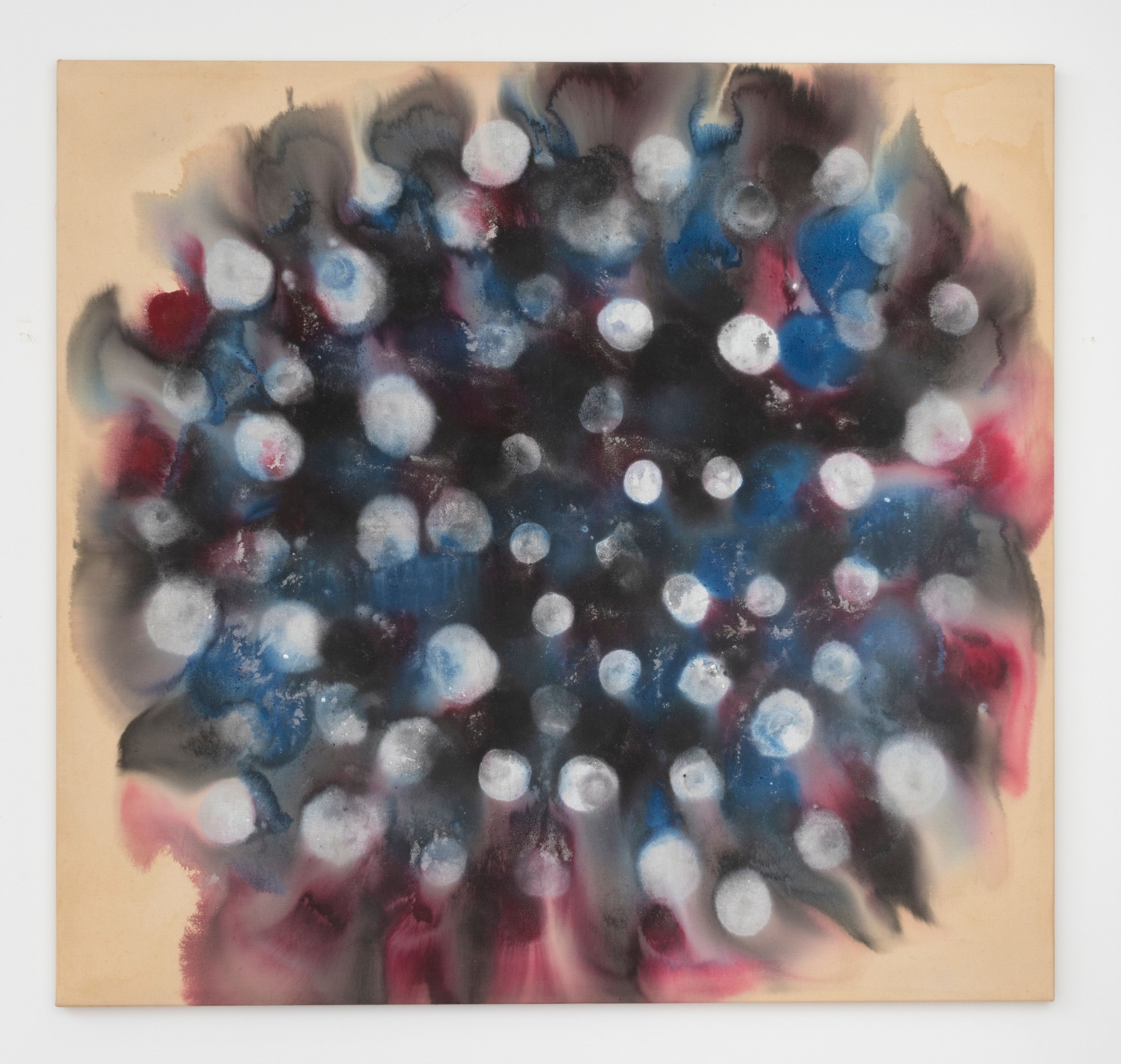
The white discs are sharpest where the darkness is deepest. Small and bluish against the grey-black wash, they gather near the centre, with pale speckle dusted around them: clean coins on the dark, in it the way lights are in a night. Farther out they grow larger and softer, acquiring haloes; the lowest trail grey streaks downward. Ultramarine runs through the wash, with crimson reaching the bottom edge and dark tide lines along the top. Even the crispest discs remain suspended in the darkness. Their edges hold, but the space around them does not flatten.
The green painting shares the corner with the orange one. Its olive blots have not changed: several with a firm rim inside a pale ring and no tail, sitting still while the teal goes past them. At the rim of a teal blot the yellow takes the tail into itself, and the seam between them is green. At the rim of a firm olive blot the yellow thins into the pale ring and stops a little short of the olive. The two blots sit in the same wash, close enough for the eye to pass between them without leaving the yellow.
At one rim the yellow is a sky. At the next it is yellow. Then a sky again, with the teal going out through it towards the bare canvas and the grey-violet leaving by the top, and the painting still leaving its centre.
Five paintings from 1970 to 1972 move between cellular and celestial space. Across their surfaces, floating bodies appear and dissolve within fields of colour, until a difference at their edges begins to change the space they occupy.
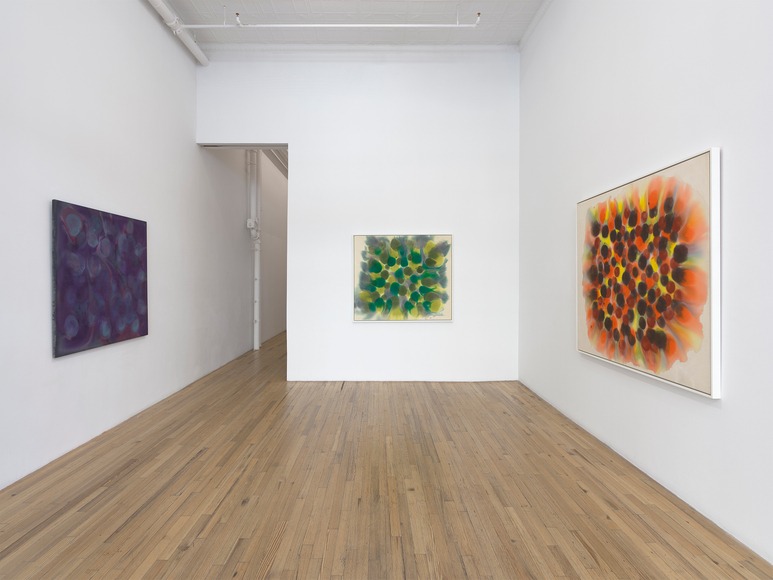







Cover Image: Exhibition view: Kenneth Victor Young, Works 1970 - 1972, Andrew Kreps Gallery, New York (18 September–31 October 2026). Courtesy Andrew Kreps Gallery. Photo: Elisabeth Bernstein.