

In 2020, while much of the world was confined to its rooms, Máté Dobokay began a task that would keep him in one. He had a stack of sheets of photographic paper, nine centimetres by six, each given the same exposure to light, and one bath of developer, a tray of the solution that turns exposed paper dark. The sheets would go through the liquid one after another, the bath never changed, until it could develop no more. That sequence, first sheet to last, is a run, and its length was the bath’s to decide.
The first attempt had no end. He had mixed too much developer; the bath would never have run down, and the work would never have stopped. The second time the chemistry was right and he was not. The bath was weakening as it should, each sheet coming out a little paler than the last, when, somewhere in the middle of the run, he lay down. He was away for an hour and a half, perhaps two. A person tires; a bath does not rest. The developer had gone on weakening with nothing passing through it, and the sheet that followed his return was paler than its place allowed. The descent from black had stepped.
He started again. This time he stayed. The run took about two days, and when the liquid gave out there were 604 sheets, black to near white without a break.
When he ran it again, the same procedure produced about 436.
Studies in Depletion, at Bigaignon, puts three bodies of work in one skylit room, one to a wall. On the end wall is Development till Exhaustion, the later run. On the left long wall is Fixation till Exhaustion, the same procedure run on the fixer, the bath that makes a photograph permanent, instead of the developer. On the right is Parts of Matter, 105 handmade sheets pulped from the leftovers of earlier work, test strips, failed enlargements and used paper, each floated in a white box frame, in five rows that pass from grey to white.
The end wall is thirteen white shelves of loose sheets standing on edge, about 436 of them, black at the top left and lightening shelf by shelf to near white at the bottom right. Each sheet curls forward, leaning on the next and throwing a small shadow on it. The darkest sheets are glossy and catch the skylight in a line down the middle of each curl. The first hundred and twenty or so are near black; the run reaches an olive mid-tone about halfway; the last eighty are close to white, a white that up close is cream. The middle of the run is the least even, soft cloud inside each sheet with a few fine dark hairlines, and the two ends are the cleanest. The last shelf is about nine-tenths full.
The left long wall is the same shelf system at twice the width: thirteen shelves of about sixty sheets each, some 770 in all. The first ten shelves are white. About halfway along the eleventh, cloudy dark marks appear and deepen along the shelf into the first sheets of the twelfth, each marked sheet carrying a pale band across its middle; the rest of the twelfth and all of the thirteenth are solid, dense black. The last shelf stops about an eighth short of its end.
Across the room the three walls agree. Each is a run of near-identical units; each moves from dark to light or from light to dark; each has a stretch where the change happens. Seriality: repetition with variation, difference read inside sameness, three runs of one kind.
The title says where the procedure came from. Dóra Maurer’s Printing till Exhaustion of the Drypoint began with a single aluminium plate. Drypoint prints from lines scratched into metal with a needle, which throws up a ridge, the burr, that holds the ink. Her vertical lines were spaced at intervals that widen by the Fibonacci sequence, and she printed the plate over and over as the burr wore down and the grooves flattened. The 2020 version of Development till Exhaustion stood its 604 sheets on sixteen aluminium shelves, the metal of her plate. In both, repetition consumes its own means. Every pull, a single print taken from the plate, takes something from it, as every sheet takes something from the bath, and the series is the record of the taking. Each of Maurer’s pulls also records how far the plate had worn: the thinning line is the image, and a single print taken out of the sequence still shows the state of the plate that made it.
Peter Dreher painted an empty glass: from 1974, on the same table, from the same distance, at life size, by day and by night, each painting finished on the day it was begun. He had meant to do it five or six times. There are more than five thousand. Each glass records the light it was painted in; the morning or the night is in the paint, and one canvas lifted from the series still says which it was. Which number it was, the canvas does not say.
A sheet from the end wall records the strength of the bath that reached it, and because that bath only ever weakened, the record also places the sheet: a near-black sheet came early, a cream one late, and an olive sheet with cloud in it fell somewhere near the middle of a run that ended when the bath did. In 2020 the same record caught his two hours away. The sheet after them had met a bath that had gone on weakening without him.
On the right wall, Parts of Matter keeps the same kind of record: its grey thins row by row toward white, and each framed sheet shows roughly where it falls. Two of the room’s three walls show their change as it happens.
The left long wall, read in the order the end wall teaches, top left to bottom right, runs the other way. The first sheets are white. The black comes last. The procedure is the end wall’s with the fixer run down instead of the developer, until, in the gallery’s phrase, the image can no longer be stabilised. Exhaustion produces white on one wall and black on the other. If the two walls were two gradients of one kind, one of them would simply be hung upside down. They are hung the same way, and their whites sit at opposite ends.
On the left wall about 630 white sheets, the first ten shelves and half the eleventh, hold their brightness from first to last. From about the two-hundredth sheet a faint warmth comes into the white, too slight to see from one sheet to the next, plain only when a late sheet is set beside the first. A pull of Maurer’s records the plate, a glass of Dreher’s records its light, a sheet from the end wall records its bath. A white sheet from this wall records little more than that the bath still worked. Had he stopped for two hours halfway along this wall, nothing the bath did in that time would show.
The failure begins halfway along the eleventh shelf, and it has a shape. Across the next fifty sheets or so a pale band sits at the same height on every sheet, dark above it and dark below, with a thin light edge at the top and the bottom. On the end wall the unevenness is cloud, soft and irregular; here it is one shape, repeated, deepening sheet by sheet and keeping its place. The band runs across the sheet. The skylight’s highlight on the curl runs down it. The band is in the sheet, then, and not on it, and nothing on the wall says what put it there. Stabilising is the gallery’s word for what fails here. The darkroom’s word is fixing, and the word has a date.
The date is 1839, when John Herschel fixed his first photographs with hyposulfite of soda, hypo, still the darkroom’s nickname for fixer. Most silver photographs made since have passed through some version of that bath, and it leaves no mark on them. A sheet of photographic paper carries silver salts that darken in light. Developing turns the exposed ones into the black of the image. Fixing dissolves the ones light never reached, so that the paper can be washed clear of them and carried into daylight.
Since the print shows nothing of a tiring fixer, the darkroom tests the bath on a strip of film, against a clock. Ilford’s data sheet for its fixer says to time how long the strip takes to clear, its milky coating dissolving until the film turns transparent, and to discard the bath when that time has doubled. The clock works because a fixer slows before it stops. As the bath loads with silver it takes longer to clear a sheet, and a sheet given more time than a fresh bath needs still comes out clear; the print never shows the slowing until the time given is no longer enough. The left wall reads like that clock running down: the whites are the margin being spent, and the run turns where the margin runs out. In an ordinary darkroom the two baths stand side by side and a sheet passes from one to the other inside a few minutes, so that making the image and keeping it are one act in two trays. The room at Bigaignon pulls the act apart and lets each half run out on a wall of its own.
On the end wall, black is what the chemistry did and white is what it could no longer do: the first shelves are paper the developer blackened, the twelfth and thirteenth paper it failed to darken, cream where the first shelves are brown-black. On the left wall the assignment reverses. White is what the chemistry did and black is what it could no longer do: the first ten shelves are paper from which the fixer took the undeveloped silver salts, paper unable to form an image; the twelfth and thirteenth are silver the fixer failed to remove, gone dark afterwards, in the light or under a developer. Whether it has stopped darkening cannot be seen. The two blacks look alike, brown-black on both walls. The titles name the baths, and a darkroom-literate viewer could work the rest out from them alone. What they cannot supply is the two runs side by side.
The developer’s last whites are cream, a warmth left in the paper by a bath with almost nothing left to give; the fixer’s first whites are the white of the paper itself. A white sheet tells which end of the room it belongs to, to an eye that has seen the other. On its own, neither white can say whether it marks a bath succeeding or a bath failing. The two blacks share a corner: the end wall’s at the top, where its run began; the left wall’s at the floor, where its run ended. From that corner the left wall climbs back through its black and its marked sheets to the last of its whites, halfway along the eleventh shelf. Those sheets came out of a bath that was nearly spent; set beside the first sheet on the top shelf, they show only a faint warmth. Along the wall, six hundred sheets look the same, and the bath was different for every one of them. On this wall, too, the bath decided where. It gave no sign until it had.
Because the bath was changing the whole time they were made. On the end wall the developer’s tiring shows on every sheet, so the run reads like a record. On the left wall the fixer tires just as steadily, yet for six hundred sheets the white holds, with only a faint warmth that comparison catches. Fixing is the step in photography that, done right, leaves no trace; Dobokay runs it until it can only show itself by failing, and the whites are where its work went unseen.


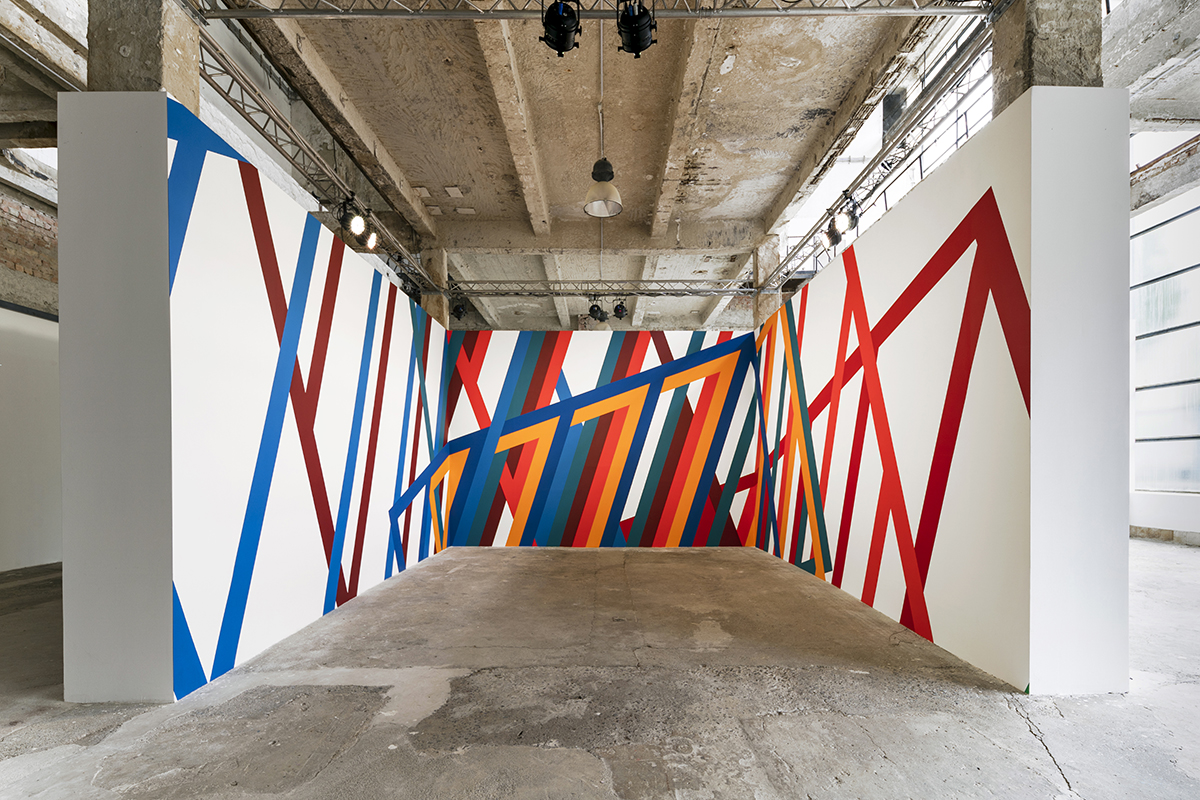
Cover image: Installation view, Máté Dobokay: Studies in Depletion, Bigaignon, Paris, 9 October – 14 November 2026. © Máté Dobokay. Courtesy the artist and Bigaignon, Paris.