



Color, in Winston Roeth’s paintings, is not arranged. It is tested. A narrow border accelerates perception; the interior slows it. What appears monochrome begins to separate into conditions — matte against iridescent, absorbent against reflective — as viewing time accumulates. The work does not declare itself immediately. It requires duration.
Working with raw pigment and minimal binder, color behaves less like coating and more like material. The surface matters: slate absorbs differently than honeycomb panel; wood interrupts differently than smooth aluminum. Pigment does not sit passively. It shifts as the viewer shifts. Illumination is generated through calibration rather than illusion.
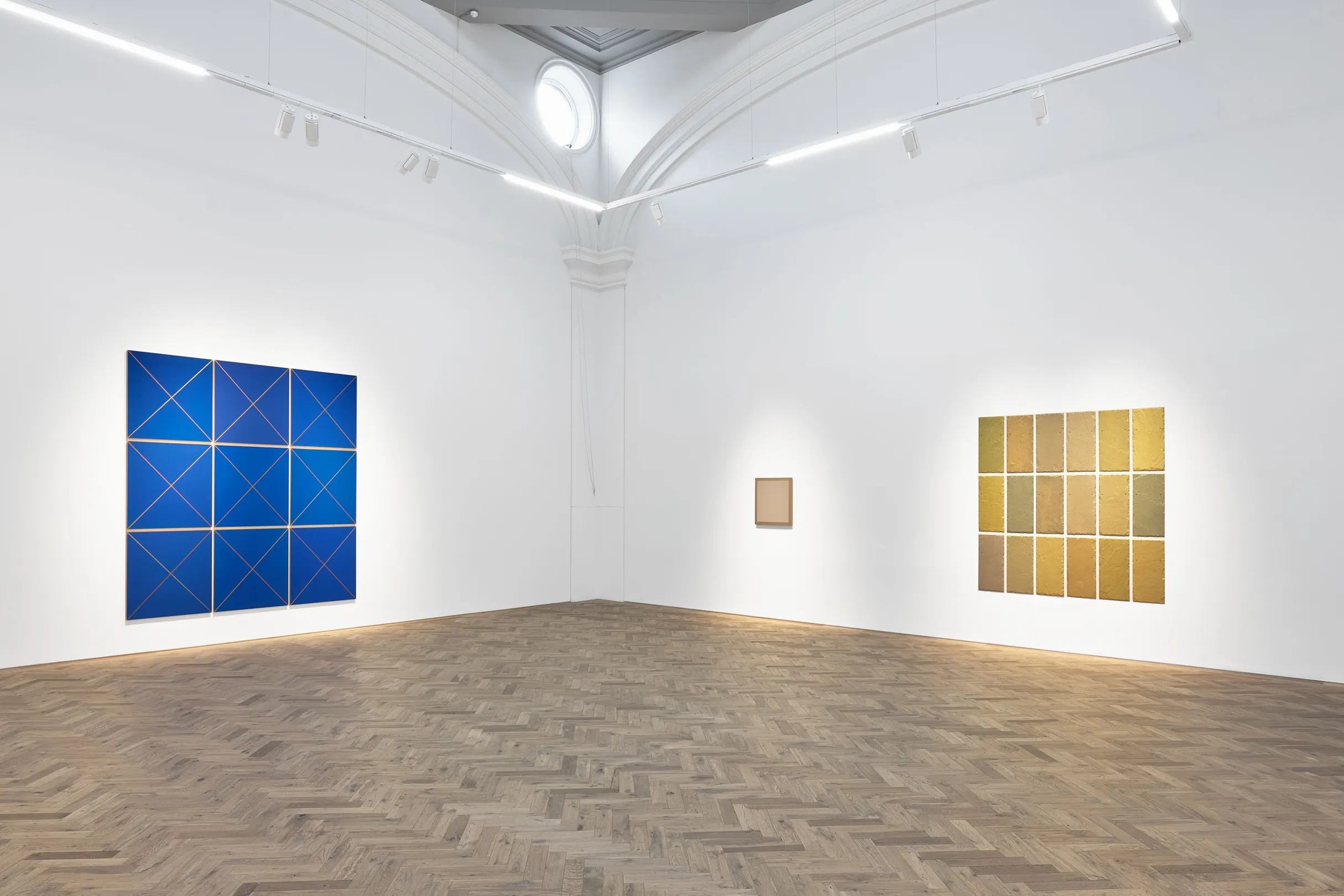
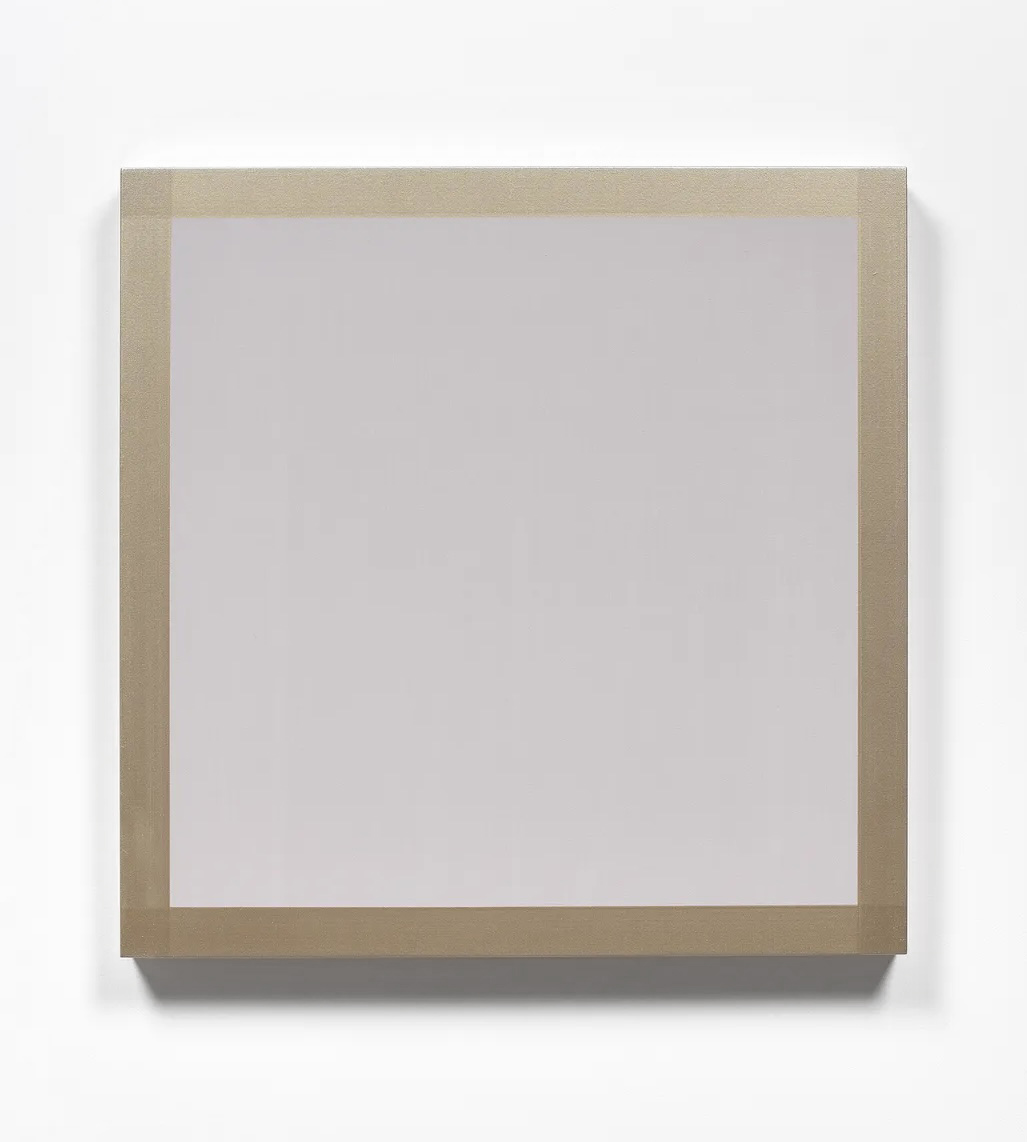
In Twilight (2025), that calibration becomes explicit. The narrow gold frame is not decorative; it regulates speed. The eye moves quickly along the perimeter before entering the interior field Roeth calls the “drift.” There, perception decelerates. Two temporal conditions coexist within a single surface: velocity and suspension.
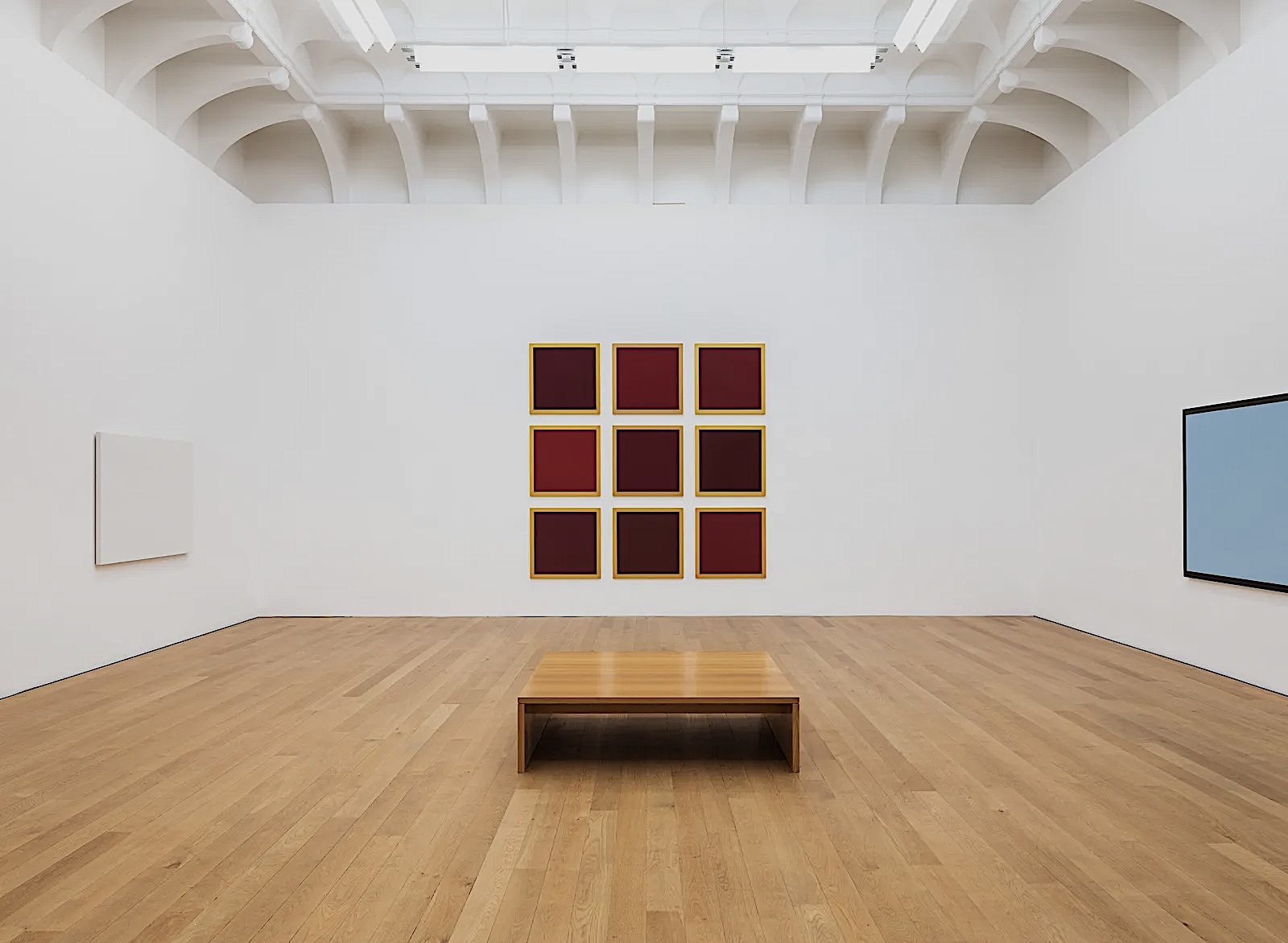
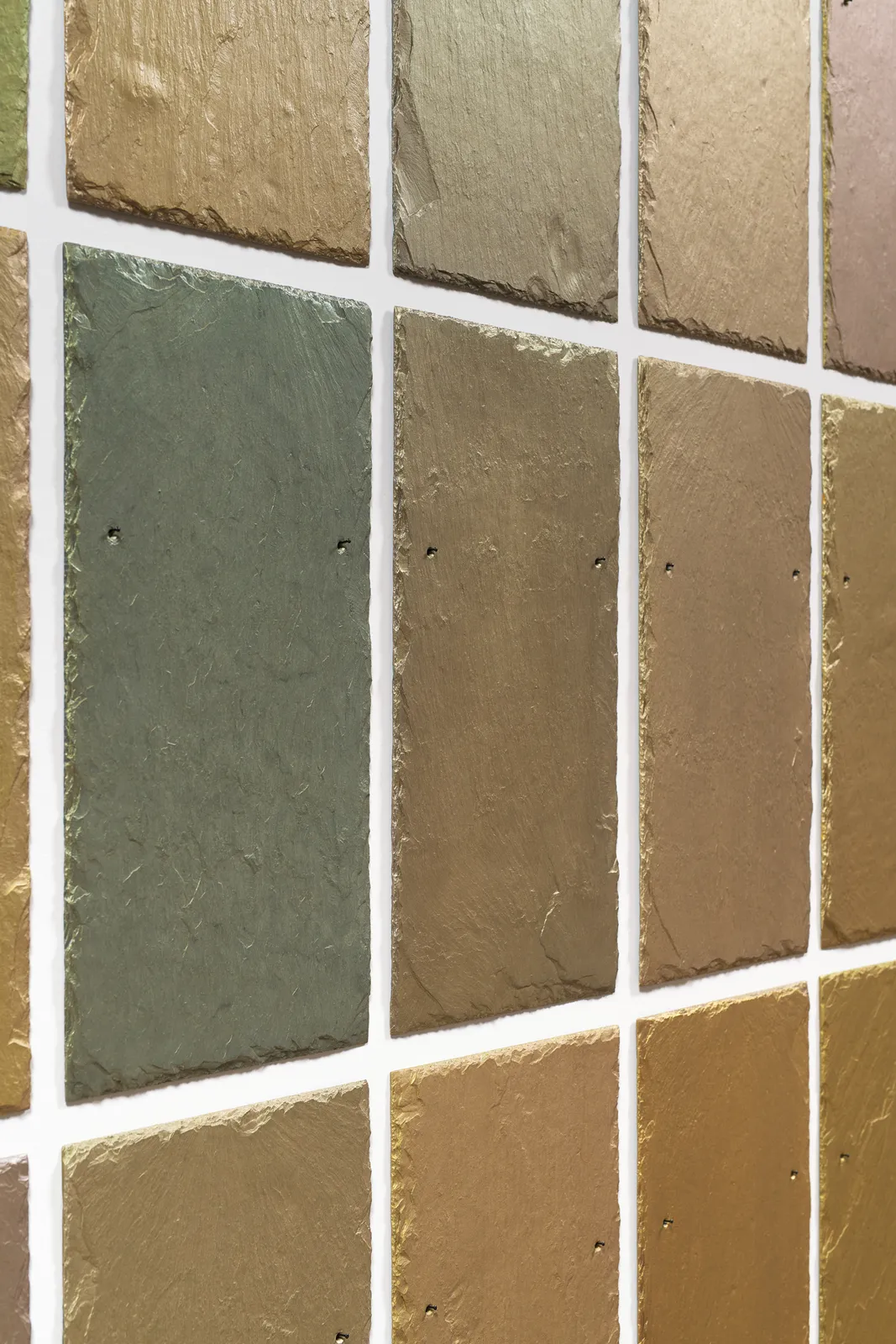
This logic expands in the multipanel works. In Stones of Gold (2025), eighteen slate panels hold closely modulated earth tones that shift unevenly under light. The grid does not assert system; it organizes relation. Each panel registers a slightly altered chromatic condition — dry beside wet, absorptive beside reflective. A single panel risks closure. The grid resists it.
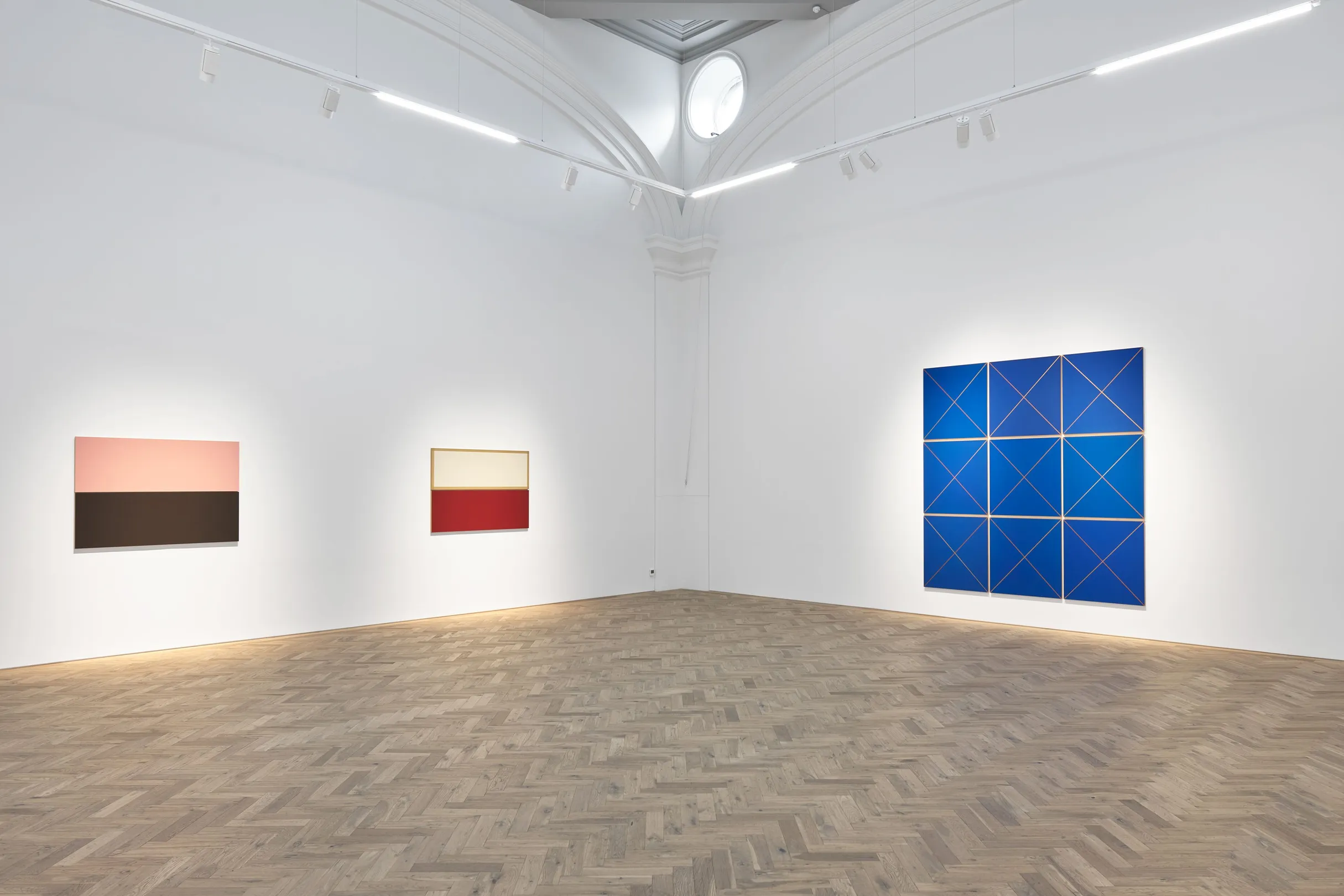
In Lines of Light (2023), structure moves inward. A nine-part blue field is crossed by diagonal metallic bands, introducing directional force within each panel. The grid no longer only organizes adjacency; it contains tension internally. Unity gives way to subtle fracture. The surface holds its coherence, but only through restraint.
The work accepts that aftermath. Color is neither expressive nor symbolic; it is subjected to conditions — surface, adjacency, duration — until it sustains light without spectacle. No single panel resolves the experience. Perception builds through comparison and duration.
What emerges is neither revival nor parody of modernism, but a sustained inquiry into how light can be generated materially rather than described.
The work does not overwhelm. It steadies. Illumination is not performed. It is held.
When autonomy fades, painting can no longer rely on the authority of form alone. Structure must justify itself through experience. In Roeth’s work, borders do not frame assertion; they regulate duration. Grids do not demonstrate order; they generate comparison. The painting becomes less a self-sufficient object than a field of perceptual negotiation.
This shift changes what abstraction asks of the viewer. Instead of confronting a resolved image, one moves through calibrated conditions — edge against field, matte against reflective, panel against panel. Meaning is not declared; it is built through adjacency and time. Light is not represented. It is stabilized through restraint.





1. Installation view: Winston Roeth, solo exhibition, Ingleby, Edinburgh. Photograph © John McKenzie.
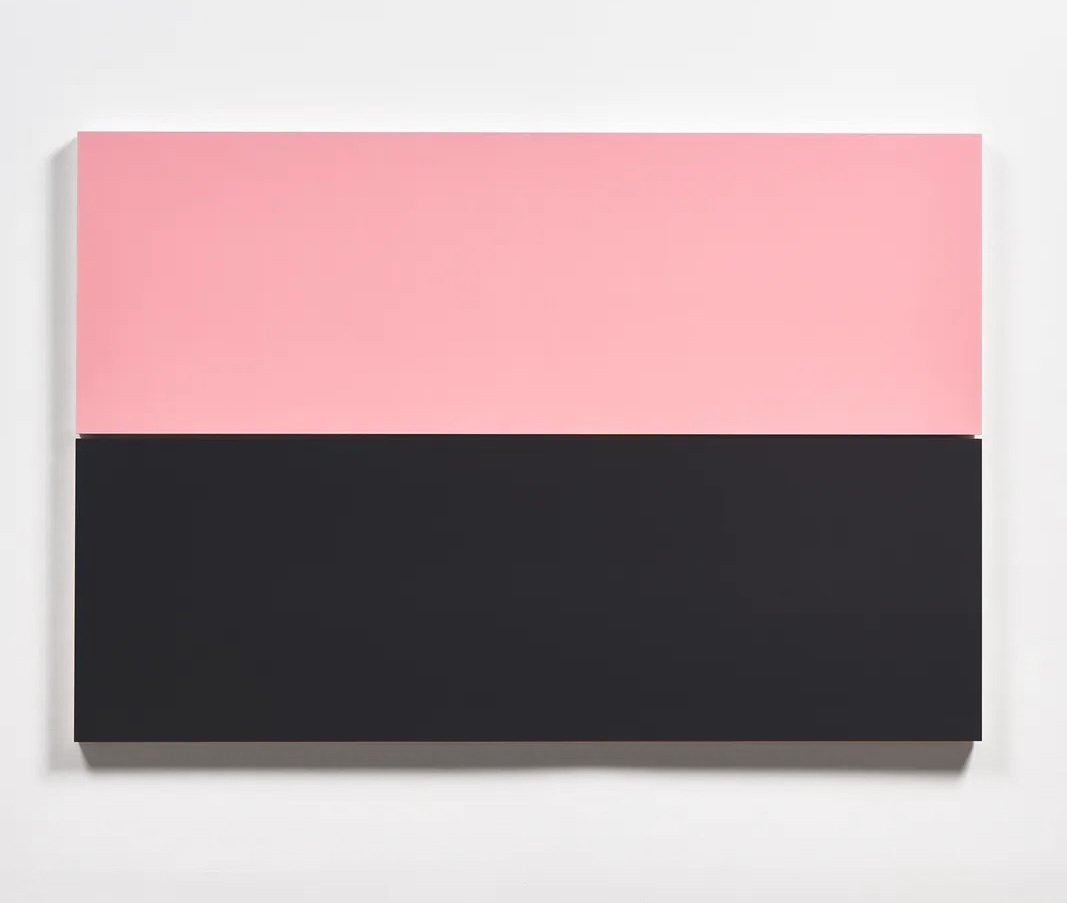
2. Winston Roeth, Tuscola, 2025. Kremer pigments and polyurethane dispersion on Dibond mounted on basswood, in two (2) parts, 100.6 × 149.5 cm. Artwork © Winston Roeth.
3. Winston Roeth, Lines of Light, 2023. Kremer pigments and polyurethane dispersion on Dibond mounted on basswood, in nine (9) parts, 264 × 264 cm. Artwork © Winston Roeth.
4. Detail: Winston Roeth, Lines of Light, 2023. Kremer pigments and polyurethane dispersion on Dibond mounted on basswood, in nine (9) parts, 264 × 264 cm. Artwork © Winston Roeth.
5. Installation view: Winston Roeth, solo exhibition, Ingleby, Edinburgh. Photograph © John McKenzie.
6. Winston Roeth, Twilight, 2025. Kremer pigments on mounted panel, 61 × 61 cm. Artwork © Winston Roeth.
7. Winston Roeth, Stones of Gold, 2025. Kremer pigments and polyurethane dispersion on slate, in eighteen (18) parts, 188.4 × 198 cm. Artwork © Winston Roeth.
8. Detail: Winston Roeth, Stones of Gold, 2025. Kremer pigments and polyurethane dispersion on slate, in eighteen (18) parts, 188.4 × 198 cm. Artwork © Winston Roeth.
9. Winston Roeth, Decatur, 2025. Kremer pigments and polyurethane dispersion on Dibond mounted on basswood, in two (2) parts, 100 × 151 cm. Artwork © Winston Roeth.
10. Detail view: Winston Roeth, Decatur, 2025. Kremer pigments and polyurethane dispersion on Dibond mounted on basswood, in two (2) parts, 100 × 151 cm. Artwork © Winston Roeth.
11. Winston Roeth, Golden Square, 2025. Kremer pigments on Dibond mounted on basswood, 91.4 × 91.4 cm. Artwork © Winston Roeth.
12. Winston Roeth, Shades of Darkness, 2014. Kremer pigments and polyurethane dispersion on eight (8) poplar panels, 252 × 102 cm. Artwork © Winston Roeth.
13. Detail: Winston Roeth, Shades of Darkness, 2014. Kremer pigments and polyurethane dispersion on eight (8) poplar panels, 252 × 102 cm. Artwork © Winston Roeth.
14. Winston Roeth, Medomak, 2010. Kremer pigments and polyurethane dispersion on two (2) cedar panels, 55.2 × 91.6 cm. Artwork © Winston Roeth.
Cover: Winston Roeth, Lines of Light, 2023. Kremer pigments and polyurethane dispersion on Dibond mounted on basswood, in nine (9) parts, 264 × 264 cm. Artwork © Winston Roeth.
All images © their respective rights holders.
Image rights & attribution →