



Autobiography in Fragments tells you how to enter.
The title is difficult to resist because the life is there before the sculptures are even described. Alina Szapocznikow was a Polish Jewish teenager during the war. She passed through ghettos and camps, including Auschwitz, Bergen-Belsen, and Theresienstadt. After the war came illness, exile, training, return, public commissions, Paris, the body casts, the plastics, the breast cancer that entered the work in 1969 and killed her in 1973, when she was forty-six.
Seen from that life, the fragments seem to gather themselves into an answer. A mouth, a leg, a belly, a head, a death mask, a pressed face. The works appear to offer the biography back in parts. The cast becomes survival. The resin becomes memory. The tumor seems to give the biography its final confirmation.
That reading is not wrong. It is part of why the work remains so difficult to look at cleanly. Szapocznikow’s life cannot be peeled away from the sculptures, and no formal reading should try to make it disappear.
But the title also gives an answer before the sculptures have had time to act. It asks us to see fragments as pieces of a life. The works are stranger than that.
They do not simply show a body broken by history. They show sculpture finding different ways to take in what the life brought to it: body, death, memory, image, softness, repetition, family, illness, trace.
One of the earliest works in the first room is a death mask. It is the face of Tadeusz Trepkowski, a Polish graphic designer who died in 1954. Szapocznikow cast it in plaster and laid it flat. The mouth and brow read as specific to one person, the way a death mask always does. The plaster has the faint chalkiness of something pressed against a body and lifted off. It rests horizontal, and the horizontality reads as the position of a body more than the position of a sculpture.
It is a face taken after life has left it, and the cast keeps that intimacy visible. The work contains everything that biography might ask sculpture to hold: a body, a death, direct contact between flesh and material, the memory of a person, the trace of a face that will not exist again.
Still, the form that receives it is an old one. The death mask belongs to one of sculpture’s oldest ways of keeping the dead. Plaster has been receiving faces for centuries. The tradition can hold a person, and the person can become a cast, and the cast can sit on its plinth in 1954 and behave exactly as the genre asks. Whatever changes in Szapocznikow’s later work, it is not simply the meeting of a body and the material that takes its imprint.
A few years later the work steps further into history. In 1957 she made a study for a monument to the heroes of the Warsaw Ghetto, a tall hand of patinated plaster mixed with iron filings, almost a meter and a half high. In 1958 she made a sketch for a monument at Auschwitz, two hands in patinated plaster. For an artist who had survived the camps as a teenager, these subjects were not remote. They belonged to memory, history, and the public forms of postwar remembrance.
Much of Polish public sculpture in the late 1950s moved through monument commissions, and Szapocznikow took them. The Ghetto and Auschwitz arrive in her work through the form available to that history: plaster, iron filings, public-memorial scale, patinated surfaces, hands raised into monument. The Holocaust is present, but it is carried here by an inherited language of public memory.
Then, in 1962, a leg.
It is hers. The cast is plaster, laid on its side, bent at the knee. The proportions are not idealized. The skin texture is not idealized. The cast is unmistakably the leg of a particular woman. It is taken from contact, not modeled from outside. The procedure returns from the death mask, but the body has changed: it no longer enters the work as a thing to be represented from outside. It enters as the mold.
In a 1966 letter about Giacometti, Szapocznikow described the move plainly. She was preoccupied, she said, by the fact that abstraction was becoming academic, and partly out of perversity, partly out of a kind of artistic exhibitionism, she had made a cast of her own leg and an assembly of casts of her own face. Fortunately, she added, we know that everything in art has already been done, and so nothing has yet been done. The wartime past is not the frame she gives this move. What enters her account is the academic state of abstract sculpture and a perverse response to it.
From here, four years pass in this show before the materials visibly shift. The 1963 work is still plaster. The 1964 work is still bronze and limestone. The 1965 work is still cement and iron filings. The cast leg of 1962 is not immediately followed by the resin mouths of 1966. The procedure has changed. The material has not. The interval is not empty. In 1963, Tabu places metal inside patinated plaster. The surface no longer holds a clean line between the cast and what does not belong inside it. But the larger shift has not yet arrived.
Then, 1966. A tall thin object. Colored polyester resin. On its stem, two mouths.
The object is Bouches en Marche. The Polish title, Kroczące Usta, means walking mouths. The stem is slim and pale-pink, almost flesh-toned, and the two mouths are set at its top facing in opposite directions. They are full, slightly parted, painted to read as lipsticked lips. They sit on the stem the way two flowers sit on a stalk, and also the way two pedestrians might if you fused them at the spine. One mouth is Szapocznikow’s. The other is the mouth of her model and friend Arianne Raoul-Auval, who was at the time the partner of the cartoonist Roland Topor. The casts are direct. Szapocznikow took an impression of her own lips, an impression of Arianne’s, and set them on a single resin stem.
The polymer does not only answer the body. It answers a world of repetition, modularity, color, cheapness, and reproduction. Szapocznikow said as much. In this material, the body can become cast and product at once.
The procedure has changed beyond Noga. In 1962 the body that became a mold was her own. In 1966 the body that becomes a mold is her own and someone else’s, set against each other on one object. The cast is no longer only an imprint. It is a composition between imprints. The leg of Noga was a whole limb. The face of the Trepkowski death mask was a whole face. The mouths of Bouches en Marche are fragments released from the face entirely: no jaw, no chin holding them in place, just two pairs of lips on a stem. The mouth has come loose from the head, paired with another mouth, set upright in colored resin.
Biography enters here too, but not as confession. It enters as relation, pairing, repetition, and cast. The fragment is the unit. The unit can be combined. The combination can be reproduced.
A year later, in 1967, a small object titled Autoportrait appears in the chronology. It is polyester resin again, but something else has been set inside it: a photograph. The photograph returns the artist’s image to the object. The image is suspended in the material, visible through the resin’s translucence, fixed in place by it.
In 1966 the resin took the shape of the mouths it was cast from. In 1967 it also receives a printed picture of a face, and holds it. The cast and the image now sit in the same object.
In 1968 the belly arrives.
Ventre-coussin is polyurethane foam, cast from the stomach of Arianne Raoul-Auval, the same friend whose mouth sits on the stem of Bouches en Marche. The foam shape appears soft, slightly domed, the size of a small pillow. The title names it as a cushion. This is something the previous works could not have been. The death mask is heavy. The leg is heavy. The cast of mouths on the stem is small but rigid, made to stand upright. The belly cushion belongs to a category of things that can be leaned against, carried, placed, used. Szapocznikow imagined it as a reproducible object, one that could move out of the studio and into ordinary rooms.
The body has become an object you can rest against. Not a monument to a body. Not a portrait of a body. Not yet the illness that would enter the work later. A use-object cast from a friend’s stomach, multiplied, distributed, held.
The modernity Szapocznikow saw in plastic, the repetition and reproduction and modularity and cheapness, comes into full operation here. In 1966 the polymer made a stem with two mouths on it. In 1968 it makes a cushion that could go into a home. The belly has crossed into the domestic and useful.
But the belly cushion is not the only thing happening to the belly in 1968. That summer Szapocznikow went to Italy, to the marble quarries at Querceta. An archival photograph by Roger Gain, made for Elle magazine, shows the artist in working clothes at the quarry. She stands near two enormous bellies. Grands Ventres. They are made of Carrara marble and belong to the same belly cycle as the foam cushion.
In 1968, the same belly is in plaster, in polyurethane foam, and in Carrara marble at once. Three materials in one summer, all worked from the same impression of Arianne’s stomach. The cushion is one solution. The monumental marble is another. The plaster is a third. The materials are not replacing one another. They are carrying the body differently. The story of Szapocznikow’s career is sometimes told as a move from traditional sculpture to industrial polymer, plaster giving way to resin and foam. The 1968 Belly cycle does not fit that story. The polymer does not retire the marble. The marble does not retire the polymer. Marble gives the belly monument. Polyurethane gives it use. Plaster remains the object of transfer between them.
In 1969, resin is still there. It is also the year Szapocznikow was diagnosed with breast cancer. The diagnosis matters. The Tumeurs that followed would bring illness into the work with a force no formal reading should flatten. But even there, illness enters a material language already present in the studio. Polyester had arrived in this exhibition’s chronology in 1966. Resin had begun holding photographs in 1967. Cancer did not invent the language. It changed what the language had to carry.
In 1971 Szapocznikow worked with chewing gum and her own mouth. She chewed pieces of gum, stretched them, pulled them out, and set the resulting small forms before the camera. Roman Cieślewicz photographed them. The later edition shown as Fotorzeźby, Photosculptures, preserves those small chewing-gum sculptures as photographs.
The mouth that had stood on a stem in 1966 is now doing something else. It is no longer being cast. It is producing. The sculptures it makes are not meant to last. The gum will dry. The form will not hold. What holds is the photograph.
The polymer was a material that could be cast and reproduced. The photograph is a material that can preserve what cannot be cast. The cast and the image, set together inside resin in 1967, now separate into two roles. The body produces the form. The photograph holds its image.
In 1972, the last full year of work, Szapocznikow made a small object she titled Herbier (Tête de Piotr), Herbarium (Head of Piotr). Piotr was her son. The object is polyester resin. It is the head of Piotr, cast and pressed flat, as if a face had been laid between the leaves of a botanical book and dried there. The depth has gone out of it. The face survives as surface.
Herbier names the kind of preservation a herbarium does: collecting plants, pressing them, flattening them, keeping them in a form that is also the mark of their removal from life. The face of Piotr in 1972 receives that treatment. He is cast, and the cast is pressed, and what remains is something between a record and a residue. The body is preserved, but not restored to wholeness.
In 1966, on the stem of Bouches en Marche, the artist’s mouth and Arianne’s mouth shared a single object. The cast of the self sat beside the cast of another. In 1972, with Herbier, another relation enters the polymer: not artist and friend, but artist and son. The fragment no longer stages a doubling across one object. It carries family through a single pressed face.
By 1972, the fragment is no longer only a broken remainder. It is also a form preservation can take.
In a 1972 statement sent to Pierre Restany, near the end of her life, Szapocznikow wrote: “My work has its roots in sculpture.” For years, she said, she had thrown herself into problems of balance, volume, space, shadow, and light, all to arrive at what she was then: a sculptor whose vocation had been thwarted.
The line does not remove biography from the work. It gives biography a harder condition. The life is there: the camps, exile, illness, the body, the breast cancer, the shortness of the life itself. But the life does not explain the sculptures before they act.
It enters through what Szapocznikow made sculpture carry.
A face after death. A hand raised toward monument. A leg cast from contact. A mouth released from the head. A belly passed between foam, plaster, and marble. A photograph held in resin. A piece of gum preserved only as image. A son’s face pressed toward herbarium.
The fragment was not only what history left behind.
It was what sculpture learned to hold.
At galerie Loevenbruck, Alina Szapocznikow. Autobiography in Fragments: A Centenary Retrospective follows the body across early sculpture, casts, mouths, drawings, resin, photographs, and late fragments. The review begins with biography, but does not let biography finish the works. It asks how sculpture carries a life through form: as cast, imprint, contour, surface, souvenir, and self-portrait.
This review forms part of a two-exhibition reading of Szapocznikow. Read the companion review of Alina Szapocznikow — Autobiography in Fragments at Hauser & Wirth Zurich.
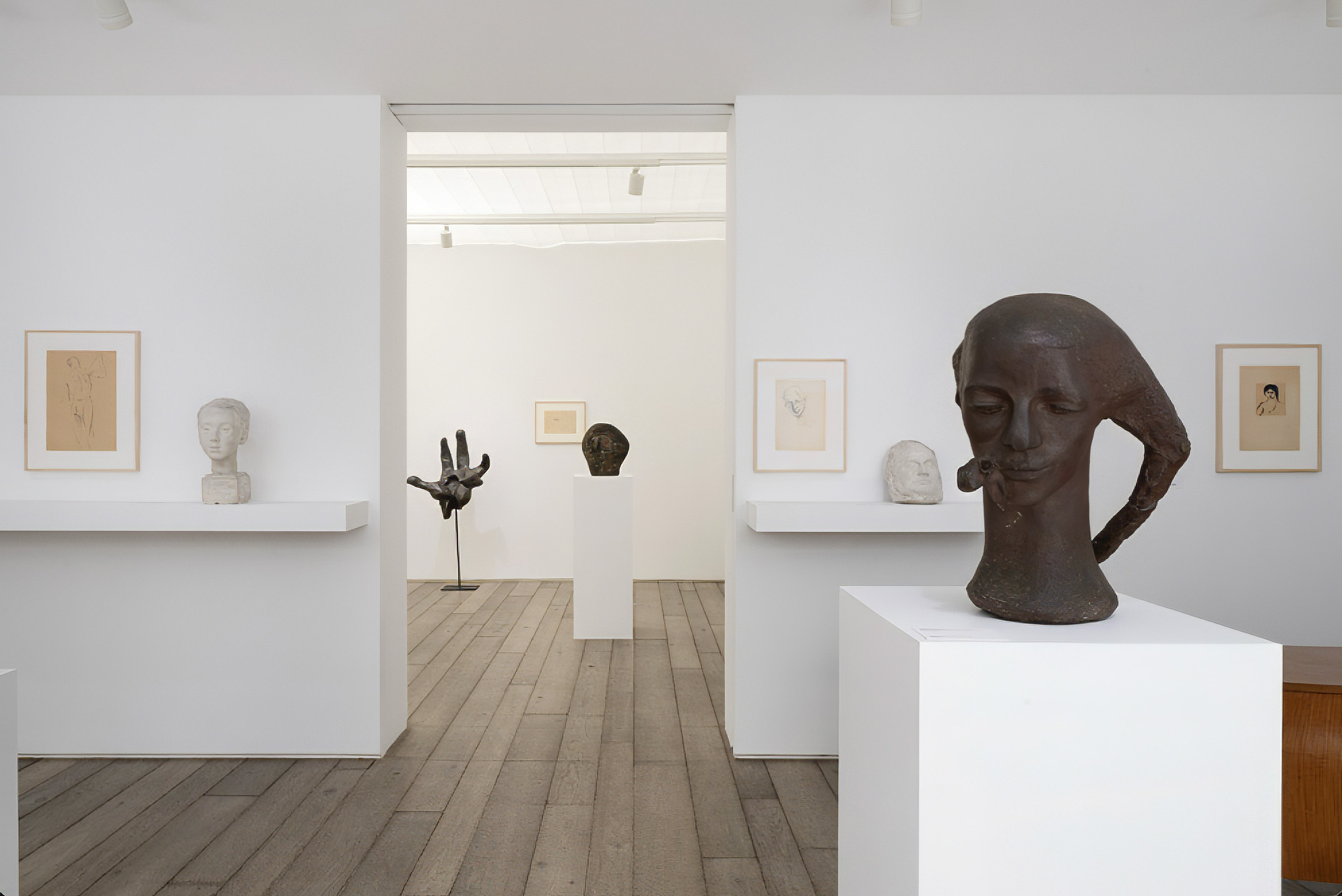


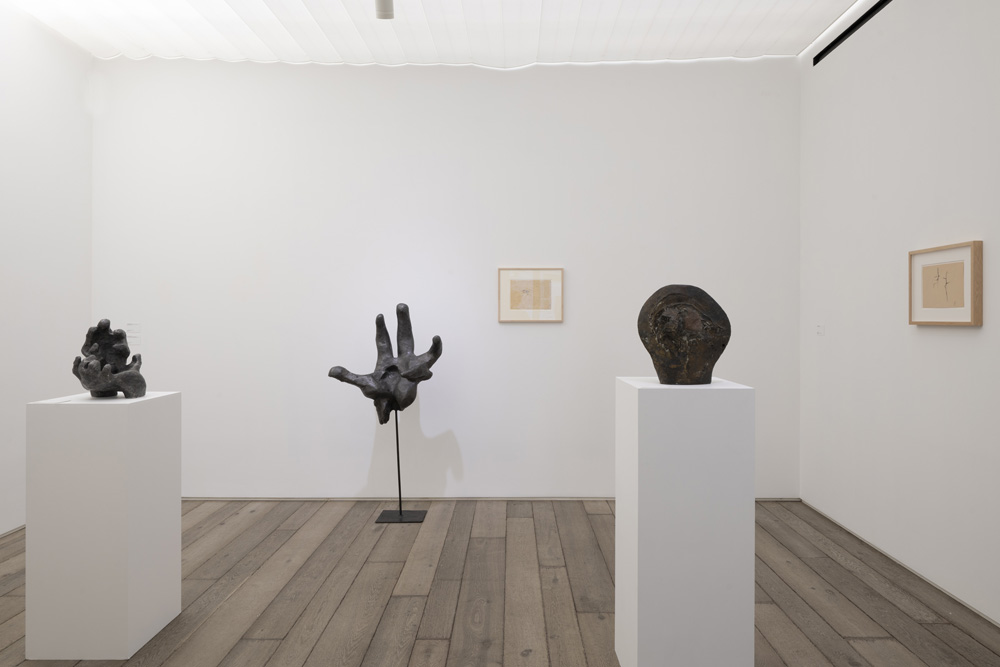


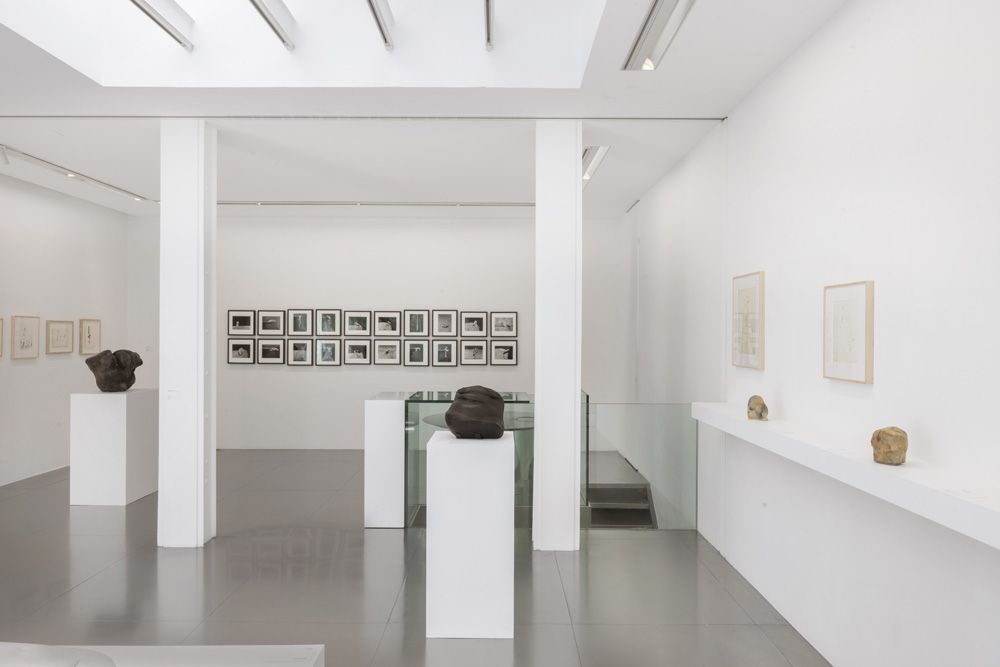

Cover Image: Exhibition view, "Alina Szapocznikow. Autobiography in Fragments. A Centenary Retrospective," galerie Loevenbruck, Paris, 2026. © ADAGP, Paris. Photo Fabrice Gousset, courtesy Loevenbruck, Paris.
All images © their respective rights holders.
Image rights & attribution →