



The whites arrive before the body.
At first they seem almost neutral: tennis skirt, collar, shirt, the pale surface of a uniform made to disappear into the game. White promises discipline without spectacle. It gives the figure a place before the figure has resolved. The face can be delayed, the limbs can loosen, the body can arrive unevenly, and the player still reads as a player because the clothing has already done part of the work. The body is not the first thing that secures recognition. Costume is. Role is. By the time the figure appears, the game has already dressed it.
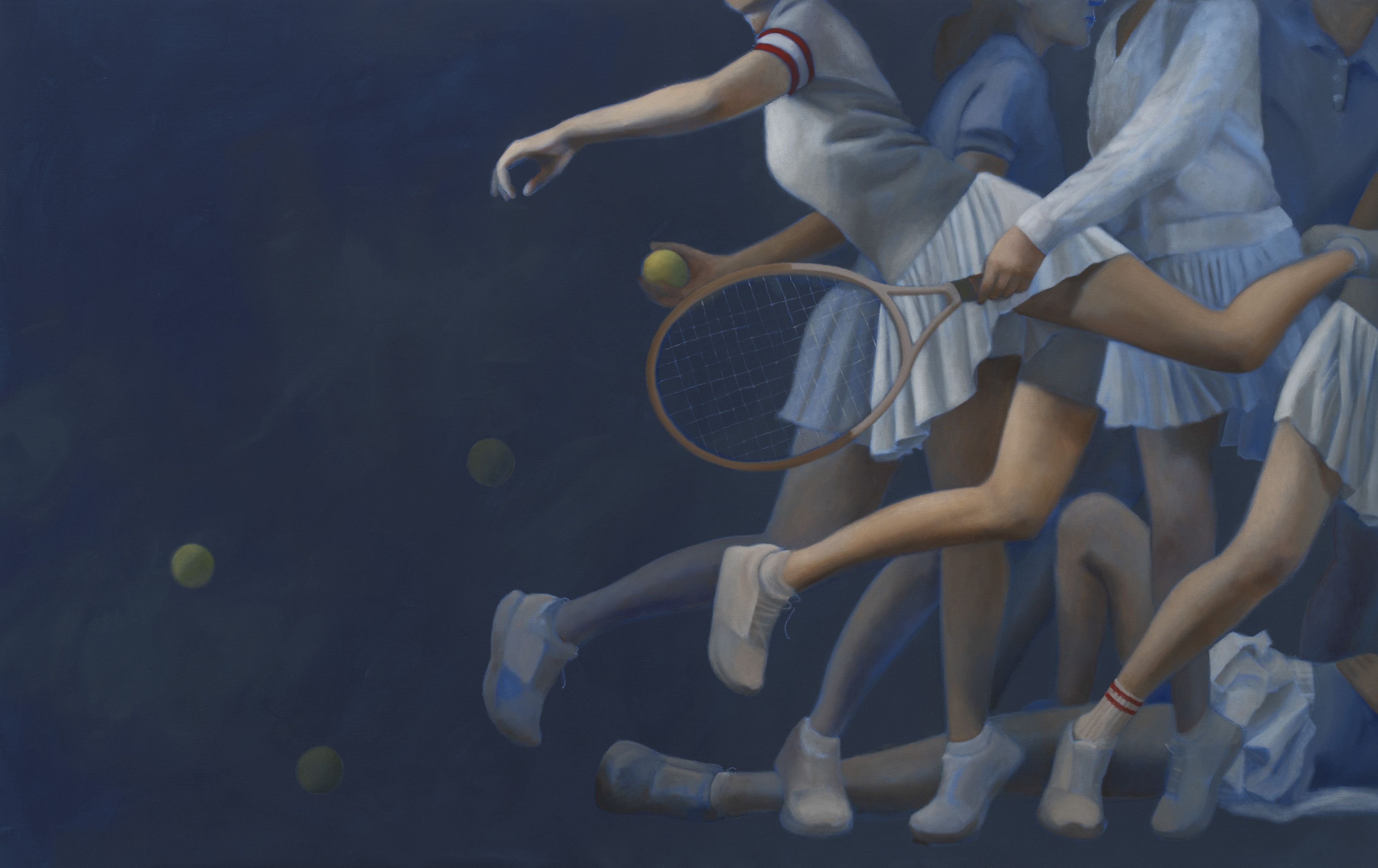
State of Nature begins with a stroke that should clarify. Blue ground, tennis whites, the pleated skirt caught mid-swing, the racket held in a line the eye already knows how to follow. Then the legs stop agreeing. They cross and double along the lower edge, four or five of them where one body’s stride should be, and a white shoe comes loose from the foot it should belong to, drifting into the dark blue with a loose thread trailing behind it. The racket still holds its arc. A ball hangs near the strings, another floats off to the left, unattached to any serve. The stroke keeps organizing the picture, but the player it organizes has multiplied past the count of one.
The skirt still names her. The racket still names the motion. Both keep naming a figure that has scattered underneath them. The pleats, racket, and white fabric go on working after the limbs have quit deciding where the single body is. A player assembles out of equipment even when her legs no longer share a stance.
The easy reading would be collapse. A body breaks apart, coherence fails, and something underneath the social role begins to appear. Lowen gives almost the opposite. Nothing underneath is allowed to surface cleanly. The player does not become freer as the body scatters; whatever pressure the whites are holding down remains caught inside the role that still names her.
The paintings do not hide the person behind costume. They show costume continuing to work after the person no longer holds the figure together.
In Social Contract, that survival passes into a group. A pale ladder runs the height of the canvas against a wall of green. Women in white cable knit cluster up its rungs, and their hands reach for it in sequence, one after another, more reaching hands than a quick count of bodies would license, each cuff white. Where the faces should be, black hats sit instead, wide brims pulled down so the head becomes hat, falling hair, and nothing above the jaw. The group resolves before the eye can find one person inside it.
The face withheld is not a withheld mystery. Mystery would still protect the idea of an inner person waiting behind the image. Lowen’s figures are caught in a harsher condition: the painting already has enough. Cuff, posture, ladder, hat, and shared reach have filed each body as a member before the question of who arrives.
Leviathan compresses the same order until it can barely breathe. The figures are packed shoulder to shoulder across a red-brown floor, their white tennis sweaters, shorts, wristbands, and socks repeating down the row. The painting crops them at the throat. Where the collar opens, the canvas ends; the heads are almost entirely withheld. A racket rests across one pair of knees. A ball sits in a cupped hand. Hands cross thighs. Forearms pass in front of other bodies. The group is assembled through clothing, equipment, and pressure before any single face can claim it.
The painting has already done the naming. Sweater, band, ball, racket, lap, row: each term arrives before the face could. The figures are not unknowable because their heads are gone. They have been known without them.
The titles arrive as if the social theory has already been assembled. State of Nature, Social Contract, and Leviathan belong to a Hobbesian vocabulary of disorder, agreement, authority, and collective form. Together they tempt the viewer to read Colosseum as a passage from violence into structure, from instinct into agreement, from crowd into society.
Lowen’s paintings make that passage arrive too late. Before the contract, before the myth, before the sovereign body, recognition has already begun. The skirt, racket, hat, sweater, cuff, and seated backs have done the work first. The body is not disciplined into society. It is socially named before it can gather itself as a person.
The game helps because tennis knows how to make force look clean.
White clothing, quiet spectators, marked lines, ranked gestures, controlled movement. Nothing is hidden exactly, but everything has to pass through form before it can appear. A stroke becomes acceptable once it becomes technique. Competition becomes visible once it accepts etiquette. Tennis is not a metaphor borrowed from outside the paintings. It is a world that already knows how to train bodies into roles. That training does not erase volatility; it gives volatility a form in which it can be seen without being called violence.
In The Audience, play stops. The painting shows the backs of those watching: four figures seated in tennis whites, faces withheld by orientation, bodies turned toward a red field that fills the picture beyond them. Nothing depends on a racket or a court line. Clothing, posture, and shared direction are enough. They are spectators before they are people.
That recognition is not only in the painting. It happens in the looking. You name them before you could have met them. The eye files the group by backs, whites, seated posture, and direction, and the painting holds that instant open: the moment recognition closes before the person can appear.
The whites are not crisp. They do not behave like clean uniforms held apart from the painting. The shirts and skirt soften into rubbed passages of gray, cream, pink, and pale green. On the central figure the white streaks downward, more like weathered fabric or worked ground than a finished garment. Edges blur where clothing should sharpen the body.
The uniform that hands the figures a role is also the pale material through which the figure starts to lose its edge. White as dress and white as paint touch here. The watchers are held by the same arrangement they came to observe, and the painting catches the viewer joining it. They are not outside the game. Neither is the eye that recognizes them.
Fragile Society removes the tennis costume without removing the staging. Roosters replace players, court etiquette disappears, the whites vanish. But the birds are still set against each other, still bounded, still raised into a confrontation arranged for someone to watch. What falls away is not arrangement, only the civilized name it had been given.
Colosseum is exact because it keeps spectatorship in view. A tennis court is already an arena softened by etiquette, a bounded space where bodies perform conflict and become recognizable through rules. The colosseum strips the softness and keeps the watching. Its risk is that the passage can sound too clean: order, then violence; decorum, then exposure. The paintings refuse that passage. They never let the body fall backward into nature.
Lowen’s figures matter because they make identification appear before intimacy, before psychology, before the face can return the person to painting. The work is not asking how much of a figure can disappear and remain mysterious. It is asking how little of the person is needed before recognition begins.
The body was never alone in the painting. It had already been recognized before it could appear.
The whites came first. The body had to follow.
In Colosseum, Holly Lowen’s figures are already being read before they can settle into themselves. Whites, rackets, court etiquette, group formation, spectatorship, and title give the body a role before identity has stabilized. The exhibition’s Hobbesian language suggests order, contract, and collapse, but the paintings complicate that frame. Across State of Nature, Social Contract, Leviathan, The Audience, and Fragile Society, bodies remain legible even as their continuity breaks. The review follows that pressure: not the hidden self beneath costume, but the speed with which codes make a body visible.
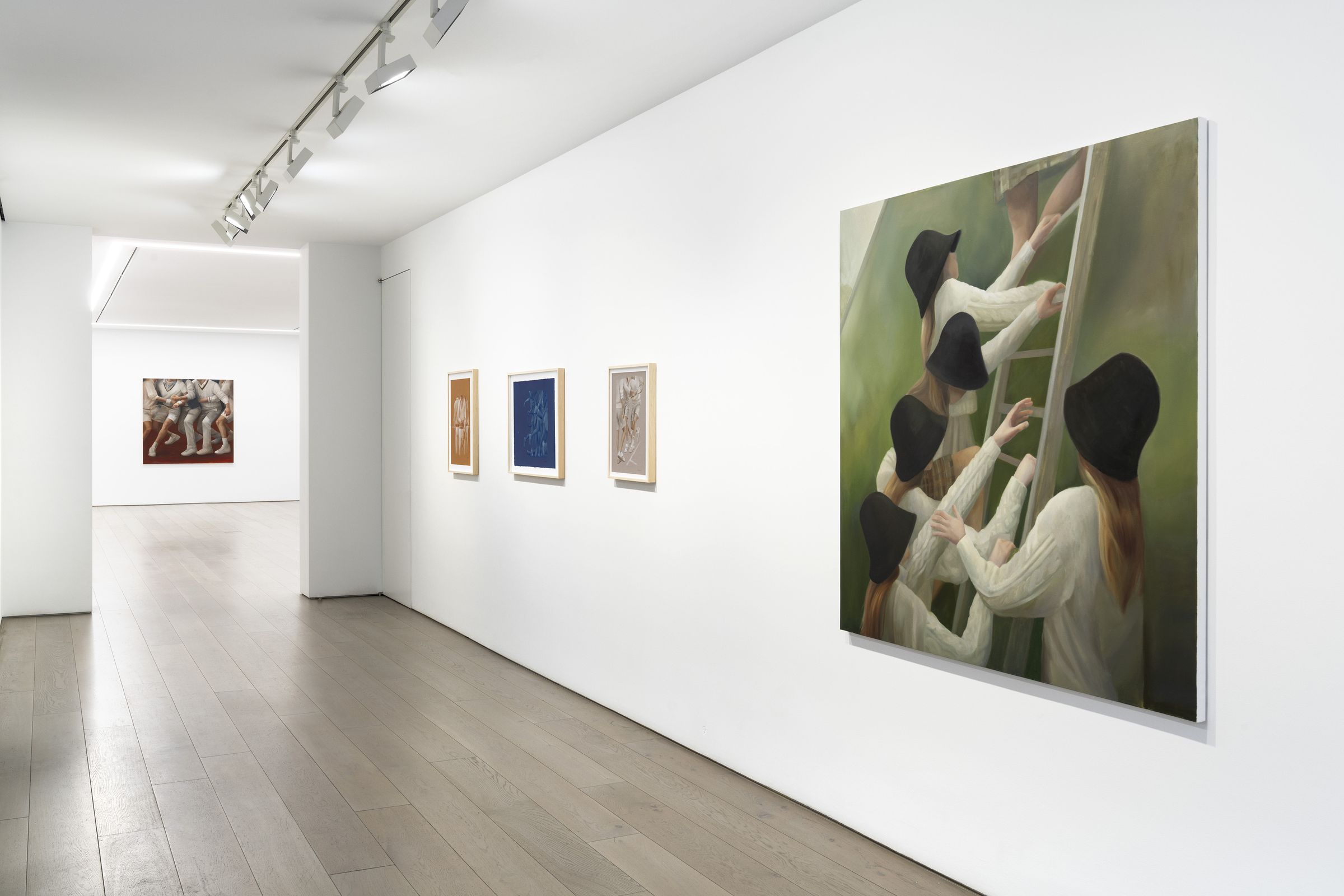

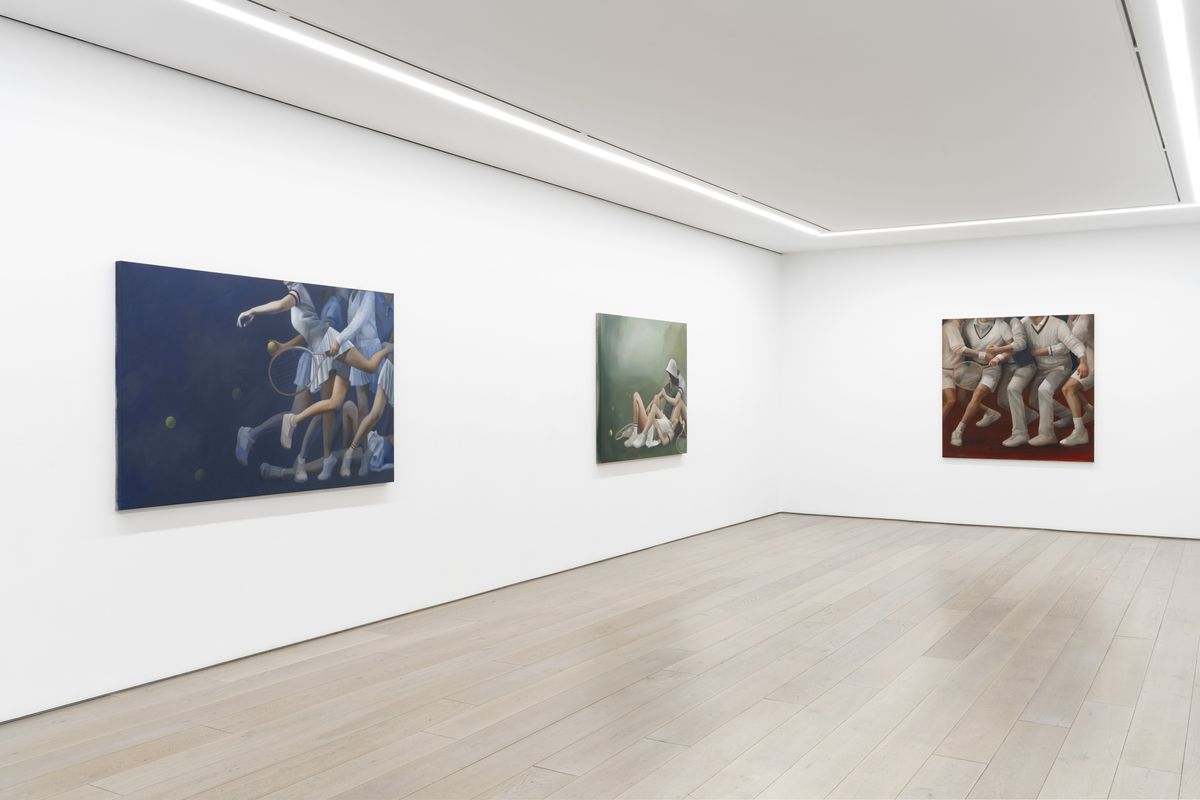

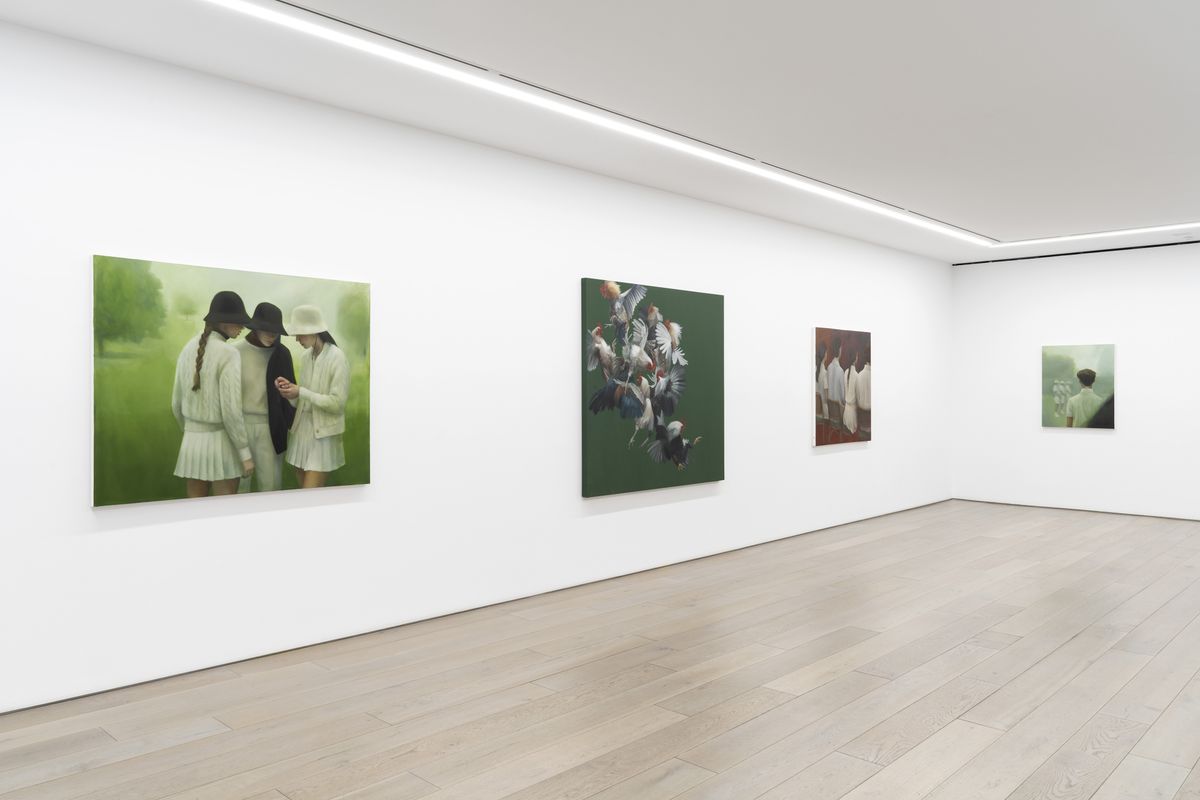

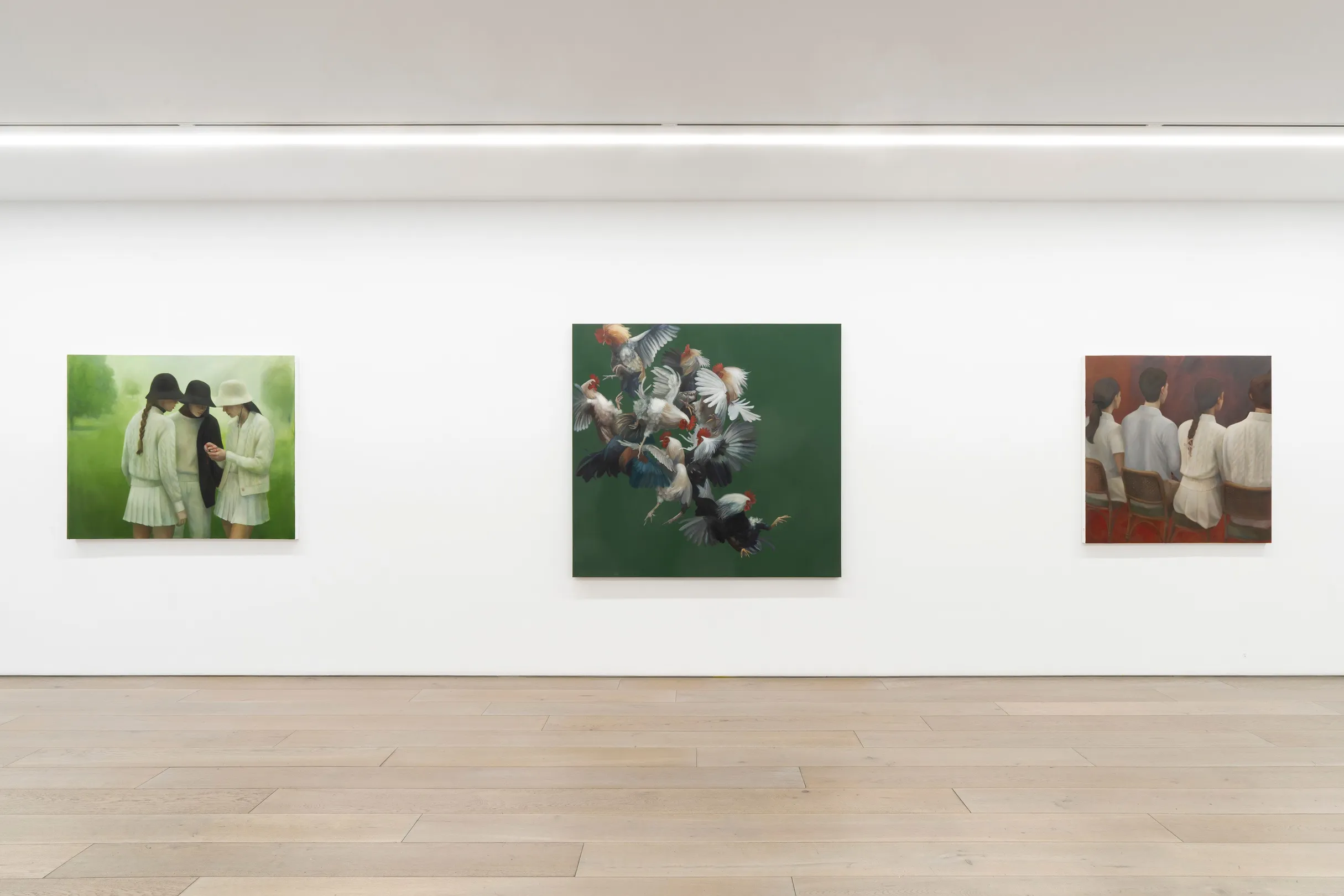

Cover Image: Holly Lowen, Colosseum, 2026. Installation view, Perrotin New York.© Holly Lowen. Courtesy of the artist and Perrotin. Photo: Guillaume Ziccarelli.
All images © their respective rights holders.
Image rights & attribution →